A challenge in the Art of Ancient Egypt: Osirian-Solar Iconography.


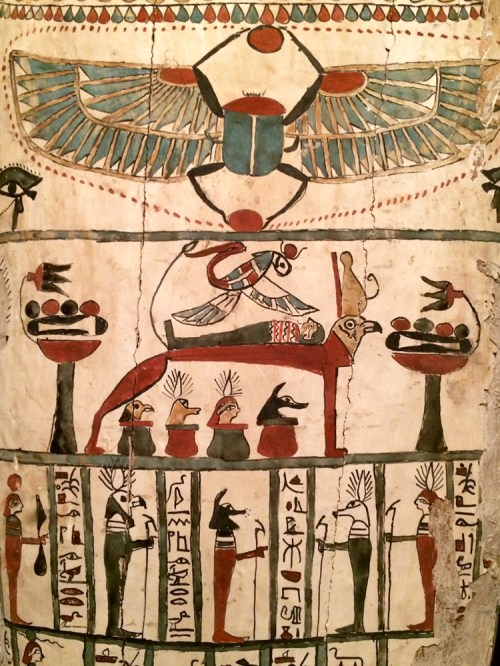
One of the main challenges for priests and artists in Ancient Egypt were to combine the osirian and solar cosmogonies in the funerary literature and iconography.

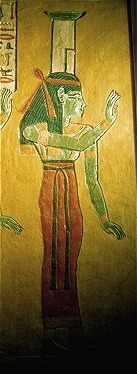
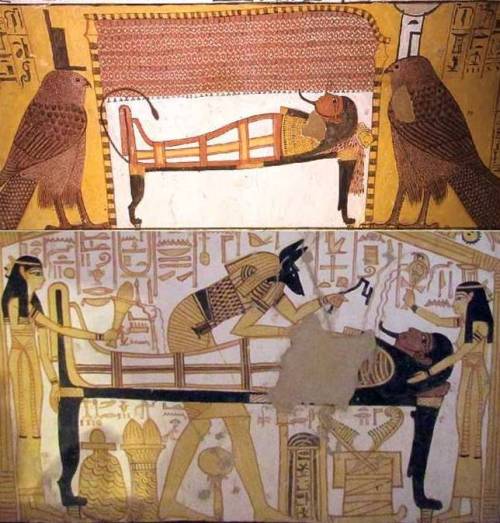
Ram-Headed mummy (Re-Osiris) with Isis and Nephthys. Ancient Egypt. Tomb of Nefertari. XIX Dynasty.

Ram-Headed mummy (Re-Osiris) with Isis and Nephthys. Tomb of Nefertari. XIX Dynasty.

The two main pillars in the belief of resurrection in Ancient Egypt were the myth of Osiris and the solar theory. The central aspect in the first one was the resurrection and new life in its most human version: a human body (Osiris), which needs to be embalmed and revived for the eternity. In the second one the stellar body (the sun-Re) did a cyclic trip through the sky; it died in the night and sailed in the solar bark through the dark sky; in the morning after the sun came back to life renewed plying the clear sky.

In Ancient Egypt both ideologies, due to its importance, were quickly conciliated as two versions of a same concept. In the thinking, ancient Egyptian priests could unite Re and Osiris in the funerary texts through the narrative, that is why, for instance, in chapter 67 from the Book of the Dead the dead Osiris wants to get out from the tomb and get into the solar bark of Re.

What happened in the art of Ancient Egypt?
Continue reading in www.mariarosavaldesogo.com

Ancient Egypt Resurrection. The Penis of Tutankhamun.


In Ancient Egypt, virility was an essential faculty for granting the dead’s resurrection.

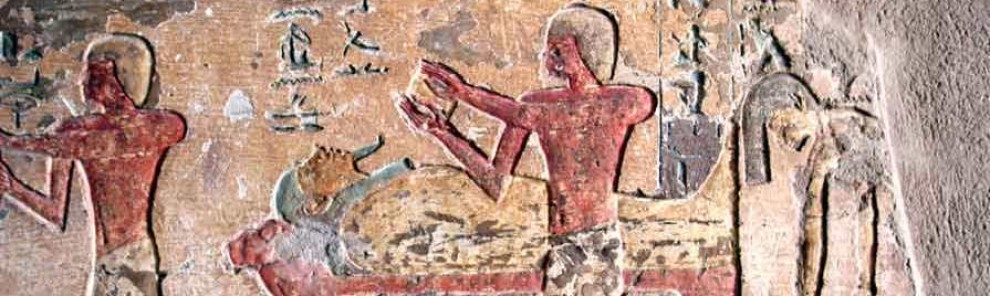
Stele Abkaou.XI Dynasty. Ancient Egypt

Mourners over the corpse. Detail of the stele of Akbaou. XI Dynasty. Musée du Louvre

All along my work I have been showing that, among the many practices in Ancient Egypt for reviving the corpse, there was one made by the professional mourners in the role of Isis and Nephthys. These two women shook their hair forwards the mummy for symbolising the mythical moment, in which Isis stimulated her husband Osiris and gave him back his virility.

Mummy of Tutankhamun. Ancient Egypt.

Mummy of Tutankhamun. Photo:The History Blog

In this sphere I would like to remind an aspect of the Tutankhamun’s mummy: his penis. This pharaoh was mummified with his erect penis, although it was broken from the body after the discovery. Obviously to embalm the corpse of this ancient Egyptian king with an erection was not unjustified. According to Salima Ikram, “it was a deliberate attempt to make the king appear as Osiris in as literal a way as possible. The erect penis evokes Osiris’ regenerative powers”. Yes, it evokes the regenerative power, but first of all it is the best proof of a male living body.

Continue reading in www.mariarosavaldesogo.com

Isis in Ancient Egypt: A Winged Snake with Hathoric Crown.


There is always news about artifacts of Ancient Egypt. Now it is the turn of the coffin of “Denit-Ast”. It dates from the Persian Period and it is in the Toronto’s Royal Ontario Museum.

As Gayle Gibson exposed, this coffin has many oddities in its decoration, which could be a proof of the lack of god masters in Egyptian art during this period of the Ancient Egyptian history.

Coffin of Denit-Aset from Persian Period. Isis over the mummy. Ancient Egypt. Torontos Royal Ontario Museum

Coffin of Denit-Aset from Persian Period. Isis over the mummy. Ancient Egypt. Torontos Royal Ontario Museum

I would like just to make some reflections on the icon of the snake flying over the corpse. It is a winged cobra with two horns and a solar disk on the head. As Gibson says, this crown is usually associated with the ancient Egyptian goddess Hathor. But makes sense an hathoric crown here? Could we think on an association of this icon with the goddess Isis?

Continue reading in www.mariarosavaldesogo.com

Isis with Apis in Ancient Egypt Iconography.


Isis and Osiris were in the religion of Ancient Egypt the perfect couple. Despite the murder of Osiris, they could go on, Isis could revive her husband and both could have a boy. But Osiris was replaced by Apis.

Isis and Osiris. Relief from Abydos. XIX Dynasty. Ancient Egypt.

Isis and Osiris. Relief from Abydos. XIX Dynasty. Photo: fineartamerica.

In the mortuary iconography of Ancient Egypt the union of Osiris and Isis was constant, as symbol of resurrection. However from the Saite Period, this icon suffered a transformation. Apis, the bull god of Memphis, was asimilated with Osiris, becoming after his death Osiris-Apis. And Apis in sometimes occupied the place of Osiris.

That is the case of the stele dedicated to Apis from the Louvre Museum. It dates from the reign of Psametik I and was found in the Serapeum of Saqqara. The god is identified as Osiris-Apis (that is Serapis) Khentamentiu and, following the traditional icon of Ancient Egypt, behind him stands Isis. She is not identified by any inscription, but by the hieroglyph of her head.

Stele to Apis. Reign of Psametik I. Louvre Museum. Ancient Egypt.

Stele to Apis. Reign of Psametik I. Louvre Museum. Photo: wikimedia

It has some consequences…

Continue reading in www.mariarosavaldesogo.com


Nephthys in Ancient Egypt, Assitant of Isis.


Nephthys in the tomb of Khaemwaset. XX Dynasty. Ancient Egypt.

Nephthys in the tomb of Khaemwaset. XX Dynasty. Photo:globalegyptianmuseum.org

In the last post it was considered the role of Nephthys in the religion of Ancient Egypt. It is a fact that Nephtys was a very important goddess in the ancient Egyptian pantheon. Isis needed her help for granting the resurrection of Osiris; they both Isis and Nephthys formed a perfect team. But it is also a fact that Nephthys in some cases seemed not to be indispensable.

Isis was the real one who stimulated the virility of Osiris.

Isis was the mother of Horus, so Isis was the one who could give a legitimate heir to the throne of Ancient Egypt. Nephtys was also important in that birth, since she was present during this childbirth. So Nephthys assisted her sister Isis.

Isis nursing Horus. Louvre Museum. Ancient Egypt

Isis nursing Horus. Louvre Museum. Photo: wikipedia

The common icon in Ancient Egypt for maternity was the woman nursing her baby, applied by the artist of Ancient Egypt in private and royal art. It is very common the image of a mother suckling his baby in statues and reliefs from private tombs. We find also regular in royal monuments to find reliefs of Hathor or Sekhmet nursing the king; but the image of maternity par excellence in Ancient Egypt for maternity was Isis nursing Horus.

Nephthys was not a mother, but the wet nurse. According to the Pyramid Texts (Pyr. 365) she suckled the king, Horus on earth. So, as in the case of the chilbirth, Nephthys assisted her sister Isis.

Continue reading in www.mariarosavaldesogo.com


Had in Ancient Egypt the Goddess Nephthys a Lower Status?


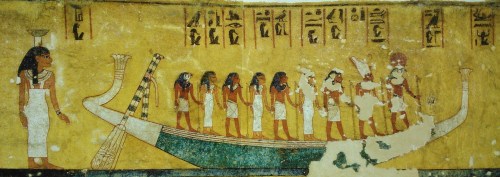
There is a scene of the Book of the Dead from the tomb of Ay, in which are depicted on the solar boat the gods of the Heliopolitan cosmogony and the Myth of Osiris (apart from Seth): Re-Horakhty, Atoum, Shu, Tefnut, Geb, Nut, Osiris, Isis, Horus…and out of the boat Nephtys stands alone apart from her fellows. Why?

Scene of the Book of the Dead from the tomb of Ay. XVIII Dynasty. Ancient Egypt.

Scene of the Book of the Dead from the tomb of Ay. XVIII Dynasty. Photo: www.osirisnet.net

Isis and Nephtys were usually represented together. They were a perfect divine team in Ancient Egypt for the favour of the Osiris’ resurrection. They were always depicted both collaborating together for the corpse’s resurrection.

However, Nephthys had in some way a secondary role and maybe not the same prestige as her sister Isis.

Firstly, Isis was the wife of Osiris, the dead god, so she supported the main responsability in the regeneration of her husband’s body. Isis, although assisted by Nephthys, was the one who made the ancient Egyptian mourning ritual on the mummy of Osiris for restoring his vital faculties.

Continue reading in www.mariarosavaldesogo.com

Requirements of Professional Mourners in Ancient Egypt.


Among the Ancient Egypt gods, Isis and Nephtys occupied a very important role.

It is an ancient Egypt fact, that the two professional mourners in the role of Isis and Nephtys did a mourning rite during the funeral for granting the dead’s resurrection.

All along our work we have been writing about those two women, who were essential in the funerary ceremony of Ancient Egypt, but what do we really know about them?

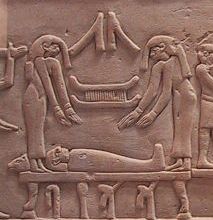
Two different ways of representing Isis and Nephtys assisting the deceased: as the two kites (tomb of Sennedjem) and as women (tomb of Nakhtamon). XIX Dynasty. Photos: www.osirisnet.net

Two different ways of representing Isis and Nephtys assisting the deceased: as the two kites (tomb of Sennedjem) and as women (tomb of Nakhtamon). XIX Dynasty. Photos: http://www.osirisnet.net

Ancient Egyptian art shows the two professional mourners always at both ends of the corpse in the cortege to the tomb; they are identified as Isis and Nephtys or as “kites” (according to the legend of Osiris Isis adopted the shape of a kite for giving him back the breath and his virility), but the inscriptions do not clarify much more about them.
There is an important ancient Egypt document, which could help us in understanding better the requirements of these two representatives of Isis and Nephtys for “working” as official mourners in ancient Egyptian funerals: The Songs of Isis and Nephtys (Brisith Museum Papyrus No. 10188)…

Continue reading in www.mariarosavaldesogo.com

Sexual Stimulation in Ancient Egypt: The Ushabti of Pay.


In ancient Egypt the dead needed many faculties for restarting his new life in the Hereafter: breathing, seeing, walking…and virility.

Sex was an essential aspect for the resurrection in Ancient Egypt and in the funerary rites some ritual practices were full of sexual symbolism.

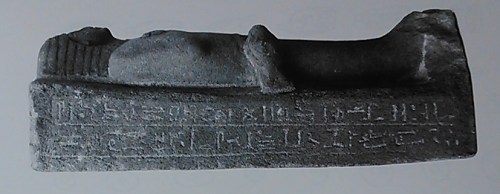
Ushabti of Pay and Repit. Lateral view with ba bird. Louvre Museum. XVIII Dynasty. Ancient Egypt

Ushabti of Pay and Repit. Lateral view with ba bird. Louvre Museum. XVIII Dynasty. Photo: Raven, M. J. The tombs of Pay and Raia at Saqqara. Leiden. 2005, plate 110.

In this line I would like to focus on the ushabti of Pay (from his tomb in Saqqara), dating from the XVIII Dynasty and exposed in the Louvre Museum (N2657).

It is a double-ushabti showing Pay and his wife Repyt both lying on the funerary bed. Man and woman were depicted in the typical posture for mummies in Ancient Egypt: with both arms crosses over the chests. However there is a great difference in the man’s image. He is being accompanied by a ba bird, with arms and face and whose hands touch the Pay’s body.

And this difference could have  very deep sexual meaning….

Continure reading in www.mariarosavaldesogo.com


Sex in Egyptian Art: the Stele of Sebekaa.


Egyptian art can hide very important information in small pieces.

That is the case of the stele of Sebekaa in British Museum.

Stele of Sebekaa from Thebes. XI Dynasty. Ancient Egypt. British Museum

Stele of Sebekaa from Thebes. XI Dynasty. Photo: British Museum.

This piece of ancient Egyptian art dates from XI Dynasty and it was found in Thebes. In just a space of 70 cm x 60 cm (aprox.) the Egyptian artist could include a number of typical scenes which dominated the corpus of funerary Egyptian art.

Although the whole composition does not have a narrative logic, the greater part of the activities can be identified: butchery, bakery, offerings…

Stele of Sebekaa from Thebes. XI Dynasty. British Museum. Ancient Egypt. On the left a detail of the image of the dead being embraced by a smaller human figure

On the left a detail of the image of the dead being embraced by a smaller human figure.

At the left of the middle register there is an isolated scene, which was not too usual in ancient Egypain art: the dead lies on his bier and he is embraced by a smaller figure. According to the information from the British Museum’s website: The man on the bed is probably the deceased, and the figure on top of him might be one of a variety of goddesses, such as Isis, Nephthys and Nut, who embrace him. Whether there are any sexual connotations in this scene is uncertain”.

Continue Reading in www.mariarosavaldesogo.com


The Ancient Egyptian Dead Breathes Thanks to “The Hand in the Mouth”.


Funerary practice in the mastaba of Qar with lector priest, embalmer and mourner Drt; the scene is closed by two images of an ox. V-VI Dynasty. Giza. Ancient Egypt. Image: W.K. Sympson.

Funerary practice in the mastaba of Qar with lector priest, embalmer and mourner Drt; the scene is closed by two images of an ox. V-VI Dynasty. Giza. Image: W.K. Sympson.

The ancient Egyptian expression “The Hand in the Mouth” (Djat Ra) as a way in Egyptian language of referring to the gesture made by the mother breastfeeding her baby. In the funerary sphere of Ancient Egypt that expression seems to be related to the mourning rite made by the professional mourner during the Opening of the Mouth ceremony. The dead, assimilated to a new-born, would need this gesture as a symbol of his first feed for the Hereafter.

In the relief from the tomb of Qar, this movement of approaching the hand to the mouth was also made by the embalmer. The expression Djat Ra related to a masculine figure cannot have a maternal explanation.

Sem priest opening the mouth with his little finger. Rekhmire. Ancient Egypt

Sem priest opening the mouth with his little finger. Tomb of Rekhmire.

Looking at some depictions of the Opening of the Mouth ceremony from the New Kingdom we can see how, among the many practices made in favor of the deceased in Ancient Egypt, there is one in which the funerary sem priest opens the dead’s mouth (or the statue’s dead  mouth) with his little finger. Had this ritual gesture made on the corpse or on the statue a resurrection purpose in Ancient Egypt?

Continue Reading in www.mariarosavaldesogo.com