Category Archives: 09. VARIA

The Ancient Egyptian Goddess Serket. The Water Scorpion that Helped the Dead Breathe.


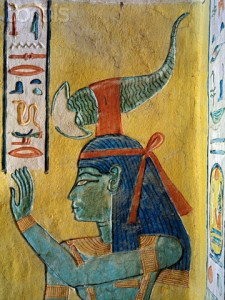
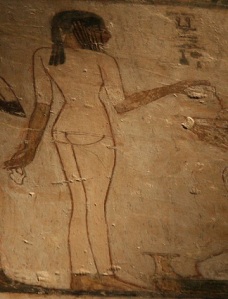
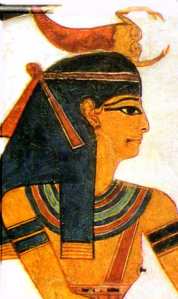
Serket from the tomb of Nefertari. XIX Dynasty. Ancient Egypt.

Serket from the tomb of Nefertari. XIX Dynasty. Valley of the Queens. Photo: www.jfbradu.free.fr

It has been always thought that the ancient Egyptian deity Serket was the Scorpion Goddess, whose power was in her stings.


Scholars considered that, due to the quality of killing with the poison, Serket was in Ancient Egypt an effective divine protection against poisonous bites.


Nowadays it is widely considered that in fact Serket was not a scorpion, but a nepid, that is a water scorpion.
Water scorpion

Water scorpion. Photo: www.geoffpark.wordpress.com

The water scorpion is an insect which lives in the marshes and, whose appearance remembers the one of scorpions. The water scorpion looks like an earth’s scorpion due to the shape of its two forelegs and to a long breathing-tube at the end of the abdomen that looks like a sting.

Although morphologically they seem to be very close, the nepid is a harmless insect, while the scorpion is harmful and in some cases can cause death. The bite of a scorpion produces many damages, among them the asphyxiation; on its behalf the waterscorpion presents a breathing-tube at the end of the abdomen which allows t take air while the animal is under the water. So, Ancient Egyptians could have considered the water scorpion as the positive counterpoint of the lethal scorpion. They would be the both side of the same matter:

Serket. scorpion versus nepid

Serket. scorpion versus nepid

Serket.Hieroglyph. Ancient EgyptOn the other hand, Serket is a name which comes from the verb srk:Serket. Name in Hieroglyps. Ancient Egypt
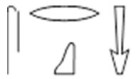
which means “breathe”, “make breathe” (Wb IV, 201). And Serket is the short version of the name of this goddess. Her complete name was srkt Htw:

Serket. complete name. Ancient Egypt

This ancient Egyptian name meant: “she makes breathe the windpipe”.

Among the faculties the dead (assimilated to Osiris) needed for coming back to his new life, was the breath. According to the belief of ancient Egypt, it was Isis the goddess who blew air to the nostrils of Osiris by beating her wings. And Serket was eventually assimilated to Isis.
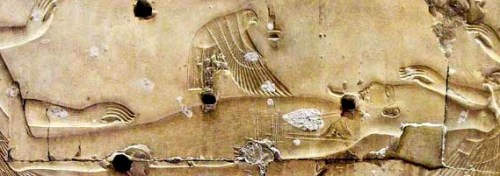
Isis as a kite flaps wings and put herself over her husband.  Relief from the temple of Seti I in Abydos.  XIX Dynasty. Photo: www.passion-egyptienne.fr

Isis as a kite flaps wings and put herself over her husband. Relief from the temple of Seti I in Abydos. XIX Dynasty. Photo: http://www.passion-egyptienne.fr

This exposure makes us think of the posibility that ancient Egyptians included Serket in the team for protecting the corpse thanks to her faculty for allowing the breathing.
The Ancient Egyptian Goddess Serket, a Dead Protector.


Last week we knew that the ancient Egyptian goddess Neith had her reasons for being part of that team of four goddesses-mourners (Isis, Nephtys, Neith and Serket) protecting the dead.

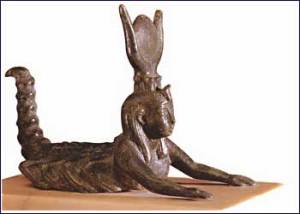
Serket as scorpion. Statue from Late period. Musée du Louvre. Ancient Egypt

Serket as scorpion. Statue from Late period. Musée du Louvre. Photo: www.museumsart.de

Serket was also a very important divinity in the Egyptian pantheon. She had a great healing power and for that reason she was invoked in ancient Egyptian remedies against scorpion bites.  


In the funerary sphere of Ancient Egypt Serket helps the Egyptian solar god in his daily rebirth. Re, during his journey in the darkness of the night has to fight against his enemy, the serpent Apophis, which is facing the solar bark.

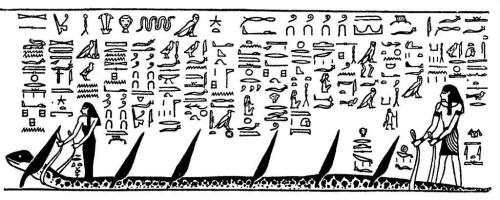
Serket killing Apophis. Detail from the tomb od Seti I. XX Dynasty. Ancient Egypt

Serket killing Apophis. Detail from the tomb od Seti I. XX Dynasty. Photo: www.bibelwissenschaft.de

The Egyptian the Book of the Amduat from the New Kingdom tells how in the seventh hour, which takes place in the Cavern of Osiris, the power of Serket becomes a great help for defeating Apophis. This great serpent had drunk all the water and the solar bark juts could move thanks to the magic of Isis (the magic of Isis helped also Anubis in the mummification process of Osiris). So, Apophis was in the solar sphere of Ancient Egypt the image of chaos. And among the gods who helped Re against his enemies, was Serket, whose power helped in capturing Apophis and dismembering his body.

Serket from the tomb of Khaemwaset. Valley of the Queens. XX Dynasty. Ancient Egypt.

Serket from the tomb of Khaemwaset. Valley of the Queens. XX Dynasty. Photo: www.corbisimages.com

But Serket appears also associated to the Myth of Osiris. According to a version of the legend Serket helped Isis and Horus the Child when both had to hide from Seth in the marshes. Maybe for that reason Serket appears already mentioned in the Pyramid Texts of Old Kingdom associated with Isis, Neith and “The Two Harmonious Ones” (Pyr. 308).

However, is this link of the goddes with the protection of the dead, which comes from ancient times, related just to these two things we have mentioned?

Next week we will tackle an aspect of goddess Serket, which could make easier to understand her association with the protection of the corpse.

Why Became the Ancient Egyptian Goddess Neith a Protective of the Dead?


In Ancient Egypt Isis, Nephtys, Neith and Serket formed a team of four goddesses, who protected the caponic jars containing the organs of the dead.

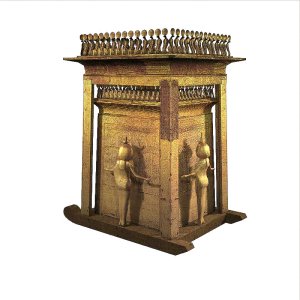
Canopic shrine of Tutankhamun. Serket. Ancient Egypt.

Canopic shrine of Tutankhamun with Serket on the left and Isis on the right. XVIII Dynasty. Cairo Museum. Photo: www.globalegyptianmuseum.org

For that reason Egyptians depicted these four goddesses in the canopic chests and sometimes also in sarcophagi.

We know that the link of Isis and Nephtys with the corpse is related to the Osiris Legend and to their mourning rite for helping him in his final resurrection. But, which attributes did Neith and Serket have for being part of that divine quartet?

In the case of Neith maybe the link would also be related to the Myth of Osiris, and concretely to the incident of the battle between Horus and Seth. This Ancient Egyptian myth tells how Horus had to revenge the death of his father Osiris at the hands of Seth. In the most popular version Horus and Seth battled, with the resulting bloodshed, which ended with the victory of Horus.

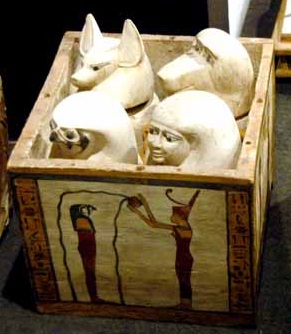
Canopic chest of priest of Montu Pady-Imenet. Neith pouring water on Qebehsenuef, the son of Horus who protected the intestines. XXII Dynasty.Luxor Museum. Ancient Egypt.

Canopic chest of priest of Montu Pady-Imenet. Neith pouring water on Qebehsenuef, the son of Horus who protected the intestines. XXII Dynasty. Luxor Museum. Photo: www.ancient-egypt.co.uk

According to another version, a court trial had to resolve the conflict. The gods were assembled in Heliopolis and Horus stated againt Seth. But, due to a lack of information the gods decided to write to Neith, an ancient Egyptian goddess of wisdom, and ask her for advice. The answer of Neith was clear: Seth was an usurper; Horus was Osiris’ legitimate heir, so he had to be in the throne of Egypt.

It seems quite probably that this mythical defence of Osiris and his son Horus caused the introduction of Neith in the funerary thought of Ancient Egypt as a protective goddess of the organs of the dead.

And…what about Serket?


The Beauty of Hair in Ancient Egypt.


Hair has been from ancient times an important element for preserving a good- looking. Recently in the blog Studia Humanitatis it was published a very interesting post about how the concept of a woman’s beauty is closely related to hair.

He mentioned a passage of The Metamorphoses of Lucius Apuleius, in which he falls in love of Fotis and concretly of her hair. The author notices then that hair is the main point of beauty of women for two reasons: 1)  because it is the first thing that men see and that it is shown to them;2) becasue, if the clothes embellish the body, the hair do the same thing with the head. In fact, Apuleius dedicates a big paragraph for exalting the sensuality of a long hair, the gesture of plaiting it, the hair loose… and he says that a bald women could never be attractive. (Lucius Apuleius, The Metamorphoses, II, 8-9).

Woman with mirror. Turin Papyrus. Ancient Egypt

Woman with mirror. Turin Papyrus. Photo: www.gettyimages.es

This thoutgh can also be applied to Ancient Egypt. For Egyptians the appearance was such a important thing, that cosmetic remedies were included in medical texts. For instance the Edwin Smith Papyrus includes prescriptions for renewing the skin and rejuvenating the face (Pap. Edwin Smith, V. 4, 3-8).

Hair was not an exception in Ancient Egypt among beauty cares. Egyptians were concerned, as nowadays, about grey hair and baldness. The Papyrus Ebers shows many remedies against these two problems, always using the natural components they had.

Man with sparse hair. Painting from the tomb of Horemheb. XVIII dynasty. Louvre Museum. Ancient Egypt.

Man with sparse hair. Painting from the tomb of Horemheb. XVIII dynasty. Louvre Museum. Photo: www.lessingimages.com

For growing hair Ancient Egyptians rubbed the scalp with a mixture of tooth of ass with honey, also they rubbed the bald area with a mixture of fat from different animals (lion, hippopotamus, crocodile, cat, snake and goat).

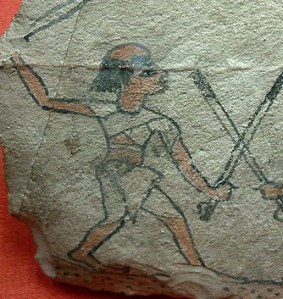
Ostraca from Louvre Museum with men with alopecia. Ancient Egypt

Ostraca from Louvre Museum with men with alopecia. Photo: www.wikipedia.org

Ancient Egyptians fought against accidental alopecia rubbing the affected area with quills of hedgehog warmed with oil or with a mixture of lead and froth of beer.

Finally, against grey hair men and women from Ancient Egypt applied blood of the gabgu bird (an unknown bird mentioned in the Coffin Texts as a dangerous bird) for dyeing the white hair, or horn of deer mixed with warm oil, or womb of cat mixed with egg of gabgu bird and oil. Grey eyebrows could be dissimulated with a mixture of liver of an ass, warm oil and opium.

Obviously we do not know the efficacy of these beauty remedies for the hair, but our question is: if they were important in Ancient Egypt for the livings, were they also for the dead? Did the Egyptians apply these prescriptions to their mummies? Had their mummies be as beautiful as possible for the Afterlife?

Mummy with wig of queen Henuttawy. XXI Dynasty. Cairo Museum. Ancient Egypt

Mummy with wig of queen Henuttawy. XXI Dynasty. Cairo Museum. Photo: www.commons-wikimedia.org


Hair in Egyptian Art for Respect and Reverence in Women.


Egyptian artisans of the New Kingdom used hair in their drawings for expressing body movements (dance, body bow…).

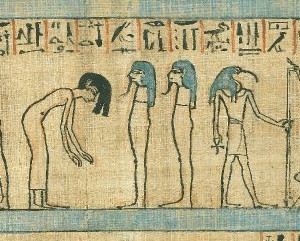
This technique, adopted from the way of drawing the professional mourners, was applied to the masculine figures in a respectful attitude. The front lock of hair forwards helped the Egyptian artist to represent the respectful bow in front of deities.

Later on, we find that this same practice was applied also to some femenine figures.

In the Papyrus of Anhai, which dates from XX Dynasty, the dead women was represented  also bending her body to the goods, but her whole mane of hair is shaken forwards. The gesture remembers the one of the mourners covering their faces with their hair.

Papyrus of Anahi. the dead woman with her hair forwards and bending her body as a sign of respect. XX Dynasty. Ancient Egypt . British Museum.

Papyrus of Anahi. the dead woman with her hair forwards and bending her body as a sign of respect. XX Dynasty. Photo: British Museum.

Obviously we are not facing here a mourning rite. The Egyptian artist took the tachnique from the mourning scenes and this way he could stress the gesture of respect of the dead women in front of the goods.

The point here is to see how this practice of the whole mane of hair forwards is applied in Egyptian art to a female figure. While for the dead men the front lock of hair was enough for stressing the respectful attitude. The idea that comes to our mind is that the hair forwards covering the face was in Egyptian art just a female gesture.

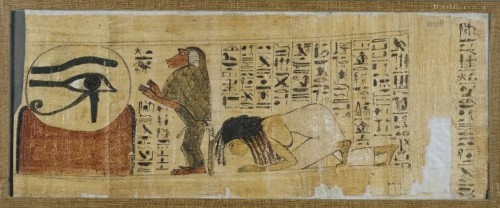
Book of the Dead of Henuttawy. XXI Dynasty. Ancient Egypt. British Museum

Book of the Dead of Henuttawy. XXI Dynasty. Photo: British Museum

The Book of the Dead of Henuttawy dates also from XXI Dynasty and shows Henuttawy adoring the rising sun . In this case the body gesture is not just respect, but reverence. She is completely on earth, kneeling and facing the ground, while many locks of hair are falling in front of her head. Here the Egyptian artist utilised this femenine resource of the disheveled hair falling forwards for stressing the reverential attitude of the woman.

Summin up, Egyptian artists used the hair for representing the mourning gestures of women in funerals. This technique was later also adopted in Egyptian art from the New kingdom to express some quotidian body movements (playing music, dancing, bending) and some attitudes related to them (respect and reverence).


Hair in Egyptian Art for Expressing Respect.


Hair became in Ancient Egypt a resource for expressing things.

The bending hair was used in Ancient Egypt art for drawing body movements.

As some movements were related in ancient egyptian belief to some attitudes, hair was also used for expressing those attitudes. We are referring concretly to “respect”.

The gesture of bending the body forwards was utilised by artists of Ancient Egypt for expressing the respect in front of kings and deities. And the hair forwards became a resource of stressing this gesture of veneration.

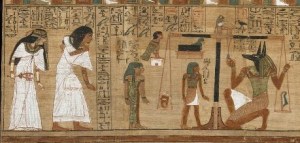
Papyrus of Ani. The couple in front of the final judgment. XIX Dynasty. British Museum. Ancient Egypt

Papyrus of Ani. The couple in front of the final judgment. XIX Dynasty. Photo: British Museum.

One good example is the Papyrus of Ani (XIX Dynasty) in the Brisith Museum. In it  we can see the couple bended when coming in front of the final judgment. Ani’s wife appears with her hair slightly forwards, this way the Egyptyian artists emphasized her body movement.

Papyrus of Ani. Ani greeting the Ennead. XIX Dynasty. British Museum. Ancient Egypt

Papyrus of Ani. Ani greeting the Ennead. XIX Dynasty. Photo: British Museum.

This was exagerated in the same papyrus when, after passing the judgment, Ani gets into paradise and greets the gods. In this case Ani is represented with a front lock of hair forwards; the artist stressed the meaning of bending the body as a signof respect.

The papyrus of Ramose (XIX Dynasty) in the Fitzwilliam Museum of Cambridge is too damage, but we can guess the same scene as in the former one. Ramose’s body is greeting the gods, while his body is bended and a front black lock of hair can be discerned.

Book of the Dead (Papyrus of Ramose). Ramose seems to show his front lock of hair. Fitzwilliam Museum. Cambridge. Ancient Egypt.

Book of the Dead (Papyrus of Ramose). Ramose seems to show his front lock of hair. XIX Dynasty. Photo: Fitzwilliam Museum. Cambridge.

Although these examples all date from XIX Dyansty, next week we will see that it was not trendy just at that time,

Hair in Egyptian Art for Expressing Dance.


Due to the estrict rules of the Egyptian art, artists in Ancient Egypt needed to find unnatural ways of expressing some movements, especially during the Old and Middle Kingdom. Distorsion and sprain characterises dynamic scenes (dancing, acrobaces, games…) in those periods of Egyptian history.

Dancing scene from mastaba of Mereruka. VI Dynasty. Saqqara. Ancient Egypt

Dancing scene from mastaba of Mereruka. VI Dynasty. Saqqara. Image: http://www.osirisnet.net

musician girls in Rekhmire's tomb. Ancient Egypt

Musician girl playing the long neck lute. Tomb of Rekhmire in Gourna. XVIII Dynasty. Photo courtesy: Dagmar Krejci.

However, from the New Kingdom dynamism appears in Ancient Egypt decoration in a more natural way. The Egyptian artist gradually tretaed the bodies in movement in a less rigid way. And one of the elements which helped them was the hair. We have already seen, for instance, that hair was a resource for expressing the movement while playing an instrument. However, hair as an artistic resource of Egyptian artist applied to the body language dates not from the New Kingdom, but before. According to the iconography, the mourning gesture of shaking hair forwards was expressed in Ancient Egypt by drawing the mane of hair over the woman’s face. That way, the Egyptian artist represented this body movement. We can imagine that the mourner was not permanent bended, but moving her body and head forwards and backwards.

Detail of the stele of Abkaou in the Louvre Museum. XI Dynasty. Ancient Egypt

Detail of the stele of Abkaou in the Louvre Museum. XI Dynasty. Photo: http://www.commons.wikimedia.org

As long as we know, the first example of this artistic resource comes from Middle Kingdom; in the stele of Abkaou (XI Dynasty) and in a fragment of a coffin (XII Dynasty) mourners bend their body and their hair is forward.

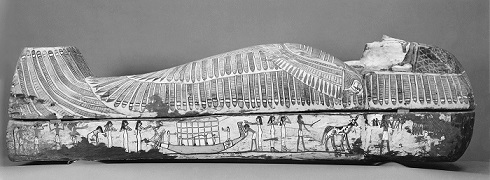
Later on, in a rishi coffin from XVII Dynasty, there is a scene of the funerary procession, in which one mourner bends her body and shakes the hair forwards. That way of expressing this mourning gesture will go on in the Ancient Egypt iconography.

Rishi coffin. Right side with the funerary procession. On the left a common mourner shaking hair forwards. XVII-XVIII Dynasty. Thebes. Funerary ceremony in Ancient Egypt.

Rishi coffin. Right side with the funerary procession. On the left a common mourner shaking hair forwards. XVII-XVIII Dynasty. Thebes. Photo: http://www.metmuseum.org

Tomb of the Dancers from Thebes. XVII Dynasty. Ashmolean Museum of Oxford. Ancient Egypt.

Tomb of the Dancers from Thebes. XVII Dynasty. Ashmolean Museum of Art and Achaeology in Oxford. Photo: www.ashmoleanprints.com

The paintings from the “Tomb of the Dancers” date from the XVII Dynasty and we can see in them how in that period of the Egyptian history  artists started to treat the body in movement in a more realistic way, traying to express what that women were doing: jumps, gestures with the shoulders, arms raised…, although their hair are motionless.

In the New Kingdom, Egyptian art takes the technique from the sacred funerary decoration and the hair forwards and/or backwards became a way of drawing more daily gestures. Artist will learn to manipulate hair in a realistic way for expressing the movement of dancing.

Music scene from the tomb of Djeserkaraseneb. XVIII Dynasty. Tempera of Charles. K. Wilkinson. Ancient Egypt.

Music scene from the tomb of Djeserkaraseneb. XVIII Dynasty. Tempera of Charles. K. Wilkinson. Photo: www.metmuseum.org

In the tomb of Dyeserkaraseneb (TT 38), dating from the reign of Tuthmosis IV there is a music scene in which one of the musicians appears with her plaits moving for expressing how she turns he head back. Next to her a dancing girl is slightly bended backwards, whose lateral plaits of hair were drawn following her movement.

Dancing girl. Tomb of Dyeserkaraseneb (TT 38). XVIII Dynasty. Ancient Egypt.

Dancing girl. Tomb of Dyeserkaraseneb (TT 38). XVIII Dynasty. Photo: www.osirisnet.net


Dancers and musicians from the tomb of Nebamon (TT 90). XVIII Dynasty. Ancient Egypt.

Dancers and musicians from the tomb of Nebamon (TT 90). XVIII Dynasty. Photo: www.commons.wikimedia.org

The famous scene of the dancers from the tomb of Nebamon (TT 90) shows one of the dacing girls with both laterals plaits of hair shaing forwards with her head. In fact, the whole body was treated in such a realistic way that we can imagine her moving herself to the rhythm of the music her fellows are playing.

In that period of Egyptian history the artists learnt how to draw the body movement in a more realistic way manipulating many parts of the human body, included the hair. This last one was a technique taken from the sacred funerary art of Ancient Egypt.


Offering the Make-up in Ancient Egypt. Funerary rites get into Egyptian Art.


We usually think that the decoration from the Egyptian tombs does not change in the whole history of Ancient Egypt. But in fact, there are  some images, which appear in some periods and become usual during some time.

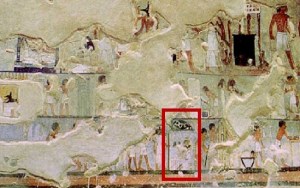
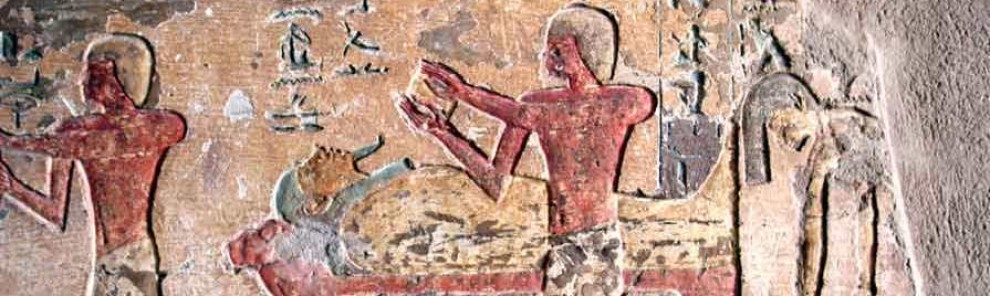
Mourner offering make-up in the tomb of Rekhmire. XVIII Dynasty. Ancient Egypt.

Mourner offering the make-up. Detail from the south wall in the tomb of Rekhmire. XVIII Dynasty.

That is the case of a typical Egyptian scene of the professional mourner in some tombs of the New Kingdom: the tomb of Rekhmire (TT 100), the tomb of Sobekhotep (TT 63) or the tomb of Sennefer (TT 96). The mourner appears with no mane of hair kneeling in front of an altar and offering globular vases. According to the inscription in Rekhmire’s tomb, she if offering green make-up for the eyes (Hodel-Hoenes, S., Leben und Tod im Alten Ägypten. Thebanische Privatgräber des Neuen Reiches. Darmstadt, 1991, p. 130).

Offering make-up in the tomb of Sennefer. Ancient Egypt.

Offering make-up in the tomb of Sennefer.It is similar to the scene in the tomb of Rekhmire. Gourna. XVIII Dynasty. Photo: www.osirisnet.net

We could think that, if the scene appears now it is becuase it refers to something belonging to the Egyptian funerals of the New Kigndom,  but in fact it is not so.

This action happens just after the Opening of the Mouth ceremony; ; a group of Ancient Egypt sacred practices 8And also secret) for giving back the life to the deceased. We have already seen that, according to the documents, it seems that in these ceremony the mourners were shaven just after the official mourning rite. It was the moment of offering the Udjat eye to the mummy and reviving this way the myth of Osiris, in which the god received the Udjat eye as a sign if his final resurrection. And in the rite it happens when the ox (as a sethian victim) has already been sacrificed.

Offering make-up in the tomb of Sennefer. Gourna. Ancient Egypt.

Detailof the offering make-up in the tomb of Sennefer. Gourna. XVIII Dynasty. Photo: http://www.osirisnet.net

At the end of Ancient Egypt funerals the dead had to receive the Udjat eye. The funeral staff symbolized it shaving the mourners and giving make-up for the eyes. The fact of presenting make-up is already documented in the Pyramid Texts of the Old Kingdom (Pyr. 54b-55; Pyr. 609) and the Coffin Texts of the Middle Kingdom (CT VII, 934; 936) as a gesture which symbolizes “to fit the eye in the face” (Wb, IV, 370, 12).

In many cases the mourners offered green make-up for the left eye and black make-up for the right one. This was a way of representing the whole lunar cycle, and therefore the victory of Horus over Seth. A belief, which was very rooted to Egyptian though from immemorial times. So, to give the make-up at the end of the Opening of the Mouth ceremony would be much older than the XVIII Dynasty.

For some reason, the practice of offering the make-up could be during the XVIII Dynasty represented. As it happens with some other gestures of funerary rites, the artists of the New Kingdom were more aware than before of what happened during the Egyptian funerals. The secret funerary rites of Ancient Egypt, got into the Egyptian art.


Hair: a Resource in Ancient Egypt Art for Expressing Movement.


XVIII Dynasty tombs located in Luxor are especially rich in small details, some of them escaping easily from our sight, which give much information about Ancient Egypt.

This is the case of an image in the scene of the banquet in the tomb of Rekhmire (I have to express my gratitude to Dagmar Krejci, who called my attention on it).

Banquet in Rekhmire's tomb.Ancient Egypt. Egyptian Art

Banquet in Rekhmire’s tomb in Gourna. XVIII Dynasty. Photo: Mª Rosa Valdesogo

The whole scene shows many women during the Egyptian banquet being assisted by young girls. These servants are pouring drinks, offering floral necklaces and playing music. The Egyptian artist expressed the youth of those girls by means of their hairstyle, made by lateral fine plaits and a thicker back lock.

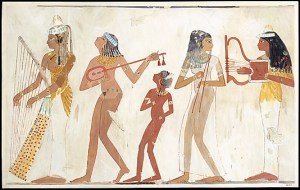
musician girls in Rekhmire's tomb. Ancient Egypt

Musician girl playing the long neck lute. Tomb of Rekhmire in Gourna. XVIII Dynasty. Photo courtesy: Dagmar Krejci.

We want to focus on one girl playing a long neck lute, whose hair covers her face. About this girl Dagmar Krejci and Peter Zamarovsky, from Czech Republic, already wrote something, paying especial attention to the lute she is playing.

What about her hair? Watching carefully, we realize that her hairstyle is the same one as her fellows’, with the lateral plaits and the back lock. However her face is covered by the plaits, while the black stroke in her front seems to be her back lock, which is now onwards. Why?

The answer could be in her gesture. This girls is slightly bended forwards for playing the lute. Maybe the Egyptian artist tried to find a way of expressing this position drawing her hair forwards.

However, some other girls in this same scene appear also bended, in many cases with a real nod, and their hairstyle has no changes. Then, which is the difference with our lute player?

We need to consider two things: 1) the long neck of the lute based on the ground and 2) the fact that she is playing while standing. Maybe for playing with this posture she needed to move and this movement was expressed by the Egyptian artist with the change in her hairstyle. So, she was not just playing, but also moving.

Rishi coffin. Right side with the funerary procession. On the left a common mourner shaking hair forwards. XVII-XVIII Dynasty. Thebes. Funerary ceremony in Ancient Egypt.

Rishi coffin. Right side with the funerary procession. On the left a common mourner shaking hair forwards. XVII-XVIII Dynasty. Thebes. Photo: www.metmuseum.org

The movement expressed by means of the hair forwards is not new for us. We have seen all over this blog that it was a resource in Egyptian art for depicting the movement of the Egyptian mourners. On the other hand, in Rekhmire’s tomb there are many new artistic solutions for expressing different things: the girl turning her back, the lateral perspective of the shoulders, the body spinning around, the dynamism of some workers…

Man spinning his body around. Tomb of Rekhmire. Ancient Egypt. Egyptian Art

Man spinning his body around. Tomb of Rekhmire in Gourna. XVIII Dynasty. Photo: Mª Rosa Valdesogo

Girl turning her back. Tomb of Rekhmire. Ancient Egypt. Egyptian Art

Girl turning her back. Tomb of Rekhmire in Gourna. XVIII Dynasty. Photo: Mª Rosa Valdesogo

The XVIII Dynasty was a moment of news in Egyptian art and the young lute player in the tomb of Rekhmire could be a sign of it. The Egyptian artist manipulating her hairstyle, tried to express as real as he could what the young girl was exactly doing: moving herself while playing the lute.

Shaven Mouners in an Ancient Egypt Funerary Boat.


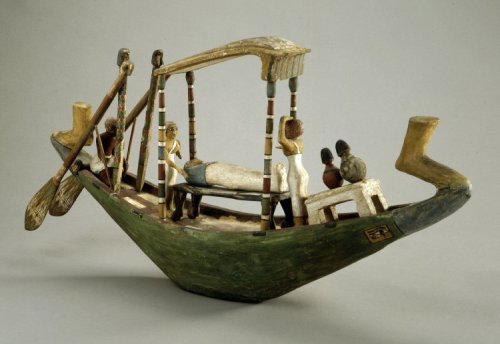
Ancient Egypt wooden models were frequent during the Middle Kingdom and thanks to them we know much today about everyday life of ancient Egyptians: butchery, bread production, granaries… Among them there were also many dedicated to the funerary boats which Egyptians utilized for transporting the mummy on the Nile to the necropolis.

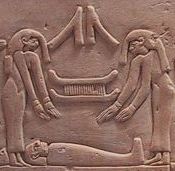
These funeral barges show the body lying on the bier and being flanked at both ends by the two professional Egyptian mourners in the role of Isis and Nephtys and sometimes accompanied by one priest. The attitude of that two women depicted by the artist is quite static and not too much can be deduced from it, except that they accompany the deceased.

wood model of a boat with mummy and mourners. British Museum EA9524. XII Dynasty. Ancient Egypt

Wooden model of a funerary boat with the mummy and the two professional mourners. Their scalp is well visible in pink color and with black spots. XII Dynasty. Photo: British Museum.

However, piece EA9524 in the British Museum, dating from the XII Dynasty, represents the funerary boat with the corpse and the two mourning women and both extremes; in this case there is no priest, but a helmsman. And the image of both women gives some interesting information about them.

The two professional Egyptian mourners are not in such a static posture as usual. They appear with their left arms raised and the hand on the head, while the right arms are extended towards the mummy. So, they are not just standing, but making the typical gesture of mourning in Ancient Egypt.

But the most important point in this piece is in the head of those two professional Egyptian mourners. They are not with long hair, and their hair is not covered by a scarf. In both women (and also in the helmsman) the scalp can be seen. Their heads were painted in pink color with small black spots. So, the Egyptian artist indicated that their hair was very short or that their head had just been shaved.

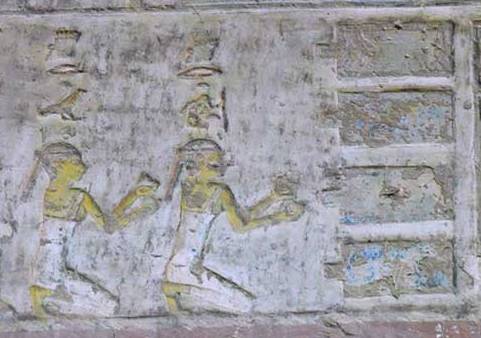
The two Drty (two kites), offering nw vases to the four pools. Relief from the tomb of Pahery in el-Kab. XVIII Dynasty. Ancient Egypt

The two professional mourners with short hair at the end of the funeral. Relief from the tomb of Pahery in el-Kab. XVIII Dynasty. Photo: www.osirisnet.net

That links perfectly with one of our affirmations: the hair of two professional Egyptian mourners in the role of Isis and Nephtys was cut and that short hair was a distinctive of the professional mourner in Ancient Egypt. The short hair became a resource for the artists of Ancient Egypt for depicting these two professional mourners and differentiate them from the common mourners.