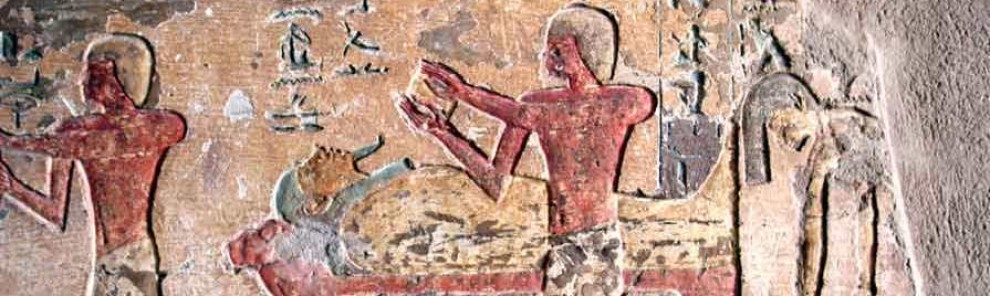
Re and Geb also place Isis and Nephtys at both ends of the Egyptian mummy.


We know that goddess Nut places Isis and Nephtys in some Egyptian coffins of the XII Dynasty. That goddess, as mother of these two mourners, decided to put Isis at the feet and Nephtys at the head of the mummy.

But that was not always like that in the Egyptian belief.

Some other coffins from XII dynasty and also found in Middle Egypt show that some other gods of the Heliopolitan cosmogony were also involved in that decision.

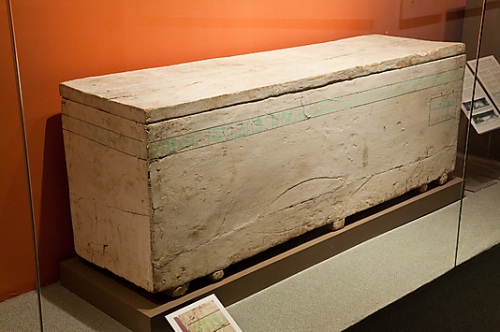
Feet end of inner coffin of Gua from el-Bersha. XII Dynasty. Ancient Egypt

Feet end of inner coffin of Gua from el-Bersha. XII Dynasty. Photo: www.britishmuseum.org

The inner coffin of Gua, from el-Bersha, presents inscriptions at both extremes of the box. At the feet end we read “Words said by Geb, I have put Isis at your feet in order she weeps you“. At the head end the hieroglyphs show that again Nut is the responsible of placing Nephtys there.

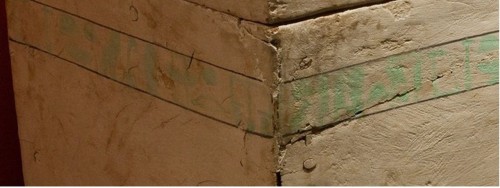
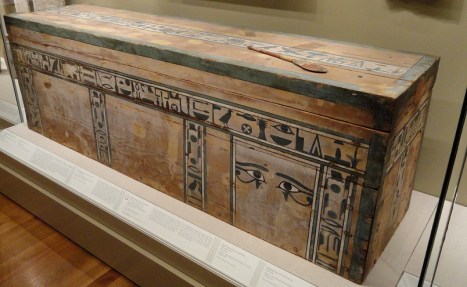
Head end of the coffin of Nakhti from Asyut. XII Dynasty. Ancient Egypt

Head end of the coffin of Nakhti from Asyut. XII Dynasty. Photo: www.cartelfr.louvre.fr


The coffin of Nakhti from Asyut is different. At the head end of the box we read: “Words said by Ra, I have put Isis at your head in order she weps you and she mourns“.

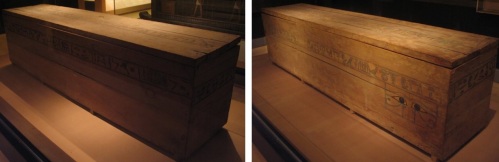
Feet end of the coffin of Nakhti from Asyut. XII Dynasty. Ancient Egypt

Feet end of the coffin of Nakhti from Asyut. XII Dynasty. Photo: www.cartelfr.louvre.fr

At the feet end we read: “Words said by Ra, I have put Nephtys at your feet in order she weps you and she mourns“.

In the coffin of Nakhti we find two things. On one hand Isis is at the head, while Nephtys is at the feet; the opposite of the expected location. On the other hand, the one who decides that location is Ra, the main god of the Heliopolitan cosmogony.


The coffin of Sebekhetepi from Beni Hassan has no trace of Isis andNephtys at both ends of the box. Instead of that, Sebekhetepi is in front of Anubis and The Great God Lord of the Sky, which is usually an epithet of Re.

These three coffins date from the XII Dynasty and come from Middle Egypt. The information we get from the inscriptions demonstrates that nothing about this subject was still fixed in the period of the Egyptian history.

Some reflections come to my mind:

  • The Egyptian mourning rite for helping in the dad resurrection was still too unknown and also the role of these two women as representatives of Isis and Nephtys. So what they did or where the were was not so clear for Egyptian  artists.
  • The mourning rite had a deep osiriac origin and was not yet well stablished in Egyptian decoration.
  • The mourning rite and its osiriac origin needed the Heliopolitan cosmogony for helping in that stablishment. Maybe Egyptian priests during the Middle Kingdom were atill looking for the way of combining these two traditions in the Egyptian coffins.
Nut places the two mourners in some coffins of the XII Dynasty.


In Ancient Egypt Isis was usually located at the feet extreme of the mummy, while Nephtys were located at the head extreme of it. Although it seems to have a logic based on a mythic legend, we find that this was not the rule all over the Egyptian history.

In previous posts we have seen how during the XI and XIII Dynasties Egyptian coffins show Isis at the head end and Nephtys at the feet end.

However, some coffins dating back on the XII Dynasty (the core Middle Kingdom), show that in that period of the Egyptian history Egyptians started thinking of Nephtys at the head end of the box and Isis at the feet end of it.

Coffin of Senbi from Meir. XII Dynasty. Ancient Egypt.

Coffin of Senbi from Meir. XII Dynasty. Cleveland Museum of Art. Photo: www.commons.wikimedia.org

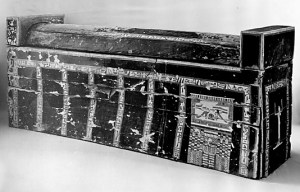
For instance, in the coffin of Senbi from Meir in the Cleveland Museum of Art, the inscription shows that the place of Nephtys was the head extreme of the coffin.

Detail of the head end of the coffin of Senbi. Inscription referring to goddess Nephtys. Meir. XII Dynasty. Ancient Egypt

Detail of the head end of the coffin of Senbi. Inscription referring to goddess Nephtys. Meir. XII Dynasty.

Another example is the coffin of lady Senbi from Asyut in the Altes Museum of Berlin, which also shows the head extreme of the box as the place for Nephtys. So, in both cases Isis would be standing at the feet end.

Coffin of Lady Senbi from Asyut. XII Dynasty. Nephtys at the Head. Ancient Egypt

Coffin of Lady Senbi from Asyut. According to the hieroglyphs, Nephtys is at the head end. XII Dynasty. Egyptian Museum in Berlin: Photo: www.egyptian-museum-berlin.com

There are some other coffins, whose information is still much more complete. Not only they indicate the place for each goddess, but also inform us about who decided that.

Coffin of Sopi from el-Bersha. XII Dynasty. Musée du Louvre. Ancient Egypt.

Coffin of Sopi from el-Bersha. XII Dynasty. Musée du Louvre. Photo: www.cartelfr.louvre.fr

The coffin of Sopi, an intendant under the reigns of Sesostris II and III, from el-Bersha and now in the Louvre Museum, has a very rich decoration inside and a more austere one outside. Anyway, in both cases, the inner and outer decorative/textual pattern sends the same information: Isis is at the feet of the mummy. That happens because, according to the inscription,  “Nut has placed Isis at the feet of the corpse.

Coffin of Sepi from el-Bersha. XII Dynasty. Outer head end. Nut places Nephtys at the head. Ancient Egypt.

Coffin of Sepi from el-Bersha. XII Dynasty. Outer head end. Nut places Nephtys at the head. British Museum. Photo: www.britishmuseum.org

The same case we find in the coffin of the army commander Sepi, also from el-Bersha and in the British Museum. Outside of both extremes the hieroglyphs read how Nut has placed Isis at the feet and Nephtys at the head.

Coffin of Sepi from el-Bersha. XII Dynasty. Inner head end with the name of Nehtys. Ancient Egypt.

Coffin of Sepi from el-Bersha. XII Dynasty. Inner head end with the name of Nehtys. British Museum. Photo: www.britishmuseum.org

Coffin of Sepi from el Bersha. XII Dynasty. Outer feet end. Nut places Isis at the feet. Ancient Egypt.

Coffin of Sepi from el Bersha. XII Dynasty. Outer feet end. Nut places Isis at the feet. British Museum. Photo: www.britishmuseum.org

And also in the inner head end of this coffin, we read how the dead is there in front of Nephtys.


In these two cases, Isis stands at the feet of the dead and Nephtys at the head, following a decision of the goddess Nut.

Could we conclude something?

Not at all!

Next week we will see that nothing was stablished about this subject in the XII Dynasty.

Some other gods will also decide about tyhe location of Isis and Nephtys at both ends of the mummy.

The two Mourners Isis and Nephtys in the Egyptian Coffins of XIII Dynasty.


We saw on 1st April that during the XI Dynasty hieroglyphs on Egyptian coffins show that Isis was supposed to be at the head of the mummy and Nephtys at the feet. 

Later on, in the XIII Dynasty the tendency was the same one. Inscriptions on Egyptian coffins were also embellished with images. One of the best examples is the coffin of Khnum Nakht from Meir. 

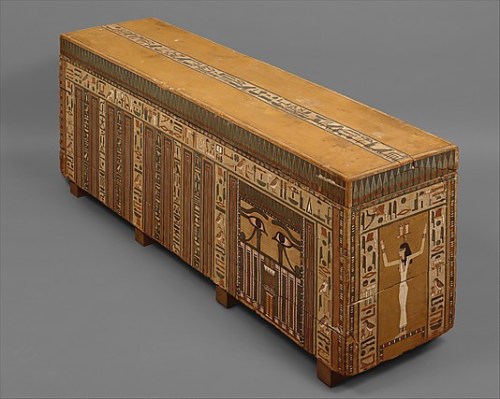
Coffin of Khnum Nakht. Head extreme with image of Isis. On the left the false door with the two udyat eyes indicating the threshold between the earthly world and the Afterlife. XIII Dynasty. Metropolitan Museum of Art of New York. Ancient Egypt.

Coffin of Khnum Nakht from Meir. Head extreme with the image of Isis. On the left the false door with the two udyat eyes indicating the threshold between the earthly world and the Afterlife. XIII Dynasty. Metropolitan Museum of Art of New York.

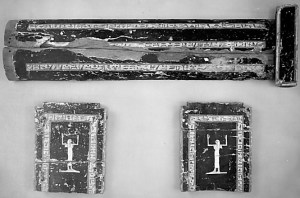
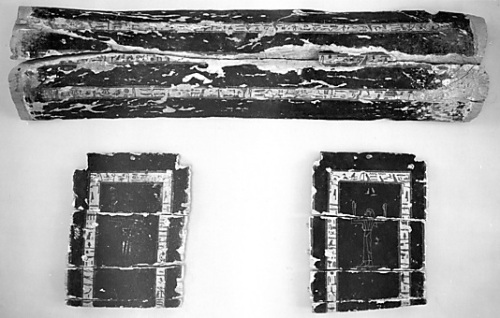
There is a group of coffin from Thebes (from el-Asasif) dating back to the XIII Dynasty and whose main feature are their black background colour. They also include some figures: at the head end of the panel there is the false door and at both extremes of the coffin the artists draw the images of two goddesses with her raised arms.

Coffin of Ikhet. XIII Dynasty from el-Asasif. Ancient Egypt

Coffin of Ikhet from el-Asasif. XIII Dynasty. At the head end there is the false door and at the head extreme a feminine figure stands with raised arms. Photo: www.metmuseum.org

Coffin of Nefnefret. XIII Dynasty from el-Asasif. Isis and Nephtys. Ancient Egypt.

Coffin of Nefnefret from el-Asasif. XIII Dynasty At both extremes the two feminine images, Photo: www.metmuseum.org

These two women are not always identified, as for instance in the coffin of Ikhet or the one of Nefnefret, but in some cases the hieroglyphs accompanying them says clearly that they are Isis and Nephtys. This is what we can see in the coffin of Entemaemsaf. The woman on the head extreme is goddess Isis and the woman on the feet extreme is goddess Nephtys.

Coffin of Entemaemsaf. XIII Dynasty.Isis at the head and Nephtys at the feet. el-Asasif. Ancient Egypt.

Coffin of Entemaemsaf. Isis at the head and Nephtys at the feet. XIII Dynasty. El-Asasif. Photo: Metropolitan Museum of Art of New York.

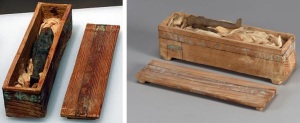
Model coffins are not an exception, because Egyptians treated them as authentic coffins. For instance the model coffin of Teti from the Second Intermediate Period is of unknown origin (maybe from Thebes, although it is not for certain), but it follows the feature indicated above. The coffin, with some spells from the Coffin Texts, has a false door in the head end of the right panel and at the head extreme a feminine figure is standing with her raised arms.

Model Coffin of Teti. Second Intermediate Period. Ancient Egypt

Model Coffin of Teti. Second Intermediate Period. British Museum. Photo: www.britishmuseum.org

In Ancient Egypt the decoration of coffins during the XI and XIII Dynasties could include hieroglyphs and images of these two women at both extremes. It seems reasonable to think that they were Isis at the head extreme and Nephtys at the feet extreme.

But, what happened during the XII Dynasty?…


The two Mourners Isis and Nephtys in the Egyptian Coffins of XI Dynasty.


In Ancient Egypt iconography Isis and Nephtys appeared at both extremes of the corpse, usually Isis stood at the feet, while Nephtys stood at the head of the mummy. However this position was not always like that. We saw on 18th March how at the Egyptian coffin of Khnum Nakht, dating from the XIII Dynasty and coming from Meir (Middle Egypt) had an excellent manufacture in the decoration but probably with the wrong location of these two goddesses; the inscriptions of the feet extreme of the coffin mention Nephtys, while at the head extreme was the figure of a goddess named as Isis.

Model coffin of Neferu. XI Dynasty. Deir el-Bahari. Ancient Egypt

Model coffin of Neferu. XI Dynasty. Deir el-Bahari. Photo: Metropolitan Museum of Art of New York.

Many coffins and model coffins (small model coffins made of wood contained figurines of the deceased and have been used in Ancient Egypt from the Middle Kingdom) from the Second Intermediate Period show the same location for both Isis and Nephtys. But if we look back to the XI Dynasty, we find that also that happened.

The model coffin of Queen Neferu dates from the XI Dynasty and comes from Deir el-Bahari in Thebes. The inscriptions on it show that the extremes of the coffin was already at that time reserved to the two mourners of Osiris, Isis and Nephtys. But, according to the inscription, the place for Nephtys here was the feet end of the box.

Coffin of Child Myt. XI Dynasty. Thebes. Ancient Egypt

Coffin of Child Myt. XI Dynasty. Thebes. Photo: Metropolitan Museum of Art of New York.


This is not the only example of that; the coffin of Child Myt, from Thebes and dated in the XI Dynasty, shows also an inscription at the feet of the box mentioning the goddess Nephtys.

Coffin of Child Myt. XI Dynasty. Detail of Nephtys hieroglyph. From Thebes. Ancient Egypt

Coffin of Child Myt. Detail of Nephtys hieroglyph. XI Dynasty. Thebes. Photo: Metropolitan Museum of Art of New York.

The coffin of Princess Mayet dates from XI Dynasty and comes also from Thebes. The hieroglyphs in it shows clearly that the head end was the place for Isis, while the feet end was the extreme for Nephtys.

Coffin of Princess Mayet from Thebes. XI Dynasty. At the feet end the name of Nephtys. At the head end the name of Isis. Ancient Egypt.

Coffin of Princess Mayet. At the feet end (left) the name of Nephtys. At the head end (right) the name of Isis. XI Dynasty. Thebes. Photo: Brooklyn Museum

This location of Isis at the head and Nephtys at the feet in the coffin is also visible in some Theban coffins from XIII Dynasty, as for instance in the coffin of Entemaemsaf, from el-Asasif.

Coffin of Entemaemsaf. XIII Dynasty.Isis at the head and Nephtys at the feet. el-Asasif. Ancient Egypt.

Coffin of Entemaemsaf. Isis at the head and Nephtys at the feet. XIII Dynasty. El-Asasif. Photo: Metropolitan Museum of Art of New York.


But it is not the only example…

To be continued.


The Egyptian Verbs for “Disheveling Hair”


Ancient Egypt language had many different words for expressing the disorder in a long female hair.

We have seen that in the funerary context the most used one was the verb nwn, which literally meant “to dishevel the hair over the face”,nwn gesture of disheveling hair in Ancient Egypt that is, to shake the mane of hair forwards and cover the face with it.  So the verb refers to the fact of extending the hair upside down. That was the gesture the mourners did during their mourning ritual in the Egyptian funerals. The verb is documented already from the Old Kingdom and closely realted to the funerary context.
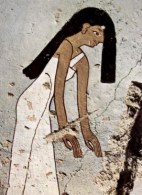
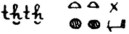
All during this blog we have seen how the nwn gesture was made by the common mourners during the cortège, but overall by the two professional mourners in the role of Isis and Nephtys during the resurrectional rites. Making the nwn gesture those two women evoked some crucial moments of the Myth of Osiris, as the copulation beweet Isis and Osiris, when Isis as a kte produces vital breath with her wings or the maternity of Osiris.


Another Egyptian word was tejtej (also written with the determinative of hair) tejtej-dishevel hair in Ancient Egyptwhich meant the tangled hair. According to Erman and Grapow, it was documented from Middle Kingdom and the sense of this verb was related to disorder. It was also applied to the fact of having the ideas mixed-up, so producing a state of confusion. The enemies of Egypt were as well tejtej when captured, since they were put all together in a disordered pile.

Isis as a kite over the corpse of Osiris. Relief from the temple of Seti I in Abydos. XIX Dynasty. Photo: www.common.wikimedia.org)

Isis as a kite over the corpse of Osiris. Relief from the temple of Seti I in Abydos. XIX Dynasty.

It is interesting to notice that chapter 17 of the Book of the Dead, which relates the copulation of Isis with Osiris, uses the verb tejtej for referring to the disordered hair of isis during her copulation with Osiris (Urk. V, 87). It still gains sense when we realise that tejtej is a reduplicated form from the Egyptian verb tej, which meant “get drunk”. And one epithet of Isis from the New Kingdom was “Lady of the Inebriation”. So, aluding to this state of confusion, which in the Myth of Osiris would be the moment of the copulation.

The verb sps has a very similar meaning as nwn, it was used for the tousled hairsepes- dishevel hair in Ancient Egypt, the main difference is that sps was documented from the New Kingdom, concretely in the Book of the Dead, while nwn is an existing verb for disheveled hair from the Old Kingdom. On the other hand it seems quite sure that nwn was the verb for referring to the concrete gesture of covering the face with the hair.

Two women shaking their hairs. Relief from the Red Chapel of Hatshepsut in Karnak. Photo: Mª Rosa Valdesogo Martín

Two women shaking their hairs in the Festival of the Valley. Relief from the Red Chapel of Hatshepsut in Karnak. Photo: Mª Rosa Valdesogo Martín

We have also to notice that the verb sps was later on also written with the determinative of a dancing person and it meant “dance”. sepes- dishevel hair in Ancient Egypt

At that point we could think that the verb sps could refer to the tousled during some dancing. If so, it comes tour mind those dances made by women during the Festival of the Valley or the Heb Sed. In them those dancers shook their hair forwards and disheveled it on her faces as symbol of renewing.

For the moment we cannot give many conclusions, but we know that the original word related to disheveled hair was nwn, as the gesture of shaking hair forwards by the mourners in the funerary ceremony.

In the Middle Kingdom appears the verb txtx, apparently evoking the chaos and disorder of a tousled hair and applied to the copulation of Isis and Osiris.

From the New Kingdom the verb sps is another way of referring to disheveled hair, although probably taken from ritual dances in which the dancing women made the nwn gesture of shaking hair forwards.

The wrong location of Isis and Nephtys in the coffin of Khnum Nakht.


In Ancient Egypt iconography Isis was mainly placed at the feet of the mummy, while Nephtys were at his head. That happened in tomb walls and in sarcophagi.

We have seen that this position was not accidental, but something deliberate. That typical icon of the mummy flanked by Isis at his feet and Nephtys at his head would remain two things. On one hand, it could represent a birth itself, when one woman gives birth (Isis) and being assisted by a midwife (Nephtys). On the other hand, it could refer to the mythical copulation between Isis and Osiris, so the goddess being at his feet would be ready for putting herself over her husband.

Coffin of Khnum Nakht. Head extreme with image of Isis. On the left the false door with the two udyat eyes indicating the threshold between the earthly world and the Afterlife. XIII Dynasty. Metropolitan Museum of Art of New York. Ancient Egypt.

Coffin of Khnum Nakht. Head extreme with image of Isis. On the left the false door with the two udyat eyes indicating the threshold between the earthly world and the Afterlife. XIII Dynasty. Metropolitan Museum of Art of New York.

But, sometimes, Egyptian art surprises us with some exceptions. Looking at the coffin of Khnum Nakht in the Metropolitan Museum of Art of New York we realised that the decoration in it did not follow the rule we have said before.

The coffin of Khnum Nakht dates from the XIII Dynasty and comes from Meir (Middle Egypt). The decoration in it includes on the left side of the coffin the false door with the two udyat eyes. That indicates that the head of the mummy was located behind it.

Coffin of Khnum Nakht from Meir. XIII Dynasty. Metropolitan Museum of Art of New York. Ancient Egypt

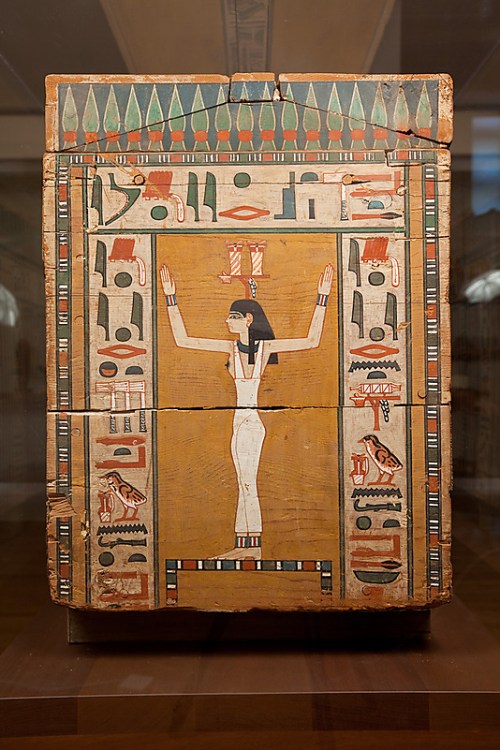
Coffin of Khnum Nakht from Meir. An image of Isis at the head extreme of the coffin. XIII Dynasty. Metropolitan Museum of Art of New York.

At both extremes of the corpse the artist placed two goddesses. At the extreme of the head appears a goddess with a strange standard on her head carrying two hieroglyphs of the sealed oil jar with unguent mrht or mDt. According to the inscription above, she is Isis the Divine (Ast nTrt).

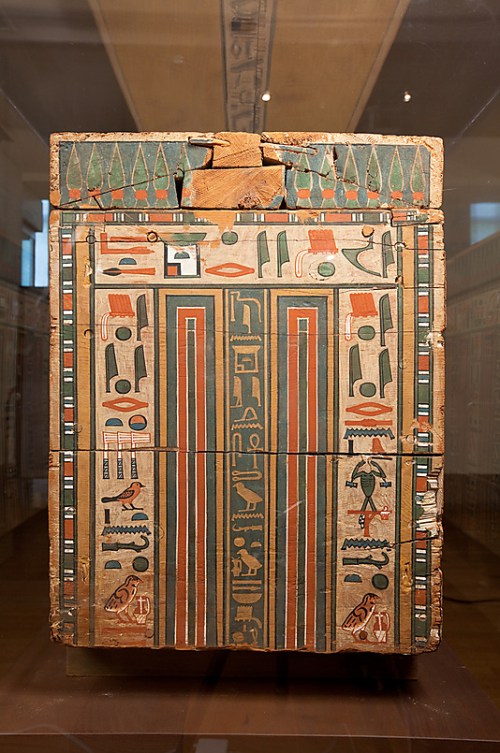
At the feet of the coffin there is no image, but two paintings of the façade of the palace. However we know this was the place of Nephtys thanks to the inscription.

Coffin of Khnum Nakht. Feet extreme with inscriptions referring to Nephtys. XIII Dynasty. Metropolitan Museum of Art of New York. Ancient Egypt

Coffin of Khnum Nakht. Feet extreme with inscriptions referring to Nephtys. XIII Dynasty. Metropolitan Museum of Art of New York.

Isis and Nephtys were there, at both extremes of the coffin assisting in the deceased’s resurrection. But it is surprising to watch that they were not where they were supposed to be: that is, Isis at the feet and Nephtys at the head.

We do not why, but the artist who decorated the coffin of Khnum Nakht located the feet as the place for Nephtys and the head as the place of Isis.

Was it maybe just a mistake? The coffin is made with an exquisite technique, so the manufacturer was not a beginner. The coffin was decorated by an expert (or a team of experts).

Was the icon of Isis at the feet and Nephtys at the head of the corpse still not too consolidated during the Middle Kingdom?…

Three Dimensions of the Ancient Egypt Mourning Rite in a Rishi Coffin.


The distribution of images is clue in Ancient Egypt decoration. Depending on how the scene is ordered and where it is located it has a sense or not.  We have seen how mourning women took up different spaces in a rishi coffin, indicating so two different dimensions onwards the deceased’s resurrection.

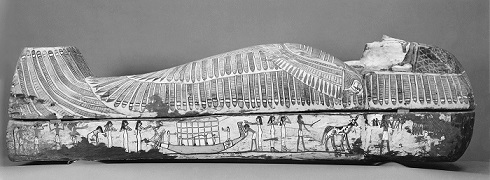
Rishi coffin of Lady Rini from Thebes. The whole lid is covered by feathers. XVII Dynasty. Ancient Egypt

Rishi coffin of Lady Rini from Thebes. The whole lid is covered by feathers. XVII Dynasty. Metropolitan Museum of Art of New York.

But there is still a third one: the top of lid. On the exterior of the lid a pair of big wings wrap the whole body[1], these ones are usually identified with the wings of Isis. What is the sense of these feathers?

At the end of the XVII Dynasty the feathers on a rishi coffin symbolizing the Isis’ wings would be a way of remembering the image of this goddess over the corpse of Osiris.

Isis as a kite is over the body of the dead. Statuette of prince Tutmosis, son of Amenhotep III. XVIII Dynasty. Altes Musuem (Berlin). Photo: Mª Rosa Valdesogo Martín.

Isis as a kite is over the body of the dead. Statuette of prince Tutmosis, son of Amenhotep III. XVIII Dynasty. Altes Musuem (Berlin). Photo: Mª Rosa Valdesogo Martín.

In the Egyptian myth of Osiris, Isis, the mourning wife, put herself as a kite over the mummy of her husband for giving him back his breath and his virility. So, we would be facing the highest level outside the coffin as the divine sphere.

coffin of Ahhotep Tanodjmu. Nut outside the lid of the coffin. Early XVIII Dynasty. Ancient Egypt

Coffin of Ahhotep Tanodjmu. Nut outside the lid of the coffin. Early XVIII Dynasty. Metropolitan Museum of Art of New York.

But due that in the Egyptian belief the upper part of the lid is the divine sphere, this surface accepted another goddess: Nut. At the beginning of the XVIII Dynasty some of the anthropoid coffins changed the feather by an image of Nut, as we can see in the coffin of Ahhotep Tanodjmu. In it an extended image of Nut appears covering the upper part of the lid.

We know that in Ancient Egypt cosmogony Nut was the mother of Osiris and that in the mourning ritual the nwn gesture of shaking hair forwards was a way of evoking this goddess and giving the deceased back to his birth. The mummy came back to his mother’s womb and was a new-born.

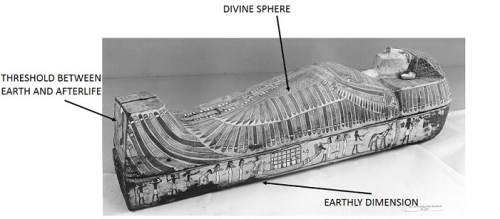
So between the end of the XVII and the beginning of the XVIII dynasties, the anthropoid coffins in Thebes had three dimensions:

  1. The coffin base was the earthly dimension, where the common mourners on earth shook their hair, remembering what happened on Earth for the deceased’s resurrection.
  2. The threshold of the divine dimension was at the feet of the lid, where the two professional mourners in the role of Isis and Nephtys did their mourning rites for bringing the dead back to life.
  3. The upper part of the lid was the pure divine sphere, where the goddesses Isis and Nut had their place as wife and mother of Osiris and performed according to the myth.

DIMENSION IN A RISHI COFFIN. ANCIENT EGYPT


To be continued…


[1] In fact this is why these coffins are known as rishi coffins, from the Arabic word for “feather”.

In Ancient Egypt each Mourner had her place in a Rishi Coffin.


When looking at the decoration of some rishi coffins from Ancient Egypt we notice that many of them follow similar rules:

  1. On both sides of the coffin base there are the funerary ceremony practices, which can include the common mourners shaking their hair and sometimes the two professional mourners in the role of Isis and Nephtys accompanying the corpse.

    The two mourners in the role of Isis and Nephtys at the feet of the lid in a rishi coffin. XVIII Dynasty.Funeral in Ancient Egypt

    The two mourners in the role of Isis and Nephtys at the feet of the lid in a rishi coffin. British Museum. XVIII Dynasty. Photo: www.britishmuseum.org

  2. At the feet of the lid in the frontal extreme the coffin usually the two professional mourners, who are the representatives of Isis and Nephtys (Drty), appear kneeling over the neb hieroglyph making mourning gestures or holding the shenu hieroglyph, as we can see in this rishi coffin from the British Museum.

The distribution of these images in the coffin was not accidental, but something deliberate. Why?

The exterior of the coffin base had images of the Egyptian funeral, that is, the practices which took place on earth, as the mourning ritual and the nwn gesture of shaking hair made by the common mourners.  We are facing here the earthly dimension; this decoration shows what happens on Earth for the deceased’s resurrection.  That is the reason why the artist put these scenes on the exterior side of the lowest part of the coffin.

Rishi coffin. Right side with the funerary procession. On the left a common mourner shaking hair forwards. XVII-XVIII Dynasty. Thebes. Funerary ceremony in Ancient Egypt.

Rishi coffin. Right side with the funerary procession. XVII-XVIII Dynasty. Thebes. Photo: www.metmuseum.org

In some cases the two Drty appear standing at both extremes of the corpse, but in a static way. They do not shake or pull their hair as we know they did in the professional mourning ritual. Why? Because the rites they did for granting the mummy’s regeneration did not belong to the earthly sphere, but were closer to the divine one.

The two mourners at the feet of the lid in a rishi coffin. XVII-XVIIIDynasty. Funeral in Ancient Egypt.

The two mourners at the feet of the lid in a rishi coffin. XVII-XVIII Dynasty. Metropolitan Museum of Art of New York. Photo: www.metmuseum.org

The two Drty appear at the feet of the coffin, but on the exterior side of the lid, so an upper level. They are here the two representatives of Isis and Nephtys. Two human women performing as goddesses, they are carrying out the divine rites for bringing the dead back to life, so they are at the threshold of the divine dimension.

Summing up, it seems to exist a place for each mourner and for each mourning ritual in a rishi coffin. In the lower part the common mourners were lamenting on earth; at the feet of the lid the two mourners in the role of Isis and Nephtys did their mourning rites reproducing at the gates of the Afterlife the Osiris myth for bringing the dead back to life.

But that is not all…

To be continued…

A double Coffin from Roman Egypt. Double Nut…double Funeral?


Ancient Egyptian culture and traditions were adopted also by foreign people who ruled the country in many different periods of Egyptian history. Funerary customs were not an exception.

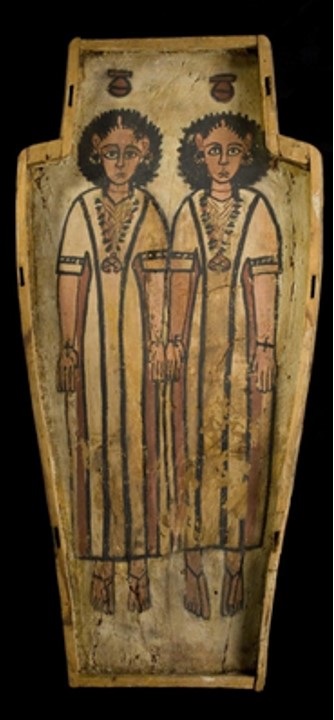
In the National Museum of Scotland there is a very interesting double coffin which belongs to two children: Petamun and PenhorpabikBoth mummies were supposed to be buried together inside this sarcophagus dated from the Late Roman Period (175-200 A.D.).

Double coffin of Petamun and Penhorpabik. In the image a double image of Nut inside the lid. Funerary ceremony in Ancient Egypt.

Double coffin of Petamun and Penhorpabik. In the image a double image of Nut inside the lid. National Museum of Scotland. Late Roman Period. 

Following the Egyptian belief, inside the cover of the coffin, the image of Nut in a very Roman style, dominates all along the surface. The artist who decorated the inside selected the image of the goddess who, as the mythical mother, granted the resurrection of the deceased, considered in ancient Egypt a new born.

The image of Nut in the inner part of the lid would show that the funerary though in ancient Egypt had not change even under the Roman rulers. Anyway, the fact is that Nut does not appear as we could imagine, that is, with raised arms and disheveled hair. We already know that this was the gesture of this goddess for assuring the dead’s resurrectionNut with a short hair here would be indicating that things were already changing in the Egyptian belief.

Detail of the double Nut in the coffin of Petamun and Penhorpabik. Funerary ceremony and funerary belief in Ancient Egypt.

Detail of the double Nut in the coffin of Petamun and Penhorpabik.

Another point to consider is that, due that the coffin was for two bodies, they needed two images of Nut for their resurrection. So, what comes to our mind is that the image of Nut is double, because the resurrection was also double.

Taking that into consideration, we could also think, that during the funerary ceremony, the mourning rite for reviving the corpse could also be double in the burial of these two children?

If this image of Nut is still a legacy of the ancient Egypt belief from pharaonic times, some questions come to our mind:

Did the Egyptians a funerary ceremony per person?

Did the Egyptians an Opening of the Mouth Ceremony per person?

If the burial was double, then, did they double also the funerary ceremony and each funerary rite?

So, did the two mourners in the role of Isis and Nephtys (the two Drty) make the mourning rite twice?

Let’s think about it…

An Egyptian Mourning Ritual from the Cache DB320 in Thebes.


We usually think that there is a strong lack of documents on the subject about mourning in ancient Egypt. But the more we visit museums all over the world, the more examples we find. The point is that we need to look even at the smallest pieces and also watch at them.

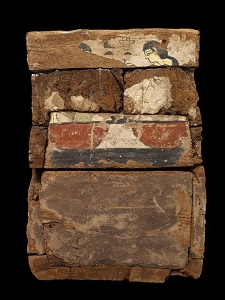
In this fragment of a coffin from Thebes the decoration shows a part of the mourning ritual, which was one of the main practices in the funerary ceremony of ancient Egypt.

Fragment of coffin from TT320 (Thebes) showing a part of the mourning ritual in ancient Egypt. Two mourners are bending over the royal mummy. XVII-XVIII Dynasty. Photo: Metropolitan Museum of Art in New York

Here we have a piece of a rishi coffin in the Metropolitan Museum of Art in New York. It is small, with incomplete decoration and with no inscriptions, so it could be of no relevance. Probably visitors ignore it, but it is extremely important for our subject about mourning women in ancient Egypt and their mourning ritual in the Egyptian funerary ceremony.

It comes from the debris area in the Royal Cache TT320[1] (also known as DB 320 for being next to Deir el-Bahari temples) and it is dated at the end of the XVII dynasty and the beginning of the XVIII dynasty.

The decoration of this small piece of wooden coffin shows the Egyptian mourning ritual made by five women. Three of them are on the left standing with crossing arms on their chests. On the right side, the mummy is flanked by two other mourning women. Although the whole bodies are incomplete, we can guess from their hips that both are bending over the corpse. The lower part of the mane of hair in the mourner on the left is still visible and from it we could deduce that she would be making the typical Egyptian nwn gesture of shaking the hair forwards. Most probably her fellow on the right was making the same gesture.

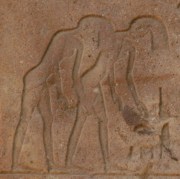
Detail of the stele of Abkaou in the Louvre Museum. XI Dynasty. Photo: www.commons.wikimedia.org

Detail of the stele of Abkaou in the Louvre Museum. XI Dynasty. Photo: www.commons.wikimedia.org

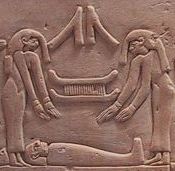
This would remind us the scene of the stele of Abkaou in Louvre Museum and dated in the XI dynasty, where the two mourners during the rites of the Osiris festivities are bending and shaking hair towards the mummy. The difference here is that it is royal mummy. In that case it reminds the scene in the funerary temple of Seti I in Dra Abu el-Naga, where the two mourners are bended and making the nwn gesture towards the king’s corpse.

Mummy with both mourners on the extreme making the nwn gesture. Funerary temple of Seti I in Dra Abu el-Naga. Photos: Mª Rosa Valdesogo Martín

Mummy with both mourners on the extreme making the nwn gesture. Funerary temple of Seti I in Dra Abu el-Naga. Photos: Mª Rosa Valdesogo Martín

With all these data we could deduce that this small fragment of painted wooden from the Metropolitan Museum of Art shows the two mourners in the role of Isis and Nephtys, so the Drty, performing their ritual mourning and shaking the hair forwards, which was a part of the Opening of the Mouth ceremony, over the Pharao’s mummy.


[1] The TT 320 was built in XXI dynasty for hiding the mummies of kings, queens, royal relatives and Egyptian noble men; all of them dated from XVII dynasty until XXI dynasty.