Tag Archives: Isis

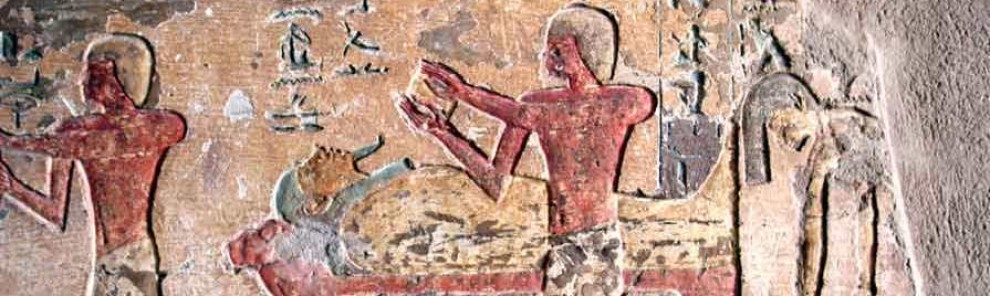
Shaven Mouners in an Ancient Egypt Funerary Boat.


Ancient Egypt wooden models were frequent during the Middle Kingdom and thanks to them we know much today about everyday life of ancient Egyptians: butchery, bread production, granaries… Among them there were also many dedicated to the funerary boats which Egyptians utilized for transporting the mummy on the Nile to the necropolis.

These funeral barges show the body lying on the bier and being flanked at both ends by the two professional Egyptian mourners in the role of Isis and Nephtys and sometimes accompanied by one priest. The attitude of that two women depicted by the artist is quite static and not too much can be deduced from it, except that they accompany the deceased.
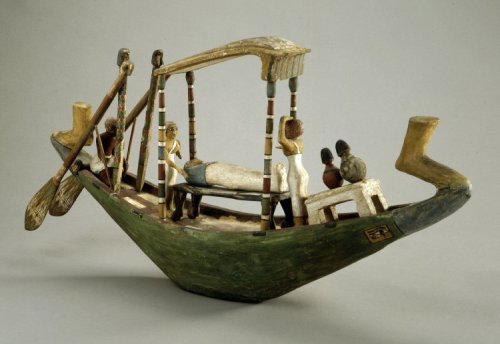
wood model of a boat with mummy and mourners. British Museum EA9524. XII Dynasty. Ancient Egypt

Wooden model of a funerary boat with the mummy and the two professional mourners. Their scalp is well visible in pink color and with black spots. XII Dynasty. Photo: British Museum.

However, piece EA9524 in the British Museum, dating from the XII Dynasty, represents the funerary boat with the corpse and the two mourning women and both extremes; in this case there is no priest, but a helmsman. And the image of both women gives some interesting information about them.

The two professional Egyptian mourners are not in such a static posture as usual. They appear with their left arms raised and the hand on the head, while the right arms are extended towards the mummy. So, they are not just standing, but making the typical gesture of mourning in Ancient Egypt.

But the most important point in this piece is in the head of those two professional Egyptian mourners. They are not with long hair, and their hair is not covered by a scarf. In both women (and also in the helmsman) the scalp can be seen. Their heads were painted in pink color with small black spots. So, the Egyptian artist indicated that their hair was very short or that their head had just been shaved.
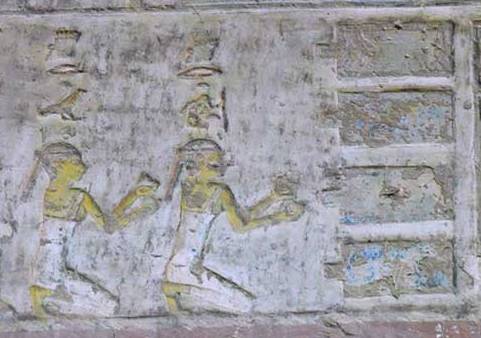
The two Drty (two kites), offering nw vases to the four pools. Relief from the tomb of Pahery in el-Kab. XVIII Dynasty. Ancient Egypt

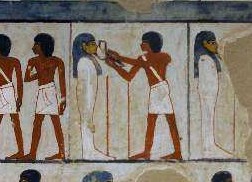
The two professional mourners with short hair at the end of the funeral. Relief from the tomb of Pahery in el-Kab. XVIII Dynasty. Photo: www.osirisnet.net

That links perfectly with one of our affirmations: the hair of two professional Egyptian mourners in the role of Isis and Nephtys was cut and that short hair was a distinctive of the professional mourner in Ancient Egypt. The short hair became a resource for the artists of Ancient Egypt for depicting these two professional mourners and differentiate them from the common mourners.

Isis, Nephtys, Neith and Serket. Four Divine Egyptian Mourners?


Last week we saw that in some cases Egyptian art offers images, whose meaning seems not clear, but which are based on well known practices from Ancient Egypt.

That was the case of two scenes, one from the Book of the Caverns in the tomb of Ramses IX and the other one from the temple of Osiris in Abydos. In both cases four mourning women appear pulling and shaking a front lock of hair.

Four mourners for Osiris. Temple of Abydos. Ancient Egypt.

Four mourners for Osiris with their front lock of hair falling forwards. Temple of Abydos. Photo: Mª Rosa Valdesogo Martín

We know that in Ancient Egypt belief the official mourners who took part in the deceased’s resurrection were two, Isis and Nephtys. However in these two images they are four women making a mourning rite. Can we deduce something more about the identity of this foursome?

These four female figures are categorized in the tomb of Ramses IX  as “goddesses” and they are included in the decorative program of a tomb and the temple of Osiris in Abydos, both belonging to a funerary context. So, for deducing more about them, we have to consider three main aspects: They are four, they have a divinie nature and they are related to the mummy and the  body’s restoration.

Is there a group of four goddesses in Ancient Egypt, who took care of the deceased? Yes, Isis, Nephtys, Neith and Serket. In the Egyptian thought they four formed a team for protecting the dead, or more concreetly, the organs of the dead.

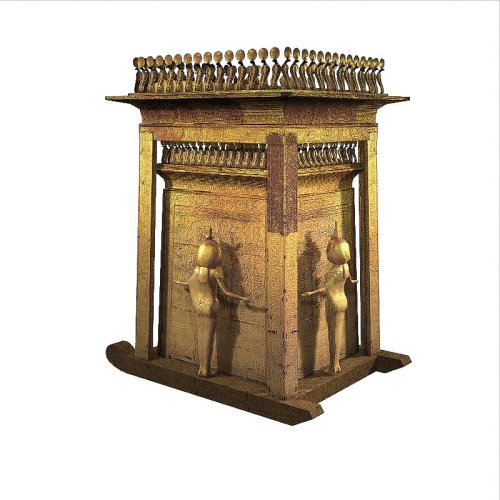
Canopic shrine of Tutankhamun. Serket. Ancient Egypt.

Canopic shrine of Tutankhamun with Serket on the left and Isis on the right. XVIII Dynasty. Cairo Museum. Photo: www.globalegyptianmuseum.org

For that reason they four were the guardians of the caponic jars which contained the organs of the dead and of the coffin, which contained the mummy. And their image together were usual in these Egyptian canopic chests and sarcophagi.

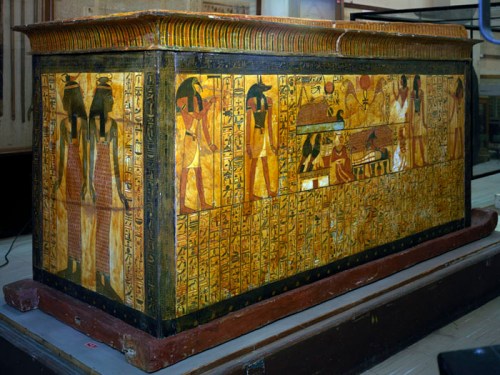
Coffin of Khonsu, Sennedjem's son, from Deir el-Medina. Neith and Serket at the feet end. XIX Dynasty. Ancient Egypt.

Coffin of Khonsu, Sennedjem’s son, from Deir el-Medina. Neith and Serket at the feet end. XIX Dynasty. Egyptian Museum in Cairo. Photo: www.drhawass.com

These are the four goddesses who spread their arms over the funeral chest of Tutankhamun. We can see them also in the coffin of Khnonsu (Sennedjem’s son) from XIX Dynasty, Isis and Nephtys are depicted at the head end of the coffin, while Neith and Serket appear together at the feet end.

Coffin of Khnum Nakht. Feet extreme with inscriptions referring to Nephtys. XIII Dynasty. Metropolitan Museum of Art of New York. Ancient Egypt

Coffin of Khnum Nakht. Feet extreme with inscriptions referring to Nephtysand also Serket. XIII Dynasty. Metropolitan Museum of Art of New York.

Neith and Serket, together with Isis and Nephtys, were also mentioned in the inscriptions of some coffins and in canopic chests dating from the Middle Kingdom.

Wooden canopic chest of Satipi. Neith is included in the inscription. XII Dynasty. Ancient Egypt.

Wooden canopic chest of Satipi. Neith is included in the inscription. XII Dynasty. Photo: British Museum.

So, the union of these four goddesses was something well established in Ancient Egyptian belief. And the four mourners in the tomb of Ramses IX and the temple of Osiris in Abydos could perfectly be those ones.


Four Egyptian Mourners, Four Egyptian Locks of Hair.


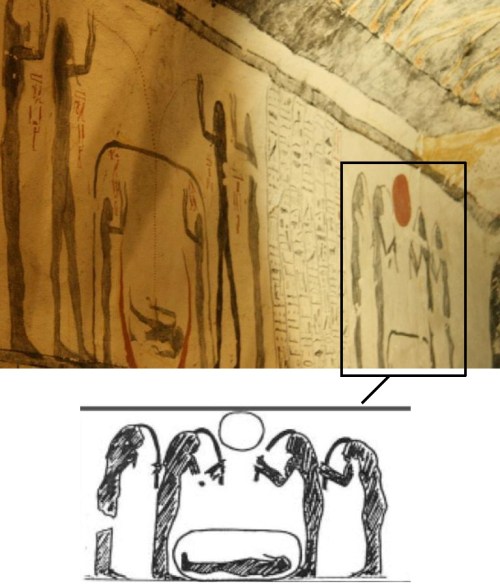
Ancient Egypt iconography is usually clear and understandable. Some other times, although the scenes are explicit, the sense of the image it is not so clear. That happens especially with religious images accompanying sacred texts from XIX Dynasty.  That is the case of the resurrection scene from the tomb of Ramses IX  belonging to the Book of the Caverns, in which four women pull their front lock of hair towards the mummy.

Women pulling lock of hair over the dead. Tomb of Ramses IX. Valley of the Kings. XX Dynasty. Ancient Egypt

Women pulling lock of hair over the dead. Tomb of Ramses IX. Valley of the Kings. XX Dynasty. Photo: Mª Rosa Valdesogo Martín.

We know that this was a gesture made by mourners as one of the practices for helping in the dead’s restoration. But we also know tha these mourners making that were the two representatives of Isis and Nephtys.

The scene from the tomb of Ramses IX shows four women instead of two. Now the question is why?

Four mourners for Osiris. Temple of Abydos. Ancient Egypt.

Four mourners for Osiris with their front lock of hair falling forwards. Temple of Abydos. Photo: Mª Rosa Valdesogo Martín

Looking for more exmaples the only similar scene we found is an image from the temple of Osiris in Abydos. Here four women appear in a sorrow position with a front lock of hair falling forwards. Although they are not pulling the hair, it is clear the realtionship of it with the Osiris resurrection. But the inportant point here is that they are four and not two.

In the Egyptian Book of the Caverns from the tomb of Ramses IX, these four women are named as “...the Goddesses who mourn together in the secret place of Osiris…“. So, it would not be crazy to think about these four female figures in the temple of Osiris in Abydos, also as women with a divine nature.

But…who?…Any idea?…

We will see in the next post.

The Ancient Egypt burial and rebirth “narrated” in a fragment of a coffin.


Today I would like just to stress the importance of watching well the pieces in museums all over the world for knowing better Ancient Egypt.

Usually people focus on travelling to Egypt or on watching those big pieces in great museums. It is obviously necessary (if not essential) both. But we cannot undersatimate less famous museums and pieces, which also show us so much about Ancient Egypt culture.

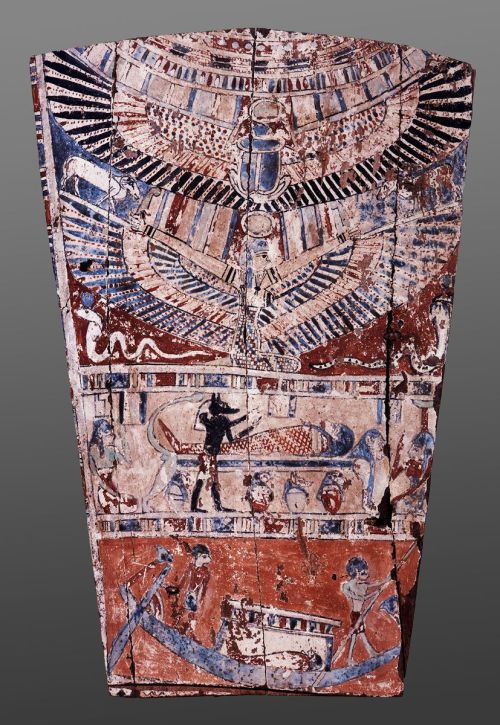
Mourning scene in a fragment of a coffin. V century BC. Ancient Egypt. Museum of Budapest

Fragment of a coffin. V Century BC. Museum of Fine Arts in Budapest.

This is the case of this fragment of a Egyptian coffin dating from the Late Period in the Museum of Fine Arts of Budapest. Apparently the images here are the usual funerary images we can find in some other formats for Ancient Egypt art (walls, stelae…). And it fact, they are. But, we are facing different scenes in the same surface. The point is: are they independent? or Are they conected and telling a sequence?

Probably many “western” visitors looking at that piece would watch it from top to down. So, first the scarab, second the winged goddess Maat, then the mummy with Anubis and the two mourners Isis and Nephtys, and finally the mummy on the boat. In that order, there is no sequence at all.

However, the decoration is on a sacred surface, on a funerary surface, and had to have a funerary meaning. Because in Ancient Egypt belief, the art had a practical purpose. In this case, and taking into consideration that these images belonged to an Egyptian cadaver, they had to be there related of the resurrection of the mummy.

Mourning scene in a fragment of a coffin. V century BC. Ancient Egypt. Museum of Budapest

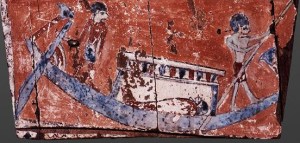
The corpse neing transported to the necropolis.

Firstly the corpse was transported to the necropolis and he/she had to to cross the Nile, and that is what the Egyptian artists drew at the bottom of the piece.

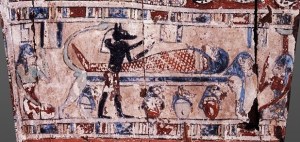
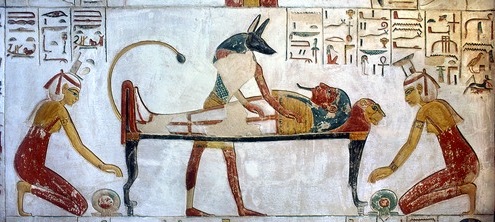
Restoring rites. Anubis emblaming the corpse and Isis and Nephtys at both ends making the mourning rite. Ancient Egypt

Restoring rites. Anubis emblaming the corpse and Isis and Nephtys at both ends making the mourning rite.

Once in the necropolis took place the restoring rites for giving back the life to the death. That is, Anubis embalming the mummy and the two professional mourners in the role of Isis and Nephtys making the mourning rite for giving back the vital faculties to the body.

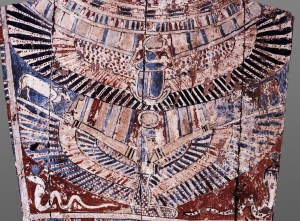
The winged goddess Maat, and the scarab with the solar disk. Ancient Egypt.

The winged goddess Maat, Egyptian goddess of order, truth and righteousness; and the scarab with the solar disk, Egyptian icon of rebirth.

Afterwards the dead entered in the Hereafter, but before being accepted there he/she had to overcome the final judgment (psicostasia). Here the dead had to show that on earth he/she had behaved following the Maat’s rules, that is correctly, since she (here the winged goddess) was the goddess of order and righteousness.

Once it was proven that he/she had been righteous, he/she could enter into the Heaven. The final resurrection was a fact. The scarab with the solar disk is a typical Egyptian icon of rebirth.

Summing up, this fragment of coffin should be “read” from bottom (funeral) to top (resurrection); only like that the two middle registers have a meaning: the restoring rites and the final judgment.

Let’s  watch at Ancient Egypt art with an Ancient Egypt logic.


An Egyptian Ostracon with Professional Mourners inside the Tomb.


Ostracon with funerary scene. New Kingdom. Manchester Museum. Ancient Egypt

Ostracon with funerary scene. New Kingdom. Manchester Museum.

Last week we could read about ostracon 5886 in Manchester Museum. In that skecht the Egyptian artists represented what happened outside the tomb. Let’s see now what happened inside.

Inside the tomb, a man is descending and some others appear in the funerary chamber carrying the coffin. But there are two important things: a man with a jackal head is next to the corpse and two kneeling figures are in a corner of the chamber.

Acccording to Campbell Price the coffin would be being  placed into the tomb, which is completely true. But was it necessary for placing the coffin a man with a jackal-headed mask and those two kneeling figures?

Ostracon with funerary scene. Detail of the inside. New Kingdom. Manchester Museum. Ancient Egypt.

Ostracon with funerary scene. Detail of the inside. New Kingdom. Manchester Museum.

The schematic scene would in fact represent what happened inside the tomb for reviving the deceased. We have already seen that the Egyptian Opening of the Mouth ceremony would happen inside the tomb and that the two mourners in the role of Isis and Nephtys were a part of the party making a mourning rite in favour of the mummy.

The man with the jackal-headed mask as a living image of Anubis would play the role of the embalmer. In our opinion these two kneeling figures would be the two representatives of Isis and Nephtys.  In fact the scene shows the members of the common Egyptian scene in which Anubis assists the mummy while Isis and Nephtys are (standing or kneeling) at both ends of the corpse. The difference here is that these ones stay apart in the chamber and already with their short hair.

Isis and Nephtys at both extremes of the corpse with shen rings. Tomb of Siptah. XIX Dynasty. Valley of the Kings. Ancient Egypt. Photo: www.thethebanmappingproject.com

Isis and Nephtys at both extremes of the corpse with shen rings. Tomb of Siptah. XIX Dynasty. Valley of the Kings. Photo: http://www.thebanmappingproject.com

The man on the right seems to hold with his hand a long straight object, which seems to be more similar to a kind of strike than to an incense burner, Could we consider it as the adze used in the Opening of the Mouth ceremony?

Opening of the Mouth ceremony from the tomb of Menna in Gourna. XVIII Dynasty. Photo: www.osirisnet.net

Opening of the Mouth ceremony from the tomb of Menna in Gourna. XVIII Dynasty. Photo: http://www.osirisnet.net

Both men are holding the mummy as if they wanted to place it down in the shaft after having finished the rites.

It does not seem too ridiculous to think that such schematic skecth would represent the end of the Opening of the Mouth ceremony and the moment in which the mummy is finally buried. Meanwhile the two professional mourners in the role of Isis and Nephtys would wait kneeling and already with no mane of hair until the dead is placed in the burial place and the shaft is sealed.

While that was happening inside the tomb, outside the common mourners would be lamenting, three of them with raise arms and one of them with hair on her face and her arms hanging down.

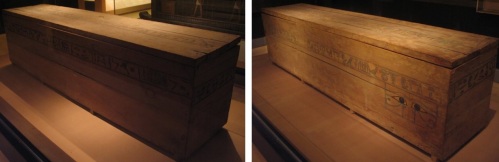
Nut places the two mourners in some coffins of the XII Dynasty.


In Ancient Egypt Isis was usually located at the feet extreme of the mummy, while Nephtys were located at the head extreme of it. Although it seems to have a logic based on a mythic legend, we find that this was not the rule all over the Egyptian history.

In previous posts we have seen how during the XI and XIII Dynasties Egyptian coffins show Isis at the head end and Nephtys at the feet end.

However, some coffins dating back on the XII Dynasty (the core Middle Kingdom), show that in that period of the Egyptian history Egyptians started thinking of Nephtys at the head end of the box and Isis at the feet end of it.

Coffin of Senbi from Meir. XII Dynasty. Ancient Egypt.

Coffin of Senbi from Meir. XII Dynasty. Cleveland Museum of Art. Photo: www.commons.wikimedia.org

For instance, in the coffin of Senbi from Meir in the Cleveland Museum of Art, the inscription shows that the place of Nephtys was the head extreme of the coffin.

Detail of the head end of the coffin of Senbi. Inscription referring to goddess Nephtys. Meir. XII Dynasty. Ancient Egypt

Detail of the head end of the coffin of Senbi. Inscription referring to goddess Nephtys. Meir. XII Dynasty.

Another example is the coffin of lady Senbi from Asyut in the Altes Museum of Berlin, which also shows the head extreme of the box as the place for Nephtys. So, in both cases Isis would be standing at the feet end.

Coffin of Lady Senbi from Asyut. XII Dynasty. Nephtys at the Head. Ancient Egypt

Coffin of Lady Senbi from Asyut. According to the hieroglyphs, Nephtys is at the head end. XII Dynasty. Egyptian Museum in Berlin: Photo: www.egyptian-museum-berlin.com

There are some other coffins, whose information is still much more complete. Not only they indicate the place for each goddess, but also inform us about who decided that.

Coffin of Sopi from el-Bersha. XII Dynasty. Musée du Louvre. Ancient Egypt.

Coffin of Sopi from el-Bersha. XII Dynasty. Musée du Louvre. Photo: www.cartelfr.louvre.fr

The coffin of Sopi, an intendant under the reigns of Sesostris II and III, from el-Bersha and now in the Louvre Museum, has a very rich decoration inside and a more austere one outside. Anyway, in both cases, the inner and outer decorative/textual pattern sends the same information: Isis is at the feet of the mummy. That happens because, according to the inscription,  “Nut has placed Isis at the feet of the corpse.

Coffin of Sepi from el-Bersha. XII Dynasty. Outer head end. Nut places Nephtys at the head. Ancient Egypt.

Coffin of Sepi from el-Bersha. XII Dynasty. Outer head end. Nut places Nephtys at the head. British Museum. Photo: www.britishmuseum.org

The same case we find in the coffin of the army commander Sepi, also from el-Bersha and in the British Museum. Outside of both extremes the hieroglyphs read how Nut has placed Isis at the feet and Nephtys at the head.

Coffin of Sepi from el-Bersha. XII Dynasty. Inner head end with the name of Nehtys. Ancient Egypt.

Coffin of Sepi from el-Bersha. XII Dynasty. Inner head end with the name of Nehtys. British Museum. Photo: www.britishmuseum.org

Coffin of Sepi from el Bersha. XII Dynasty. Outer feet end. Nut places Isis at the feet. Ancient Egypt.

Coffin of Sepi from el Bersha. XII Dynasty. Outer feet end. Nut places Isis at the feet. British Museum. Photo: www.britishmuseum.org

And also in the inner head end of this coffin, we read how the dead is there in front of Nephtys.


In these two cases, Isis stands at the feet of the dead and Nephtys at the head, following a decision of the goddess Nut.

Could we conclude something?

Not at all!

Next week we will see that nothing was stablished about this subject in the XII Dynasty.

Some other gods will also decide about tyhe location of Isis and Nephtys at both ends of the mummy.

The two Mourners Isis and Nephtys in the Egyptian Coffins of XIII Dynasty.


We saw on 1st April that during the XI Dynasty hieroglyphs on Egyptian coffins show that Isis was supposed to be at the head of the mummy and Nephtys at the feet. 

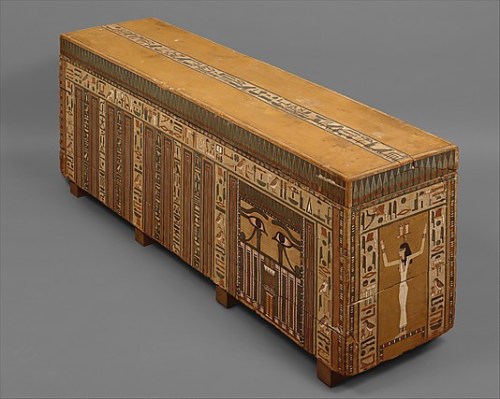
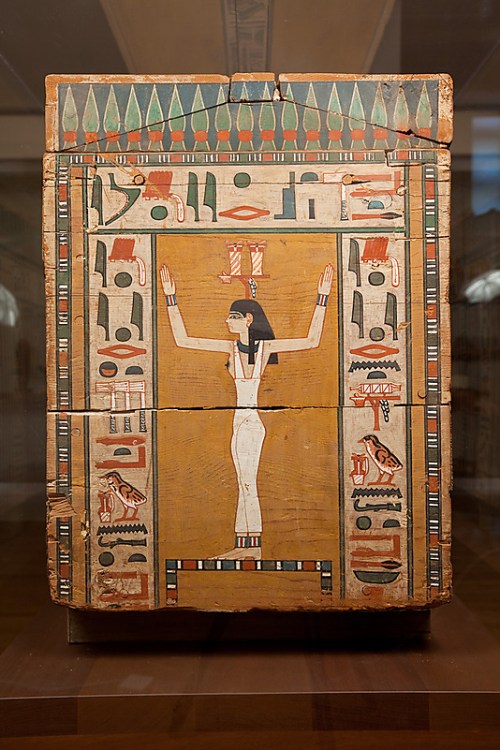
Later on, in the XIII Dynasty the tendency was the same one. Inscriptions on Egyptian coffins were also embellished with images. One of the best examples is the coffin of Khnum Nakht from Meir. 

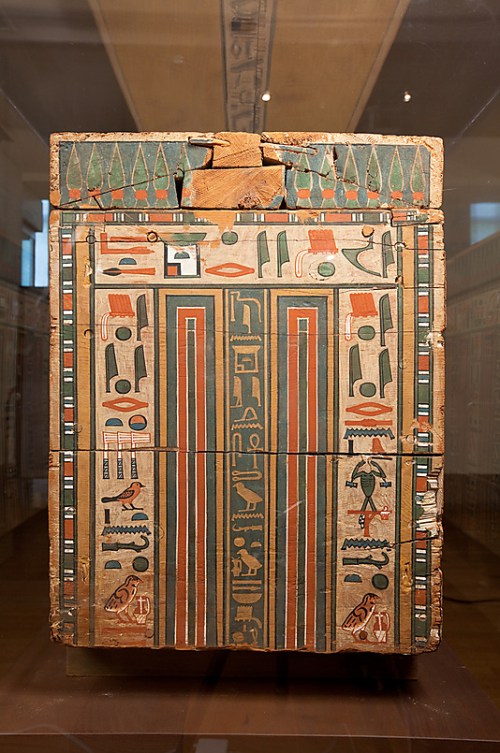
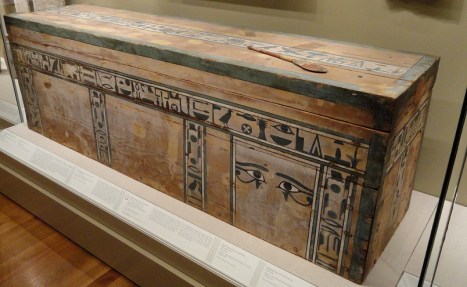
Coffin of Khnum Nakht. Head extreme with image of Isis. On the left the false door with the two udyat eyes indicating the threshold between the earthly world and the Afterlife. XIII Dynasty. Metropolitan Museum of Art of New York. Ancient Egypt.

Coffin of Khnum Nakht from Meir. Head extreme with the image of Isis. On the left the false door with the two udyat eyes indicating the threshold between the earthly world and the Afterlife. XIII Dynasty. Metropolitan Museum of Art of New York.

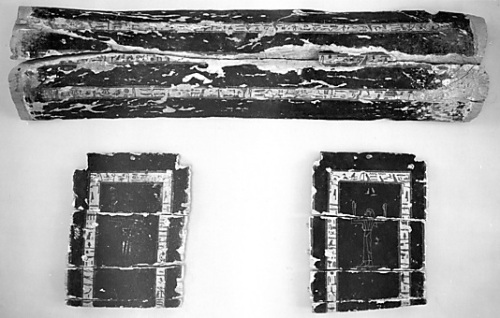
There is a group of coffin from Thebes (from el-Asasif) dating back to the XIII Dynasty and whose main feature are their black background colour. They also include some figures: at the head end of the panel there is the false door and at both extremes of the coffin the artists draw the images of two goddesses with her raised arms.

Coffin of Ikhet. XIII Dynasty from el-Asasif. Ancient Egypt

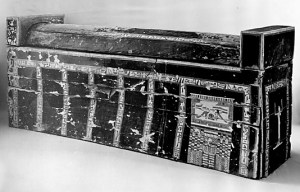
Coffin of Ikhet from el-Asasif. XIII Dynasty. At the head end there is the false door and at the head extreme a feminine figure stands with raised arms. Photo: www.metmuseum.org

Coffin of Nefnefret. XIII Dynasty from el-Asasif. Isis and Nephtys. Ancient Egypt.

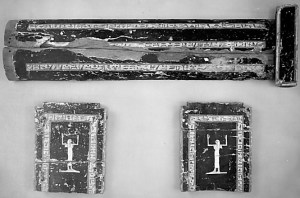
Coffin of Nefnefret from el-Asasif. XIII Dynasty At both extremes the two feminine images, Photo: www.metmuseum.org

These two women are not always identified, as for instance in the coffin of Ikhet or the one of Nefnefret, but in some cases the hieroglyphs accompanying them says clearly that they are Isis and Nephtys. This is what we can see in the coffin of Entemaemsaf. The woman on the head extreme is goddess Isis and the woman on the feet extreme is goddess Nephtys.

Coffin of Entemaemsaf. XIII Dynasty.Isis at the head and Nephtys at the feet. el-Asasif. Ancient Egypt.

Coffin of Entemaemsaf. Isis at the head and Nephtys at the feet. XIII Dynasty. El-Asasif. Photo: Metropolitan Museum of Art of New York.

Model coffins are not an exception, because Egyptians treated them as authentic coffins. For instance the model coffin of Teti from the Second Intermediate Period is of unknown origin (maybe from Thebes, although it is not for certain), but it follows the feature indicated above. The coffin, with some spells from the Coffin Texts, has a false door in the head end of the right panel and at the head extreme a feminine figure is standing with her raised arms.

Model Coffin of Teti. Second Intermediate Period. Ancient Egypt

Model Coffin of Teti. Second Intermediate Period. British Museum. Photo: www.britishmuseum.org

In Ancient Egypt the decoration of coffins during the XI and XIII Dynasties could include hieroglyphs and images of these two women at both extremes. It seems reasonable to think that they were Isis at the head extreme and Nephtys at the feet extreme.

But, what happened during the XII Dynasty?…


The two Mourners Isis and Nephtys in the Egyptian Coffins of XI Dynasty.


In Ancient Egypt iconography Isis and Nephtys appeared at both extremes of the corpse, usually Isis stood at the feet, while Nephtys stood at the head of the mummy. However this position was not always like that. We saw on 18th March how at the Egyptian coffin of Khnum Nakht, dating from the XIII Dynasty and coming from Meir (Middle Egypt) had an excellent manufacture in the decoration but probably with the wrong location of these two goddesses; the inscriptions of the feet extreme of the coffin mention Nephtys, while at the head extreme was the figure of a goddess named as Isis.

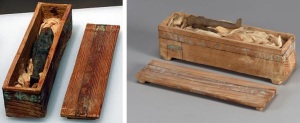
Model coffin of Neferu. XI Dynasty. Deir el-Bahari. Ancient Egypt

Model coffin of Neferu. XI Dynasty. Deir el-Bahari. Photo: Metropolitan Museum of Art of New York.

Many coffins and model coffins (small model coffins made of wood contained figurines of the deceased and have been used in Ancient Egypt from the Middle Kingdom) from the Second Intermediate Period show the same location for both Isis and Nephtys. But if we look back to the XI Dynasty, we find that also that happened.

The model coffin of Queen Neferu dates from the XI Dynasty and comes from Deir el-Bahari in Thebes. The inscriptions on it show that the extremes of the coffin was already at that time reserved to the two mourners of Osiris, Isis and Nephtys. But, according to the inscription, the place for Nephtys here was the feet end of the box.

Coffin of Child Myt. XI Dynasty. Thebes. Ancient Egypt

Coffin of Child Myt. XI Dynasty. Thebes. Photo: Metropolitan Museum of Art of New York.


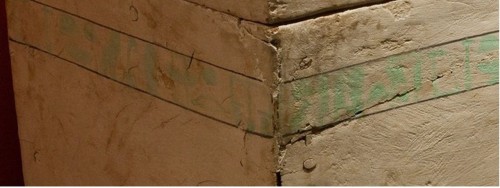
This is not the only example of that; the coffin of Child Myt, from Thebes and dated in the XI Dynasty, shows also an inscription at the feet of the box mentioning the goddess Nephtys.

Coffin of Child Myt. XI Dynasty. Detail of Nephtys hieroglyph. From Thebes. Ancient Egypt

Coffin of Child Myt. Detail of Nephtys hieroglyph. XI Dynasty. Thebes. Photo: Metropolitan Museum of Art of New York.

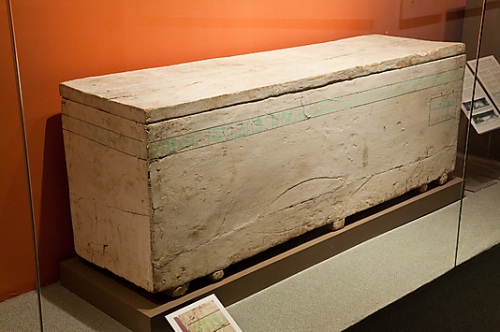
The coffin of Princess Mayet dates from XI Dynasty and comes also from Thebes. The hieroglyphs in it shows clearly that the head end was the place for Isis, while the feet end was the extreme for Nephtys.

Coffin of Princess Mayet from Thebes. XI Dynasty. At the feet end the name of Nephtys. At the head end the name of Isis. Ancient Egypt.

Coffin of Princess Mayet. At the feet end (left) the name of Nephtys. At the head end (right) the name of Isis. XI Dynasty. Thebes. Photo: Brooklyn Museum

This location of Isis at the head and Nephtys at the feet in the coffin is also visible in some Theban coffins from XIII Dynasty, as for instance in the coffin of Entemaemsaf, from el-Asasif.

Coffin of Entemaemsaf. XIII Dynasty.Isis at the head and Nephtys at the feet. el-Asasif. Ancient Egypt.

Coffin of Entemaemsaf. Isis at the head and Nephtys at the feet. XIII Dynasty. El-Asasif. Photo: Metropolitan Museum of Art of New York.


But it is not the only example…

To be continued.


The wrong location of Isis and Nephtys in the coffin of Khnum Nakht.


In Ancient Egypt iconography Isis was mainly placed at the feet of the mummy, while Nephtys were at his head. That happened in tomb walls and in sarcophagi.

We have seen that this position was not accidental, but something deliberate. That typical icon of the mummy flanked by Isis at his feet and Nephtys at his head would remain two things. On one hand, it could represent a birth itself, when one woman gives birth (Isis) and being assisted by a midwife (Nephtys). On the other hand, it could refer to the mythical copulation between Isis and Osiris, so the goddess being at his feet would be ready for putting herself over her husband.

Coffin of Khnum Nakht. Head extreme with image of Isis. On the left the false door with the two udyat eyes indicating the threshold between the earthly world and the Afterlife. XIII Dynasty. Metropolitan Museum of Art of New York. Ancient Egypt.

Coffin of Khnum Nakht. Head extreme with image of Isis. On the left the false door with the two udyat eyes indicating the threshold between the earthly world and the Afterlife. XIII Dynasty. Metropolitan Museum of Art of New York.

But, sometimes, Egyptian art surprises us with some exceptions. Looking at the coffin of Khnum Nakht in the Metropolitan Museum of Art of New York we realised that the decoration in it did not follow the rule we have said before.

The coffin of Khnum Nakht dates from the XIII Dynasty and comes from Meir (Middle Egypt). The decoration in it includes on the left side of the coffin the false door with the two udyat eyes. That indicates that the head of the mummy was located behind it.

Coffin of Khnum Nakht from Meir. XIII Dynasty. Metropolitan Museum of Art of New York. Ancient Egypt

Coffin of Khnum Nakht from Meir. An image of Isis at the head extreme of the coffin. XIII Dynasty. Metropolitan Museum of Art of New York.

At both extremes of the corpse the artist placed two goddesses. At the extreme of the head appears a goddess with a strange standard on her head carrying two hieroglyphs of the sealed oil jar with unguent mrht or mDt. According to the inscription above, she is Isis the Divine (Ast nTrt).

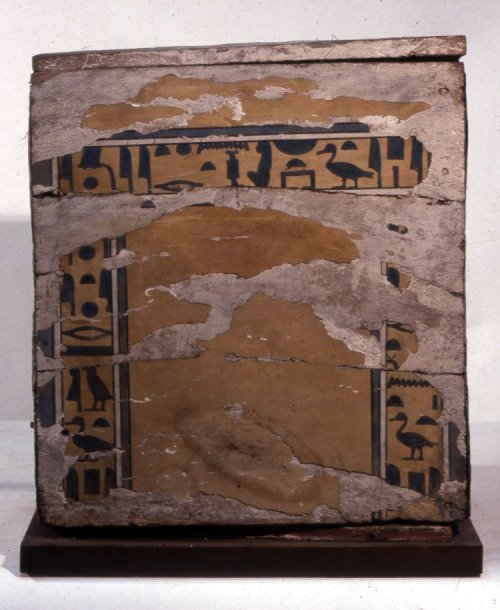
At the feet of the coffin there is no image, but two paintings of the façade of the palace. However we know this was the place of Nephtys thanks to the inscription.

Coffin of Khnum Nakht. Feet extreme with inscriptions referring to Nephtys. XIII Dynasty. Metropolitan Museum of Art of New York. Ancient Egypt

Coffin of Khnum Nakht. Feet extreme with inscriptions referring to Nephtys. XIII Dynasty. Metropolitan Museum of Art of New York.

Isis and Nephtys were there, at both extremes of the coffin assisting in the deceased’s resurrection. But it is surprising to watch that they were not where they were supposed to be: that is, Isis at the feet and Nephtys at the head.

We do not why, but the artist who decorated the coffin of Khnum Nakht located the feet as the place for Nephtys and the head as the place of Isis.

Was it maybe just a mistake? The coffin is made with an exquisite technique, so the manufacturer was not a beginner. The coffin was decorated by an expert (or a team of experts).

Was the icon of Isis at the feet and Nephtys at the head of the corpse still not too consolidated during the Middle Kingdom?…

Two Mourners in the new discovered Tomb of the Egyptian King Senebkay?


Two mourners in the new discovered tomb of the Egyptian King Senebkay?

That was my first thought when I saw yesterday the new about the recent discovery of the university of Pennsylvania in Abydos. The tomb of King Senebkay, probably dating from XIII Dynasty, built in a simple way and, according to archaeologists, with reutilised blocks, is not too well preserved.

The painted decoration that it remains in this Ancient Egypt grave is very scarce and also quite simple. On a white background some images are visible, like the King’s cartouche, the winged sun disk and some female figures.

Decoration at the funeral chamber of Pharaoh Senebkay in Abydos. XIII Dynasty. Ancient Egypt. Photo: www.terrantiqvae.com

Decoration at the funeral chamber of Pharaoh Senebkay in Abydos. XIII Dynasty. Photo: http://www.terrantiqvae.com

The scene which attracted our attention was the one at the last chamber. It is very typical Egyptian funerary scene. On the top of the wall a winged sun disk (image of Horus) is over a painted false door, which is crowned by the heker frieze and contains two Udjat eyes. This icon is very common in Middle Kingdom coffins; the eyes, in the Ancient Egypt belief are the deceased’s connection with the world of the living, so this part of the tomb symbolises the limit between this world and the Hereafter. At both sides of the false door two standing women appear as the only human beings.

According to Joseph Wagner (responsible of the works), the bad conditions of the tomb could be a proof of the bad economical situation of Egypt at that period (Second Intermediate Period). If so, it would make sense the lacking decoration of the tomb (let’s remember that itis about a Pharaoh’s tomb). But this premise would be important. If the decorative programm was limited, the artists had to include in the tomb just the essential for granting the Senebkay’s resurrection. Obviously, the false door and the Udjat eyes as the meeting point between the world of the living and the Hereafter were necessary. And what about those two women?

Let’s emphasize some points:

These two women appear alone, with no other human figures, so they were important.

These two women stand at both sides of the false door, in the same way Isis and Nepthys stand later on at both extremes of the coffin and/or the mummy.

These two women are at the connection point between the world of the living and the Hereafter. It is the place were the Egyptian mummy comes back to life after the resurrection ritual. We have seen all along our research that the two mourners in the role of Isis and Nephtys were a very important part in the resurrection of the deceased.

These two women wear around their wrists apparently the hieroglyph of the seal. We still do not know really how to interpret that, but at first sight one image came to mind: the one of Isis and Nephtys in the New Kingdom scenes at both extremes of the coffin holding the shen ring, as a symbol of eternity. The seal and the shen ring hieroglyphs could be both determinative for the Egyptian word djebat (Wb V, p. 566), which meant “signet-ring“, so the seal in a ring worn by the Pharaoh.

Isis and Nephtys at both extremes of the corpse with shen rings. Tomb of Siptah. XIX Dynasty. Valley of the Kings. Ancient Egypt. Photo: www.thethebanmappingproject.com

Isis and Nephtys at both extremes of the corpse with shen rings. Tomb of Siptah. XIX Dynasty. Valley of the Kings. Photo: http://www.thebanmappingproject.com

These two women had to be there for granting the resurrection of the king. The question is who were they? There is an inscription next to them, which probably will shed light on that issue. Meanwhile let’s also think that the tomb is located in Abydos, place were the Myth of Osiris was specially important. Had the Egyptian artist represented the Osiris (so Senebkay) resurrection as summarized (or even cheap) as he could?