Tag Archives: resurrection

Hathor and Baldness in Ancient Egypt Symbolism.


We have already seen the importance of Hathor and her two ringlets in the Ancient Egypt funerary imagery and symbolism. This goddess has many epithets which link her directly with the hair element; she is the “Lady of the plait” (Hnskt) or « the One of plait » (Hnsktt, Hnkstt)[1]. Also the priestesses who took part in the Hathor mysteries were called « the ones with plaits » (Hnskywt) or « the ones with ringlets » (wprtywt)[2].

There is a fragment of the Ramesseum Papyrus XI, where we read: “Mi heart is for you, my heart is for you as the heart of Horus is for his eye, the one of Set for his testicles, the one of Hathor for her plait, the one of Thoth for his shoulder[3]”. The text is mentioning mutilations suffered by these gods, so maybe were there an Egyptian myth where Hathor could lose a plait of hair? If so, we could then understand why in some magical practises dedicated to Hathor there had to use a plait of hair[4].

We must also take into consideration that in the Egyptian religion Hathor and Isis were associated. Plutarco assured that Isis pulled herself a lock of hair out when she knew about Osiris’ death[5]; this assertion makes us think of the image of mourners pulling their hair in funerals. We could link that with the damages mentioned above suffered by those gods in some parts of their bodies found in the text of Ramesseum Papyrus; however we have also to consider:

1) The iconography just shows us the gesture of pulling the lock of hair, but not the mutilation Plutarco mentions.

2) Ramesseum Papyrus mentions mutilations caused by another one to the god. In the case of Isis we would not be facing an attack to the goddess, but a self lesion.

Hathor and the loss of hair derives us to some statues dating from New Kingdom representing men sit in front of an Hathor’s symbol and which were studied by J.J. Clère[6]. Those men either they are bald, or they were supposed to be bald[7], because the inscription in all of them describe them as « the bald of Hathor ».the bald of Hathor

The Egyptian word for « bald » is is o iasiAs calvo , which defines the natural baldness, that is, the alopecia[8]. J.J. Clère considers that the term ias would have two senses: on one hand it would be « bald » in the most generic meaning, and on the other hand it would allude to the “sincipital baldness”[9]. That is, the alopecia in the upper half of the cranium, so the baldness in the wpt, as in the statues of the ias priests of Hathor[10], who had to be bald.

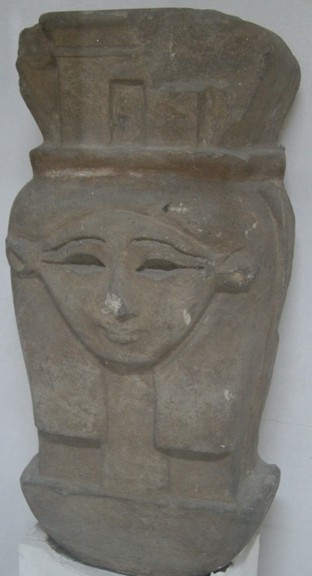
Head fragment from a statue of a "Bald of Hathor". New Kingdom. Metropolitan Museum of New York. Photo: www.metmuseum.org

Head fragment from a statue of a “Bald of Hathor”. New Kingdom. Metropolitan Museum of Art of New York. Photo: http://www.metmuseum.org

Around this matter it is interesting to have a look on a sentence in the Songs of Isis and Nephtys, which although very incomplete, could gain sense with all we have seen until now:

“…the baldness on the top of the head…” [11].
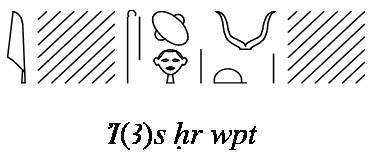
baldness on the top of the head

 J.J. Clère did not see the relationship between this partial sentence and the context it is written[12], but in fact it has, because that text is mentioning the damage that Seth has caused: « Seth is in every bad thing he has done » [13], «he has messed up the sky administration» [14], «and he has sent to us bad intentions» [15]. Could we think about a version of the Myth of Osiris, where Seth amputated the hnskt of Hathor? That would explain the comparison with the eye of Horus and the testicle of Re.

That being the case, the term is/ias would describe a sincipital baldness, however not a natural alopecia, but one caused by mutilation; ias would refer to an involuntary loss of the hair, while the term f3k would refer to the voluntary shave.

Equally we could think that Hnskt would be not just a lock of hair falling on the back, but also the hair in the top of the head (wpt). The priesthood of Hathor in the statuary lacks the hair on the wpt; the top of the head; where Hathor, as the cow goddess, has her horns. Could we then think of assimilation between the hair and the horns? If so, then we should also think about a possible version of the Myth of Osiris where Seth damaged Hathor’s horns. Maybe it would be more reasonable to consider that the Hathor in the Ramesseum Papyrus was in fact Isis, the mourning wife pulling her lock of hair as a despair gesture when she knew about the death of Osiris at the hands of Seth. In addition, the title of those ias priests in some statues refers to Isis: “I am the bald of Isis, the Big One” [16] ; « I am a bald one, excellent, favourite of Isis » [17].

Maybe for being assimilated to Isis, Hathor was a divinity very closed to Osiris in the Egyptian religion and it was very common to find her in images accompanying Osiris[18]. But her presence was not just in iconography; in celebrations in honour to Osiris during the month of Khoiak Hathor had also an important role. For instance, in the Middle Kingdom there was at the beginning of the month a sailing of Hathor. This goddess also appears six times accompanying Isis in the Festival of Sokaris (god assimilated to Osiris); her boat guides the other ones and the rest of goddesses are considered as different forms of Hathor[19].

Anyway, statues of ias priest show them always with an hathoric symbol; those men belonged to an Hathor’s clergy, who had to lack hair in the top of the head, apparently not voluntary; maybe in honour to the goddess, who suffered a mutilation with a similar result in her body.

"Bald of Hathor" Ameneminet. XIX Dynasty. Luxor Museum. Photo: www.eternalegypt.org

“Bald of Hathor” Ameneminet. XIX Dynasty. Luxor Museum. Photo: http://www.eternalegypt.org

Summing up, we have three main points related to Hathor and the hair:

  • Hathor related to the two ringlets wprty. These two lateral ringlets are like the two sky doors, which open and allow the deceased to go up to the celestial sphere and see the face of the lunar goddess, that is the moon, so the light in the darkness. The wprty are a grant of resurrection.
  • Hathor or Isis had a possible loss of hair (hnskt), as it was a mutilation, similar to that one suffered by Horus with his eye or Seth with his testicle.
  • Existence of a clergy of Hathor, whose requirement was the lack of hair on the top of the head (wpt), showing this way a relationship between Hathor and the lack or loss of hair.

[1] G. Posener, 1986, p. 113.

[2]S.A. Naguib, 1990, p. 13.

[3] According to some versions Seth attacked Thoth and cut off his arm. G. Posener,  1986, p. 111.

[4] Pap. Berlin 3027 9, 3-7; A. Ermann, 1901, p. 34. Although here the Egyptian word for plait is not Hnskt, but dbnt. Some scholars assure that there are representations of locks of hair with hathoric symbols of regeneration. E. Staehelin, 1978, p. 83.

[5] Plutarco, De Iside et Osiride, 14.

[6] J-J. Clère, 1995.

[7] J-J. Clère, 1995, p. 14.

[8] There is another Egyptian term for “bald”: f3k, used for the priesthood of Heliopolis. Actually it refers to the “shave”, not to the natural baldness. We have already written about the baldness and the lack of vegetation.

[9] J-J. Clère, 1995, p. 28.

[10] We read in the chapter 588 of the Coffin Texts and chapter 103 of the Book of Dead: “Speech for being at both sides of Hathor. I am one who has passed pure, a iAs priest. I will be Ihy in the Hathor’s entourage”.

[11] Pap. Bremner-Rhind, 2, 23.

[12] J-J. Clère, 1995, p. 30.

[13] Songs…, 2, 19.

[14] Songs…, 2, 20.

[15] Songs…, 2, 21.

[16] J-J. Clère, 1995, p. 76.

[17] J-J. Clère, 1995, p. 160.

[18] This assimilation comes from the Old Kingdom. Also in some cases Isis can appear as Re’s wife.

[19] Papyrus Bremner-Rhind ,19, 13 ff.

The Ringlets wprty and the lunar Resurrection.


We have already seen how in chapters 107, 109, 332 and 533 of the Coffin Texts the moon is the main element. In them Hathor is the lunar goddess who guides the boat during the night (this boat assimilated to the quarter of the moon) and the one who receives the deceased in the Hereafter. Her two ringlets wprty are separated and/or given and this helps the dead to get out from the darkness of the death and see the Hathor’s face, that is, the moon, the light.

Image of Hathor with her two ringlets at both sides of the face. paintign from the tomb of Roy in Dra Abu el-Naga. XVIII Dynasty. Photo: Mª Rosa Valdesogo Martín.

Image of Hathor with her two ringlets at both sides of the face. Paintign from the tomb of Roy in Dra Abu el-Naga. XVIII Dynasty. Photo: Mª Rosa Valdesogo Martín.

Hathor is “The one with bright face” (thnt Hr), « The Luminous one » (HAit)[1], and her two ringlets open to see « The Bright One, who makes live everyone she loves, people live when they see her » [2]. The idea of this act is completely opposite to the nwn gesture of covering the eyes with the hair; to die means a lack of light; it is the night of the death; the rebirth comes when the moon appears and provides light in the darkness.

Why is the moon so relevant in the deceased’s resurrection? It is a star that grows and dies, but the moon’s death is not definitive; after a period of some days it revives and appears again as a first quarter. The moon is at the same time death and resurrection, darkness and brightness. The moon is the first dead and symbolises the crossing point from death to life. For that reason the human being wants to have also a lunar nature; the star’s regeneration means a hope of resurrection for him.

Some cultures consider the moon the place for the resurrection; it can be as a trip in the star or as an immortal stay in it after the death.  According to R. Briffault, in tribal societies, thanks to its cyclic nature, the moon measures the time and also creates it[3], so it has the mystery of the resurrection. The moon changes constantly, it increases and decreases, with an interval of invisibility (identified with the death), where it goes out from regenerating itself[4]. If the moon causes the time, to convert in moon means to control the temporality and come into the eternity.

Due to this changing nature, lunar mythic beings are usually crippled[5], as in Ancient Egypt was Osiris. The moon dies, as the man dies, and it resurrects as the man wants to resurrect. It is supposed the human condition to be identical as the lunar condition, so humans, after dying, come back to life in a lunar shape. For that reason for ancient Egyptians Osiris was “the moon in the sky”, he renews himself as he wishes and he gets old when he wants[6].

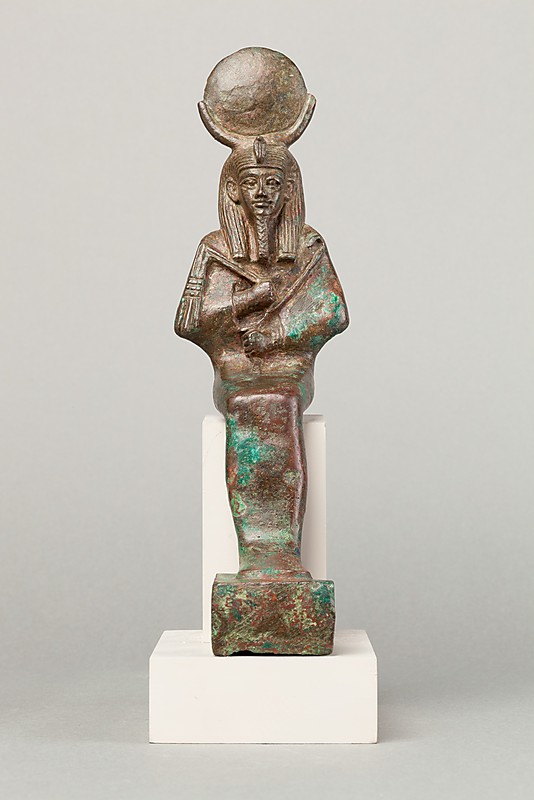
Bronze statue of Osiris in his lunar facet. Late Period. Photo: www.metmuseum.org

Bronze statue of Osiris in his lunar facet. Late Period. Photo: http://www.metmuseum.org

This context helps us understand the lunar nature of Hathor and why opening her two ringlets of hair means to get into the light, into the cyclic renewal, to get into the lunar boat and plough through the night sky[7]. Lunar Hathor guides the dead in the boat through the sky until Sothis, the morning star which announces the flood and the beginning of the Egyptian year, so the renewal of everything.

The ancient Egyptians celebrated the « Festival of the Sky » (Hb n pt), which inaugurated the lunar year and started with the appearance of Sothis. This moment was called in Egyptian “opening of the year” (wpt rnpt). This same expression meant also « the beginning of the youth », since rnpt was substantive of the verb rnpi (« to be young », « to be rejuvenated ») [8]. We find then two parallel concepts: the opening of the lunar year and the beginning of the lunar youth of the deceased. We must here remember that with the term rnp was also designed Osiris in the Songs of Isis and Nephtys.

The moon is a symbol of fecundity too , since it controls the waters, the rain and the tides[9]. Moon seems to be associated to the primeval waters as receptacle of creation power. For that reason the moon metaphorically speaking is the egg or the womb of the world, both elements as life generators. That makes the moon a life centre; and if it distributes the waters, it also intercedes between the sky and the earth (whose union we have seen is the hierogamy, the primeval couple).

In many cultures, the moon is closely related to woman and her fecundity power, because her physiological cycle is also regulated by the star. The moon is, then, the “Lord of the women” and he is sentimentally united to them. “Many people thought that the moon, with the look of a man or with the shape of a snake, mate with their women” [10], in the same way Osiris, as lunar god, is bound to Isis. The menstrual cycle contributes also to the idea of the moon as the first husband of female, as Osiris is Isis’ spouse.

As a star bound to the female fecundity, the moon is united as well to the Mother Goddess, and therefore has a maternal influence over the individual, as alimentary and affective mother[11]. In the funerary ritual that turns the deceased into a new born, who Isis looks after and Hathor takes in (both goddesses related to fecundity and moon).

On the other hand, the connection between the moon and the femininity would explain the intervention of the two mourners in the roles of Isis and Nephtys in the funerary ceremony for helping in the deceased’s resurrection. It would also explain why lunar Hathor, opening and/or giving her two ringlets wprty, allows the dead to get into the Hereafter and aim for a lunar regeneration.


[1] Ph. Derchain, 1972.

[2] A. Mariette, 1875, VI, 33, 8.

[3] R. Briffault, 1974, p. 297.

[4] According to Frazer, due to this regenerating nature, for increasing something it has to be done during the crescent and for decreasing it during the waning moon.  (J.G. Frazer, 1914, Vol. II, p. 133).

[5] G. Durand, 1979, p. 292.

[6] A. Mariette, 1880, II, 54 f., Z.5.

[7]CT VI, 623.

[8] Wb II, 432.

[9] G. Rossi, 1990, pp. 32-33.

[10] M. Eliade, 1970, p. 147.

[11] It is proven that there are more births during full moon (G. Rossi, 1990, p. 36).

Hair, Hathor and Moon.


Joint with the hair, we have seen now two new important elements which we cannot ignore: Hathor and light. Hathor is mentioned as the « guide of the boat, who keeps ropes kasu in front of the rudder in the West ways… », she is « the lady of the light, who guides the Big One who is tired ». Hathor and light means that the text is referring to the lunar Hathor, the guide during the night.

According to an Egyptian tradition, Hathor was patroness of deceased[1]; she was a goddess that very soon became the goddess of The West and the imagery put her on the flank of the mountain, the place of the sunset and where the dead ones got into the Underworld[2].

The goddess Hathor in the flank of the west mountain ready for receiving the dead. Painting from the tomb of Shuroy in Dra Abu el-Naga. XIX Dynasty. Phot: Mª Rosa Valdesogo Martín.

The goddess Hathor in the flank of the west mountain ready for receiving the dead. Painting from the tomb of Shuroy in Dra Abu el-Naga. XIX Dynasty. Phot: Mª Rosa Valdesogo Martín.

Religious texts show that from very soon Hathor was a goddess who received the dead[3], who sheltered him[4], who helped him in reaching the eternity[5]; in the Afterlife the dead was in the entourage of Hathor[6] and she was the main one in the necropolis, that is why one of her epithets was “Hathor at the head of the Necropolis”[7]. Hathor helped the dead to go up to the sky, the same sky where she is guardian and that is his own body as celestial cow. In fact, the Egyptian name Hathor means « The house of Horus » [8].Hathor's name

Hathor grants the dead be sitting in the sky, that according to E. Drioton would be a lunar paradise[9], so a night sky. Not only Hathor has a relationship with the moon, with the night sky and with Horus[10], she also is connected somehow with the Udyat eye[11]. There are several examples of Hathor with a lunar character, so she is the “left eye of Re” [12], the “eye of Re in the sky during the day and the eye of Horus which makes the darkness bright” [13].

It is well-know the relationship between cattle and the moon, because the horns are assimilated to the crescent quarter. This aspect contributes to that image of Hathor as a sky goddess, which exist in Ancient Egypt from the Predynastic period.

Cow-head palette from Gerzeh. Predynastic period. Photo: www.touregypt.net

Cow-head palette from Gerzeh. Predynastic period. Photo: http://www.touregypt.net

We see it clearly in the cow-head palette from Gerzeh in Cairo Museum with the image of a cow rounded with stars making a very ancient image of a celestial cow[14].

But Hathor, is mainly a mother goddess, a celestial cow whose main role is feed people and gods and, so that, has the faculty of giving the life[15]. Maybe that is the reason why, as a mortuary divinity, Hathor also took part in the deceased’s resurrection and was assimilated with Isis[16].

The maternal nature of the cow makes that animal a symbol of rebirth. In this sense Hathor should be consider as a manifestation of the primeval mother[17]. Because “horns of cattle, that characterize great fecundity gods, are the emblem of the divine “Magna Mater[18] and because moon and fertility go together.

Hathor, as lunar deity, is also guide of the boat and she maintains the ropes. In this regard we consider interesting to refer to chapters 404 and 405 in the Coffin Texts, where the bow rope is assimilated to the braid of Isis. It is the night boat, which carries the deceased when he revives during the night, so it is the moon. The shape of the boat could remember the quarter of the moon, so the boat crescent-shape will be one of the first means of transport[19] in Egyptian culture, as it will be for the dead once he will be in the Afterlife.

In fact, the usual head-dress for lunar deities is a full moon over a crescent, in the same way the deceased reborn as a full moon will travel in the Hereafter in the lunar boat, identified with the crescent.

Head-dress of Khonsu with full moon over the crescent. Relief from the temple of Khonsu in Karnak. XIX Dynasty. Photo: Mª Rosa Valdesogo Martín.

Head-dress of Khonsu with full moon over the crescent. Relief from the temple of Khonsu in Karnak. XIX Dynasty. Photo: Mª Rosa Valdesogo Martín.

So, what we are facing is a lunar rebirth. In that rebirth we have seen the important role of the hair element. The feminine hair appears related to water, maternity, sexuality…and also now to the moon.  If hair is related to water and moon, the lock of hair swt in mourning should also have a connection with the lunar resurrection of the dead, with the goddess Hathor in her lunar nature, as guide of the boat (crescent of the moon) in the dark of the night sky.

Hathor capital. Bahr el-Yussef museum. Photo: Mª Rosa Valdesogo Martín.

Hathor capital. Bahr el-Yussef museum. Photo: Mª Rosa Valdesogo Martín.

So, we have the mourners and /or the locks of hair swt in the moan, that is, mourning on earth during the funerals while the goddess Hathor in her lunar nature is in the night sky with her both ringlets on each side of her frontal face;  Hathor  is a grant of the deceased’s resurrection and she guides the boat, which bow rope is the braid of Isis. In the funerary ceremony the two locks of hair of the mourners could be the announcement of the lunar resurrection.


[1] E. Drioton, 1985, p. 188.

[2] A. Erman, 1952, p. 50.

[3] Pyr. 1026.

[4] CT VI, 769.

[5]CT V, 398.

[6] LdM, 144.

[7] S. Allam , 1963, p. 67

[8] S. Allam, 1963, p. 99

[9] E. Drioton, BiOr 15, p. 189.

[10] A. Mariette, 1875, IV, 77 a; en Ph. Derchain, 1962, p. 46.

[11] CT VI, 670.

[12] A. Mariette, 1875, I, 112, 7(A).

[13] A. Mariette, 1875, VI, 144, 2-3(J).

[14] According to F. A. Hassan it could represent Orion (F. A. Hassan, 1992, p. 314).

[15] One epithet for Hathor is “Mistress of Life” (A. Mariette, 1875, I, 26 f.).

[16] According to a version of the Osiris legend, Isis lost her head and Thoth replaced it with a cow’s head (Pap. Sallier IV). In addition, sometimes Hathor is called with the epithet of “Beautiful One of Osiris” (A. Mariette, 1875, VI, 3, 3).

[17] F. A. Hassan, 1992, p. 315.

[18] M. M. Eliade, 1970, p. 146.

[19] G. Durand, 1979, p. 238.

The meaning of the word swt


There is another chapter referring to swt; although it is a confusing text, we can make some deductions examining consciously the words. In the chapter 332 of the Coffin Texts the dead is being guided by a powerful goddess who is

“…the lady of the power, who guides to those ones in the caverns. I am Hathor, Lady of the northern sky, who maintains the ropes kAsw of those awaken…the earth trembles because of the jubilation, while the locks of hair are in the mourning…

locks of hair in the mourning

Sw is a verb, whose meaning is “to be something harmful for someone”[1], maybe it could be translated as “hurt “or “wound”. The substantive would then be swt (“damage”, “hurt”)[2].  We already find this verb in the Pyramid Texts of the Old Kingdom:

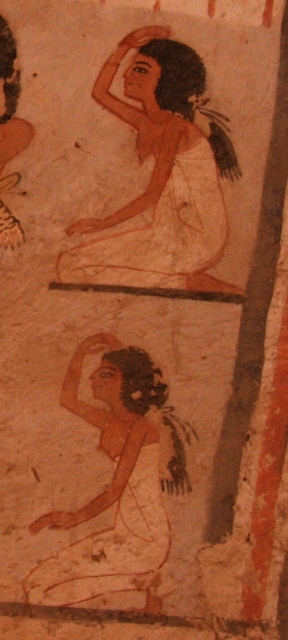
The two armas over the head is a very normal posture among mourners in Ancient Egypt. Painting from the tomb of Roy in Dra Abu el-Naga. XVIII Dynasty. Photo: Mª Rosa Valdesogo Martín.

The two arms over the head is a very normal posture among mourners in Ancient Egypt. Painting from the tomb of Roy in Dra Abu el-Naga. XVIII Dynasty. Photo: Mª Rosa Valdesogo Martín.

“The deceased is the Lord of his enemies, which have been beaten by Horus for him. Go up! Sit over him! You are stronger than him, hurt him…!” (di ir.k swt ir.f)[3]Isis is sitting, her arms over her head. Nephtys, holds her breasts because of the death of her brother, Anubis is bended over his stomach, Osiris is in his damage » (Wsir m swt.f) [4].

We could maybe consider the word swt as a passive participle of the verb sw, so the translation would be something as: “the damaged ones” or “the hurt ones”, the ones who have been damaged, that is, the mourners Isis and Nephtys; they were hurt by the death of Osiris and that is why they are in mourning.  This would also explain the use of the hieroglyph of hair as determinative in so many words that refer to mourners and mourning.This passage is clearly describing the typical funerary scene in which the mummy is laying while Anubis makes his embalming process and the two mourners Isis and Nephtys regret the death of her husband/brother.

We should also notice a kind of word game with the “locks of hair” (swt) in chapter 531 and the “hurt ones” (swt) in chapter 332, in both cases applied to the mourners who dishevel their hair as a sign of mourning.  It is as well interesting how each mourner is indentified with a lock of hair; so mourners and hair go together. That is what we call a metonymy; the whole (the mourners) is designated using its most significant part (the hair).

But we wanted to go on searching more on the verb swverb sw  and we found that it also could be translated as “to increase the strength” or “to get the strength back” [5]. We can read this verb in the Pyramid Texts[6] and also in the Coffin Texts:

“…I came and I recovered the strength back in nsrsr island”[7].isla nsrsr

In both texts the dead, after drinking milk or beer (both considered revitalising drinks), recover his force and comes back to life. It makes sense the use of the hair as determinative ; if the hair is an energy source and the nwn/nwn m gesture pretend the resurrection of the corpse, it is normal here to find it related with a verb meaning « fortify ». On the other hand, swt is a causative verb that derives from wt, whose translation is “be powerful” or “be big” [8]. In addition, wt also means « to embalm » [9] and there is direct relationship between embalming and the deceased’s resurrection. One of the main goals of embalming was to reconstruct the whole body, the physical reconstruction as getting the soul’s support, and this consolidation is connected with the hair element.


[1]   Wb IV, 59, 16

[2]   Wb IV, 59, 18

[3] Pyr., 652.

[4] Pyr., 1281-1282.

[5] D. Meeks, 1977-1979, II, p. 311, nº 78.3367; D. Meeks, 1976, p. 88, n. 14.

[6] Pyr., 1282 b.

[7]CT VII, 1013. Translation of P. Barguet (P. Barguet, 1986, p. 417).

[8] Wb IV, 77, 9.

[9] Wb I, 378, 8.

The Locks of Hair swt are Isis and Nephtys.


The chapter 531 of the Coffin Texts treats about the prophylaxis of the different parts of the funerary mask, always assimilating them with many divinities. After saying how perfect is the face (that is the mask) of the dead we read:

Your White Crown is Thoth; your crown is Wp-wawt[1]. Your eyebrows are both Enneads. Your eyes are the boat of the day and the boat of the night.

Your two locks of hair are Isis and Nephtys.

Swt are Isis and Nephtys

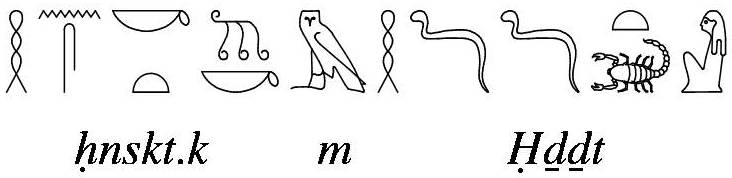
Your nape is Duanenuy. Your plait is Hddt

Hnskt is Hddt

 The funerary mask is like a complete head, or like its substitute, and to put it on the deceased’s face is a revivifying action. The dead is assimilated to the acephalic Osiris and the mask has two functions. On one hand it hides the damage made by Seth on the Osiris’ face; on the other hand it restores the faculties to the head, as to see and to breath; through the mask the dead can also perceive things that mortals cannot notice[2]; the replacement of the head, symbolised by the placement of the mask, allows the deceased to come back to life.

Scholar D. Meelks translated the word swt as “lock” or “plait”[3]. Due that the chapter is describing the funerary mask; we could think that this word would be making an allusion to the two locks of hair that fall on both sides of the face; in the same way that Isis and Nephtys are always at both extremes of the dead.

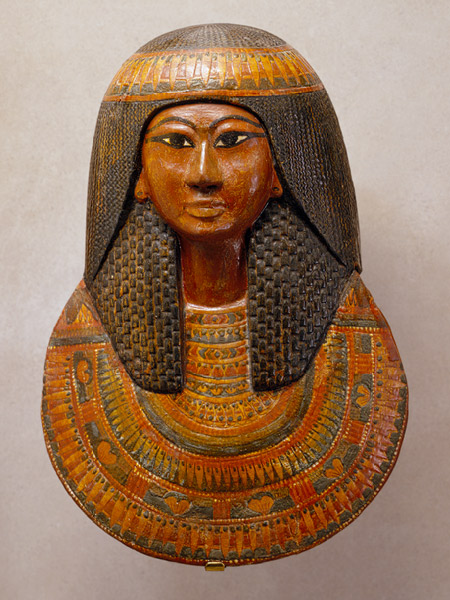
Khonsu's funerary mask. XIX Dynasty. Metropoliltan Museum of New York. Photo: www.metmuseum.org

Khonsu’s funerary mask. XIX Dynasty. Metropoliltan Museum of New York. Photo: http://www.metmuseum.org

Let’s remember also that we have already seen how the word swt designates the front lock of hair the mourners pull. Maybe both locks of hair were assimilated to the hair the two goddesses pull from.

In the wig both locks of hair fall at both sides of the face while the rest of the hair falls over the back. The term hnskt usually means “plait of hair”[4].  But in the context we are the two locks of hair are assimilated with Isis and Nephtys, and just before the text mentions the nape, so it makes sense to think of Hnskt as the mop of hair that in the wig falls on the back[5]. On the other hand, the term Hnskty is a dual that means « the two women with plait », Isis and Nephtys[6]. And that refers us to those images of Isis and Nephtys with the head-dress afnt (see image in header) or to those images of mourners with the hair tied in a back tail; , which would reinforce the idea that hnskt could be that hair identified with the goddess Hddt (a kind of Isis in Edfu).

Mourners with hair tied in a back tail. Painting from the tomb of Roy in Dra Abu el-Naga. XIX Dynasty. Photo: Mª Rosa Valdesogo Martín.

Mourners with hair tied in a back tail. Painting from the tomb of Roy in Dra Abu el-Naga. XVIII Dynasty. Photo: Mª Rosa Valdesogo Martín.

At this point we consider important to point out a scene of a libation on an altar in Dendera. In it the spelling of Isis Hddt is changed by another one that refers to a light symbolism.  We are in a context where the mission of Isis is to bright in the sky just in the moment of bringing the flood[7]. That makes us think about what we have seen in former chapters about the nwn gesture and the beginning of the Egyptian year; the nwn gesture would be a way of symbolising the new flood, the new year and, therefore, the new life. Again we would be facing the hair element with a strong regenerating symbolism.


[1] “The One who open the ways”, the name of the jackal god from Asiut, that opens the ways to the king in the battle. Let’s think about its presence also in the Sed Festival.

[2] D. Meeks, 1991, p. 7.

[3] D. Meeks, 1977-1979, II, p. 312, nº 78.3373.

[4] Wb III, 116, 4.

[5] Chr. Desroches-Noblecourt considers that Hnskt refers to the small braids under the head-dress afnt (Chr. Desroches-Noblecourt, 1953, p. 28, n. 2) and that it is related with the manifestation of the deceased’s ka (Chr. Desroches-Noblecourt, 1953, p. 25, n. 5). The mother of the dead in funerals wears the head-dress afnt: “Your mother is the great cow in el-Kab, (with) the crown Atef and head-dress afnt, with long hair, with hanging breasts, which has nursed you(Pyr., 2003).

[6] Wb III, 121, 1. It appears like that in The Songs of Isis and Nephtys, Pap. Bremner-Rhind I; 1,9; 3,23; 6,23 y 11,19.

[7] M-Th. Derchain-Urtel, 1993. Leuven, p. 102.

When did the mourners pull or shake hair in the Egyptian funerary ceremony?


During these days we have seen how iconography and texts proof the existence of a gesture, posture or movement made by mourners in Ancient Egypt funerals. Sometimes they pulled their front lock of hair (nwn m) and sometimes they shook their mane onwards covering their faces with it (nwn). In both cases there was always an implicit symbolism, mostly related to the Osiris legend and the resurrection of the dead.

But now many questions come to mind: when did these women do that gesture during the funerary ceremony? Was the mourning rite constant during the whole ceremony or was just for some special moments? Were the normal mourners and the representatives of Isis and Nephtys making it together and/or at the same time?

Firstly we should distinguish the common mourners from the two women in the role of Isis and Nephtys. It makes sense to think about two different kind of performance. The iconography has several examples of mourners “outdoors” making the nwn m or nwn gesture. They would be part of the group of women accompanying the coffin in the funerary procession, we see them in movement in the reliefs from the tombs of Mereruka and Idu or in the Middle Kingdom coffin from Abydos; but also we see them in a more static moment, when some mourners are sit while others are making the nwn gesture, as in the tombs of Amenemhat, Miankht or Rekhmire.

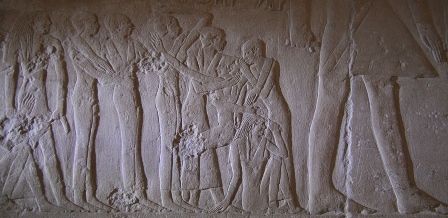
Mourners in the tomb of Mereruka at Saqqara. VI Dynasty. Photo: Mª Rosa Valdesogo Martín

Mourners in the tomb of Mereruka at Saqqara. VI Dynasty. Photo: Mª Rosa Valdesogo Martín

From the iconography we could deduce that the nwn gesture made by common mourners could take place:

-During the procession, while the coffin was transported.

-In necropolis, when the retinue has already close to the burial.

-Both, first during the procession and second once the retinue were in the necropolis, while the body was being buried.

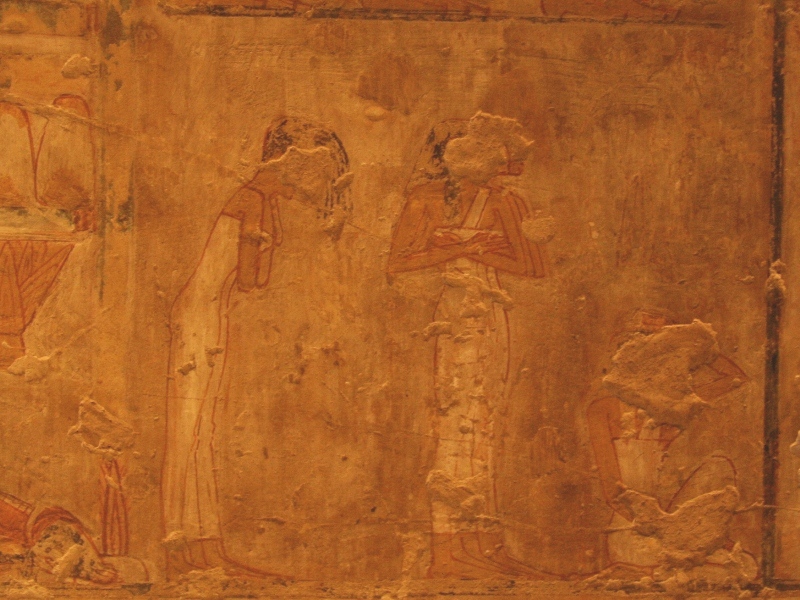
Mourners. Painting from the tomb of Rekhmire in Gourna. XVIII Dynasty. Photo: Mª Rosa Valdesogo Martín

Mourners. Painting from the tomb of Rekhmire in Gourna. XVIII Dynasty. Photo: Mª Rosa Valdesogo Martín

However we only have Isis and Nephtys in iconography making the nwn gesture in the stele C15 from the Middle Kingdom (the whole scene represents the Osiris Festivity) and the funerary temple of Seti I in Dra Abu el-Naga and also pulling their front lock of hair (nwn m) in the coffin of Ramses IV and the one of dwarf Djedhor. Religious texts mention how the goddesses make the nwn gesture and show or give the hair sema to the deceased. It does not seem to be a public moment, but a more secret practice and closely linked to the corpse and the resurrection of the dead. If so, the two mourners representing Isis and Nephtys would be two selected women for representing a divine role. And maybe their mourn ritual with their hair was a part of the group of practices made for the resurrection of the dead.

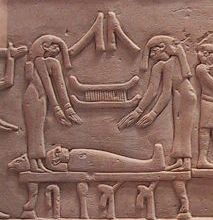
Mourners over the corpse. Detail of the stele of Akbaou. XI Dynasty. Photo: www.commons-wikimedia.org

Mourners over the corpse. Detail of the stele of Akbaou (stele C15). XI Dynasty. Photo: http://www.commons-wikimedia.org

In Ancient Egyptian funerals there was a ceremony for restoring the deceased’s faculties: the ceremony of the Opening of the Mouth, which ended with the final resurrection of the dead. Was it maybe during that ritual when the two mourners made their mourning gesture with their hair? As we will see further in this work, the Ceremony of the Opening of the Mouth was not a public ceremony, but a rite reserved for those who accomplished it, as they were the sem priest, the lector priest and the two mourners. It consisted of a group of practices in favour of the deceased; the goal was to restore all the faculties he needed for his resurrection and his new life in the Herefater: breathing, eyesight, mobility, sexuality… Those practises were made over the mummy or the statue of the deceased and it seems reasonable to think that the mourners in the role of Isis and Nephtys did their nwn gesture near the body in some moment during the Ceremony of the Opening of the Mouth. In fact it is usual to find in the Egyptian iconography many scenes of that ceremony with the presence of mourners; maybe the most explicit one would be the one in the tomb of Renni, where we can see how priest is making the ritual over the corpse and the statue, while a mourner is making the nwn gesture.

Opening of the Mouth with mourner in nwn gesture on the right. Tomb of Renni in el-Kab. XVIII Dynasty. Photo: http://www.oisplendorsofthenile.blogspot.com.es

Summing up, the nwn and nwn m gesture had two dimensions, with different meanings and in different moments of the funerary ceremony. The public one made by common mourners outdoors during the procession or out of the tomb in the necropolis; and the private one, made by the two women in the divine role of Isis and Nephtys for the resurrection of the dead. In the first case the nwn/nwn m gesture is related to the chaos, the darkness of the death and is a sign of despair. In the second one those same practices had a revivifying goal.

The sexual Meaning of Hair in Ancient Egypt Funerals. Part II.


In Egyptian religion, Osiris is the god of death, but also of vegetation and his myth has an erotic component. According to M. Eliade “moments of cosmic crisis are a pretext for the unleashing of an orgy. The earth needs to be revived and the sky needs to be excited, to make the good conditions for the cosmic Hierogamy; this way cereal grows up, women engender children, animals reproduce and dead ones full their vacuum with vital power[1].

From the basis of the Eliade’s theory, orgy is an act of renovation and regeneration; it is a way of coming back to the first moment just before the final creation, when still chaos and confusion dominate the existence.  After the orgy a new life starts and with it the chaos disappears and the world is reorganised; the orgy is the experience of the original state[2].

Orgy is even the image of chaos. Orgiastic festivities allude to the chaotic moment in which the world is lost and from where the new power comes out for reorganising and restoring the cosmic order. As J. E. Cirlot says “the goal is not to obtain physical pleasure, but to help the world dissoluteness; a temporary breaking-off for the following restoration of the original “illud tempus[3]. Orgy is, then, according to scholars, an act which generates life.

The connexion of orgy with life could make us think of the relationship also with the moon, because it is a star which remakes and renews itself. The moon is also the night star, when chaos and darkness reign. And it is in the same way related to vegetation, since agricultural rites are also lunar rites due to their regeneration nature. In fact, from prehistoric times, lunar symbols have erotic connotations thanks to the analogy between vulva and shell; for instance, the spiral is a sign that derivates from the snail shell; and this animal, which appears and disappears, is usually assimilated to the moon, and also for that same analogy the spiral has an erotic nuance[4].

We can guess that in Ancient Egypt funerary ceremony, mourners representing Isis and Nepthtys and the gesture nwn of shaking hair smA onwards could also have an erotic nature, whose goal was to help the dead come back to life. For some scholars “the spreading through sexual act could be considered according to primitive thought, as an alternative to the eternal life”[5]. The fertilizing nature of copulation seems to be united to resurrection as a regenerating element. It is the union of the two principles, masculine and feminine, the union that in the Creation myth produces the first manifestation of life.

In this regard, we cannot forget to mention chapter 17 of Book of the Dead, which captures perfectly all we have been talking about[6]:

“I am Isis, you found me when[7] I had my hair disordered[8]  over my face, and my crown[9] was dishevelled[10]. I have conceived[11] as Isis, I have procreated as Nephtys.

Isis dispels my bothers (?)[12]. My crown is dishevelled; Isis has been over her secret, she has stood up[13] and has cleaned[14] her hair”[15]Chapter 17 BD

H. Goedicke states that the chapter is describing clearly the copulation of Isis and Osiris[16]. Isis, making the nwn gesture put herself over the body of her husband Osiris, who lies face up; she gets pregnant and protects the dead. All that practice is her secret; afterwards she stands up and does her hair. It is also interesting to point out that in Papyrus Turin, just before that we read: “…both sisters are given to me for pleasure…”[17]

It seems clear the relationship between the dishevelled hair and the sexual act; especially if we consider that the verb “dishevel” (txtx) has the same root as « inebriation » (txi).

According to A. Gutbub, the festivity of inebriation in honour of Hathor which was a part of the Festival of the Valley maybe was also celebrated in funerals in honour of the deceased[18]. The scholar considers also that the ritual wpi hn made in the Sed Festival could be interpreted as the union of Hathor with the king during an inebriation celebration[19]. That being the case, the sexual element would be a part of funerary-initiation rites; in them the goal is the change of status of the initiated one by means of returning to the primeval moment and the subsequent rebirth.

The Osiris legend tells that Isis invented during the mummification the remedy for getting the immortality, but it was not enough. She had to assure a descendent of the deceased, because the earth needed an heir for the throne, who also had to help in his father’s resurrection. Isis became a kite, flapped her wings and revived her husband; with this gesture she could also conceive her son Horus, but this “is something that needs to be hidden, it is not allowed that a man or a woman divulges it aloud[20]. Maybe that is the reason of describing the act as « secret » and could also explain the shortage of documents.

It is important for that matter to mention one scene of resurrection in the tomb of Petosiris. The deceased, assimilated with Osiris and represented as a scarab with the atef crown, has the goddess Isis on both sides.

Scene from the tomb of Petosiris in Tuna el-Gebel. The deceased in the middle, as ascarab with atef crown, is flanked by Nekhbet and Uadyet and by two late versions of Isis. Late Period.

Scene from the tomb of Petosiris in Tuna el-Gebel. The deceased in the middle, as ascarab with atef crown, is flanked by Nekhbet and Uadyet and by two late versions of Isis. Late Period.

The Isis in the right hand is represented with the sign of the full sail, symbol of breath and wind; in this scene the goddess is called the Lady of the North, the Lady of vivifying wind, while Osiris is on copulation:

Words said by Isis, Lady of the red crown: the north wind is destined to your nose…I made your throat breath. The divine mother, she joined the limbs of her brother in the palace. They look for Osiris…he is in copulation[21].

In this passage we read about the breath of life and the sexual act, both apparently evoked by the nwn gesture. This posture would recall the Osiris legend, when Isis as a kite lands over her husband, she flaps her wings for giving him the breath of life and put herself over his phallus for giving him back his virility and conceive Horus. The birth of the son means the victory over the temporality by means of perpetuity of the lineage; the second element is result and image of the former one[22]. The son is the image of eternity and balance in the same person, as result of the creation.

Isis as a kite flaps wings and put herself over her husband.  Relief from the temple of Seti I in Abydos.  XIX Dynasty. Photo: www.passion-egyptienne.fr

Isis as a kite flaps wings and put herself over her husband. Relief from the temple of Seti I in Abydos. XIX Dynasty. Photo: http://www.passion-egyptienne.fr

It makes sense then to think about the nwn gesture in funerals made for the mourners representing Isis and Nephtys (by extension) as a way of remembering the sexual episode of the Osiris myth, but in the most human version.

Tomb of Renni in el-Kab. Photo: www.egyptraveluxe.blogspot.com.es

The mourner is making the nwn gesture to the deceased. Tomb of Renni in el-Kab. XVIII Dynasty. Photo: http://www.egyptraveluxe.blogspot.com.es


[1] Eliade, 1970, p. 301.

[2] Durand, 1979, p. 297.

[3] Cirlot, 1991, p. 341.

[4] Elíade, 1970, p. 140.

[5] Briffault, 1974, p. 313.

[6] Urk.V, 87, 1-7; Urk. V, 89, 1-3.

[7] sDm.n.f expressing past tense.

[8] The verb psx can be transitive: “dishevel the hair” or intransitive: “be crazy”, “despair”. It could also refer to the disorder of the hair or of the heart because of fear (Wb I, 550, 16).

[9] Wpt can be translated as “crown” or the top of the head. RA can be “the beginning”, as the origin of the scalp, where the hair starts, so the “crown”; or also the beginning of the hair from the face, so, the forehead.

[10] txtx is to dishevel the hair (Wb V, 328, 8).

[11] The verb iwr means “conceive”, “be pregnant” (Wb I, 56, 1).

[12] According to Erman and Grapow, sAwt means “safe-keeping” (Wb III, 418, 5); but if we apply this translation, the sentence makes no sense.  In another version of chapter 17 of Book of the Dead, with Dr.s  sAwt.i, we read: Nb-Hwt  bHn.s  Xnnw.i (Junker, 1917, p. 157). BHn means “cut” or “eliminate” (Wb I, 468, 10; Faulkner, 1988, p. 83), as a parallel with Dr; and Xnnw means “disturbance”, “disorder” (Wb III, 383, 15; Faulkner, 1988, p. 203), so sAwt maybe has a similar meaning.

[13] aha.n sDm.n.f can be a narrative tense, so it could be translated as “then”. But if we consider aha as a verb, the translation should be “she stood up”.

[14] sin means “clean”, “scrub” (Wb III, 425, 8; Faulkner, 1988, p. 213). It would be possible to think of Isis standing up and doing her hair after dishevel. (txtx).

[15] Urk. V, 87, 1-4 y Urk. 88, 17- 89,3.

[16] Goedicke, 1970, p. 25. He also thinks that there is a passage in Pap. Chester Beatty I, 16, 10-11 and in Pap. Westcar 2, 1.

[17] Rachewiltz, 1989, p. 59.

[18] Gutbub, 1961, p. 50.

[19] Gutbub, 1961, p. 60.

[20] Books of Breathing cf. Desroches-Noblecourt, 1968.

[21] Daumas, 1960, p. 68, pl. I.

[22] Durand, 1979, p. 290.

The sexual Meaning of Hair in Ancient Egypt Funerals. Part I.


We already know the relationship between mourning and hair and the connexion it has with the Osiris legend. A very important part of that myth is the episode when Osiris recovers his virility. According to the legend, once the different parts of Osiris corpse were found and the body was restored, Isis put herself over her husband’s body and conceived the posthumous son Horus. Thanks to that act the cosmic order was again established; Horus became the king of Egypt and Osiris resurrected as the king of the Hereafter.

Isis as a kite is over the body of the dead. Statuette of prince Tutmosis, son of Amenhotep III. XVIII Dynasty. Altes Musuem (Berlin). Photo: Mª Rosa Valdesogo Martín.

Isis as a kite is over the body of the dead. Statuette of prince Tutmosis, son of Amenhotep III. XVIII Dynasty. Altes Musuem (Berlin). Photo: Mª Rosa Valdesogo Martín.

In a coffin found in Gebelein and dating from the XIII Dynasty, there is a vignette with both women assisting the dead, over him is bending a feminine image.

A female figure is bending over the dead. Scene in a coffin from Gebelein. XIII Dynasty.

A female figure is bending over the dead. Scene in a coffin from Gebelein. XIII Dynasty.

Already in the 50’s Chr. Desroches-Noblecourt considered that the goal of this gesture was to give back the virility to the mummy[1]. In fact, the Pyramid Texts show that in the Old Kingdom Isis and Nephtys were considered the responsible ones of regenerating the deceased’s faculty for fertilising[2]. The Egyptian iconography has several examples of the copulation of Isis and Osiris; Isis as a kite[3] put herself over the phallus of her husband, and she assures the conception of the son who will avenge the murder of his father; also literature has many examples of that episode:

I am your sister Isis. No god and no goddess have done what I have done. I have performed the procreation, although I am a woman alone, for making your name to endure on earth. Your divine semen was inside my womb and I put it over the earth, this way he can spread your image. He is healthy, although you suffer. He must send the violence to those who had caused it. Set succumb to his knife. Fellows of Set succumb because of Set. The throne of Geb is yours. You are his beloved son…”[4]

 In some tombs of the Middle Kingdom were found some figurines maybe used for restoring the virility to the dead. According to Chr. Desroches-Noblecourt, these figurines evocate a young femininity and with no visible effects of maternity; so, they would not be images of fecundity, but of eroticism[5]. That premise would send us to what we exposed formerly (see post of 27th May) about the two mourners in the roles of Isis and Nephtys; we think that these two women should have been mother yet. It looks as if these figurines were also put in tombs of New Kingdom for restoring the ka of the dead[6].

In chapter 991 of the Coffin Texts we could read how the dead is “the one who fertilises the mourners” (see post of 21rst May) and in The Songs of Isis and Nepthys there are several allusions to that matter; many times Osiris is “the lord of the sexual pleasure”[7], “the lord of the love [8], “bull that fertilises the cows[9]. We also read in that text: « you give the life over the woman[10], so, « you impregnate her »; it is the same meaning as we read in chapter 991 of Coffin Texts. In the Songs of Isis and Nephtys Osiris is also called « the one who engenders » [11] and the mourners ask him to have sexual relations:

“Copulate you with us as a male” [12].

“Copulate you with your sister Isis[13].

 There is a very meaningful sequence: 

“Lord of the sexual pleasure,

¡Oh! Come to me;

Be in union the sky and the earth”[14].

 In the mythic sphere the primeval union is the one between earth and sky (in Ancient Egyptian cosmogony between Geb and Nut); it is the moment of the Creation, symbolised by the sexual act because it contents the power of generating life. This reflexion makes us think of orgy as a sexual celebration; in many cultures orgy is a synonym of agricultural fecundity; it is an act in favour of life for stimulating new births; and there is also a bond between vegetation and eroticism.


[1] Desroches-Noblecourt, 1953, p. 43.

[2] Pyr., 366, 628 a, 631 b, 632 a-d and 123-125.

[3] Roeder, 1960, p. 180.

[4] Pap. Louvre, 3079; Roeder, 1960, p. 182.

[5] Desroches-Noblecourt, 1953, p. 18. However she accepts the idea of the virginity of the two mourners representing Isis and Nephtys.

[6] Desroches-Noblecourt, 1953 p. 39.

[7] Songs…1,23; 12,8.

[8] Songs…3,5.

[9] Songs…3,6.

[10] Songs…14,27.

[11] Songs…3,26.

[12] Songs…2,9.

[13] Songs…5,25.

[14] Songs…12,8-9-10. There are allusions to that matter in 7,4; 12,11-12; 12,16.


Hair and Maternity in Ancient Egypt.


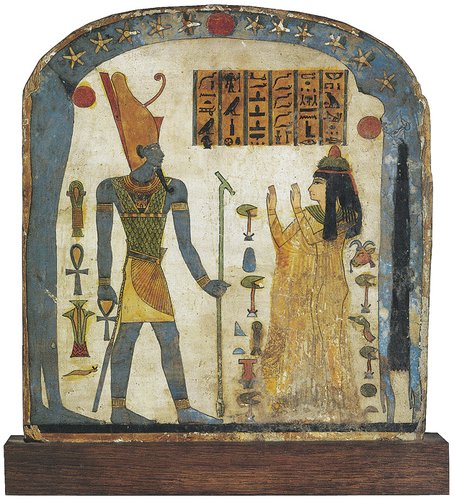
We already read in Old Kingdom how Isis and Nephtys were considered the responsible ones of the dead resurrection: “Ounas goes up through the two thighs of Isis. Ounas rises through the two thighs of Nepthys” [1]. Both goddesses were the two women who conceived and who gave birth to the Pharaoh, this one rose to heaven after his night travel (death). In the funerary context, the dead Osiris had to be reborn as the son of Geb and Nut: “he is the first-born of Geb, the first-born son of Nut, the one who gone out from the womb with the ureus…”[2]. Also, the resurrection of the deceased had a lunar nature and there is another explanation of the lunar cycle, in which the star was born from the womb of the sky goddess Nut and was then swallowed by her at the end of the cycle[3]. Taking into consideration these three points, we could consider that the two women representing Isis and Nephtys in the symbolic sphere engendered the newborn (the dead) and in somehow made also the role of mothers of the deceased. For that reason we read in the Pyramid Texts “Isis has conceived him and Nephtys has nursed him” [4]. From the Old Kingdom there was a relationship between the goddess Nut and the hair: « Nut gives you her two arms, she with the long hair, whose breasts are suspended »[5]. Nut-nwn  Also in the Middle and the New Kingdoms we read: “…this N. goes up to Busiris for seeing Osiris… Nut shakes her hair when she sees me…[6] So, from those quotes we could imagine the goddess Nut making the nwn gesture of shaking hair onwards. The following step was to search on the multiples images in Ancient Egyptian art of Nut and to see if that could have an iconographical basis. The best example is the funerary stele of the Lady Taperet from XXII Dynasty. It is a small wooden stele with painted decoration in both sides with Taperet praying Ra and Atum. On both sides the upper part is decorated with the body of Nut as the vault of heaven, interesting is the scene with Atum where Nut is the firmament and her hair is falling onwards.

Funerary stele of Lady Taperet with an image of Nut in nwn gesture. XXII Dynasty. Musée du Louvre. Photo: www.nybooks.com

Funerary stele of Lady Taperet with an image of Nut in nwn gesture. XXII Dynasty. Musée du Louvre. Photo: http://www.nybooks.com

This image of Nut and the fact that she is the mother of Osiris in the Ancient Egyptian cosmogony lead us to the conclusion that passages from Pyramid Texts, Coffin Texts and  Book of the Dead allude to the birth of the dead. Nut, bended and with her face looking at her pubis sees how his son (the dead) is coming to life. For that reason it is said that Nut shakes her hair when she sees Osiris; in that moment she is making the nwn gesture. This posture has then a very strong symbolic meaning: it is an image of maternity and very close to the rebirth of Osiris as a newborn/resurrected. There is also similar example in a coffin of Uresh-Unefer from the Late Period. We see in it a relief with late version of the same scene with Nut onwards and with a suspended lock of hair. Thinking about coffin as the receptacle of the mummy we need to look on how could be Nut represented on it.

Relief on the coffin of Uresh-Nefer. Late Period. Metropolitan Museum of New York. Photo: www.egiptologia.net

Relief on the coffin of Uresh-Nefer. Late Period. Metropolitan Museum of New York. Photo: http://www.egiptologia.net

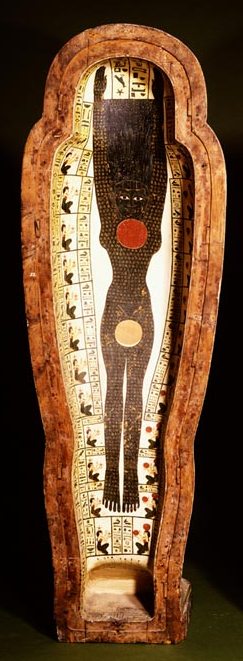
There are many examples of coffins from the Late Period with representations of Nut on the internal side of the cover. In them the goddess is frontally extended all over the surface with hair standing up. In this case we are facing just a different perspective of the same posture. Nut in the cover would be making also the nwn gesture of shaking the hair onwards. The goddess as the sky vault swallows the evening sun and gives birth the morning sun; also many times Nut is the night sky, so she swallows the evening sun and gives birth the full moon.

Coffin of Khenstefnakht from the Late Period. Inside the cover, the goddess Nut with her hair standing up. She swallows the evening sun and gives birth the morning sun. Musée Royaux d'Art et d'Histoire (Brussels). Photo: www.vroma.org

Coffin of Khenstefnakht from the Late Period. Inside the cover, the goddess Nut with her hair standing up. She swallows the evening sun and gives birth the morning sun. Musée Royaux d’Art et d’Histoire (Brussels). Photo: http://www.vroma.org

Internal side of the cover of the Coffin of Peftjauneith. Nut in black is an image of the night sky vault. The goddess with her mane standing up is swallowing the evening sun and giving birth the full moon. Rijsmuseum. Photo: www.rmo.nl

Internal side of the cover of the Coffin of Peftjauneith. Nut in black is an image of the night sky vault. The goddess with her mane standing up is swallowing the evening sun and giving birth the full moon. Rijsmuseum. Photo: http://www.rmo.nl

Inside the coffin takes place the conception and rebirth of the dead, Nut bended, with the hair onwards, will give birth his son Osiris and will put her arms around him: “…Geb is there protecting you; he is your father, you have been put on the world by him; the arms of Nut are around you, she has brought you to life, she brings your beauty…[7].


[1] Pyr., 379c y  996c.
[2] Mariette, 1875, 152-153, 3; Derchain, 1963, p. 22.
[3] Derchain, 1962, p. 27.
[4] Pyr. 1154.
[5] Pyr.2171 a.
[6] CT I, 312 y LdM, 78.
[7]CT I, 60. Translated by Barguet, 1986, p. 198).

The Hair gives the Breath of Life in Ancient Egypt.


In Abaton, where Isis and Nephtys moan[1], is also where “Osiris receives the crying from your mouth and his soul breaths thanks to the weeping”[2]. The breathing is essential for living and also for rebirth; according to what we have read, that breath can be transmitted by means of mourning. There is a chapter of the Coffin Texts where the deceased’s breath is assured thanks to different aspects of hair, we read how the dead “…breathes the east wind through her plait, he catch the north wind through her plait, he takes the south wind through his plaits[3], he takes the west wind through his curls (or his plaits)…” [4].

Thanks to the hair element the dead /Osiris can breathe the wind from the four cardinal points, in the same way that he could breathe in Abaton thanks to the weeping. Again hair and mourning are two inseparable aspects[5] and once again this union hair-mourning-breath sends us to the Osiris Myth. Isis as a kite moved her wings over the corpse of Osiris made the air for causing his resurrection.

Isis as a kite over the corpse of Osiris. Relief from the temple of Seti I in Abydos. XIX Dynasty. Photo: www.common.wikimedia.org)

Isis as a kite over the corpse of Osiris. Relief from the temple of Seti I in Abydos. XIX Dynasty. Photo: http://www.common.wikimedia.org

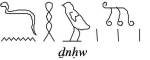
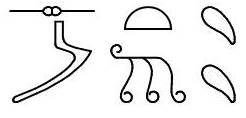
On the other hand it is also interesting to have a look on the word hw, which indicates a movement made by the feathers and whose writing in hieroglyphs was with the determinative of the hair[6]; also words as “feather” or “wings” in some cases could be written with the determinative of hair.

verbo Hw                          pluma Swt                        alas DnHw

So, the union feather-kite-air seems to be very close to the union hair-mourning-breath; it would not be hare-brained to think then in a relationship between the kite’s feather (in the mythical dimension) and the mourner’s hair (in the ritual dimension), both elements making the breath of life.


[1] Guglielmi, 1980, p. 81.

[2] Guglielmi, 1980, p. 80.

[3] In some coffins we read “eyebrow”.

[4]CT III, 228. A very similar passage is in Book of the Dead (LdM 172).

[5] In the Coffin Texts we read: “…the hands of Ssmw are united over the lungs…” (CT III, 168); and in coffin B4Bo the writing for “lungs” is pulmones

[6]CT II, 148