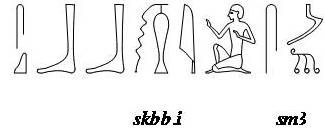
The Hair sm3 and the Healing of the lunar Eye in Ancient Egypt. Part II: The damaged Eye of Horus.


The god Thoth. Relief from the ptolemaic temple in Deir el-Medina. Photo: Mª Rosa Valdesogo Martín.

The god Thoth. Relief from the ptolemaic temple in Deir el-Medina. Photo: Mª Rosa Valdesogo Martín.

We find already in the Old Kingdom the belief of Thoth being the god who healed the injured eye of Horus with sputum:

He has come with that one that spits the hair (sm3), for his hair (sm3), which is sick at the beginning of each month and sick[1] at the beginning of middle month[2].

This passage belongs to a chapter of the Pyramid Texts which mentions two lunar festivities (3bd[3] and smdt(?)[4]); they are Helioplitan celebrations with some rituals for the reconstruction of the lunar eye, to give it back the health[5]. These festivities appear also in the Coffin Texts when the deceased has to be transformed into Thoth:

“…this N. is the one who makes the rite ibd (the second day of the month) and he is the one who controls the rite nt (fifteenth day of the month).The plait of hair of Horus is on the hand of this N. in the Thoth’s entourage…“ [6] (important to remember that chapters 167 and 674 mention mourner’s hair sm3 joint with two lunar festivities: snwt and dnit).

Egyptians considered equal the lunar eye and hair sm3, and we will see that many times. After spitting at the hair sm3, chapter 133 says how the deceased gets up triumphant, it seems that after healing the eye, he could rebirth again. In chapter 164 again the act of spitting at the hair sm3 is a healing action, here the god spits first over the shoulder. According to P. Barguet the passage relates the healing of the Osiris’ injured shoulder and hair sm3, that is, the lunar eye[7] ; the chapter mention mutilations that have happened in the myth of Osiris and that have been solved after the battle.

In chapter 610 the healing is over the hair sm3 of Atum and also over Hdd. In Egyptian mythology the moon, that is, the Udjat eye, is one of the eyes of Atum, the other one was the sun. Hdd is a name coming from the verb hd, which means “attack”[8]. It is a 2-lit. verb with second radical geminated in perfect passive participle. So, the meaning of hdd could be “attacked”, “the one who has been attacked”. This way, Hdd would be personifications of the attacked eye of Horus, hence the need of refreshing it for its cure. But it is also interesting to notice how in chapter 667 the healing of the hair sm3 is at the same level of offering a leg and giving breath, both gestures for giving life.

Finally, we find a very visual moment in all that process of healing the damaged lunar eye. We have translated chapter 335 as the action of raising the hair from the Udjat eye. P. Barguet considered that m was an equivalence preposition, so for him the text was saying that the hair Sny was the same Udjat eye. But if we take preposition m as “from”, the passage makes more sense. It would be describing the gesture of moving the hair away from the lunar eye for healing it, and also from the face for allowing seeing the light after the darkness.

Falcons have an excelent vision. In the image a Lanner Falcon. Photo: www.ibc.lynxeds.com

Falcons have an excelent vision. In the image a Lanner Falcon. Photo: http://www.ibc.lynxeds.com

In Ancient Egypt (as many cultures) the eye, as the vision organ, symbolizes the light and its disappearance or mutilation is a synonym of darkness. The sacrifice of the eye and its following recovery supposes a regenerating act, in the same level of creation after the chaos. Restitution of vision means access to light after the darkness of the death.

We have already seen in chapter 533 how the face of Hathor gets visible and clear after separating the two lateral ringlets, opening them as if they were curtains the deceased can see the full moon. When moving the hair Sny away from the face allows healing the eye and makes the Udjat eye visible, the healthy eye, that is, the full moon. On the other hand, we know that hair Sny is similar to hair sm3, the same hair that did not allow to see the brightness and could be a symbol of darkness and shadows[9]. The one who moves the hair away from the eye is Thoth because, according to the Egyptian legend, he is the lunar god who heals the lunar eye after the fight against Seth.

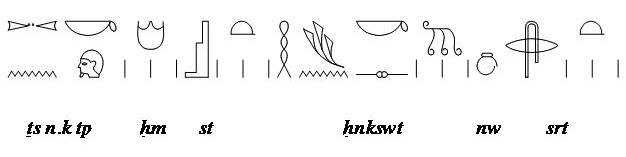
The connection between the hair and the eye of Horus is clear, but if Thoth spits over the hair sm3 for healing the eye, this one cannot be the Udjat eye (the healthy one), but the damaged eye of Horus, which in Egyptian was nknkt[10] or nkkt[11] and who needs a cure for becoming the Udjat eye.destacada 24de junio Once again we find the hair with a negative nuance; we have seen previously that the hair sm3 was a symbol of the chaos, the primeval waters, it was the Nun that dominated the world before the final creation. H. Kees considered that the hair sm3 in the context that concern us could be the damage suffered by the lunar eye[12], which makes the darkness of the night; in the same way that the hair sm3 over the faces of the mourners covers their eyes and they cannot see. So, to split over the hair sm3 would eliminate that damage, in the same way that to move the hair away from the face means to see the light.
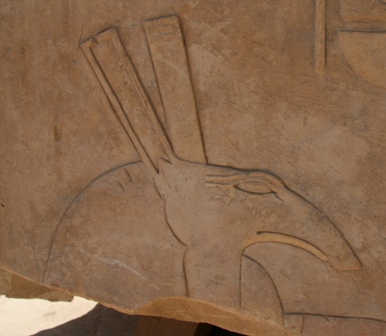
The god Seth. Relief from a block in the Open Air Musuem of Karnak. Photo: Mª Rosa Valdesogo Martín.

The god Seth. Relief from a block in the Open Air Musuem of Karnak. Photo: Mª Rosa Valdesogo Martín.

The hair sm3 would then symbolize in Egyptian belief the disorder dominating during the fight between Horus and Seth. This combat is full of sense, since, as says J.E. Cirlot, the fight is the “primeval sacrifice”[13]; it is the combat between two apposite forces, and it contributes to stimulate the vital energy, whose result is the victory of the order over the chaos. This victory means the world creation, and the winner goes out from it as a hero with an extra power. In the Egyptian funerary context that meant the resurrection of the deceased, the access to the light to his new life.


[1] The word nqm, parallel to “sick”, in reality designates a “bad property of the hair”(Wb II, 344, 3).

[2] Pyr., 521.

[3] Wb I, 65, 10.

[4] Wb IV, 147, 1.

[5] S. Ratié, 1984, p. 179.

[6] iw dnt irt ¡r Hr(y)-a n N pn m smswt DHwty CT  IV, 277.

[7] P. Barguet, 1986, p. 377, n. 10.

[8] Wb II, 504, 15.

[9] According H. Kees, Sni and  sm3 have both the same relationship with the lunar legend (H. Kees, 1925, p. 8).

[10] Wb II, 347, 6.

[11] Wb II, 347, 9.

[12] H. Kees, 1925, p. 8.

[13] J. E. Cirlot, 1991, p. 282.
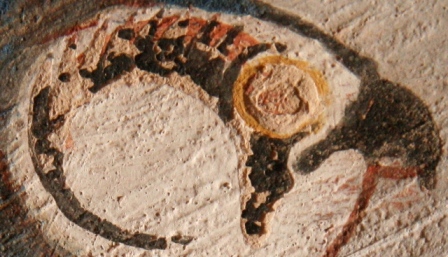
The Hair sm3 and the Healing of the lunar Eye in Ancient Egypt. Part I: Chapters in Coffin Texts.


We have seen how the reading of the Coffin Texts shows many different aspects of hair related to renovating practices or regenerating symbols. The main symbol of renovation, resurrection and regeneration in Egyptian religion was the Udjat eye. The eye of Horus, injured during the fight against Seth, was identified with the moon, and the process of the increasing from crescent to full moon was assimilated with the combat between both gods.

Eye of Horus, the falcon god. Detail from an image of Horus in the tomb of Roy in Dra Abu el-Naga. XVIII Dynasty. Photo: Mª Rosa Valdesogo Martín.

Eye of Horus, the falcon god. Detail from an image of Horus in the tomb of Roy in Dra Abu el-Naga. XVIII Dynasty. Photo: Mª Rosa Valdesogo Martín.

The full moon was the evidence of final victory of Horus over Osiris’s murderer, which finished with the resurrection of Osiris as king of the Hereafter.

Many chapters of the Coffin Texts mention the hair sm3 in an Osiris context of healing. Let’s have a look of each and deduce some ideas:

  • Chapter 133:

“Those ones who are in their temples they blink and make the Great One. The Great One belongs to me; the eye of the Great One belongs to me. I have spitted[1] over the hair sm3 of Sw[2] for his healing.

chapter 133

 Everything has been given to me, I feel triumphant, and I stand up triumphant. I have created all my family, for whom I have spoken. I am Re, the sun’s father”

  • Chapter 164:

“…I treat the great god because of his harm

Which one is the suffering of the great god?

It is his head, his shoulder and his leg.

I came for spitting in his shoulder, for refreshing the hair sm3

chapter 164

And for healing the two legs of the great god…”

  • Chapter 610:

« … This N. has spitted over the hair sm3 of Atum, he has refreshed Hdd[3]

chapter 610

 Shu and Thoth, beloved, being together behind the great god, Shu and the hair sm3…this N, has spitted (over) the hair sm3, this N has refreshed his vertebra. It is a medicine inside the body of this N…[4] »

  • Chapter 667:

« …He has spitted (over) the hair sm3

chapter 667

He carries a leg and he gives breath to who does not have. This N has brought his ba soul; his has taken his power and magic ».

  • Chapter 335:

“…I have recovered the eye after it was damaged the night of the combat between the Two Fellows[5]. I have raised the hair from the Udjat eye when he was furious

chapter 335

Who raises the hair from the Udjat eye? Who is the Udjat eye in his moment of anger?

It is the right eye of Re and Thoth is the one who raises the hair from it… »

chapter335thoth

 We find a common denominator: the hair, mainly sm3, but in one case also Sni, is linked somehow to the Udjat eye, it gets involved in fight and suffers damage; in the mythic sphere this hair is treated and healed with a spit.


[1] iw sDm.n.f is a narrative tense and it stress a very important fact of the story.

[2] According to Barguet, it is the city of Seth in the Heracleopolitan nome (P. Barguet, 1986, p. 256, n. 6)

[3] “The attacked one”, eye of Horus?

[4] Healing properties of saliva.

[5] Horus and Seth.

Hair and Death in Ancient Egypt. First Summary.


Hair and mourning women. Summary

According to what we have seen in the category « Hair and Mourning Women » we can mention some main ideas:

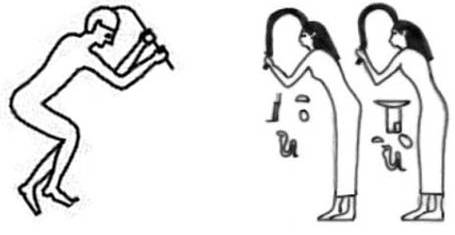
  • Mourners in Ancient Egypt made two gestures: Nwn: to cover their faces with their hair sm3 (in some cases is Snw) and nwn m: to pull their front lock of hair swt. Both are a way of showing despair and sadness.

    Mourning woman of Minnakht's tomb. www.1st-art-gallery.com

    Mourning woman of Minnakht’s tomb. http://www.1st-art-gallery.com

  • The hair over the face symbolized the darkness of the death into which the dead is sunk; it remembered the chaos in the primeval state of creation, so the Nwn gesture symbolized the Nun, the primeval waters.
  • Egyptians assimilated the hair sm3 to vital elements as breath, vegetation and water. So, to give the hair sm3 with the nwn gesture was a propitiatory practice, the hair became an instrument for sending vital energy to the deceased.
  • The heir was an important figure for the deceased’s resurrection in Ancient Egypt belief. As in the Osirian myth, Horus was the avenger who restored the cosmic order. For that reason the dead had to get again his virility. The nwn gesture in funerals could be a way of symbolizing the mythical copulation through which Osiris recovered his virility and Isis could conceive Horus.

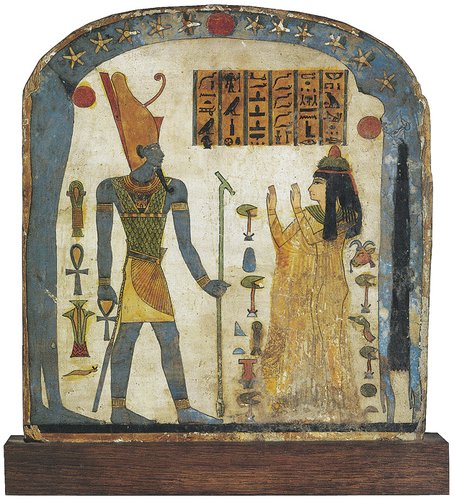
    Funerary stele of Lady Taperet with an image of Nut in nwn gesture. XXII Dynasty. Musée du Louvre. Photo: www.nybooks.com

    Funerary stele of Lady Taperet with an image of Nut in nwn gesture. XXII Dynasty. Musée du Louvre. Photo: http://www.nybooks.com

  • The deceased, as Osiris and as a reborn, became Nut’s son. This goddess also made in the mythic sphere the nwn gesture. In funerary ceremony, the nwn gesture that the mourners made with the hair would remember the posture of Nut, as sky goddess, when bearing Osiris.

Locks, Plaits and Ringlets. Summary

The main ideas of the second category are:

The goddess Hathor with lateral ringlets. Column from the temple of Khnum in Elephantine Island. Photo: Mª Rosa Valdesogo Martín.

The goddess Hathor with lateral ringlets. Column from the temple of Khnum in Elephantine Island. Photo: Mª Rosa Valdesogo Martín.

  • The deceased was welcome to the Hereafter by Hathor, lunar goddess whose face is flanked by the two ringlets wprty. When she received the dead one these two ringlets opened and let see her face; that symbolized to see the light of the full moon in the night sky and it was the culmination of the lunar resurrection for the deceased, in the same way the full moon in the Osiris myth meant the resurrection of the god.
  • Egyptians identified the plaits Hnskt with lunar elements as horns (an image of the crescent) and snakes (which regenerates regularly), and also helped in that lunar resurrection.

    The god Khonsu with side lock. Relief from the funerary temple of Seti I in Dra Abu el-Naga. Photo: Mª Rosa Valdesogo Martín.

    The god Khonsu with side lock. Relief from the funerary temple of Seti I in Dra Abu el-Naga. Photo: Mª Rosa Valdesogo Martín.

  • The lock of hair s3mt seems to be also identified with the first moments of life and the childhood of the moon (it would be the side lock of children), so it was as well an element for contributing to the lunar resurrection of the dead. It also seems to have a negative aspect, since it was maybe identified with the evil which threats the dead one and which suffers an ablation for allowing the deceased to get back to life.

Hair, Enemy and Sacrifice in Ancient Egypt. Part II: Tekenu and Magical Heads.


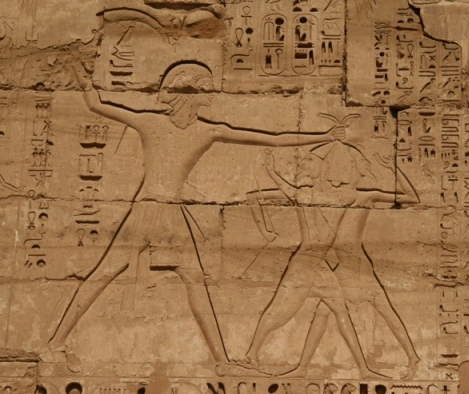
The gesture made by the enemy is the same as the one made by mourners when they hold the front lock of hair swt. enemy and mournersThe relationship between enemy and hair is not exclusive of Sed Festival. Egyptian iconography always shows how the Pharaoh grabbed the hair of the enemies of Egypt. They were the personification of the evil and the king had to eliminate them for protecting the country from that danger. Was to kill them also to cut their locks of hair? In those scenes we can see the Pharaoh holding the mace but also sometimes a cutting weapon, the sickle. He could with it to cut the enemy’s head or as well his lock of hair.

Ramses III holding the enemies. Relief from his funerary temple of Medinet Habu. XIX Dynasty. Photo: Mª Rosa Valdesogo Martín.

Ramses III holding the enemies. Relief from his funerary temple of Medinet Habu. XIX Dynasty. Photo: Mª Rosa Valdesogo Martín.

If cutting the enemy’s hair symbolizes to eliminate the danger, then the lock of hair swt symbolizes the enemy, the evil. We would be again in a case of metonymy with lock of hair swt. As we saw formerly the lock of hair swt identified the two mourners. Once again the whole (the enemy) is identified with a very significant part (lock of hair). In the renovation/resurrection sphere of ancient Egypt the tekenu, whose image appears in Sed festivals and funerals, would be that malignant being that must be destroyed; to cut and get his lock of hair could symbolize his murder, so the end of the danger, the pass from darkness to light, from death to new life.

Obviously this is just a hypothesis, since the rite of tekenu is still much unknown. Anyway, there are some documents that allow us to approach. The tomb of Montuherkhepeshef in Thebes[1] dates from XVIII Dynasty and has a very valuable scene related to the tekenu.

Funerary scene of the tomb of Montuherkhepeshef in Dra Abu el-Naga. XVIII Dynasty.

Funerary scene of the tomb of Montuherkhepeshef in Dra Abu el-Naga. XVIII Dynasty.

Among the many funerary scenes, there is one showing a hole containing the word tknwtknw; four elements share the place: the skin meska piel msk(apparently where the tekenu was wrapped), the heartheart, a bull leg bull leg and a lock of hairhair. It seems that they are parts of the tekenu[2]. Could we think that the human victim in some moment of the Egyptian history was replaced by an animal victim? All those parts of the victim seem to be very important in the funerary ceremony, at least in Montuherkhepeshef’s burial. Concretely, the lock of hair had to be in the same level of importance as the skin, the heart and the leg and maybe with a very similar function.

If the lock of hair swt in the Egyptian Sed Festival could be a symbol of the evil, and its destruction a symbol of the victory over the meanness, we could also think something similar in the funerary context. To eliminate the lock of hair swt would mean the victory of the good over the evil that the deceased needs for coming back to life. The document has not an easy explanation, but at least we can see how important could be the lock of hair in the mortuary ritual of tekenu; we could consider it as something for providing vital energy to the dead and as a grant of the end of the chaos and the danger; so the beginning of a new life for the deceased.

In this line we consider appropriate to mention the research made by R. Tefnin about the called “magical heads”[3] found in Giza[4]. They are sculptures of heads made in limestone and discovered in non royal tombs from IV Dynasty. The individual features makes think of portraits, but their purpose is not clear.

Magical heads from Giza. IV Dynasty. Cairo Museum. Photo: www.wikipedia.org

Magical heads from Giza. IV Dynasty. Cairo Museum. Photo: http://www.wikipedia.org

R. Tefnin noticed that, although their individuality, they shared many characteristics; actually it seems that a kind a damage was made in those heads before the burial; these damages were deep incisions in neck, top of the head, ears and in the frontal line of the hair. According to R. Tefnin these marks would respond to a ritual made in some moment of the funerary ceremony. We have already said that in Egyptian though the head was the centre of the life, the head has vital faculties as breathing, seeing, hearing, tasting. Not to have head meant the incapacity of making breathing and perceiving, and that was a synonym of death. Funerary texts show Osiris as a death being who needs to recover vital faculties for finishing his resurrection. In that point R. Tefnin refers to “the ambiguous attitude of Egyptians towards their deceased ones” [5].

Magical head of Nofer from his tomb in Giza (G2110A). IV Dynasty. Museum of Fine Arts Boston. Photo: www.mfa.org

Magical head of Nofer from his tomb in Giza (G2110A). IV Dynasty. Museum of Fine Arts Boston. Photo: http://www.mfa.org

On one hand the deceased needs the help of the living ones, but he can also be a danger; the dead ones belong to an unknown dimension, which the living ones cannot control, so the deceased can become a spirit coming back from the beyond to the earth with bad intentions[6]. If the dead could be an adversary, he had to be treated as an enemy. For R. Tefnin this point of view would explain those ritual mutilations made on the “Magical heads”.

The head, as image of the deceased as an enemy, suffers in some moment of the funerals, some ritual damages, which refer to punishments inflicted to adversaries: the incision in the neck would symbolize the beheading, the mark on the skull would be the hit with the mace, the cut of the ears was also a documented war practice, to cut the hair over the front should then also be a punishment made to the enemies.

Again we meet a relationship between cutting the hair and eliminating the danger. It is the same principle of the tekenu; the idea of an expiatory sacrifice materialized in renovating rites through the ablation of a lock of hair.


[1] TT 20.

[2] Spanish mission in the tomb of Dyehuty has discovered a very interesting scene related to the tekenu.

[3] Also known as “reserve heads” or “replacement heads”.

[4] R. Tefnin, 1991.

[5] R. Tefnin, 1991, p. 86.

[6] In fact we there were conjurations and incantations for avoiding the ghosts to annoy the living ones.

Hair, Enemy and Sacrifice in Ancient Egypt. Part I: The Tekenu.


Related to the lock of hair s3mt we have seen two important points:

  • To keep the lock of hair s3mt intact is a hope of new life for the deceased.
  • The lock of hair s3mt seems to be victim of ablation, just in the moment when the dead gets his head back again (see chapter 532 of Coffin Texts).

It is interesting to notice that the Egyptian verb utilised for “cut” the s3mt is Hsq, which also means “decapitate”[1] ; so the whole sentence could also be translated as « behead the lock of hair s3mt ». The act of beheading is very close to sacrifice. The idea of sacrifice is very common in Ancient Egyptian religion, mainly the sacrifice for avoiding dangers or the slaughter as revenge. But our area is funerals, dead, and renovation, resurrection, regeneration. Could we think of a symbolic sacrifice made in funerals for benefitting the deceased? Or do we know sacrifices made in Ancient Egypt with renovation finality? Yes, we do and we know a victim’s name: tekenu. This enigmatic figure appears in Sed Festival rites and also in funerary ceremony[2]. In both cases he is a man wrapped in a kind of shroud sit or in foetal position and his role is still too unknown.

Tekenu wrapped in a shroud and in foetal position over a sledge. Painting from the tomb of Ramose in Gourna.XVIII Dynasty. Photo: Mª Rosa Valdesogo Martín.

Tekenu wrapped in a shroud and in foetal position over a sledge. Painting from the tomb of Ramose in Gourna.XVIII Dynasty. Photo: Mª Rosa Valdesogo Martín.

According to some scholars there was in ancient Egypt a prehistoric rite where a royal adolescent was sacrificed[3] and wrapped into an animal skin[4]. After the young’s death, the king would cover himself with that animal skin obtaining so the vitality the teenager had impregnated[5]. This gesture would symbolize the king’s return to his mother womb and the following rebirth; granting this way the renovation of the sovereign. The human sacrifice of Sed Festival, real or symbolic, is proven from the scenes of some slabs dating from the early I Dynasty. Maybe this practice of murdering was abandoned during that same I Dynasty and had just a symbolic dimension. After a previous symbolic sacrifice (human or animal)[6] the Pharaoh would be wrapped in a skin/shroud for getting the vitality needed.

It seems that in the heb Sed, the sacrifice had two values, one Osiriac and propitiatory and another ones Sethiac and expiatory. Both, although apparently opposed are complementary, since the death of Osiris requires next Seth’s. On one hand Osiris’ death reflects vileness and on the other hand Seth’s death means the victory of the good over the evil. Two faces of the same coin, where the king dies and comes back to life as Osiris did, while the meanness is destroyed as was Seth in the myth[7]. The tknw of some images of New Kingdom as a huddled person on a sledge could be in origin that human victim of archaic times sacrificed for the benefit of the sovereign, replaced in funerals for the benefit of the dead.

One of the first documents of Sed Festival is the tablet of king Djer found in Abydos by Petrie. The entire scene is disposed in there registers and in the first row is one of the little documents in iconography of a human sacrifice in Ancient Egypt.

Tablet of king Djer. Photo: www.ancient-egypt.org

Tablet of king Djer. Photo: http://www.ancient-egypt.org

The second register shows two possible victims represented in a conventional way, the surprising thing is that both have a frontal trace. What did the sculptor want to represent? The answer is not so easy. A priori it could remember the image of the so common Egyptian image of the enemy, usually interpreted as gripping his own stream of blood flowing from his front. EnemyBut, makes it sense to hold a liquid element with both hands? Would not be more logical to think of a more solid element to catch with both hands?


[1] Wb III, 168, 16.

[2] Designation tknw for the victim in funerals appears in New Kingdom.

[3] A king’s son, that is a prince (msw nsw).

[4] The use of animal skins is common in initiation ceremonies (J.L. Le Quellec, 1993, p. 335)

[5] Enel, 1985, p. 204.

[6] J. Cervelló Autuori, 1996, p. 211.

[7] J. Cervelló Autuori, 1996, p. 209.


Cutting the Lock of Hair s3mt in Ancient Egypt.


The Coffin Texts show us how the lock of hair s3mt was not just a symbolic element which had a very important place in the funerary imagery. Apparently it could also have been a physical thing which was manipulated and cut during the ceremony.

Chapter 532 is about to restore many parts of the corpse. To place the deceased’s head in his neck is the main gesture for reaching the new life:

Formula for placing the head…Mi head is placed. My neck is put by Tefnut. This is the day of putting their heads to the gods. My two eyes are given to me, I see with them. I have received my dorsal spine from Ptah-Sokaris. Is tied to me a lock of hair in Heliopolis, the day of cutting the lock s3mt[1]

chapter 532

In this chapter the deceased gets his eyes, his neck, his spine and the lock of hair syt, which we have already identified as the frontal lock of hair in mourners. According to the text it is a Helipolitan practice for restoring the corpse, which also includes the cutting of the lock of hair s3mt.

The Osirian ritual of Ancient Egypt represented the life, death and resurrection of that god. During the Stundenwachen-liturgy, where the two representative mourners of Isis and Nephtys had an important role, there was a practice of tying up the lock of hair. According to the inscription[2], in the second hour of the night one of the mourners, called “small Dyerit”, says:

“Join the head for you, put the plaits of hair Hnskwt[3].Stundenwachen

 Sr can be translated as “hair of woman” or “hair of animal”[4] and srt means “bull’s hair”[5]. The action takes place in a resurrection rite where the mourner is giving a hair element. Could we think of a relationship between this passage of the Stundenwachen and the chapter 532 of the Coffin Texts? The imbalance here is that the document of the Middle Kingdom mentions the lock of hair syt, while the document from a later period mentions the plait of hair Hnskwt. Maybe we should think of a variation due to the passing of time.

Chapter 640 of the Coffin Texts mentions also the same practice, although in a more confusing context:

“A knot is tied for me around me in the sky connected with the earth by Re each day. He puts a knot on the inert over his two thighs on that day of cutting the lock of hair s3mt.

chapter 640

  Seth ties a knot around me when the ennead is in its first power, with no turmoil.

You protect me against those who slew the father. Nut ties a knot around me, at the sight of the first time before I had seen Maat, before the gods were created[6]. I am Penty[7]; I am the heir of the gods”[8].

We find again the expression to cut the s3mt in a context of Heliopolitan divinities.

Would the action of cutting the lock of hair in Ancient Egyptian funerals come from prehistoric times? Cutting rituals (depilation, cutting hair, dental mutilations…) are usually in all cultures one of the first techniques of purification; by means of that men apart themselves from animality[9]. The fact of cutting is something fundamental in initiation ceremonies, as it is for instance circumcision. We know that in Ancient Egypt the cut of the side lock in children was made when they were already adults[10] (nowadays some African peoples still do the same), so in the pass from childhood to a new state of existence.

Nudity and lock of hair were features of childhood. Relief from the mastaba of Ptahhotep in Saqqara. VI Dynasty. Photo: Mª Rosa Valdesogo Martín.

Nudity and lock of hair were features of childhood. Relief from the mastaba of Ptahhotep in Saqqara. VI Dynasty. Photo: Mª Rosa Valdesogo Martín.

We know that death for the Egyptians was just a change of condition and funerary ritual was not just a burial ceremony, but a rite of passage. The dead changed his condition; he passed from dead to reborn, from child to adult, from crescent to full moon. And in some moment of that process happened to cut the s3mt. The fact that this Egyptian word could also be translated as “mourning” or “sadness” refers us again to the mourning women; were there a connection between these women and the cut of the lock of hair s3mt?

P. Barguet considered cutting the s3mt as a Helipolitan ritual[11]. The side lock of Egyptian children was cut when they became adults. In Roman times athletes and youth initiated in Isis cult were distinguished because first ones had a side lock on the top of the head, while second ones had it over the right ear; this lock of hair was cut with the puberty at the same time of circumcision[12]. In religious sphere, Khonsu, the lunar god, was represented with his side lock and his lunar head-dress.

Could we think of cutting the s3mt of chapters 532 and 640 as a lunar rite? In a symbolic context, maybe to cut the s3mt was made when the moon was not a crescent anymore, but a full moon, that is, when the moon stopped being a child and became an adult. In the funerary ceremony, this cut of hair was maybe made as a symbol of the lunar rebirth of the deceased; it could reflect the end of the chaos and darkness which dominated the universe before the creation. Cutting the s3mt would mean full moon, light, order and new life.


[1] CT VI, 532

[2] H. Junker studied the inscription from Dendera, Edfu and Philae.

[3] H. Junker, 1910; E XIV, 95.

[4] Wb IV, 191, 3 y 4.

[5] Wb IV, 191, 5.

[6] The primeval moment.

[7] Pnt is an Egyptian verb related to the making of bread (to knead) and beer (press) (Wb I, 511, 3). Desinence y converts it in a prospective passive participle, which indicates a future fact, so, Pnty would mean “The one who will be produced”; that would refer to the deceased as a new creation.

[8] CT VI, 640

[9] G. Durand, 1979, p.160.

[10] Scholars consider that circumcision in Ancient Egypt was made between six and fourteen years old.

[11] P. Barguet, 1986, p. 52, n. 5

[12] V. von Gonzenbach, 1957 (summary in AEB, nº 57214, pp. 61-62).

The Lock of Hair s3mt and the Childhood of the Deceased in Ancient Egypt.


The Coffin Texts mention a final shape of hair also with a deep symbolic meaning. It is the lock of hair s3mt. About the meaning of s3mt there are different opinions. According to A. Erman and H. Grapow s3mt means “sadness” [1]; A. Gardiner translates it as “mourning” [2] and for R.O. Faulkner its meaning is “lock of hair” [3]. We will treat that later and we will notice that all translations result in the same idea.

In chapter 334 of the Coffin Texts the deceased is Ihy[4], the son of Hathor[5], but he is also son of Re, Isis and Nephtys. In fact, many passages of the text refer to the dead one as a being in his first steps of existence. The chapter is very long, so we will skip a part of the text and will focus on the most interesting sentences for the subject we talk about:

“To change into Ihy…I am the first product of Re, he created me in the body of my mother Isis…

 I am the son of Nephtys, I have been great and lucky.

 My lock of hair s3mt is not destroyed in the bosom of my father and my mother.

 CT 334 samt

I live, I exist…I am a protector. I am acclaimed in my name of Khonsu. I am immortal in the sky, with Re and my mother Hathor…”

His lunar nature comes from his condition as son of Re; he succeeds his father the sun, who rules the daily sky, in the sky during the night, the moonlight follows the sunlight. And we already know that the moon in Ancient Egypt is a symbol of new life in the Hereafter. The entire chapter is about the dead one as a new born, a son, he has the ability to be born with no handicaps, even his s3mt keeps intact and thanks to it, he can live and exist.

It is also interesting to notice that because the s3mt has not been destroyed the deceased exists and he is acclaimed in the name of Khonsu. This god was the son of Amon and Mut (Theban Triad) and his image characterized by the lunar head-dress and the side lock of hair[6]. Khonsu and his side lock were a symbol of youth and showed him as the heir[7]. Could we think of the s3mt as the side lock of Khonsu?

Khonsu with side lock and lunar head-dress. Relief from the funerary temple of Seti I in Dra Abu el-Naga. XIX Dynasty. Photo: Mª Rosa Valdesogo Martín.

Khonsu with side lock and lunar head-dress. Relief from the funerary temple of Seti I in Dra Abu el-Naga. XIX Dynasty. Photo: Mª Rosa Valdesogo Martín.

If the lock of hair is synonymous with rebirth and inheritance; not destroy it would mean continuity and constant renovation.  The dead one would be in the funerary thought of Ancient Egypt assimilated with Khonsu in the first step of the regeneration. Khonsu with the side lock (maybe s3mt) is the crescent, the childhood of the moon, and he starts its way to maturity; its growth for becoming the full moon, which materializes the deceased’s resurrection[8].

We have to take into consideration also the following passage:

“I am the ejaculated one, I crossed through her two legs…I have germinated in the egg, I have harried up through its sf[9], I have slid on its snf[10]. I am the lord of the blood…my mother Isis conceives me when she is unaware of her body under the fingers of the lord of the gods, who invades her that day of magnificence[11]…that day of disorder[12]… »

To keep the s3mt means to germinate into the egg, that vital centre which contains the energy to create a new being. The deceased remains inside the egg still unborn but and he will be reborn from it.

So, the lock of hair s3mt and the rebirth/regeneration appear together. Could we then think of that lock of hair s3mt as vital factor which helps the deceased in his resurrection? The answer seems to be affirmative[13].


[1] Wb IV, 18, 10.

[2] A. Gardiner, 1988, p. 588.

[3] R. O. Faulkner, 1988, p. 210.

[4] He is the musician with the sistrum.

[5] Already in Old Kingdom the deceased is “Horus, son of Osiris,…son of Hathor, the semen of Gueb (Pyr., 466 a-b)

[6] J. Zandee, recalling Kees, who considered the lunar eye a parallel of the lock of hair (ZÄS 60), identified this one with Khonsu (J. Zandee, 1953, p. 112).

[7] Ph. Derchain, 1962, p. 40.

[8] In chapter 310 there are many verbs of growth, and that could be a proof of how the power of Khonsu increases (J. Zandee, 1953, p. 111)

[9] P. Barguet translates “egg white”.

[10] P. Barguet translates “yolk”, although its real meaning is “blood”.

[11] Could that refer to the sexual act?

[12] The translation of Xnnw is “uproar”, “disturbance” (Wb III, 383, 15). We are facing in this passage a moment of disorder, while the deceased is conceived; that shows the relationship we have already seen between chaos and orgy.

[13] As son of Isis the deceased is then also Horus and we will see later the relationship between this god and the lock of hair s3mt.

Hair and Snake as Symbols of Rebirth in Ancient Egypt.


The connection between the hnskt plait and the snake shows again a relationship of two vital elements. All during this work we have seen how the hair was considered in ancient Egyptian as a generating life element. Egyptians also attributed vital energy to snakes, since in mythology this animal was one of the first manifestations of live. On the other hand it is interesting to notice that this is a lunar animal par excellence[1].

According to R. Briffault, “the snake and the moon are interchangeable” in many cultures because both are immortal; they are in constant renovation and that is why the snake is considered a representation of the moon[2]. The serpent shed its skin periodically, it transforms, but it does not perish, it renews itself as the moon does. But also snakes appear and disappear easily; they hide under the ground, the “underworld”, where shed the skin and regenerate themselves. In Book of the Amduat, the snake is one of the symbols of death and rebirth[3] and Re, in the twelfth hour, rejuvenates in a snake’s belly[4].

Twelfth Hour of Amduat, where Re goes out as Khepri from the snake . Painting from the tomb of Amenhotep II in the Valley of the Kings. XVIII Dynasty. Photo: www.cefb.it

Twelfth Hour of Amduat, when Re goes out as Khepri from the snake . Painting from the tomb of Amenhotep II in the Valley of the Kings. XVIII Dynasty. Photo: http://www.cefb.it

What about women? They are also “closely associated with the snake, in the same way they are related to the moon”[5]. Serpents have as well a deep fecundity symbolism. Some scholars think that the snake has at the same time a feminine side (lunar) and a masculine one, since its shape and its movements suggest the virility of the penis[6]. So, snakes combine the two principles masculine and feminine needed for the creation. Anyway, in Ancient Egypt the phallic condition of the snake does not seem to be too emphasized[7].

Lastly, the snake is a death’s keeper and, according to Egyptian religious texts, it protects the dead[8]; since it lives in the underworld, it dwells close to the deceased’s spirits and knows the secret of the death. Serpent has a very positive role in the myth of the hero who defeats the death[9]. In fact, according to M. Eliade, « Great goddesses have usually a snake as attribute, they maintain this way their lunar nature, and these goddesses are at the same time funerary divinities. The snake is so, a funerary animal and a symbol of regeneration » [10]. For that reason, we can find in some versions of the Egyptian myth that in the creation of the world, the primitive god is in the Nun as a serpent, where he comes back again also in shape of snake[11].

We can see clearly in chapter 219 of the Coffin Texts the connection between the snake and the resurrection, since to go out from the egg with the plaits hnkswt and the snakes is a synonym of rebirth. The dead one is reborn from the place where the life germinates and goes out from it with its vital power (snakes and/or plaits of hair hnkswt), a very similar image we can have in mind just thinking of Osiris going out from the womb of his mother Nut with the uraeus [12]. If hnkst is a parallel of hnskt and this one is the lock of plaits falling at the back of mourners, again we find these women and their hair in a resurrection act.


[1] All animals that appear and disappear in a cyclic way (snails, reptiles, bears…) are considered as lunar creatures (J.E. Cirlot, 1991, p. 285).

[2] R. Briffault, 1974, p. 314.

[3] W.B. Kristensen, 1992, p. 21.

[4] V, 648.

[5] R. Briffault, 1974, p. 316.

[6] G. Durand, 1979, p.303.

[7] V, 650.

[8] Pyr. 226-224, 276-299, 375-401, 727-733; CT 160, 369, 372, 375, 378, 381, 423, 434-436, 586, 686, 717, 885; LdM,  33-35, 37, 39.

[9] G. Durand, 1979, p.305.

[10] M. Eliade, 1970, p.150.

[11] LdM, 175.

[12] A. Mariette, 1875, II, 152-153, 3; Ph. Derchain, 1963, p. 22.
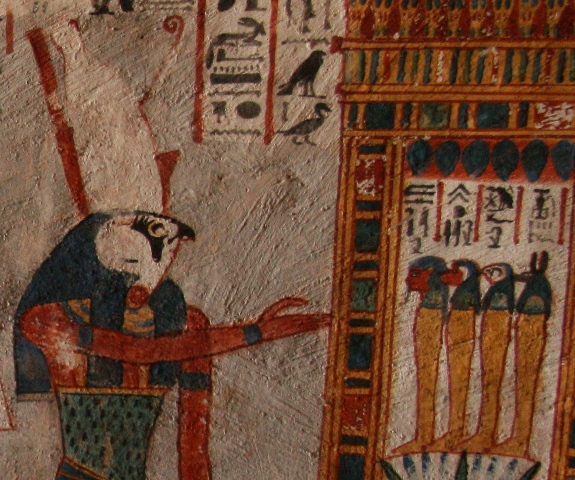
Hair and Horns in Ancient Egypt Imagery.


The chapter 218 has different versions of the same text, in one coffin the deceased Osiris is called « the bull of the plait hnskt » while in other one and in the same sentence he is « the Lord with two horns ». It seems quite clear the assimilation between the plait hnskt and the horns. In Ancient Egypt, as in many cultures, horns are a symbol of the crescent of the moon, when the star begins its way to the full moon; in fact in those religions where the bull is a prominent divinity, that animal is usually identified with the moon or with lunar gods[1]. So, in Egyptian funerary thought horns are related to the lunar resurrection of the dead.

At this point we need to come back or minds to the Hathor clergy, those ias priest who had the sincipital baldness. If maybe that baldness was related to a Hathor’s loss of hair, could it be also possible to think of a loss of the horns as a cow goddess? Then, is the Ramesseum Papyrus XI we have seen before making allusion to a mutilation of the horns of Hathor? Maybe in the Myth of Osiris Isis suffered a loss of hair; due to the fact that Isis and Hathor are interchangeable, in some moment of the Egyptian history appeared a version of the Myth of Osiris where it was supposed Hathor to lose her horns, instead of Isis to lose her lock of hair. In any case, the priests of Hathor were the “Bald of Hathor” because of their baldness in the wpt, just the place where bulls and cows have their horns.

If horns are assimilated to the crescent of the moon and, as we have read in chapter 218, the plait hnskt is assimilated to the horns, it would be reasonable to think of a comparison between the hair element and the crescent of the moon, both symbols of resurrection.

Then, it would make sense why Hathor, as a cow, is also a lunar deity and why her two ringlets of hair wprty, maybe assimilated to both horns, are a grant of lunar resurrection for the deceased[2]. The two ringlets would compare with the horns; both elements sprout in the wpt and are at both sides of the Hathor’s head; ringlets fall down at both sides of the face, while horns point upwards. We can find the graphic result of that in the Egyptian art legacy; we just need to turn face up the frontal image of Hathor and we notice that her ringlets become the horns/crescent and her face the full moon as in the head-dress of lunar deities.

Comparison of image of Hathor from Deir el-Bahari (Photo: www.1worldtours.com) and lunar head-dress of Thot in Medinet Habu (Photo: Mª Rosa Valdesogo Martín)

Comparison of image of Hathor from Deir el-Bahari (Photo: http://www.1worldtours.com) and lunar head-dress of Thot in Medinet Habu (Photo: Mª Rosa Valdesogo Martín)

The imbalance here is how to fix two different aspects of the hair (hnskt and wprty) with the horns of Hathor. Were the wprty the two ringlets of Hathor while still in her head and the hnskt plait the mutilated hair not in her head anymore but in a mop of hair? And belonged this cut mop of hair to the deceased Osiris?

Many questions, whose answers we will try to clear up later. In any case, we keep reading about hair, resurrection and Myth of Osiris. And these three elements refer us again to the funerary ceremony, where mourners cry the death and makes gestures with the hair before the final regeneration of the corpse.


[1] R. Briffault, 1974, p. 382

[2] In Sahara there are many cave images of cattle and snakes together.  According to Le Quellec, both animals are duplicates of the moon (J-L. Le Quellec, 1993, p. 238). This affirmation is important for us, because we have seen how horns and snakes appear related to the plait of hair in a context of lunar resurrection.

The Plait hnskt in the Coffin Texts.


Ancient Egyptian religion show us how rich was ancient Egyptian thought. They converted common things into special elements able of helping the deceased to get to a new life. There is another aspect of the hair which had a very strong symbolic meaning. The Coffin Texts mention plaits hnskt as an element related to two concrete things: horns and snakes, and both in a context where the dead starts his regeneration.

In chapters 181 and 218 the text mentions an action located in a celestial context where the deceased going forward occident is

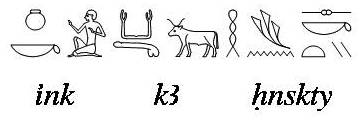
“the bull of the plait”[1] ink ka hnsktyand « the bull, lord of the plait »[2] [3].

wsirpakanbhnskt

Both chapters are describing the deceased in a lunar shape. To use the image of a bull for it is not a random choice. It comes from the fact that the bovine horns, due to its shape, are a symbol of the crescent of the moon[4]. That is why in the glorification ceremony in Papyrus Louvre 3079 we read: “Oh! The one, who appears as the moon, bull, which rejuvenates himself in the sky every day!” [5]. Horns are the image of the first quarter of the moon, and therefore they symbolise the evolution of the star from the moment it starts its regeneration.

Comparison of crescent (photo: www.channing.info) with the horns of a bull. Relief from a block in the Open Air Museum of Karnak. Photo: Mª Rosa Valdesogo Martíni.

Comparison of crescent (photo: http://www.channing.info) with the horns of a bull. Relief from a block in the Open Air Museum of Karnak. Photo: Mª Rosa Valdesogo Martín.

The connection between bull and moon explains why in the Songs of Isis and Nephtys Osiris is called “bull which fertilizes the cows[6]. Sometimes “the bull of the stars” was assimilated to kA-mwt.f (“the bull of his mother”)[7]; the one who fertilizes his mother is father and son at the same time, this way he grants in the same person the present and future continuity[8]. We are facing the deceased Osiris, the one who impregnates Isis (she, who is mother and wife at the same time) and who is son (as newborn-resurrected) and Horus father.

Amon-Re Kamutef. Relief from the temple of Karnak. XIX Dynasty. Photo: Mª Rosa Valdesogo Martín.

Amon-Re Kamutef. Relief from the temple of Karnak. XIX Dynasty. Photo: Mª Rosa Valdesogo Martín.

As previously, chapter 219 relates how the deceased travels from East to West and on a boat he crosses the lakes of the horizon. In this context he says:

“…I cross the lakes of the horizon.

I go down in them in (or with) the eggs,

 I go out from them with snakes.

I took over their souls;

I pulled their plaits out…”[9]

Ipulledtheirplaitsout

 Hnkst is a parallel of hnskt. And A. Erman and H. Grapow translate hnksty as plait as a synonym of snake, due to the likeness between both[10].

It seems that to take the souls from the egg and pull the plaits out are on an equal footing, as if the text were describing the act of going out with the snakes. Making that, the deceased catch the life that is inside the eggs, one of the main life centres; this life would be symbolised in those snakes and/or plaits of hair. The dead would go out from the egg (the rebirth) in the same way Osiris went out from the Nut’s womb with the ureus[11]. We would be facing two different forms of saying the same thing: the deceased’s rebirth.

On the other hand, the snake is a lunar animal par excellence. For ancient Egyptians this animal was a symbol of cyclic and temporary transformation (as it was the moon), of fecundity and perpetuity.

Furthermore the word Hnskt is linked with the celestial sphere. The word for Horus (Hr) is also the word for “face” (Hr); we could deduce from that an image of the sky as a face, maybe the face of Horus. The moon and the sun would be the two eyes, while the hair would be the firmament’s supports. Already in V and VI dynasties the Pyramid Texts tells how the plaits Hnskwt of the face of Horus were considered the abode the his four sons[12]; and the Pyramid Texts of king Ounas mentions four ancient spirits who lived in the plaits Hnskwt of hair of Horus and were at the eastern part of the sky holding their sceptres[13].

Horus and his four sons. Painting from the tomb of Roy in Dra Abu el-Naga. XVIII Dynasty. Photo: Mª Rosa Valdesogo martín.

Horus and his four sons. Painting from the tomb of Roy in Dra Abu el-Naga. XVIII Dynasty. Photo: Mª Rosa Valdesogo Martín.


[1] CT III, 181

[2] In coffin L1Li instead of “plait” it has the word “horns” hnwty.

[3] CT III, 218

[4] G. Durand, 1979, p. 75.

[5] Pap. LouvreI. 3079, cols. 84-86.

[6] Songs…3,6

[7] In the New Kingdom it was an epithet of Amon.

[8] Ph. Derchain, 1962, p. 33.

[9] CT III, 219

[10] Wb III, 121, 2.

[11] See post about nwn gesture and Nut.

[12] E.A.Wallis Budge, 1969, vol. I, p. 466.

[13] E.A.Wallis Budge, 1969, vol. I, p. 157.