Tag Archives: deceased

Hair and Death in Ancient Egypt. First Summary.


Hair and mourning women. Summary

According to what we have seen in the category « Hair and Mourning Women » we can mention some main ideas:

  • Mourners in Ancient Egypt made two gestures: Nwn: to cover their faces with their hair sm3 (in some cases is Snw) and nwn m: to pull their front lock of hair swt. Both are a way of showing despair and sadness.

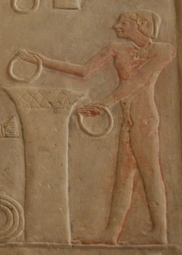
    Mourning woman of Minnakht's tomb. www.1st-art-gallery.com

    Mourning woman of Minnakht’s tomb. http://www.1st-art-gallery.com

  • The hair over the face symbolized the darkness of the death into which the dead is sunk; it remembered the chaos in the primeval state of creation, so the Nwn gesture symbolized the Nun, the primeval waters.
  • Egyptians assimilated the hair sm3 to vital elements as breath, vegetation and water. So, to give the hair sm3 with the nwn gesture was a propitiatory practice, the hair became an instrument for sending vital energy to the deceased.
  • The heir was an important figure for the deceased’s resurrection in Ancient Egypt belief. As in the Osirian myth, Horus was the avenger who restored the cosmic order. For that reason the dead had to get again his virility. The nwn gesture in funerals could be a way of symbolizing the mythical copulation through which Osiris recovered his virility and Isis could conceive Horus.

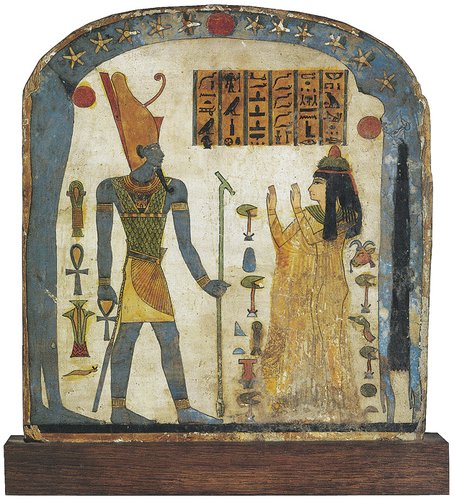
    Funerary stele of Lady Taperet with an image of Nut in nwn gesture. XXII Dynasty. Musée du Louvre. Photo: www.nybooks.com

    Funerary stele of Lady Taperet with an image of Nut in nwn gesture. XXII Dynasty. Musée du Louvre. Photo: http://www.nybooks.com

  • The deceased, as Osiris and as a reborn, became Nut’s son. This goddess also made in the mythic sphere the nwn gesture. In funerary ceremony, the nwn gesture that the mourners made with the hair would remember the posture of Nut, as sky goddess, when bearing Osiris.

Locks, Plaits and Ringlets. Summary

The main ideas of the second category are:

The goddess Hathor with lateral ringlets. Column from the temple of Khnum in Elephantine Island. Photo: Mª Rosa Valdesogo Martín.

The goddess Hathor with lateral ringlets. Column from the temple of Khnum in Elephantine Island. Photo: Mª Rosa Valdesogo Martín.

  • The deceased was welcome to the Hereafter by Hathor, lunar goddess whose face is flanked by the two ringlets wprty. When she received the dead one these two ringlets opened and let see her face; that symbolized to see the light of the full moon in the night sky and it was the culmination of the lunar resurrection for the deceased, in the same way the full moon in the Osiris myth meant the resurrection of the god.
  • Egyptians identified the plaits Hnskt with lunar elements as horns (an image of the crescent) and snakes (which regenerates regularly), and also helped in that lunar resurrection.

    The god Khonsu with side lock. Relief from the funerary temple of Seti I in Dra Abu el-Naga. Photo: Mª Rosa Valdesogo Martín.

    The god Khonsu with side lock. Relief from the funerary temple of Seti I in Dra Abu el-Naga. Photo: Mª Rosa Valdesogo Martín.

  • The lock of hair s3mt seems to be also identified with the first moments of life and the childhood of the moon (it would be the side lock of children), so it was as well an element for contributing to the lunar resurrection of the dead. It also seems to have a negative aspect, since it was maybe identified with the evil which threats the dead one and which suffers an ablation for allowing the deceased to get back to life.


Cutting the Lock of Hair s3mt in Ancient Egypt.


The Coffin Texts show us how the lock of hair s3mt was not just a symbolic element which had a very important place in the funerary imagery. Apparently it could also have been a physical thing which was manipulated and cut during the ceremony.

Chapter 532 is about to restore many parts of the corpse. To place the deceased’s head in his neck is the main gesture for reaching the new life:

Formula for placing the head…Mi head is placed. My neck is put by Tefnut. This is the day of putting their heads to the gods. My two eyes are given to me, I see with them. I have received my dorsal spine from Ptah-Sokaris. Is tied to me a lock of hair in Heliopolis, the day of cutting the lock s3mt[1]

chapter 532

In this chapter the deceased gets his eyes, his neck, his spine and the lock of hair syt, which we have already identified as the frontal lock of hair in mourners. According to the text it is a Helipolitan practice for restoring the corpse, which also includes the cutting of the lock of hair s3mt.

The Osirian ritual of Ancient Egypt represented the life, death and resurrection of that god. During the Stundenwachen-liturgy, where the two representative mourners of Isis and Nephtys had an important role, there was a practice of tying up the lock of hair. According to the inscription[2], in the second hour of the night one of the mourners, called “small Dyerit”, says:

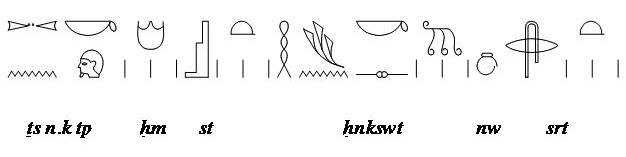
“Join the head for you, put the plaits of hair Hnskwt[3].Stundenwachen

 Sr can be translated as “hair of woman” or “hair of animal”[4] and srt means “bull’s hair”[5]. The action takes place in a resurrection rite where the mourner is giving a hair element. Could we think of a relationship between this passage of the Stundenwachen and the chapter 532 of the Coffin Texts? The imbalance here is that the document of the Middle Kingdom mentions the lock of hair syt, while the document from a later period mentions the plait of hair Hnskwt. Maybe we should think of a variation due to the passing of time.

Chapter 640 of the Coffin Texts mentions also the same practice, although in a more confusing context:

“A knot is tied for me around me in the sky connected with the earth by Re each day. He puts a knot on the inert over his two thighs on that day of cutting the lock of hair s3mt.

chapter 640

  Seth ties a knot around me when the ennead is in its first power, with no turmoil.

You protect me against those who slew the father. Nut ties a knot around me, at the sight of the first time before I had seen Maat, before the gods were created[6]. I am Penty[7]; I am the heir of the gods”[8].

We find again the expression to cut the s3mt in a context of Heliopolitan divinities.

Would the action of cutting the lock of hair in Ancient Egyptian funerals come from prehistoric times? Cutting rituals (depilation, cutting hair, dental mutilations…) are usually in all cultures one of the first techniques of purification; by means of that men apart themselves from animality[9]. The fact of cutting is something fundamental in initiation ceremonies, as it is for instance circumcision. We know that in Ancient Egypt the cut of the side lock in children was made when they were already adults[10] (nowadays some African peoples still do the same), so in the pass from childhood to a new state of existence.

Nudity and lock of hair were features of childhood. Relief from the mastaba of Ptahhotep in Saqqara. VI Dynasty. Photo: Mª Rosa Valdesogo Martín.

Nudity and lock of hair were features of childhood. Relief from the mastaba of Ptahhotep in Saqqara. VI Dynasty. Photo: Mª Rosa Valdesogo Martín.

We know that death for the Egyptians was just a change of condition and funerary ritual was not just a burial ceremony, but a rite of passage. The dead changed his condition; he passed from dead to reborn, from child to adult, from crescent to full moon. And in some moment of that process happened to cut the s3mt. The fact that this Egyptian word could also be translated as “mourning” or “sadness” refers us again to the mourning women; were there a connection between these women and the cut of the lock of hair s3mt?

P. Barguet considered cutting the s3mt as a Helipolitan ritual[11]. The side lock of Egyptian children was cut when they became adults. In Roman times athletes and youth initiated in Isis cult were distinguished because first ones had a side lock on the top of the head, while second ones had it over the right ear; this lock of hair was cut with the puberty at the same time of circumcision[12]. In religious sphere, Khonsu, the lunar god, was represented with his side lock and his lunar head-dress.

Could we think of cutting the s3mt of chapters 532 and 640 as a lunar rite? In a symbolic context, maybe to cut the s3mt was made when the moon was not a crescent anymore, but a full moon, that is, when the moon stopped being a child and became an adult. In the funerary ceremony, this cut of hair was maybe made as a symbol of the lunar rebirth of the deceased; it could reflect the end of the chaos and darkness which dominated the universe before the creation. Cutting the s3mt would mean full moon, light, order and new life.


[1] CT VI, 532

[2] H. Junker studied the inscription from Dendera, Edfu and Philae.

[3] H. Junker, 1910; E XIV, 95.

[4] Wb IV, 191, 3 y 4.

[5] Wb IV, 191, 5.

[6] The primeval moment.

[7] Pnt is an Egyptian verb related to the making of bread (to knead) and beer (press) (Wb I, 511, 3). Desinence y converts it in a prospective passive participle, which indicates a future fact, so, Pnty would mean “The one who will be produced”; that would refer to the deceased as a new creation.

[8] CT VI, 640

[9] G. Durand, 1979, p.160.

[10] Scholars consider that circumcision in Ancient Egypt was made between six and fourteen years old.

[11] P. Barguet, 1986, p. 52, n. 5

[12] V. von Gonzenbach, 1957 (summary in AEB, nº 57214, pp. 61-62).

The Lock of Hair s3mt and the Childhood of the Deceased in Ancient Egypt.


The Coffin Texts mention a final shape of hair also with a deep symbolic meaning. It is the lock of hair s3mt. About the meaning of s3mt there are different opinions. According to A. Erman and H. Grapow s3mt means “sadness” [1]; A. Gardiner translates it as “mourning” [2] and for R.O. Faulkner its meaning is “lock of hair” [3]. We will treat that later and we will notice that all translations result in the same idea.

In chapter 334 of the Coffin Texts the deceased is Ihy[4], the son of Hathor[5], but he is also son of Re, Isis and Nephtys. In fact, many passages of the text refer to the dead one as a being in his first steps of existence. The chapter is very long, so we will skip a part of the text and will focus on the most interesting sentences for the subject we talk about:

“To change into Ihy…I am the first product of Re, he created me in the body of my mother Isis…

 I am the son of Nephtys, I have been great and lucky.

 My lock of hair s3mt is not destroyed in the bosom of my father and my mother.

 CT 334 samt

I live, I exist…I am a protector. I am acclaimed in my name of Khonsu. I am immortal in the sky, with Re and my mother Hathor…”

His lunar nature comes from his condition as son of Re; he succeeds his father the sun, who rules the daily sky, in the sky during the night, the moonlight follows the sunlight. And we already know that the moon in Ancient Egypt is a symbol of new life in the Hereafter. The entire chapter is about the dead one as a new born, a son, he has the ability to be born with no handicaps, even his s3mt keeps intact and thanks to it, he can live and exist.

It is also interesting to notice that because the s3mt has not been destroyed the deceased exists and he is acclaimed in the name of Khonsu. This god was the son of Amon and Mut (Theban Triad) and his image characterized by the lunar head-dress and the side lock of hair[6]. Khonsu and his side lock were a symbol of youth and showed him as the heir[7]. Could we think of the s3mt as the side lock of Khonsu?

Khonsu with side lock and lunar head-dress. Relief from the funerary temple of Seti I in Dra Abu el-Naga. XIX Dynasty. Photo: Mª Rosa Valdesogo Martín.

Khonsu with side lock and lunar head-dress. Relief from the funerary temple of Seti I in Dra Abu el-Naga. XIX Dynasty. Photo: Mª Rosa Valdesogo Martín.

If the lock of hair is synonymous with rebirth and inheritance; not destroy it would mean continuity and constant renovation.  The dead one would be in the funerary thought of Ancient Egypt assimilated with Khonsu in the first step of the regeneration. Khonsu with the side lock (maybe s3mt) is the crescent, the childhood of the moon, and he starts its way to maturity; its growth for becoming the full moon, which materializes the deceased’s resurrection[8].

We have to take into consideration also the following passage:

“I am the ejaculated one, I crossed through her two legs…I have germinated in the egg, I have harried up through its sf[9], I have slid on its snf[10]. I am the lord of the blood…my mother Isis conceives me when she is unaware of her body under the fingers of the lord of the gods, who invades her that day of magnificence[11]…that day of disorder[12]… »

To keep the s3mt means to germinate into the egg, that vital centre which contains the energy to create a new being. The deceased remains inside the egg still unborn but and he will be reborn from it.

So, the lock of hair s3mt and the rebirth/regeneration appear together. Could we then think of that lock of hair s3mt as vital factor which helps the deceased in his resurrection? The answer seems to be affirmative[13].


[1] Wb IV, 18, 10.

[2] A. Gardiner, 1988, p. 588.

[3] R. O. Faulkner, 1988, p. 210.

[4] He is the musician with the sistrum.

[5] Already in Old Kingdom the deceased is “Horus, son of Osiris,…son of Hathor, the semen of Gueb (Pyr., 466 a-b)

[6] J. Zandee, recalling Kees, who considered the lunar eye a parallel of the lock of hair (ZÄS 60), identified this one with Khonsu (J. Zandee, 1953, p. 112).

[7] Ph. Derchain, 1962, p. 40.

[8] In chapter 310 there are many verbs of growth, and that could be a proof of how the power of Khonsu increases (J. Zandee, 1953, p. 111)

[9] P. Barguet translates “egg white”.

[10] P. Barguet translates “yolk”, although its real meaning is “blood”.

[11] Could that refer to the sexual act?

[12] The translation of Xnnw is “uproar”, “disturbance” (Wb III, 383, 15). We are facing in this passage a moment of disorder, while the deceased is conceived; that shows the relationship we have already seen between chaos and orgy.

[13] As son of Isis the deceased is then also Horus and we will see later the relationship between this god and the lock of hair s3mt.

Hair and Snake as Symbols of Rebirth in Ancient Egypt.


The connection between the hnskt plait and the snake shows again a relationship of two vital elements. All during this work we have seen how the hair was considered in ancient Egyptian as a generating life element. Egyptians also attributed vital energy to snakes, since in mythology this animal was one of the first manifestations of live. On the other hand it is interesting to notice that this is a lunar animal par excellence[1].

According to R. Briffault, “the snake and the moon are interchangeable” in many cultures because both are immortal; they are in constant renovation and that is why the snake is considered a representation of the moon[2]. The serpent shed its skin periodically, it transforms, but it does not perish, it renews itself as the moon does. But also snakes appear and disappear easily; they hide under the ground, the “underworld”, where shed the skin and regenerate themselves. In Book of the Amduat, the snake is one of the symbols of death and rebirth[3] and Re, in the twelfth hour, rejuvenates in a snake’s belly[4].

Twelfth Hour of Amduat, where Re goes out as Khepri from the snake . Painting from the tomb of Amenhotep II in the Valley of the Kings. XVIII Dynasty. Photo: www.cefb.it

Twelfth Hour of Amduat, when Re goes out as Khepri from the snake . Painting from the tomb of Amenhotep II in the Valley of the Kings. XVIII Dynasty. Photo: http://www.cefb.it

What about women? They are also “closely associated with the snake, in the same way they are related to the moon”[5]. Serpents have as well a deep fecundity symbolism. Some scholars think that the snake has at the same time a feminine side (lunar) and a masculine one, since its shape and its movements suggest the virility of the penis[6]. So, snakes combine the two principles masculine and feminine needed for the creation. Anyway, in Ancient Egypt the phallic condition of the snake does not seem to be too emphasized[7].

Lastly, the snake is a death’s keeper and, according to Egyptian religious texts, it protects the dead[8]; since it lives in the underworld, it dwells close to the deceased’s spirits and knows the secret of the death. Serpent has a very positive role in the myth of the hero who defeats the death[9]. In fact, according to M. Eliade, « Great goddesses have usually a snake as attribute, they maintain this way their lunar nature, and these goddesses are at the same time funerary divinities. The snake is so, a funerary animal and a symbol of regeneration » [10]. For that reason, we can find in some versions of the Egyptian myth that in the creation of the world, the primitive god is in the Nun as a serpent, where he comes back again also in shape of snake[11].

We can see clearly in chapter 219 of the Coffin Texts the connection between the snake and the resurrection, since to go out from the egg with the plaits hnkswt and the snakes is a synonym of rebirth. The dead one is reborn from the place where the life germinates and goes out from it with its vital power (snakes and/or plaits of hair hnkswt), a very similar image we can have in mind just thinking of Osiris going out from the womb of his mother Nut with the uraeus [12]. If hnkst is a parallel of hnskt and this one is the lock of plaits falling at the back of mourners, again we find these women and their hair in a resurrection act.


[1] All animals that appear and disappear in a cyclic way (snails, reptiles, bears…) are considered as lunar creatures (J.E. Cirlot, 1991, p. 285).

[2] R. Briffault, 1974, p. 314.

[3] W.B. Kristensen, 1992, p. 21.

[4] V, 648.

[5] R. Briffault, 1974, p. 316.

[6] G. Durand, 1979, p.303.

[7] V, 650.

[8] Pyr. 226-224, 276-299, 375-401, 727-733; CT 160, 369, 372, 375, 378, 381, 423, 434-436, 586, 686, 717, 885; LdM,  33-35, 37, 39.

[9] G. Durand, 1979, p.305.

[10] M. Eliade, 1970, p.150.

[11] LdM, 175.

[12] A. Mariette, 1875, II, 152-153, 3; Ph. Derchain, 1963, p. 22.

The Plait hnskt in the Coffin Texts.


Ancient Egyptian religion show us how rich was ancient Egyptian thought. They converted common things into special elements able of helping the deceased to get to a new life. There is another aspect of the hair which had a very strong symbolic meaning. The Coffin Texts mention plaits hnskt as an element related to two concrete things: horns and snakes, and both in a context where the dead starts his regeneration.

In chapters 181 and 218 the text mentions an action located in a celestial context where the deceased going forward occident is

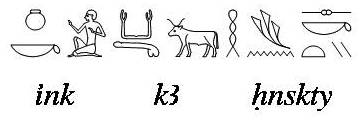
“the bull of the plait”[1] ink ka hnsktyand « the bull, lord of the plait »[2] [3].

wsirpakanbhnskt

Both chapters are describing the deceased in a lunar shape. To use the image of a bull for it is not a random choice. It comes from the fact that the bovine horns, due to its shape, are a symbol of the crescent of the moon[4]. That is why in the glorification ceremony in Papyrus Louvre 3079 we read: “Oh! The one, who appears as the moon, bull, which rejuvenates himself in the sky every day!” [5]. Horns are the image of the first quarter of the moon, and therefore they symbolise the evolution of the star from the moment it starts its regeneration.

Comparison of crescent (photo: www.channing.info) with the horns of a bull. Relief from a block in the Open Air Museum of Karnak. Photo: Mª Rosa Valdesogo Martíni.

Comparison of crescent (photo: http://www.channing.info) with the horns of a bull. Relief from a block in the Open Air Museum of Karnak. Photo: Mª Rosa Valdesogo Martín.

The connection between bull and moon explains why in the Songs of Isis and Nephtys Osiris is called “bull which fertilizes the cows[6]. Sometimes “the bull of the stars” was assimilated to kA-mwt.f (“the bull of his mother”)[7]; the one who fertilizes his mother is father and son at the same time, this way he grants in the same person the present and future continuity[8]. We are facing the deceased Osiris, the one who impregnates Isis (she, who is mother and wife at the same time) and who is son (as newborn-resurrected) and Horus father.

Amon-Re Kamutef. Relief from the temple of Karnak. XIX Dynasty. Photo: Mª Rosa Valdesogo Martín.

Amon-Re Kamutef. Relief from the temple of Karnak. XIX Dynasty. Photo: Mª Rosa Valdesogo Martín.

As previously, chapter 219 relates how the deceased travels from East to West and on a boat he crosses the lakes of the horizon. In this context he says:

“…I cross the lakes of the horizon.

I go down in them in (or with) the eggs,

 I go out from them with snakes.

I took over their souls;

I pulled their plaits out…”[9]

Ipulledtheirplaitsout

 Hnkst is a parallel of hnskt. And A. Erman and H. Grapow translate hnksty as plait as a synonym of snake, due to the likeness between both[10].

It seems that to take the souls from the egg and pull the plaits out are on an equal footing, as if the text were describing the act of going out with the snakes. Making that, the deceased catch the life that is inside the eggs, one of the main life centres; this life would be symbolised in those snakes and/or plaits of hair. The dead would go out from the egg (the rebirth) in the same way Osiris went out from the Nut’s womb with the ureus[11]. We would be facing two different forms of saying the same thing: the deceased’s rebirth.

On the other hand, the snake is a lunar animal par excellence. For ancient Egyptians this animal was a symbol of cyclic and temporary transformation (as it was the moon), of fecundity and perpetuity.

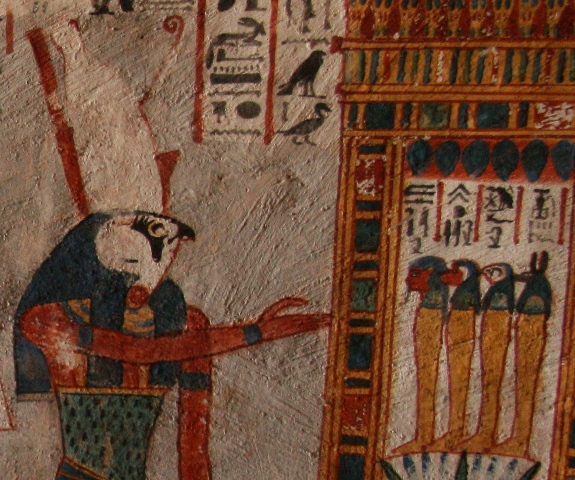
Furthermore the word Hnskt is linked with the celestial sphere. The word for Horus (Hr) is also the word for “face” (Hr); we could deduce from that an image of the sky as a face, maybe the face of Horus. The moon and the sun would be the two eyes, while the hair would be the firmament’s supports. Already in V and VI dynasties the Pyramid Texts tells how the plaits Hnskwt of the face of Horus were considered the abode the his four sons[12]; and the Pyramid Texts of king Ounas mentions four ancient spirits who lived in the plaits Hnskwt of hair of Horus and were at the eastern part of the sky holding their sceptres[13].

Horus and his four sons. Painting from the tomb of Roy in Dra Abu el-Naga. XVIII Dynasty. Photo: Mª Rosa Valdesogo martín.

Horus and his four sons. Painting from the tomb of Roy in Dra Abu el-Naga. XVIII Dynasty. Photo: Mª Rosa Valdesogo Martín.


[1] CT III, 181

[2] In coffin L1Li instead of “plait” it has the word “horns” hnwty.

[3] CT III, 218

[4] G. Durand, 1979, p. 75.

[5] Pap. LouvreI. 3079, cols. 84-86.

[6] Songs…3,6

[7] In the New Kingdom it was an epithet of Amon.

[8] Ph. Derchain, 1962, p. 33.

[9] CT III, 219

[10] Wb III, 121, 2.

[11] See post about nwn gesture and Nut.

[12] E.A.Wallis Budge, 1969, vol. I, p. 466.

[13] E.A.Wallis Budge, 1969, vol. I, p. 157.

Hathor and Baldness in Ancient Egypt Symbolism.


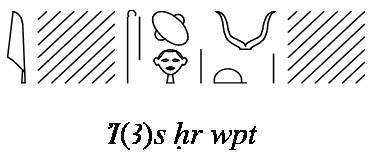
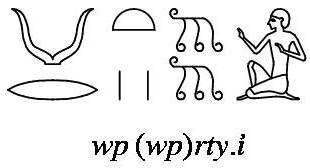
We have already seen the importance of Hathor and her two ringlets in the Ancient Egypt funerary imagery and symbolism. This goddess has many epithets which link her directly with the hair element; she is the “Lady of the plait” (Hnskt) or « the One of plait » (Hnsktt, Hnkstt)[1]. Also the priestesses who took part in the Hathor mysteries were called « the ones with plaits » (Hnskywt) or « the ones with ringlets » (wprtywt)[2].

There is a fragment of the Ramesseum Papyrus XI, where we read: “Mi heart is for you, my heart is for you as the heart of Horus is for his eye, the one of Set for his testicles, the one of Hathor for her plait, the one of Thoth for his shoulder[3]”. The text is mentioning mutilations suffered by these gods, so maybe were there an Egyptian myth where Hathor could lose a plait of hair? If so, we could then understand why in some magical practises dedicated to Hathor there had to use a plait of hair[4].

We must also take into consideration that in the Egyptian religion Hathor and Isis were associated. Plutarco assured that Isis pulled herself a lock of hair out when she knew about Osiris’ death[5]; this assertion makes us think of the image of mourners pulling their hair in funerals. We could link that with the damages mentioned above suffered by those gods in some parts of their bodies found in the text of Ramesseum Papyrus; however we have also to consider:

1) The iconography just shows us the gesture of pulling the lock of hair, but not the mutilation Plutarco mentions.

2) Ramesseum Papyrus mentions mutilations caused by another one to the god. In the case of Isis we would not be facing an attack to the goddess, but a self lesion.

Hathor and the loss of hair derives us to some statues dating from New Kingdom representing men sit in front of an Hathor’s symbol and which were studied by J.J. Clère[6]. Those men either they are bald, or they were supposed to be bald[7], because the inscription in all of them describe them as « the bald of Hathor ».the bald of Hathor

The Egyptian word for « bald » is is o iasiAs calvo , which defines the natural baldness, that is, the alopecia[8]. J.J. Clère considers that the term ias would have two senses: on one hand it would be « bald » in the most generic meaning, and on the other hand it would allude to the “sincipital baldness”[9]. That is, the alopecia in the upper half of the cranium, so the baldness in the wpt, as in the statues of the ias priests of Hathor[10], who had to be bald.

Head fragment from a statue of a "Bald of Hathor". New Kingdom. Metropolitan Museum of New York. Photo: www.metmuseum.org

Head fragment from a statue of a “Bald of Hathor”. New Kingdom. Metropolitan Museum of Art of New York. Photo: http://www.metmuseum.org

Around this matter it is interesting to have a look on a sentence in the Songs of Isis and Nephtys, which although very incomplete, could gain sense with all we have seen until now:

“…the baldness on the top of the head…” [11].

baldness on the top of the head

 J.J. Clère did not see the relationship between this partial sentence and the context it is written[12], but in fact it has, because that text is mentioning the damage that Seth has caused: « Seth is in every bad thing he has done » [13], «he has messed up the sky administration» [14], «and he has sent to us bad intentions» [15]. Could we think about a version of the Myth of Osiris, where Seth amputated the hnskt of Hathor? That would explain the comparison with the eye of Horus and the testicle of Re.

That being the case, the term is/ias would describe a sincipital baldness, however not a natural alopecia, but one caused by mutilation; ias would refer to an involuntary loss of the hair, while the term f3k would refer to the voluntary shave.

Equally we could think that Hnskt would be not just a lock of hair falling on the back, but also the hair in the top of the head (wpt). The priesthood of Hathor in the statuary lacks the hair on the wpt; the top of the head; where Hathor, as the cow goddess, has her horns. Could we then think of assimilation between the hair and the horns? If so, then we should also think about a possible version of the Myth of Osiris where Seth damaged Hathor’s horns. Maybe it would be more reasonable to consider that the Hathor in the Ramesseum Papyrus was in fact Isis, the mourning wife pulling her lock of hair as a despair gesture when she knew about the death of Osiris at the hands of Seth. In addition, the title of those ias priests in some statues refers to Isis: “I am the bald of Isis, the Big One” [16] ; « I am a bald one, excellent, favourite of Isis » [17].

Maybe for being assimilated to Isis, Hathor was a divinity very closed to Osiris in the Egyptian religion and it was very common to find her in images accompanying Osiris[18]. But her presence was not just in iconography; in celebrations in honour to Osiris during the month of Khoiak Hathor had also an important role. For instance, in the Middle Kingdom there was at the beginning of the month a sailing of Hathor. This goddess also appears six times accompanying Isis in the Festival of Sokaris (god assimilated to Osiris); her boat guides the other ones and the rest of goddesses are considered as different forms of Hathor[19].

Anyway, statues of ias priest show them always with an hathoric symbol; those men belonged to an Hathor’s clergy, who had to lack hair in the top of the head, apparently not voluntary; maybe in honour to the goddess, who suffered a mutilation with a similar result in her body.

"Bald of Hathor" Ameneminet. XIX Dynasty. Luxor Museum. Photo: www.eternalegypt.org

“Bald of Hathor” Ameneminet. XIX Dynasty. Luxor Museum. Photo: http://www.eternalegypt.org

Summing up, we have three main points related to Hathor and the hair:

  • Hathor related to the two ringlets wprty. These two lateral ringlets are like the two sky doors, which open and allow the deceased to go up to the celestial sphere and see the face of the lunar goddess, that is the moon, so the light in the darkness. The wprty are a grant of resurrection.
  • Hathor or Isis had a possible loss of hair (hnskt), as it was a mutilation, similar to that one suffered by Horus with his eye or Seth with his testicle.
  • Existence of a clergy of Hathor, whose requirement was the lack of hair on the top of the head (wpt), showing this way a relationship between Hathor and the lack or loss of hair.

[1] G. Posener, 1986, p. 113.

[2]S.A. Naguib, 1990, p. 13.

[3] According to some versions Seth attacked Thoth and cut off his arm. G. Posener,  1986, p. 111.

[4] Pap. Berlin 3027 9, 3-7; A. Ermann, 1901, p. 34. Although here the Egyptian word for plait is not Hnskt, but dbnt. Some scholars assure that there are representations of locks of hair with hathoric symbols of regeneration. E. Staehelin, 1978, p. 83.

[5] Plutarco, De Iside et Osiride, 14.

[6] J-J. Clère, 1995.

[7] J-J. Clère, 1995, p. 14.

[8] There is another Egyptian term for “bald”: f3k, used for the priesthood of Heliopolis. Actually it refers to the “shave”, not to the natural baldness. We have already written about the baldness and the lack of vegetation.

[9] J-J. Clère, 1995, p. 28.

[10] We read in the chapter 588 of the Coffin Texts and chapter 103 of the Book of Dead: “Speech for being at both sides of Hathor. I am one who has passed pure, a iAs priest. I will be Ihy in the Hathor’s entourage”.

[11] Pap. Bremner-Rhind, 2, 23.

[12] J-J. Clère, 1995, p. 30.

[13] Songs…, 2, 19.

[14] Songs…, 2, 20.

[15] Songs…, 2, 21.

[16] J-J. Clère, 1995, p. 76.

[17] J-J. Clère, 1995, p. 160.

[18] This assimilation comes from the Old Kingdom. Also in some cases Isis can appear as Re’s wife.

[19] Papyrus Bremner-Rhind ,19, 13 ff.

The Ringlets wprty and the lunar Resurrection.


We have already seen how in chapters 107, 109, 332 and 533 of the Coffin Texts the moon is the main element. In them Hathor is the lunar goddess who guides the boat during the night (this boat assimilated to the quarter of the moon) and the one who receives the deceased in the Hereafter. Her two ringlets wprty are separated and/or given and this helps the dead to get out from the darkness of the death and see the Hathor’s face, that is, the moon, the light.

Image of Hathor with her two ringlets at both sides of the face. paintign from the tomb of Roy in Dra Abu el-Naga. XVIII Dynasty. Photo: Mª Rosa Valdesogo Martín.

Image of Hathor with her two ringlets at both sides of the face. Paintign from the tomb of Roy in Dra Abu el-Naga. XVIII Dynasty. Photo: Mª Rosa Valdesogo Martín.

Hathor is “The one with bright face” (thnt Hr), « The Luminous one » (HAit)[1], and her two ringlets open to see « The Bright One, who makes live everyone she loves, people live when they see her » [2]. The idea of this act is completely opposite to the nwn gesture of covering the eyes with the hair; to die means a lack of light; it is the night of the death; the rebirth comes when the moon appears and provides light in the darkness.

Why is the moon so relevant in the deceased’s resurrection? It is a star that grows and dies, but the moon’s death is not definitive; after a period of some days it revives and appears again as a first quarter. The moon is at the same time death and resurrection, darkness and brightness. The moon is the first dead and symbolises the crossing point from death to life. For that reason the human being wants to have also a lunar nature; the star’s regeneration means a hope of resurrection for him.

Some cultures consider the moon the place for the resurrection; it can be as a trip in the star or as an immortal stay in it after the death.  According to R. Briffault, in tribal societies, thanks to its cyclic nature, the moon measures the time and also creates it[3], so it has the mystery of the resurrection. The moon changes constantly, it increases and decreases, with an interval of invisibility (identified with the death), where it goes out from regenerating itself[4]. If the moon causes the time, to convert in moon means to control the temporality and come into the eternity.

Due to this changing nature, lunar mythic beings are usually crippled[5], as in Ancient Egypt was Osiris. The moon dies, as the man dies, and it resurrects as the man wants to resurrect. It is supposed the human condition to be identical as the lunar condition, so humans, after dying, come back to life in a lunar shape. For that reason for ancient Egyptians Osiris was “the moon in the sky”, he renews himself as he wishes and he gets old when he wants[6].

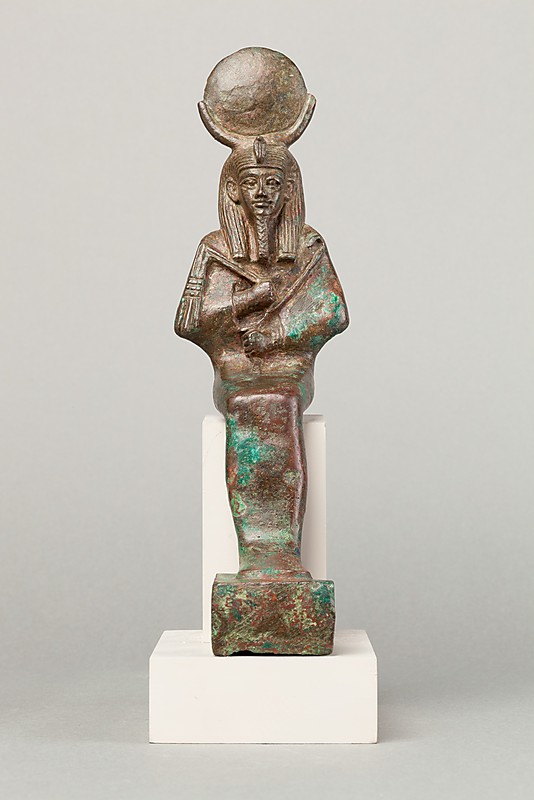
Bronze statue of Osiris in his lunar facet. Late Period. Photo: www.metmuseum.org

Bronze statue of Osiris in his lunar facet. Late Period. Photo: http://www.metmuseum.org

This context helps us understand the lunar nature of Hathor and why opening her two ringlets of hair means to get into the light, into the cyclic renewal, to get into the lunar boat and plough through the night sky[7]. Lunar Hathor guides the dead in the boat through the sky until Sothis, the morning star which announces the flood and the beginning of the Egyptian year, so the renewal of everything.

The ancient Egyptians celebrated the « Festival of the Sky » (Hb n pt), which inaugurated the lunar year and started with the appearance of Sothis. This moment was called in Egyptian “opening of the year” (wpt rnpt). This same expression meant also « the beginning of the youth », since rnpt was substantive of the verb rnpi (« to be young », « to be rejuvenated ») [8]. We find then two parallel concepts: the opening of the lunar year and the beginning of the lunar youth of the deceased. We must here remember that with the term rnp was also designed Osiris in the Songs of Isis and Nephtys.

The moon is a symbol of fecundity too , since it controls the waters, the rain and the tides[9]. Moon seems to be associated to the primeval waters as receptacle of creation power. For that reason the moon metaphorically speaking is the egg or the womb of the world, both elements as life generators. That makes the moon a life centre; and if it distributes the waters, it also intercedes between the sky and the earth (whose union we have seen is the hierogamy, the primeval couple).

In many cultures, the moon is closely related to woman and her fecundity power, because her physiological cycle is also regulated by the star. The moon is, then, the “Lord of the women” and he is sentimentally united to them. “Many people thought that the moon, with the look of a man or with the shape of a snake, mate with their women” [10], in the same way Osiris, as lunar god, is bound to Isis. The menstrual cycle contributes also to the idea of the moon as the first husband of female, as Osiris is Isis’ spouse.

As a star bound to the female fecundity, the moon is united as well to the Mother Goddess, and therefore has a maternal influence over the individual, as alimentary and affective mother[11]. In the funerary ritual that turns the deceased into a new born, who Isis looks after and Hathor takes in (both goddesses related to fecundity and moon).

On the other hand, the connection between the moon and the femininity would explain the intervention of the two mourners in the roles of Isis and Nephtys in the funerary ceremony for helping in the deceased’s resurrection. It would also explain why lunar Hathor, opening and/or giving her two ringlets wprty, allows the dead to get into the Hereafter and aim for a lunar regeneration.


[1] Ph. Derchain, 1972.

[2] A. Mariette, 1875, VI, 33, 8.

[3] R. Briffault, 1974, p. 297.

[4] According to Frazer, due to this regenerating nature, for increasing something it has to be done during the crescent and for decreasing it during the waning moon.  (J.G. Frazer, 1914, Vol. II, p. 133).

[5] G. Durand, 1979, p. 292.

[6] A. Mariette, 1880, II, 54 f., Z.5.

[7]CT VI, 623.

[8] Wb II, 432.

[9] G. Rossi, 1990, pp. 32-33.

[10] M. Eliade, 1970, p. 147.

[11] It is proven that there are more births during full moon (G. Rossi, 1990, p. 36).

The two Ringlets wprty give Access to the Realm of the Dead.


The presence of hair in Ancient Egypt funerary belief is more than just the mane or the lock of hair. There are mentions in three chapters of the Coffin Texts to another shape of hair: the ringlets.
1) In chapter 107 of the Coffin Texts the deceased goes out to the day, that is, he comes back to light and to life; in that process we read:

“…praises are given; the double ringlet starts the jubilee

wprty starts the jubilee

 While the Duat gets open for me…”

There is undoubtedly a word game with wpw (open) and wprty; since wpt can be also the crown as the origin of the hair[1], the upper part of the head (and also the zenith of the sky). On the other hand, the Egyptian word wprty describes the lateral plait or ringlet that can be seen in children as a sign of youth[2]; it is also the side lock of the god Khonsu[3], the god of moon.

The god Khonsu with side lock. Relief from the funerary temple of Seti I in Dra Abu el-Naga. Photo: Mª Rosa Valdesogo Martín.

The god Khonsu with side lock. Relief from the funerary temple of Seti I in Dra Abu el-Naga. Photo: Mª Rosa Valdesogo Martín.

D. Meeks translates it with a wider meaning as « lock of hair in the temple » [4]. Taking into account that the chapter relates how the deceased gets into the Duat, it makes sense to think about the two lateral ringlets of Hathor, the Egyptian goddess who receives the dead ones in the flank of the West Mountain, when they get into the realm of the dead, and she guides them in the night sky.

One of Hathor’s symbols of identity is her two big lateral ringlets framing her face[5]. Apparently this image of the goddess derives from a version of the myth of the “Eye of Re”.

The goddess Hathor with lateral ringlets. Column from the temple of Khnum in Elephantine Island. Photo: Mª Rosa Valdesogo Martín.

The goddess Hathor with lateral ringlets. Column from the temple of Khnum in Elephantine Island. Photo: Mª Rosa Valdesogo Martín.

It relates how Hathor (also Tefnut) lived in the Nubian desert as a wild lioness, while her father Re ruled alone the mankind. This one commanded Shu and Thot the mission of looking for Hathor and bring her back to Egypt. When they were in Philae, Hathor immersed in the holy water of the first cataract and she became a very pretty woman “goddess of love, with pretty face and the hair on two big ringlets, bright eyes and firm breast”[6]. The legend of the Eye is the legend of the return: the return of the goddess from the desert, the flood after the winter, it is also the cyclic return of the agricultural prosperity[7].

2) In chapter 109 of the Coffin Texts we read:

“Open the Occident. Praises are given. The jubilee starts when Hathor gives the double ringlet”[8]

wprty starts the jubilee (109)

This chapter confirms the previous exposure, since the wprty are the two ringlets of Hathor. It is about the funerary goddess, the one who takes the deceased in the necropolis; she is “Hathor, the Mistress of the Occident, who rules the frontier of the desert”; she presents the two ringlets, Hathor, the lunar goddess which guides the dead in the darkness of the death.

Could we think that this passage is referring to a rite? Would it be ridiculous to think of a kind of priestess or representative of Hathor in the necropolis presenting two ringlets to the mummy? If so, and taking into consideration the assimilation of Hathor with Isis in Egyptian religion, could be that woman the mourner in the role of Isis? [9]. Thinking so, we would keep in the same line and with the mourners as the main persons of our research; we would not need to resort to a third woman, which, on the other hand, does not appear in any funerary scene.

3) In chapter 533 the dead becomes a scribe of Hathor; the text is long but just in a few sentences we find something very interesting for our subject:

“Become scribe of Hathor. I am the one who is glad before her horns, being arms united, the lector priest, scribe of god words…in the secret palace…

…my two ringlets get open

my ringlets open

 and the face of Hathor makes lighter to me. Hathor holds her arms out”

Once again we are facing Hathor as the goddess who takes the dead in, holding her arms out. When the two ringlets separate, as if they were curtains, the deceased discover her face, as if it was a window that lets the light come in; Hathor’s face gets lighter, like the moon in the dark sky.

For the expression “make lighter”, the scribe used the Egyptian word HD, which it is also used for terms related to « clear », « silver » or « moon » [10]. Separate the wprty ringlets means to see the moon; it is the access to the light after the darkness of the death. Hathor/moon allows the vision during the night; she illuminates, guides and takes the deceased in.

It is also interesting to notice how in chapter 44 of the Coffin Texts we can read: “Heaven’s doors open with your beauty, you go out and you see Hathor [11]. To get into the heaven and see the goddess, either the doors get open, or the wprty ringlets get separated. It seems both elements doors and ringlets could be assimilated and interchangeable. To separate the wprty as if they were curtains allows seeing the light (Hathor’s face / moon) in the middle of the night sky.


[1] Wb I, 297, 13. It is also the part of the head new born “opens” the mother for coming to life, so it is a part related to the rebirth.

[2] Wb I, 305, 6.

[3] We can read it in the propylon of the temple of Khonsu in Karnak. K. Sethe und O. Firchow, 1957, 67 78, 81.

[4] D. Meeks, 1977-79, II, p.94, 78.0951.

[5] According to S. Aufrère “Hathor dissimulait sa face ronde et plate d’Asiatique dans une épaisse coiffure de bédouine, aux inmenses volutes, formant la nuit de lapis-lazuli” (S. Aufrére, 1993, p. 17).

[6] H. Junker, 1911.

[7] E. Bresciani, 1993, p. 47.

[8] In some coffins the writing  wprt  is reduced tort.

[9] In the scene of resurrection in the tomb of Petosiris Isis on the left with the side lock is the “Lady of Rekhyt”, an epithet of Hathor (F. Daumas, 1960, pl. I).

[10] Wb III, 206-208

[11]CT I, 44.

Hair, Hathor and Moon.


Joint with the hair, we have seen now two new important elements which we cannot ignore: Hathor and light. Hathor is mentioned as the « guide of the boat, who keeps ropes kasu in front of the rudder in the West ways… », she is « the lady of the light, who guides the Big One who is tired ». Hathor and light means that the text is referring to the lunar Hathor, the guide during the night.

According to an Egyptian tradition, Hathor was patroness of deceased[1]; she was a goddess that very soon became the goddess of The West and the imagery put her on the flank of the mountain, the place of the sunset and where the dead ones got into the Underworld[2].

The goddess Hathor in the flank of the west mountain ready for receiving the dead. Painting from the tomb of Shuroy in Dra Abu el-Naga. XIX Dynasty. Phot: Mª Rosa Valdesogo Martín.

The goddess Hathor in the flank of the west mountain ready for receiving the dead. Painting from the tomb of Shuroy in Dra Abu el-Naga. XIX Dynasty. Phot: Mª Rosa Valdesogo Martín.

Religious texts show that from very soon Hathor was a goddess who received the dead[3], who sheltered him[4], who helped him in reaching the eternity[5]; in the Afterlife the dead was in the entourage of Hathor[6] and she was the main one in the necropolis, that is why one of her epithets was “Hathor at the head of the Necropolis”[7]. Hathor helped the dead to go up to the sky, the same sky where she is guardian and that is his own body as celestial cow. In fact, the Egyptian name Hathor means « The house of Horus » [8].Hathor's name

Hathor grants the dead be sitting in the sky, that according to E. Drioton would be a lunar paradise[9], so a night sky. Not only Hathor has a relationship with the moon, with the night sky and with Horus[10], she also is connected somehow with the Udyat eye[11]. There are several examples of Hathor with a lunar character, so she is the “left eye of Re” [12], the “eye of Re in the sky during the day and the eye of Horus which makes the darkness bright” [13].

It is well-know the relationship between cattle and the moon, because the horns are assimilated to the crescent quarter. This aspect contributes to that image of Hathor as a sky goddess, which exist in Ancient Egypt from the Predynastic period.

Cow-head palette from Gerzeh. Predynastic period. Photo: www.touregypt.net

Cow-head palette from Gerzeh. Predynastic period. Photo: http://www.touregypt.net

We see it clearly in the cow-head palette from Gerzeh in Cairo Museum with the image of a cow rounded with stars making a very ancient image of a celestial cow[14].

But Hathor, is mainly a mother goddess, a celestial cow whose main role is feed people and gods and, so that, has the faculty of giving the life[15]. Maybe that is the reason why, as a mortuary divinity, Hathor also took part in the deceased’s resurrection and was assimilated with Isis[16].

The maternal nature of the cow makes that animal a symbol of rebirth. In this sense Hathor should be consider as a manifestation of the primeval mother[17]. Because “horns of cattle, that characterize great fecundity gods, are the emblem of the divine “Magna Mater[18] and because moon and fertility go together.

Hathor, as lunar deity, is also guide of the boat and she maintains the ropes. In this regard we consider interesting to refer to chapters 404 and 405 in the Coffin Texts, where the bow rope is assimilated to the braid of Isis. It is the night boat, which carries the deceased when he revives during the night, so it is the moon. The shape of the boat could remember the quarter of the moon, so the boat crescent-shape will be one of the first means of transport[19] in Egyptian culture, as it will be for the dead once he will be in the Afterlife.

In fact, the usual head-dress for lunar deities is a full moon over a crescent, in the same way the deceased reborn as a full moon will travel in the Hereafter in the lunar boat, identified with the crescent.

Head-dress of Khonsu with full moon over the crescent. Relief from the temple of Khonsu in Karnak. XIX Dynasty. Photo: Mª Rosa Valdesogo Martín.

Head-dress of Khonsu with full moon over the crescent. Relief from the temple of Khonsu in Karnak. XIX Dynasty. Photo: Mª Rosa Valdesogo Martín.

So, what we are facing is a lunar rebirth. In that rebirth we have seen the important role of the hair element. The feminine hair appears related to water, maternity, sexuality…and also now to the moon.  If hair is related to water and moon, the lock of hair swt in mourning should also have a connection with the lunar resurrection of the dead, with the goddess Hathor in her lunar nature, as guide of the boat (crescent of the moon) in the dark of the night sky.

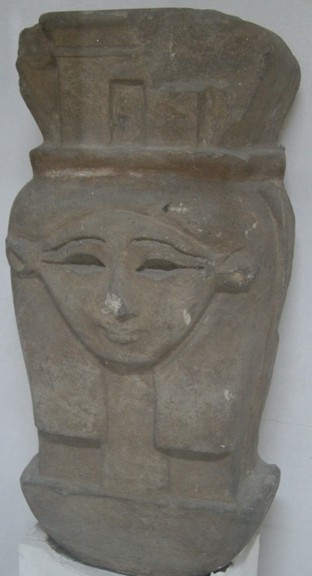
Hathor capital. Bahr el-Yussef museum. Photo: Mª Rosa Valdesogo Martín.

Hathor capital. Bahr el-Yussef museum. Photo: Mª Rosa Valdesogo Martín.

So, we have the mourners and /or the locks of hair swt in the moan, that is, mourning on earth during the funerals while the goddess Hathor in her lunar nature is in the night sky with her both ringlets on each side of her frontal face;  Hathor  is a grant of the deceased’s resurrection and she guides the boat, which bow rope is the braid of Isis. In the funerary ceremony the two locks of hair of the mourners could be the announcement of the lunar resurrection.


[1] E. Drioton, 1985, p. 188.

[2] A. Erman, 1952, p. 50.

[3] Pyr. 1026.

[4] CT VI, 769.

[5]CT V, 398.

[6] LdM, 144.

[7] S. Allam , 1963, p. 67

[8] S. Allam, 1963, p. 99

[9] E. Drioton, BiOr 15, p. 189.

[10] A. Mariette, 1875, IV, 77 a; en Ph. Derchain, 1962, p. 46.

[11] CT VI, 670.

[12] A. Mariette, 1875, I, 112, 7(A).

[13] A. Mariette, 1875, VI, 144, 2-3(J).

[14] According to F. A. Hassan it could represent Orion (F. A. Hassan, 1992, p. 314).

[15] One epithet for Hathor is “Mistress of Life” (A. Mariette, 1875, I, 26 f.).

[16] According to a version of the Osiris legend, Isis lost her head and Thoth replaced it with a cow’s head (Pap. Sallier IV). In addition, sometimes Hathor is called with the epithet of “Beautiful One of Osiris” (A. Mariette, 1875, VI, 3, 3).

[17] F. A. Hassan, 1992, p. 315.

[18] M. M. Eliade, 1970, p. 146.

[19] G. Durand, 1979, p. 238.

The meaning of the word swt


There is another chapter referring to swt; although it is a confusing text, we can make some deductions examining consciously the words. In the chapter 332 of the Coffin Texts the dead is being guided by a powerful goddess who is

“…the lady of the power, who guides to those ones in the caverns. I am Hathor, Lady of the northern sky, who maintains the ropes kAsw of those awaken…the earth trembles because of the jubilation, while the locks of hair are in the mourning…

locks of hair in the mourning

Sw is a verb, whose meaning is “to be something harmful for someone”[1], maybe it could be translated as “hurt “or “wound”. The substantive would then be swt (“damage”, “hurt”)[2].  We already find this verb in the Pyramid Texts of the Old Kingdom:

The two armas over the head is a very normal posture among mourners in Ancient Egypt. Painting from the tomb of Roy in Dra Abu el-Naga. XVIII Dynasty. Photo: Mª Rosa Valdesogo Martín.

The two arms over the head is a very normal posture among mourners in Ancient Egypt. Painting from the tomb of Roy in Dra Abu el-Naga. XVIII Dynasty. Photo: Mª Rosa Valdesogo Martín.

“The deceased is the Lord of his enemies, which have been beaten by Horus for him. Go up! Sit over him! You are stronger than him, hurt him…!” (di ir.k swt ir.f)[3]Isis is sitting, her arms over her head. Nephtys, holds her breasts because of the death of her brother, Anubis is bended over his stomach, Osiris is in his damage » (Wsir m swt.f) [4].

We could maybe consider the word swt as a passive participle of the verb sw, so the translation would be something as: “the damaged ones” or “the hurt ones”, the ones who have been damaged, that is, the mourners Isis and Nephtys; they were hurt by the death of Osiris and that is why they are in mourning.  This would also explain the use of the hieroglyph of hair as determinative in so many words that refer to mourners and mourning.This passage is clearly describing the typical funerary scene in which the mummy is laying while Anubis makes his embalming process and the two mourners Isis and Nephtys regret the death of her husband/brother.

We should also notice a kind of word game with the “locks of hair” (swt) in chapter 531 and the “hurt ones” (swt) in chapter 332, in both cases applied to the mourners who dishevel their hair as a sign of mourning.  It is as well interesting how each mourner is indentified with a lock of hair; so mourners and hair go together. That is what we call a metonymy; the whole (the mourners) is designated using its most significant part (the hair).

But we wanted to go on searching more on the verb swverb sw  and we found that it also could be translated as “to increase the strength” or “to get the strength back” [5]. We can read this verb in the Pyramid Texts[6] and also in the Coffin Texts:

“…I came and I recovered the strength back in nsrsr island”[7].isla nsrsr

In both texts the dead, after drinking milk or beer (both considered revitalising drinks), recover his force and comes back to life. It makes sense the use of the hair as determinative ; if the hair is an energy source and the nwn/nwn m gesture pretend the resurrection of the corpse, it is normal here to find it related with a verb meaning « fortify ». On the other hand, swt is a causative verb that derives from wt, whose translation is “be powerful” or “be big” [8]. In addition, wt also means « to embalm » [9] and there is direct relationship between embalming and the deceased’s resurrection. One of the main goals of embalming was to reconstruct the whole body, the physical reconstruction as getting the soul’s support, and this consolidation is connected with the hair element.


[1]   Wb IV, 59, 16

[2]   Wb IV, 59, 18

[3] Pyr., 652.

[4] Pyr., 1281-1282.

[5] D. Meeks, 1977-1979, II, p. 311, nº 78.3367; D. Meeks, 1976, p. 88, n. 14.

[6] Pyr., 1282 b.

[7]CT VII, 1013. Translation of P. Barguet (P. Barguet, 1986, p. 417).

[8] Wb IV, 77, 9.

[9] Wb I, 378, 8.