Tag Archives: deceased

When did the mourners pull or shake hair in the Egyptian funerary ceremony?


During these days we have seen how iconography and texts proof the existence of a gesture, posture or movement made by mourners in Ancient Egypt funerals. Sometimes they pulled their front lock of hair (nwn m) and sometimes they shook their mane onwards covering their faces with it (nwn). In both cases there was always an implicit symbolism, mostly related to the Osiris legend and the resurrection of the dead.

But now many questions come to mind: when did these women do that gesture during the funerary ceremony? Was the mourning rite constant during the whole ceremony or was just for some special moments? Were the normal mourners and the representatives of Isis and Nephtys making it together and/or at the same time?

Firstly we should distinguish the common mourners from the two women in the role of Isis and Nephtys. It makes sense to think about two different kind of performance. The iconography has several examples of mourners “outdoors” making the nwn m or nwn gesture. They would be part of the group of women accompanying the coffin in the funerary procession, we see them in movement in the reliefs from the tombs of Mereruka and Idu or in the Middle Kingdom coffin from Abydos; but also we see them in a more static moment, when some mourners are sit while others are making the nwn gesture, as in the tombs of Amenemhat, Miankht or Rekhmire.
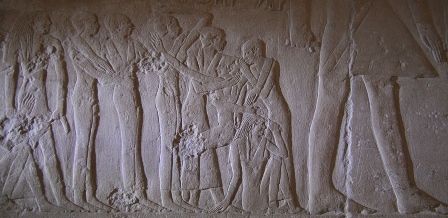
Mourners in the tomb of Mereruka at Saqqara. VI Dynasty. Photo: Mª Rosa Valdesogo Martín

Mourners in the tomb of Mereruka at Saqqara. VI Dynasty. Photo: Mª Rosa Valdesogo Martín

From the iconography we could deduce that the nwn gesture made by common mourners could take place:

-During the procession, while the coffin was transported.

-In necropolis, when the retinue has already close to the burial.

-Both, first during the procession and second once the retinue were in the necropolis, while the body was being buried.
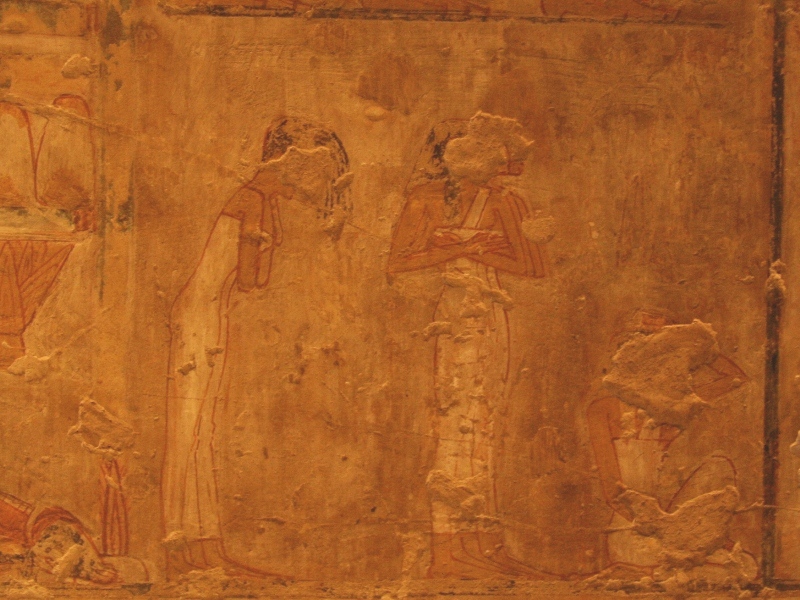
Mourners. Painting from the tomb of Rekhmire in Gourna. XVIII Dynasty. Photo: Mª Rosa Valdesogo Martín

Mourners. Painting from the tomb of Rekhmire in Gourna. XVIII Dynasty. Photo: Mª Rosa Valdesogo Martín

However we only have Isis and Nephtys in iconography making the nwn gesture in the stele C15 from the Middle Kingdom (the whole scene represents the Osiris Festivity) and the funerary temple of Seti I in Dra Abu el-Naga and also pulling their front lock of hair (nwn m) in the coffin of Ramses IV and the one of dwarf Djedhor. Religious texts mention how the goddesses make the nwn gesture and show or give the hair sema to the deceased. It does not seem to be a public moment, but a more secret practice and closely linked to the corpse and the resurrection of the dead. If so, the two mourners representing Isis and Nephtys would be two selected women for representing a divine role. And maybe their mourn ritual with their hair was a part of the group of practices made for the resurrection of the dead.
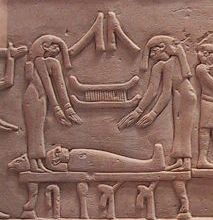
Mourners over the corpse. Detail of the stele of Akbaou. XI Dynasty. Photo: www.commons-wikimedia.org

Mourners over the corpse. Detail of the stele of Akbaou (stele C15). XI Dynasty. Photo: http://www.commons-wikimedia.org

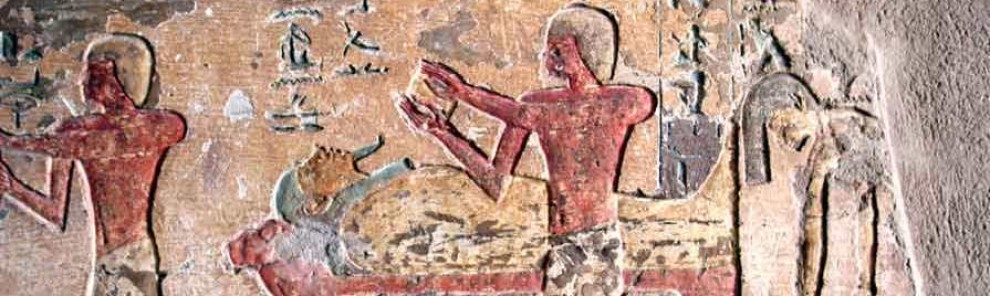
In Ancient Egyptian funerals there was a ceremony for restoring the deceased’s faculties: the ceremony of the Opening of the Mouth, which ended with the final resurrection of the dead. Was it maybe during that ritual when the two mourners made their mourning gesture with their hair? As we will see further in this work, the Ceremony of the Opening of the Mouth was not a public ceremony, but a rite reserved for those who accomplished it, as they were the sem priest, the lector priest and the two mourners. It consisted of a group of practices in favour of the deceased; the goal was to restore all the faculties he needed for his resurrection and his new life in the Herefater: breathing, eyesight, mobility, sexuality… Those practises were made over the mummy or the statue of the deceased and it seems reasonable to think that the mourners in the role of Isis and Nephtys did their nwn gesture near the body in some moment during the Ceremony of the Opening of the Mouth. In fact it is usual to find in the Egyptian iconography many scenes of that ceremony with the presence of mourners; maybe the most explicit one would be the one in the tomb of Renni, where we can see how priest is making the ritual over the corpse and the statue, while a mourner is making the nwn gesture.

Opening of the Mouth with mourner in nwn gesture on the right. Tomb of Renni in el-Kab. XVIII Dynasty. Photo: http://www.oisplendorsofthenile.blogspot.com.es

Summing up, the nwn and nwn m gesture had two dimensions, with different meanings and in different moments of the funerary ceremony. The public one made by common mourners outdoors during the procession or out of the tomb in the necropolis; and the private one, made by the two women in the divine role of Isis and Nephtys for the resurrection of the dead. In the first case the nwn/nwn m gesture is related to the chaos, the darkness of the death and is a sign of despair. In the second one those same practices had a revivifying goal.

The sexual Meaning of Hair in Ancient Egypt Funerals. Part II.


In Egyptian religion, Osiris is the god of death, but also of vegetation and his myth has an erotic component. According to M. Eliade “moments of cosmic crisis are a pretext for the unleashing of an orgy. The earth needs to be revived and the sky needs to be excited, to make the good conditions for the cosmic Hierogamy; this way cereal grows up, women engender children, animals reproduce and dead ones full their vacuum with vital power[1].

From the basis of the Eliade’s theory, orgy is an act of renovation and regeneration; it is a way of coming back to the first moment just before the final creation, when still chaos and confusion dominate the existence.  After the orgy a new life starts and with it the chaos disappears and the world is reorganised; the orgy is the experience of the original state[2].

Orgy is even the image of chaos. Orgiastic festivities allude to the chaotic moment in which the world is lost and from where the new power comes out for reorganising and restoring the cosmic order. As J. E. Cirlot says “the goal is not to obtain physical pleasure, but to help the world dissoluteness; a temporary breaking-off for the following restoration of the original “illud tempus[3]. Orgy is, then, according to scholars, an act which generates life.

The connexion of orgy with life could make us think of the relationship also with the moon, because it is a star which remakes and renews itself. The moon is also the night star, when chaos and darkness reign. And it is in the same way related to vegetation, since agricultural rites are also lunar rites due to their regeneration nature. In fact, from prehistoric times, lunar symbols have erotic connotations thanks to the analogy between vulva and shell; for instance, the spiral is a sign that derivates from the snail shell; and this animal, which appears and disappears, is usually assimilated to the moon, and also for that same analogy the spiral has an erotic nuance[4].

We can guess that in Ancient Egypt funerary ceremony, mourners representing Isis and Nepthtys and the gesture nwn of shaking hair smA onwards could also have an erotic nature, whose goal was to help the dead come back to life. For some scholars “the spreading through sexual act could be considered according to primitive thought, as an alternative to the eternal life”[5]. The fertilizing nature of copulation seems to be united to resurrection as a regenerating element. It is the union of the two principles, masculine and feminine, the union that in the Creation myth produces the first manifestation of life.

In this regard, we cannot forget to mention chapter 17 of Book of the Dead, which captures perfectly all we have been talking about[6]:

“I am Isis, you found me when[7] I had my hair disordered[8]  over my face, and my crown[9] was dishevelled[10]. I have conceived[11] as Isis, I have procreated as Nephtys.

Isis dispels my bothers (?)[12]. My crown is dishevelled; Isis has been over her secret, she has stood up[13] and has cleaned[14] her hair”[15]Chapter 17 BD

H. Goedicke states that the chapter is describing clearly the copulation of Isis and Osiris[16]. Isis, making the nwn gesture put herself over the body of her husband Osiris, who lies face up; she gets pregnant and protects the dead. All that practice is her secret; afterwards she stands up and does her hair. It is also interesting to point out that in Papyrus Turin, just before that we read: “…both sisters are given to me for pleasure…”[17]

It seems clear the relationship between the dishevelled hair and the sexual act; especially if we consider that the verb “dishevel” (txtx) has the same root as « inebriation » (txi).

According to A. Gutbub, the festivity of inebriation in honour of Hathor which was a part of the Festival of the Valley maybe was also celebrated in funerals in honour of the deceased[18]. The scholar considers also that the ritual wpi hn made in the Sed Festival could be interpreted as the union of Hathor with the king during an inebriation celebration[19]. That being the case, the sexual element would be a part of funerary-initiation rites; in them the goal is the change of status of the initiated one by means of returning to the primeval moment and the subsequent rebirth.

The Osiris legend tells that Isis invented during the mummification the remedy for getting the immortality, but it was not enough. She had to assure a descendent of the deceased, because the earth needed an heir for the throne, who also had to help in his father’s resurrection. Isis became a kite, flapped her wings and revived her husband; with this gesture she could also conceive her son Horus, but this “is something that needs to be hidden, it is not allowed that a man or a woman divulges it aloud[20]. Maybe that is the reason of describing the act as « secret » and could also explain the shortage of documents.

It is important for that matter to mention one scene of resurrection in the tomb of Petosiris. The deceased, assimilated with Osiris and represented as a scarab with the atef crown, has the goddess Isis on both sides.

Scene from the tomb of Petosiris in Tuna el-Gebel. The deceased in the middle, as ascarab with atef crown, is flanked by Nekhbet and Uadyet and by two late versions of Isis. Late Period.

Scene from the tomb of Petosiris in Tuna el-Gebel. The deceased in the middle, as ascarab with atef crown, is flanked by Nekhbet and Uadyet and by two late versions of Isis. Late Period.

The Isis in the right hand is represented with the sign of the full sail, symbol of breath and wind; in this scene the goddess is called the Lady of the North, the Lady of vivifying wind, while Osiris is on copulation:

Words said by Isis, Lady of the red crown: the north wind is destined to your nose…I made your throat breath. The divine mother, she joined the limbs of her brother in the palace. They look for Osiris…he is in copulation[21].

In this passage we read about the breath of life and the sexual act, both apparently evoked by the nwn gesture. This posture would recall the Osiris legend, when Isis as a kite lands over her husband, she flaps her wings for giving him the breath of life and put herself over his phallus for giving him back his virility and conceive Horus. The birth of the son means the victory over the temporality by means of perpetuity of the lineage; the second element is result and image of the former one[22]. The son is the image of eternity and balance in the same person, as result of the creation.

Isis as a kite flaps wings and put herself over her husband.  Relief from the temple of Seti I in Abydos.  XIX Dynasty. Photo: www.passion-egyptienne.fr

Isis as a kite flaps wings and put herself over her husband. Relief from the temple of Seti I in Abydos. XIX Dynasty. Photo: http://www.passion-egyptienne.fr

It makes sense then to think about the nwn gesture in funerals made for the mourners representing Isis and Nephtys (by extension) as a way of remembering the sexual episode of the Osiris myth, but in the most human version.

Tomb of Renni in el-Kab. Photo: www.egyptraveluxe.blogspot.com.es

The mourner is making the nwn gesture to the deceased. Tomb of Renni in el-Kab. XVIII Dynasty. Photo: http://www.egyptraveluxe.blogspot.com.es


[1] Eliade, 1970, p. 301.

[2] Durand, 1979, p. 297.

[3] Cirlot, 1991, p. 341.

[4] Elíade, 1970, p. 140.

[5] Briffault, 1974, p. 313.

[6] Urk.V, 87, 1-7; Urk. V, 89, 1-3.

[7] sDm.n.f expressing past tense.

[8] The verb psx can be transitive: “dishevel the hair” or intransitive: “be crazy”, “despair”. It could also refer to the disorder of the hair or of the heart because of fear (Wb I, 550, 16).

[9] Wpt can be translated as “crown” or the top of the head. RA can be “the beginning”, as the origin of the scalp, where the hair starts, so the “crown”; or also the beginning of the hair from the face, so, the forehead.

[10] txtx is to dishevel the hair (Wb V, 328, 8).

[11] The verb iwr means “conceive”, “be pregnant” (Wb I, 56, 1).

[12] According to Erman and Grapow, sAwt means “safe-keeping” (Wb III, 418, 5); but if we apply this translation, the sentence makes no sense.  In another version of chapter 17 of Book of the Dead, with Dr.s  sAwt.i, we read: Nb-Hwt  bHn.s  Xnnw.i (Junker, 1917, p. 157). BHn means “cut” or “eliminate” (Wb I, 468, 10; Faulkner, 1988, p. 83), as a parallel with Dr; and Xnnw means “disturbance”, “disorder” (Wb III, 383, 15; Faulkner, 1988, p. 203), so sAwt maybe has a similar meaning.

[13] aha.n sDm.n.f can be a narrative tense, so it could be translated as “then”. But if we consider aha as a verb, the translation should be “she stood up”.

[14] sin means “clean”, “scrub” (Wb III, 425, 8; Faulkner, 1988, p. 213). It would be possible to think of Isis standing up and doing her hair after dishevel. (txtx).

[15] Urk. V, 87, 1-4 y Urk. 88, 17- 89,3.

[16] Goedicke, 1970, p. 25. He also thinks that there is a passage in Pap. Chester Beatty I, 16, 10-11 and in Pap. Westcar 2, 1.

[17] Rachewiltz, 1989, p. 59.

[18] Gutbub, 1961, p. 50.

[19] Gutbub, 1961, p. 60.

[20] Books of Breathing cf. Desroches-Noblecourt, 1968.

[21] Daumas, 1960, p. 68, pl. I.

[22] Durand, 1979, p. 290.

Hair and Maternity in Ancient Egypt.


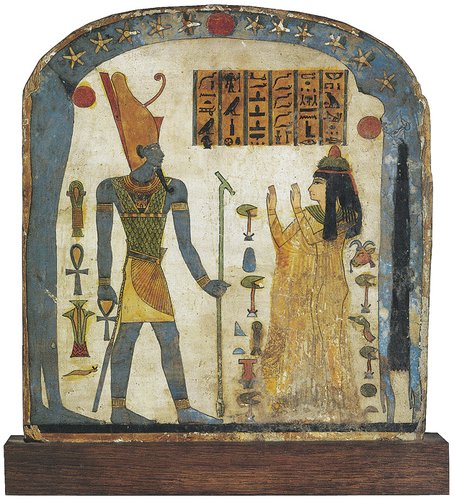
We already read in Old Kingdom how Isis and Nephtys were considered the responsible ones of the dead resurrection: “Ounas goes up through the two thighs of Isis. Ounas rises through the two thighs of Nepthys” [1]. Both goddesses were the two women who conceived and who gave birth to the Pharaoh, this one rose to heaven after his night travel (death). In the funerary context, the dead Osiris had to be reborn as the son of Geb and Nut: “he is the first-born of Geb, the first-born son of Nut, the one who gone out from the womb with the ureus…”[2]. Also, the resurrection of the deceased had a lunar nature and there is another explanation of the lunar cycle, in which the star was born from the womb of the sky goddess Nut and was then swallowed by her at the end of the cycle[3]. Taking into consideration these three points, we could consider that the two women representing Isis and Nephtys in the symbolic sphere engendered the newborn (the dead) and in somehow made also the role of mothers of the deceased. For that reason we read in the Pyramid Texts “Isis has conceived him and Nephtys has nursed him” [4]. From the Old Kingdom there was a relationship between the goddess Nut and the hair: « Nut gives you her two arms, she with the long hair, whose breasts are suspended »[5]. Nut-nwn  Also in the Middle and the New Kingdoms we read: “…this N. goes up to Busiris for seeing Osiris… Nut shakes her hair when she sees me…[6] So, from those quotes we could imagine the goddess Nut making the nwn gesture of shaking hair onwards. The following step was to search on the multiples images in Ancient Egyptian art of Nut and to see if that could have an iconographical basis. The best example is the funerary stele of the Lady Taperet from XXII Dynasty. It is a small wooden stele with painted decoration in both sides with Taperet praying Ra and Atum. On both sides the upper part is decorated with the body of Nut as the vault of heaven, interesting is the scene with Atum where Nut is the firmament and her hair is falling onwards.

Funerary stele of Lady Taperet with an image of Nut in nwn gesture. XXII Dynasty. Musée du Louvre. Photo: www.nybooks.com

Funerary stele of Lady Taperet with an image of Nut in nwn gesture. XXII Dynasty. Musée du Louvre. Photo: http://www.nybooks.com

This image of Nut and the fact that she is the mother of Osiris in the Ancient Egyptian cosmogony lead us to the conclusion that passages from Pyramid Texts, Coffin Texts and  Book of the Dead allude to the birth of the dead. Nut, bended and with her face looking at her pubis sees how his son (the dead) is coming to life. For that reason it is said that Nut shakes her hair when she sees Osiris; in that moment she is making the nwn gesture. This posture has then a very strong symbolic meaning: it is an image of maternity and very close to the rebirth of Osiris as a newborn/resurrected. There is also similar example in a coffin of Uresh-Unefer from the Late Period. We see in it a relief with late version of the same scene with Nut onwards and with a suspended lock of hair. Thinking about coffin as the receptacle of the mummy we need to look on how could be Nut represented on it.

Relief on the coffin of Uresh-Nefer. Late Period. Metropolitan Museum of New York. Photo: www.egiptologia.net

Relief on the coffin of Uresh-Nefer. Late Period. Metropolitan Museum of New York. Photo: http://www.egiptologia.net

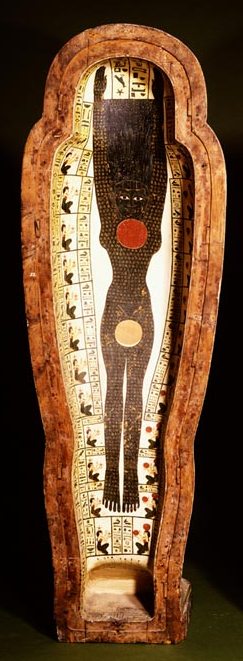
There are many examples of coffins from the Late Period with representations of Nut on the internal side of the cover. In them the goddess is frontally extended all over the surface with hair standing up. In this case we are facing just a different perspective of the same posture. Nut in the cover would be making also the nwn gesture of shaking the hair onwards. The goddess as the sky vault swallows the evening sun and gives birth the morning sun; also many times Nut is the night sky, so she swallows the evening sun and gives birth the full moon.

Coffin of Khenstefnakht from the Late Period. Inside the cover, the goddess Nut with her hair standing up. She swallows the evening sun and gives birth the morning sun. Musée Royaux d'Art et d'Histoire (Brussels). Photo: www.vroma.org

Coffin of Khenstefnakht from the Late Period. Inside the cover, the goddess Nut with her hair standing up. She swallows the evening sun and gives birth the morning sun. Musée Royaux d’Art et d’Histoire (Brussels). Photo: http://www.vroma.org

Internal side of the cover of the Coffin of Peftjauneith. Nut in black is an image of the night sky vault. The goddess with her mane standing up is swallowing the evening sun and giving birth the full moon. Rijsmuseum. Photo: www.rmo.nl

Internal side of the cover of the Coffin of Peftjauneith. Nut in black is an image of the night sky vault. The goddess with her mane standing up is swallowing the evening sun and giving birth the full moon. Rijsmuseum. Photo: http://www.rmo.nl

Inside the coffin takes place the conception and rebirth of the dead, Nut bended, with the hair onwards, will give birth his son Osiris and will put her arms around him: “…Geb is there protecting you; he is your father, you have been put on the world by him; the arms of Nut are around you, she has brought you to life, she brings your beauty…[7].


[1] Pyr., 379c y  996c.
[2] Mariette, 1875, 152-153, 3; Derchain, 1963, p. 22.
[3] Derchain, 1962, p. 27.
[4] Pyr. 1154.
[5] Pyr.2171 a.
[6] CT I, 312 y LdM, 78.
[7]CT I, 60. Translated by Barguet, 1986, p. 198).

The Hair gives the Breath of Life in Ancient Egypt.


In Abaton, where Isis and Nephtys moan[1], is also where “Osiris receives the crying from your mouth and his soul breaths thanks to the weeping”[2]. The breathing is essential for living and also for rebirth; according to what we have read, that breath can be transmitted by means of mourning. There is a chapter of the Coffin Texts where the deceased’s breath is assured thanks to different aspects of hair, we read how the dead “…breathes the east wind through her plait, he catch the north wind through her plait, he takes the south wind through his plaits[3], he takes the west wind through his curls (or his plaits)…” [4].

Thanks to the hair element the dead /Osiris can breathe the wind from the four cardinal points, in the same way that he could breathe in Abaton thanks to the weeping. Again hair and mourning are two inseparable aspects[5] and once again this union hair-mourning-breath sends us to the Osiris Myth. Isis as a kite moved her wings over the corpse of Osiris made the air for causing his resurrection.

Isis as a kite over the corpse of Osiris. Relief from the temple of Seti I in Abydos. XIX Dynasty. Photo: www.common.wikimedia.org)

Isis as a kite over the corpse of Osiris. Relief from the temple of Seti I in Abydos. XIX Dynasty. Photo: http://www.common.wikimedia.org

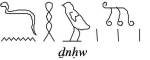
On the other hand it is also interesting to have a look on the word hw, which indicates a movement made by the feathers and whose writing in hieroglyphs was with the determinative of the hair[6]; also words as “feather” or “wings” in some cases could be written with the determinative of hair.

verbo Hw                          pluma Swt                        alas DnHw

So, the union feather-kite-air seems to be very close to the union hair-mourning-breath; it would not be hare-brained to think then in a relationship between the kite’s feather (in the mythical dimension) and the mourner’s hair (in the ritual dimension), both elements making the breath of life.


[1] Guglielmi, 1980, p. 81.

[2] Guglielmi, 1980, p. 80.

[3] In some coffins we read “eyebrow”.

[4]CT III, 228. A very similar passage is in Book of the Dead (LdM 172).

[5] In the Coffin Texts we read: “…the hands of Ssmw are united over the lungs…” (CT III, 168); and in coffin B4Bo the writing for “lungs” is pulmones

[6]CT II, 148

The Hair is a Symbol of Water in Ancient Egypt. Hair in the Festival of the Valley.


The nwn gesture is also represented in a relief from the Red Chapel of Hatshepsut in Karnak. A group of women are dancing in the Festival of the Valley[1].

Dancers in the Festival of the Valley. Red Chapel of Hatshepsut in Karnak. XVIII Dynasty. Photo: Mª Rosa Valdesogo Martín

Dancers in the Festival of the Valley. Red Chapel of Hatshepsut in Karnak. XVIII Dynasty. Photo: Mª Rosa Valdesogo Martín

This festivity is documented for the first time in the temple of Mentuhotep II in Deir el-Bahari as a funerary Theban festivity. It was a feast in honour of the deceased ones. People visited the necropolis, decorated the tombs and carried offers to the dead relatives. In the gods sphere the image of the god Amon went out from the temple of Karnak in his sacred barque [2] and crossed the Nile for visiting every funerary temple of the West Bank. In the procession accompanying Amon there was a feminine clergy, among which there were some dancers.

Barque of Amon. Relief from the mortuary temple of Seti I in Dra Abu el-Naga. XIX Dynasty. Photo: Mª Rosa Valdesogo Martín

Barque of Amon. Relief from the mortuary temple of Seti I in Dra Abu el-Naga. XIX Dynasty. Photo: Mª Rosa Valdesogo Martín

The Festival of the Valley took place in the summer solstice, between the harvest and the flooding season. That means that it coincided with the rising of Sothis in the sky announcing the arrival of the flood[3]. People, who visited the tombs of their relatives during the night sung, drank and danced; according to some scholars sometimes the scenes were even “orgiastic”[4]. “The frontier between death and life disappears with the feast and the inebriation, the border that separates the living world and the Hereafter becomes blurred with the length of the night[5].

The last visit of Amon in his procession was the temple of Deir el-Bahari[6]. In the sanctuary of Hatshepsut the image of the god passed many days and nights. In this temple there is a scene with a barque over the “golden lake” surrounded by four ponds full of milk. During the night the barque was circled by torches, which were put out into the milk n the morning. That night took place the encounter between Amon and Hathor, the Cow Goddess. According to the scholar Naguib the milk into the ponds symbolised the milk of the Sacred Cow, the nourishment of Hathor; and at the same time these four ponds would symbolise the four cardinal points. So, “the solar God gets into the belly of the cosmic mother for renewing thanks to her milk, the same milk where the fire of the night is put out[7]. After that night the procession came back to the temple of Karnak.

After this encounter Amon was energized and ready for facing a new year. In fact it was a funerary festivity in which the god, as if it was a dead one, made a trip to the necropolis and was renewed after some ceremonial practices.

In addition the Festival of the Valley took place before the flood, and during that night of ecstasy Hathor showed her most erotic side. She was “the lady of the inebriation, the happiness in ecstasy, she promoted abundance and fertility”[8] , in whose night the flood was conceived[9]. The feminine being (Hathor) awarded the masculine principle (Amon) the fecundity power confirming this way the enthronement of the solar god.

In this renewing festivity we find again the nwn gesture. In the 30’s E. Brunner-Traut already compared the women who appear in the Red Chapel of Hatshepsut with the mourners of the tombs of Renni and Amenemhat, but she considered that they had nothing to do with each other[10]. According to her, the dancers of the Red Chapel were making a gesture of excitement and ecstasy[11], the movements of the mourners ware just a part of the moan[12]. However, H. Wild considered that what was said in chapters 1005 and 1974 of the Pyramid Texts about mourners pulling hair (« The souls of Buto rock for you; they beat their bodies and their arms for you, they pull their hair for you… ») was a description of a special dance in honour to the deceased king[13].

In the Theban tomb 53 of Amenemhat from the reign of Tutmosis III there is a very similar scene to that one of the Red Chapel. Some women are dancing or tumbling and caver their faces with the hair. In front of them three more women are shaking sistrums and a mena necklace; so this ceremony was related to the cult to Hathor.

Dancers from the tomb of Amenemhat (TT53). Gourna. XVIII Dynasty.

Dancers from the tomb of Amenemhat (TT53). Gourna. XVIII Dynasty.

In the 70`s Vandier considered that these were acrobatic dances and that women were making somersaults[14]. In the 80’s W. Decker, based on a reconstruction made by O. Keel[15], accepted the theory of Vandier and thought that the women with the hair over their faces were in fact getting ready for starting the somersault forward[16]. Also W. Decker compared this gesture with the one of the mourners in funerals (in particular with mourner in the Tomb of Minakht). But it seems unlikely that they describes similar moments; while in the first document we are in a group of dancing women, while in the tomb of Minakht she is not with other women making acrobatics.

Coming back to Deir el-Bahari, in the sanctuary there is a scene of the solar barque in procession. In it two women on their knees are touching their napes and cover their faces with the hair. Vandier thought that they were waiting their turn for making the same exercise as their fellows[17]. He emphasizes the fact that those women are not in a vertical posture, so maybe getting ready for making the somersault backwards[18].

Dancers in the Festival of the Valley. Relief from the temple of Deir el-Bahari. XVIII Dynasty. Photo: Mª Rosa Valdesogo Martín.

Dancers in the Festival of the Valley. Relief from the temple of Deir el-Bahari. XVIII Dynasty. Photo: Mª Rosa Valdesogo Martín.

It seems obvious that those women were making some acrobatics, but we do not think that cover their faces with hair were just a way of representing the first step of a somersault.  If thinking of a gymnast gaining momentum, the hair is never covering the face. The gesture nwn in the images of the dancers in the Festival of the Valley is not realistic at all (although about the realism in Egyptian art is another subject for debate). Taking into consideration that as much in tombs as in temples we are facing renewing ceremonies with a regeneration intention. So it is easy to think that nwn gesture in that dance had a reviving purpose. Dancers and mourners do the same movement of bending the body and throw the hair forward; and apparently in both cases with a similar symbolism.

On the other hand, the dance is something very common in religious rituals[19], and they have a connection with lunar rites[20]. “The dance is maybe considered as a fact of pleasant magic for promoting the lunar rebirth”[21]. If we notice that the Festival of the Valley was a funerary ceremony celebrated after the first new moon (a symbol of death) and before the flood (the annual renovation in Egypt), we could think that it was, as in burials, a new creation rite, it was the announcement of a cyclic renovation and the reenergizing of Amon[22].


[1] Michalowski, 1970, fot. 70.

[2] With the ones of  Mut and Jonsu.

[3] Naguib, 1990. Leuven, p. 129.

[4] Stadelmann, 1990, p. 148.

[5] Stadelmann, 1990, p. 149.

[6] Naguib, 1990, p. 126.

[7] Naguib, 1990, p. 128.

[8] Naguib, 1990, p. 129.

[9] Naguib, 1990, p. 130.

[10] Brunner-Traut, 1938, p. 51, n. 13.

[11] Brunner-Traut, 1938, p. 52.

[12] Brunner-Traut, 1938, p. 60.

[13] Wild, 1963, p. 86.

[14] Vandier, 1964, p. 451.

[15] Keel, 1974, fig. 11

[16] Decker, 1987, pp. 140-142.

[17] Vandier, 1964, p. 450.

[18] Vandier, 1964, p. 450.

[19] “Funerary dances take part in rites of passage, as in breaking rites of African cultures” (Naguib, 1993, p. 29).

[20] Briffault, 1974, p. 341.

[21] Briffault, 1974, p. 342.

[22] The physical activity (the movement) is a help for the resurrection. Amon, as king of gods, had to renew his power, as in the living world did the pharaoh.

Hair and Death in Ancient Egypt: Pulling Hair also in the Hereafter.


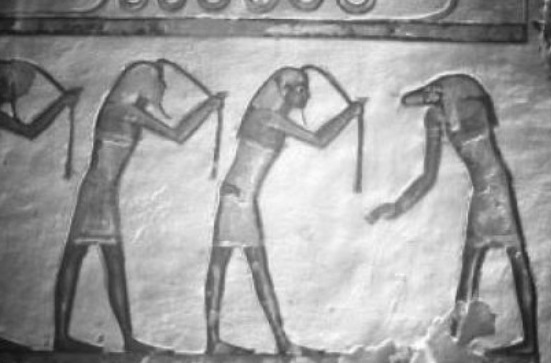
Mourners of Re pulling hair. Section two of the Book of Caverns. Tomb of Ramses VI. XX Dynasty.

Mourners of Re pulling hair. Section two of the Book of Caverns. Tomb of Ramses VI. XX Dynasty.

Not only on ancient Egyptian funerals were mourners shaking or pulling hair. Also in the Hereafter, supernatural beings were responsible of these kinds of practices. Book of Caverns show in the second section the god Re with head of crocodile walking towards nine divinities that hold their front lock of hair, the text says:

“Oh! The one who mourns, big of lock syt and of strong cry in the West protect the king.

“Oh! The one of the hair who is on the moan [1]el que está sobre el lamento

“Oh! These nein gods that mourn for Osiris, that cry for that one who is in front of Amduat.

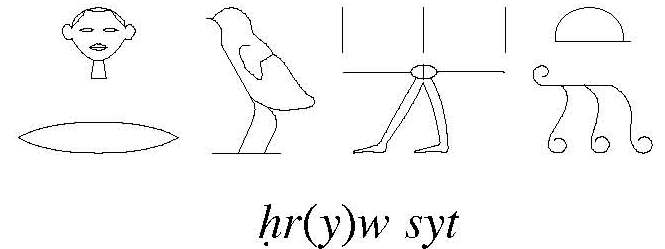
Oh, look at me! I am walking towards you I pass by your caverns I call you and you scream to me. Duaty, he feels happy with your voice, those ones who mourn in Duat, the ones with secret faces, under you lock of hair syt[2], your voice is for me. I call you together , I light you up[3], mourners…you lead me and I walk towards you[4], I really protect your souls, I make you have my light, I take away the darkness that is on you…big mourners, having goods, you who are over the lock of hair syt in the land of the West . I walk on the ground I came from in my first birth”.

In the Duat the iakbyw (mourners) work for the regeneration of the dead god Osiris, crying and holding their locks of hair. And at the same time, that resurrection provides protection and light for their souls . When the deceased is in darkness the mourners are “under the lock of hair” covered with this hair:

bajo el mechón syt

When the deceased revives  and can walk in the Duat, the expression is just the contrary: “over the lock of hair” :

sobre el mechón syt

They are not anymore under the hair, but they have come to the light and the dead is “happy with the youth of his body

The words syt and swt describe the front lock of hair the mourners pull. We find also the term syt in The Coffin Texts in chapters 799 and 532, where tells about « tying the lock syt in Heliópolis the day of cutting the samt » and in several documents from the New Kingdom we also can read how a male characters are the mourners of Re and hold their lock of hair syt/swt[5] they grant that Osiris can be justified in the Hereafter [6]. At this point it is also interesting to say that in the chapter 339 of the Coffin texts, the day of the resurrection of Osiris is the day ofshaving the mourning women”.

Again, also in the Hereafter, the nwn m gesture is a part of the mourning rite, as a sign of pain but also as a way of making the dead revive and make easier his way in to the Hereafter.


[1] . Pay attention in the word used for moan (samt), which has de determinative of the hair. In the cenotaph of Seti I in Abydos we read: “Oh! The one of the hair, over his moan, who puts his voice, to whom the souls call” 

[2] . Piankoff translated the preposition  as “carrying” the locks syt.  But the first meaning of that preposition is “under”. If we take the sentence as “under the locks of hair syt” it made sense with the previous expression: “of secret faces”, so, “hidden under the hair”.

[3] The light comes after the darkness of the death.

[4] Mourners guide the dead with their screams. The deceased is blind (dead) and on the way to the new light (new life).

[5] Piankoff and Jacquet-Gordon, 1974, p. 55, Pl. 10.

[6] Berlin Papyrus 6, Piankoff and  Jacquet-Gordon, 1974, p. 57.

Pulling and shaking hair over the mummy in Ancient Egypt.


We have already seen how in chapter 180 of Book of the Dead the mourners appear dishevelled for or over the deceased.

Mourner covering her face with her hair. Tomb of Renni in el-Kab. XVIII Dynasty. Photo: www.egyptraveluxe.blogspot.com

Mourner covering her face with her hair. Tomb of Renni in el-Kab. XVIII Dynasty. Photo: http://www.egyptraveluxe.blogspot.com

The dead is now in the Hereafter and needs to get again the mobility. This chapter treats about the physical resurrection of the deceased and it was included in many tombs of kings (Tutmosis III, Seti I, Ramses II, Meneptah I, Seti II, Siptah, Ramses III and Ramses IV). In all cases the verb used for dishevelled was nwn. Taking into consideration those determinatives and the iconography of tombs of Amenemhat and Renni, one correct translation could be “…they are dishevelled over you…”.

We can then visualize the nwn gesture over the corpse for his benefit. Because after that the chapter follows: “…your soul gets happy, your body becomes glorious…” It describes the resurrection of the mummy, process in which was important that rite of mourning.

At this point we need to mention three relevant documents that refer to the role of mourning women in front of the body.

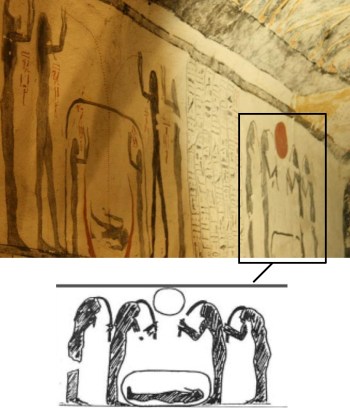
1)      The tomb of Ramses IX. On the left wall of the funerary chamber there is a unique scene of resurrection. The dead as a mummy inside an oval, over the corpse four women are making the nwn m gesture of pulling their locks of hair.

Women pulling lock of hair over the dead. Tomb of Ramses IX. Valley of the Kings. XX Dynasty. Photo: Mª Rosa Valdesogo Martín.

Women pulling lock of hair over the dead. Tomb of Ramses IX. Valley of the Kings. XX Dynasty. Photo: Mª Rosa Valdesogo Martín.

In the following scene the dead is not a mummy anymore, but now his legs and arms have movement. That makes us think about the nwn m gesture as something made for revitalising the body. The text accompanying the image is a fragment of the Book of Caverns in which we read about the resurrection of the dead and in that context it says:

“Those Goddesses are so, they are mourning over the secret place of Osiris…they are together, screaming and crying over the secret place of the ceremony…their secret is in their fingers…”

It is clear the relationship between mourning and the resurrection of the dead, to whom the women are pulling their locks of hair. On the other hand it is interesting to pay attention to the expression “…their secret is in their fingers…”, because with those fingers they are holding their hair. Which one is the secret? Is the resurrection or the way for reaching that resurrection?

2)      The coffin of Ramses IV. In the head piece there is a representation of Isis and Nephtys making the same nwn m gesture.

Isis and Nephtys pulling their locks of hair. This image is the head piece of the coffin of Ramses IV.

Isis and Nephtys pulling their locks of hair. This image is on the head piece of the coffin of Ramses IV.

Both goddesses are facing the head of the dead and the image is accompanied by an inscription where we read:

 “They move their faces during the moan; they mourn over the secret corpse of …

Both goddesses are holding their locks swt, the water is dropping from the eyes of these goddesses…the breath comes from them (the goddesses)…”

In some moment of his resurrection the dead finds Isis and Nephtys, which leaning their faces, holding their locks of hair swt and crying over the corpse, allow the dead to breathe and revive.

There is a very similar example in the coffin of the dwarf Dyedhor, who was dancer in the Serapeum. This coffin was found in Saqqara and belongs to the Persian period. The coffin of Dyedhor shows also Isis and Nephtys pulling their frontal locks of hair (Cairo Museum, nº cat. 1294).

3)      The stele C15 in Louvre Museum is another important document for this subject. It was found in Abydos and dates from XI Dynasty. His owner was Abkaou, chief of the cattle. In the Middle Kingdom became very popular to put a stele in Abydos in the memory of the deceased god Osiris. In this stele the lower register shows Abkaou receiving the offerings while in an upper register there is an image of the ceremonies that took place during the Osiris festivity. Two mourners are over the lying corpse and both cover their face with the hair; in fact it remembers what it is said in chapter 180 of Book of the Dead.

Two mourners making nwn gesture over the corpse. Detail of the stele of Akbaou (stele C15) from Abydos. Musée du Louvre. XI Dynasty. Photo (stele): www.cartelfr.louvre.fr; photo (detail): www.commons.wikimedia.org

Two mourners making nwn gesture over the corpse. Detail of the stele of Abkaou (stele C15) from Abydos. Louvre Museum. XI Dynasty. Photo (stele): http://www.cartelfr.louvre.fr; photo (detail): http://www.commons.wikimedia.org

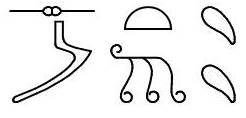
The inscription is much reduced: once hieroglyph tm and twice the hieroglyph nwi.   niw tm

The verb tm in ancient Egyptian means “complete”, “be completed”, “join the different parts of the body” (Wb V, 303), especially when it is about the parts of the dead (Wb V, 305, 1) and nwi means “to be in charge of” (Wb II, 220);  the whole could be translated as “to be in charge of completing”. In the Myth of Osiris Isis with the help of Nephtys are the ones who collect the different parts of the body of Osiris, so these two mourners of the image would also be in charge of mending the body of the dead. The nwn gesture they are doing over the body would be one of the practises for revitalizing the deceased.

Suming up, mourners in Ancient Egypt made a kind of rite with their hair during the funerals. It could be to cover the face with the hair (nwn) or pull the frontal lock of hair (nwn m). In both cases we have proofs of this practise over the corpse and always with a revitalising goal.

For understanding better the meaning of this practise we have to know more about the symbolism of hair.