Tag Archives: death

Pulling and shaking hair in Ancient Egyptian iconography.


In the former post we have seen mainly those interesting references taken from chapters of the Coffin Texts. However they are not the only documents where we can find the proof of the importance of the mourner’s hair in the funerary ceremony of Ancient Egypt. Reliefs and paintings show us how mourners effectively pulled and shook their hairs in the funeral.

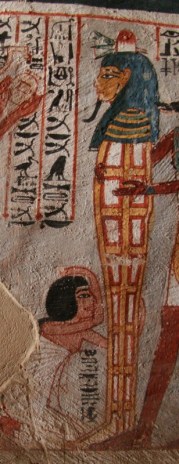
Mourning woman of Minnakht's tomb. www.1st-art-gallery.com

Mourning woman. Tomb of Minnakht. Photo: http://www.1st-art-gallery.com

Old Kingdom.

Thanks to the Pyramid Texts we also know that the gesture of covering the face with the hair existed already in the Old Kingdom. Some tombs of that period offer us scenes with mourning women pulling their lock of hair (nwn m). The tomb of Mereruka in Saqqara and the tomb of Idu in Guiza, both from VI Dynasty, have reliefs of mourning women some of them are just crying, rocking, beating their arms and heads, but we can see some women pulling their front lock of hair.
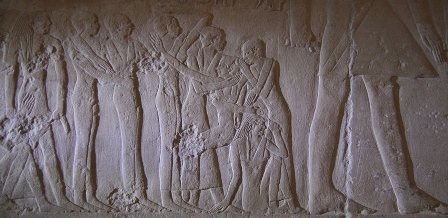
Relief of mourners, one of them pulling her frontal lock of hair. Tomb of Mereruka in Saqqara. VI Dynasty. Photo: Mª Rosa Valdesogo Martín.

Relief of mourners, one of them pulling her front lock of hair. Tomb of Mereruka in Saqqara. VI Dynasty. Photo: Mª Rosa Valdesogo Martín.

Drawing of mourning women. Tomb of Idu in Guiza. VI Dynasty.

Drawing of mourning women. Tomb of Idu in Guiza. VI Dynasty.

I want to emphasize in the tomb of Idu two reliefs representing mourning men who are also pulling their hair. It is not so usual to find scenes of mourning men in Ancient Egypt funerals and less shaking their hair or pulling from it. Here there is another open subject for a future research.

This same gesture we find it in the tomb of Inti in Dishasha (near Bahr el-Yusuf) from the VI Dynasty. In this case we are not in a funerary scene, but a war moment, in it the major of the city and a woman in front of him are pulling their front lock of hair. Although it is not a mourning scene, the gesture happens in a moment of desperation and suffering, the same feelings had to show mourners in funerals.

Drawing of the relief in the tomb of Inti. Inside the fortress we can see the major and a woman, both pulling their lock of hair. Dishasha. VI Dynasty.

Drawing of the relief in the tomb of Inti. Inside the fortress we can see the major and a woman, both pulling their lock of hair. Dishasha. VI Dynasty.

Middle Kingdom.

The stele of Abkaou from Abydos in the Louvre Museum dates from the XI Dynasty and it  is one of the best documents for us coming from the Middle Kingdom. In it the artist represented the ceremonies of the Osiris festivity, one of the scenes shows two women shaking hair forwards the mummy.

Two mourners making nwn gesture over the corpse. Detail of the stele of Akbaou (stele C15) from Abydos. Musée du Louvre. XI Dynasty. Photo (stele): www.cartelfr.louvre.fr; photo (detail): www.commons.wikimedia.org

Two mourners making nwn gesture over the corpse. Detail of the stele of Akbaou (stele C15) from Abydos. Musée du Louvre. XI Dynasty. Photo (stele): http://www.cartelfr.louvre.fr; photo (detail): http://www.commons.wikimedia.org

From Middle Kingdom comes a fragment of a coffin found in Abydos with rests of painting on one side. It shows a funerary procession where a mourning woman with tears falling on her cheek is bent and with the hair over her face. It seems that she would walk mourning besides the coffin, which would be carried by some men.

Mourning woman beside the coffin. Image in a coffin of the Middle Kingdom from Abydos.

Mourning woman beside the coffin. Image in a coffin of the Middle Kingdom from Abydos.

New Kingdom.

The main part of the figurative examples comes from the New Kingdom:

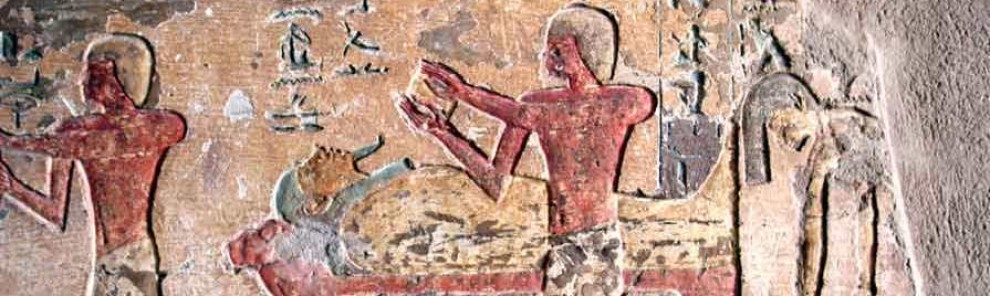
The tomb of Amenemhat (TT82) in Gourna, dates from the XVIII Dynasty and over the door there is scene in which the mummy of Amenemhat lies on a canopy, a priest in front of the dead is making a libation and burning incense; four mourning women are crying for the deceased and two of them are making the nwn gesture of shaking their hairs and covering their faces with it.

Relief from the tomb of Amenemhat (TT 82)

Drawing of the relief from the tomb of Amenemhat (TT 82) in Gourna. XVIII Dynasty.

A very similar scene is on the tomb of Ineni (TT81), also in Gourna and also from XVIII Dynasty. In front of a group of mourners there is one with the body bent, although the head is not preserved it is obvious that this woman was making the nwn gesture.

The same scene is in the tomb of Minnakht (TT87), also in Gourna and also dating from XVIII Dynasty. The only difference here is that she is making the nwn gesture and facing the rest of mourners.

Mourning woman. Tomb of Minnakht. www.1st-art-gallery.com

Mourning woman. Painting in the tomb of Minnakht in Gourna. XVIII Dynasty. Photo: http://www.1st-art-gallery.com

The tomb of Renni in el-Kab dates from the reign of Amenhotep I and it is very noticeable how a mourning woman is making the nwn gesture just in front of the dead.

The mourner on the right shows the hair to the deceased. Relief from Renni's Tomb in el-Kab. Photo: www.egyptraveluxe.blogspot.com

The mourner on the right shakes the hair to the deceased. Relief from the tomb of Renni in el-Kab.  XVIII Dynasty. Photo: http://www.egyptraveluxe.blogspot.com

A very similar scene is still visible in a relief in the funerary temple of Seti I in Dra Abu el-Naga, where both mourners are making the gesture nwn on both extremes of the body of the dead pharaoh.

The tomb of Rekhmire in Gourna (TT100) shows to us also an image of mourning in the north wall of the corridor, in which a group of women are mourning, two of them making the nwn gesture. According to the whole scene, this could be happening while inside the tomb or inside a construction was taking place the ceremony of the Opening of the Mouth. But there is something that makes this image different from the rest we have seen: a totally lack of dynamism. While in the former examples women shake their hair forward with energy and with signs of movement, Rekhmire’s mourners have the body straight and their arms are crossed over their chests, showing a passive attitude.
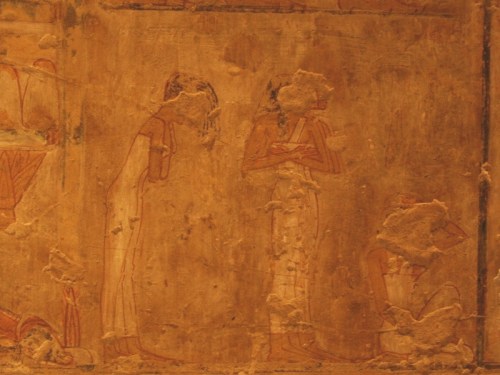
Mourning women in the tomb of Rekhmire. Gourna, XVIII Dynasty. Photo. Mª Rosa Valdesogo Martín

Mourning women in the tomb of Rekhmire. Gourna, XVIII Dynasty. Photo. Mª Rosa Valdesogo Martín

This stillness and the fact that it maybe could be happening apart from the Opening of the Mouth, could make us think that, while in some place are taking place the practises for the resurrection of the dead, in other place these mourners would be making the nwn gesture with a negative connotation, I mean, like a real exhibition of pain and sadness that dives the mourner in the darkness of the chaos that brings about the death.

Texts and iconography show that mourners made two gestures: nwn m (pull the front lock of hair) and nwn (shake hair and cover the face).

In which moment of the funerary ceremony would take place this nwn m/nwn gesture? According to Davies and Gardiner, it could happen some when between the embalming rites and the final celebrations of the funeral.

We will treat that point later. Before we need to know why the hair became such an important element in the funerary rite.
Hair and Death in Ancient Egypt: Parts of the contents.


The work has four main parts:

1) The first one is dedicated to the gesture of shaking the hair made by mourners in Ancient Egypt.

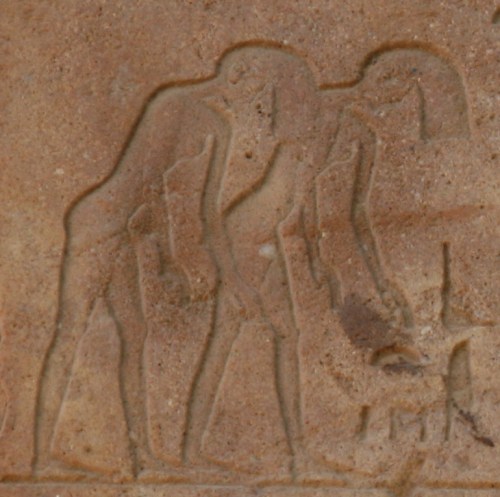
Two women shaking their hairs. Relief from the Red Chapel of Hatshepsut in Karnak. Photo: Mª Rosa Valdesogo Martín

Two women shaking their hairs. Relief from the Red Chapel of Hatshepsut in Karnak. Photo: Mª Rosa Valdesogo Martín

Using the written documents and the iconography, this subject is treated from the practical and symbolic point of view, since I write about the symbology of hair for better understanding that gesture in the funerary context.

2) In the second part I tackle four different aspects of the hair:

  • the lock of hair swt
  • the braid Hnskt
  • the two curls wprty
  • the long hair (mane)  Samt

All speeches here are about these forms of hair from a symbolic perspective, which is always related to regeneration concept, so important in Ancient Egypt.

3) The third part of the work contemplates the relationship between the hair and the Udjat eye (Eye of Horus)Udyat Eye. At the end of the funerary ceremony the delivery of the Udjat eye means the resurrection of the deceased, assimilated to the god Osiris. In this last step the presence of the hair is very relevant, and to analyse it in third place is helpful for understanding much better the final of the funeral.

4) Once I have seen evidences in Ancient Egypt of a lamentation rite with the hair as the main element, I wanted to know in which moment of the funeral it took place. Reading between the lines the funerary texts and the iconography, we could think that the mourning rite was carry out in some moment during the “Opening of the Mouth” ceremony, a group of practices made in front of the mummy or the statue of the dead.

Women mourning beside the mummy. Tomb of Roy in Dra Abu el-Naga. Photo: Mª Rosa Valdesogo Martín.

Women mourning beside the mummy. Tomb of Roy in Dra Abu el-Naga. Photo: Mª Rosa Valdesogo Martín.

The two mourners representing the goddesses Isis and Neftis could be in charge of renewing gestures with their hairs for helping the deceased’s regeneration.

Hair and Death in Ancient Egypt: Foreword.


I started this research when Dr. Nadine Guilhou from the university of Montpellier told me about some images in Egyptian iconography where hair in funerary rites was treated in a very special way.

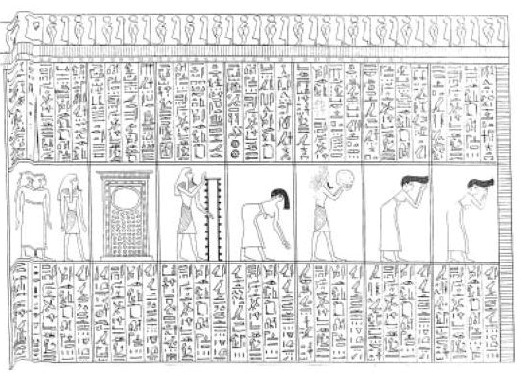
The first important document was a vignette in the chapter 168 of the Book of the Dead. Here mourning women in the funeral cortege of Re were shaking their hair and covering their faces with it.

Chapter 168 B of the Book of the Dead.

Chapter 168 B of the Book of the Dead.

I needed to be sure that it was not an isolated case, so I had to find out more similar examples. I found many similar scenes in Theban tombs from the New Kingdom where mourning women gesticulated in the same way: Amenemhat (TT82),  Minakht (TT87), Rekhmire (TT100) and Ineni (TT81), in the tomb of Renni at el-Kab (see the front of the blog). Out of the burials, but always in the funerary context, there is a scene from the funerary temple of Seti I in Dra Abu el-Naga.

Relief from the tomb of Amenemhat (TT 82)

Relief from the tomb of Amenemhat (TT 82)

Such a common attitude could not be just a coincidence, or a theatrical exposure of pain, but it had to arise from a deeper reason related to the funeral rite.

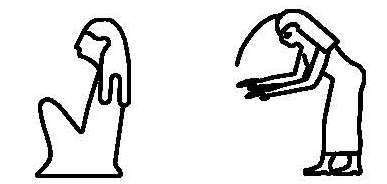
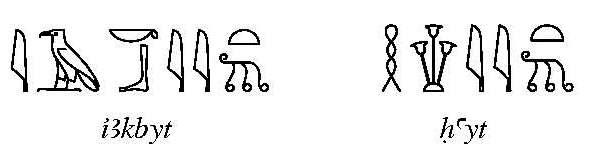
I still needed to look for more. Together with the iconography in Egyptology is necessary to have a look to the vocabulary. Among the words used by the Egyptian for “mourner” there was iakhbyt or hayt; I noticed that in many cases the writing did not include the determinative of a woman or a dishevelled woman, but the hieroglyph of the hair.

Determinatives of a woman and a dishevelled woman.

Determinatives of a woman and a dishevelled woman. Below the words in egyptian for “mourner“.

Jeroglíficos Foreword1


  This showed that the mourner’s hair was such an important part of them, that even it could identify them.

As we were in the funeral field, I had to consider all funerary texts and I found many allusions to the capillary element. Those ones were more frequent in the Coffin Texts of the Middle Kingdom and all of them with a « common denominator »: in all speeches mentioning the hair, mourner women were the main personages (and of course the mourning rite) and the Osiris myth was the backdrop.

For supporting the written document of the Middle Kingdom I found two images from the same period. One of them was a representation of a mourner beside the coffin leaning onwards and with her hair over her face; the other one was the Louvre stela C15, where the two mourners who assist the dead are doing this same gesture.

Mourning woman beside the coffin. Image in a coffin of the Middle Kingdom from Abydos.

Mourning woman beside the coffin. Image in a coffin of the Middle Kingdom from Abydos.

Given that the Coffin Texts is where more allusions to hair can be found, I decided to initiate the research with reading of this corpus, so the other texts I mention are just support documents.

HAIR AND DEATH IN ANCIENT EGYPT


In 2005 I published my book about Hair in Funerary Context in Ancient Egypt, which was my doctorate research. With the help of Nadine Guilhou from Université Paul Valéry (Montpellier) I came to important conclusions that helped to know much better some funerary rites in Ancient Egypt.  But, mainly, I noticed the importance of mourning women, whose presence was crucial for the dead’s resurrection.

Mourning women, one of them on the ground pulling her hair. Relief from the tomb of Mereruka in Saqqara. Photo: Mª Rosa Valdesogo Martín.

It was published in Spanish and my intention was to translate it into English or French for the international community.

Thanks to the new technologies, now we can share knowledge in an easy and quick way, so I have thought to use them  to transmit that content to everyone who could be interested.

I hope you enjoy.

María Rosa Valdesogo Martín