Tag Archives: Nephtys

Second Summary


The Hair and the Eye of Horus.

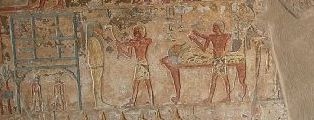
Detail of the mourners icovering their faces with the hair. Tomb of Rekhmire in Gourna. XVIII Dynasty. Photo: Mª Rosa Valdesogo

Detail of the mourners covering their faces with the hair. Tomb of Rekhmire in Gourna. XVIII Dynasty. Photo: Mª Rosa Valdesogo

The hair sm3 is assimilated to the lunar eye’s disease. The damage eye of Horus is an image of the battle between him and Seth, the Osiris’ murderer and in the Egyptian belief it symbolises the chaos and the darkness of the death. It is the moment the mourners are in nwn gesture and covering their faces with their hair sm3.

For the deceased’s rebirth it is necessary the healing of this lunar eye. In the mythic sphere is Thoth who spits on the eye for eliminating the disease it suffers, in the funerary ceremony we do not know if someone spitted on the mourner’s hair sm3.

Once the eye is recovered it becomes the Udjat eye. For contributing to the final resurrection the Udjat eye is offered to Osiris, this action symbolises the access from darkness to light.

In the funerary context it is the step from the hair sm3, image of chaos, darkness, evil, to the hair s3mt, assimilated to the Udjat eye. According to the funerary texts it is the moment of cutting the s3mt, something that can be understood as shaving the mourners and ending the mourning ritual.

The Hair and the Opening of the Mouth Ceremony.

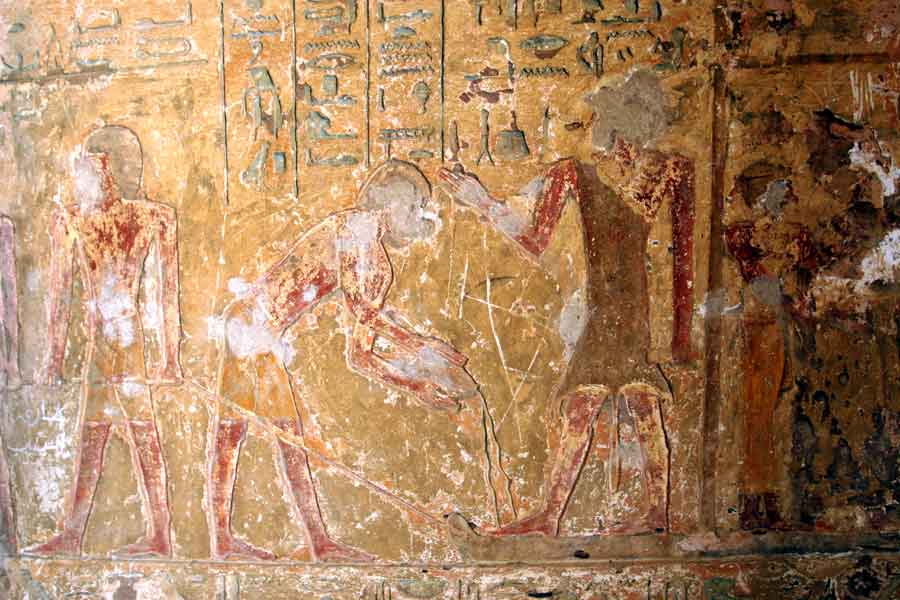
On the right the mourner in nwn gesture towards the corpse. Scene from the tomb of Renni in el-Kab. XVIII Dynasty. Photo: www.osirisnet.net

On the right the mourner in nwn gesture towards the corpse. Scene from the tomb of Renni in el-Kab. XVIII Dynasty. Photo: http://www.osirisnet.net

The mourning ritual was one of the several sacred practices which formed the Opening of the Mouth ceremony. The two Drt, or two kites, maybe were professional and expert priestess who knew quite well this secret ritual of the resurrection. They shook (nwn) and/or pulled (nwn m) their hair towards the corpse dramatizing this way the passage in the Osiris’ legend, where Isis and Nephtys mourned his death, helped in his body recovery and contributed in his final rebirth.

Probably the mourning ritual started before the sacrifice of an ox. After a while hair started the slaughter of the animal while the mourners went on making the nwn gesture. The ox was the scapegoat and its death symbolised the victory of Horus over Seth, and the recovery of the Udjat eye. The female nature of these two women was crucial thanks to the relationship of women to moon and light.

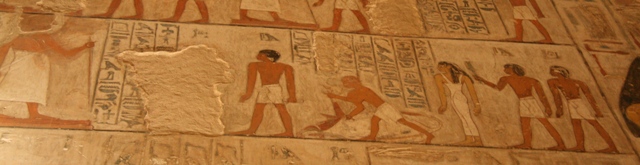
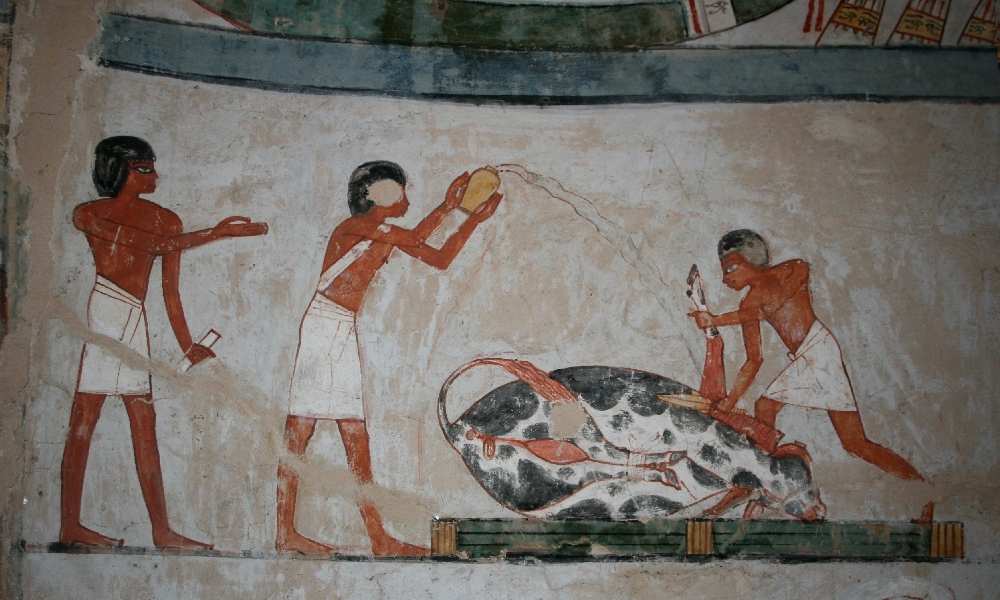
Sacrifice of the ox with the presence of the mourner. Painting from the tomb of Rekhmire in Gourna. XVIII Dynasty. Photo: Mª Rosa Valdesogo Martín.

Sacrifice of the ox with the presence of the mourner. Painting from the tomb of Rekhmire in Gourna. XVIII Dynasty. Photo: Mª Rosa Valdesogo Martín.

It is not clear if the mourning ritual was done before or after the tekenu rite, but in both cases the hair had a relevant role, because it seems that at the end a piece of hair was cut and offered to the deceased for his benefit and for contributing to his final resurrection.

Professional Mourners in Ancient Egypt.


The other point would be to discern who were these two women shaking and/or pulling their hair? Women represented next to the coffin are described as wife, widow, servant…The Egyptian Opening of the Mouth ceremony was secret and made by expert priests in the practices, therefore the mourning ritual, also secret and as a part of the first one, should be performed by women who knew very well every step of the rite.

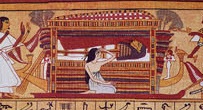
Close to the mummy the wife cries, while the two mourners in the role of Isis and Nephtys stand at both extremes. Detail from the Papyrus of Ani. XIX Dynasty. Photo: www.wikimedia.org

Close to the mummy the wife cries, while the two mourners in the role of Isis and Nephtys stand at both extremes. Detail from the Papyrus of Ani. XIX Dynasty. Photo: http://www.wikimedia.org

If we pay attention to Egyptian scenes of funerary processions, in many cases we can see the deceased’s wife crying on the coffin, while at both extremes stand two women identified as Isis and Nephtys. Although there are generic terms in Egyptian language for mourners, as iAkbyt, smwt or HAyt, the two mourners taking part in the rites for recovering the mummy are called Dryt, the two kites. They are the female figures standing at each extreme of the corpse, making the mourning ceremony impersonating Isis and Nephtys. The other mourning women or the deceased’s wife are never designed like that because the kite per excellence in Egyptian mythology was Isis and by extension, Nephtys. The role of those mourning women was too important and they could not be secular women, but official mourners who had the authority for getting into the “secret place”, where the corpse came back to life.

Isis and Nephtys are at both extremes of the mummy. Behind Roy's wife mourns her husband's death. Painting from the tomb of Roy in Dra Abu el-Naga. XVIII Dynasty. Photo: Mª Rosa Valdesogo Martín.

Isis and Nephtys are at both extremes of the mummy. Behind Roy’s wife mourns her husband’s death. Painting from the tomb of Roy in Dra Abu el-Naga. XVIII Dynasty. Photo: Mª Rosa Valdesogo Martín.

On the other hand these two women in the role of the goddesses are usually represented with clothing covering their hair, while the rest of mourners, also the wife, appear with the black mane visible. We could think that they were hiding a sacred element, through which they were able to bring the dead back to life. That makes us think that the mourning ritual was performed by someone who knew the secrets of the ceremony, a kind of priestess, who played the role of the deceased’s wife and sister-in-law, and who held the title of Drt.

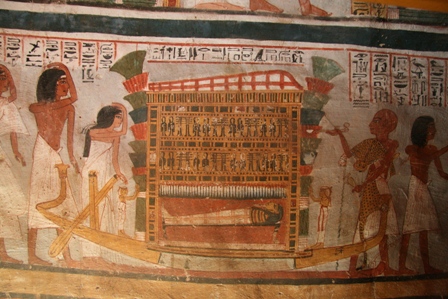
The wife is kneeling and crying, Isis stands on the left and Nephtys on the right. Painting from the tomb of Samut in Assassif. XIX Dynasty. Photo: www.osirisnet.net

The wife is kneeling and crying, Isis stands on the left and Nephtys on the right. Painting from the tomb of Samut in Assassif. XIX Dynasty. Photo: http://www.osirisnet.net

Which features should they have these called souls of Buto? Obviously they should be initiated in the Osiris Mysteries, but we know from the Lamentations of Isis and Nephtys that one of the requirements for being a mourner in the role of Isis and Nephtys was not have been mother yet, so to have intact the power of conceiving. This idea is reinforced when in that same text Osiris is considered “the first-born who opens the body”. This was a way of being faithful to the myth and also a way of securing the resurrection of the dead, because the conceiving faculty of both Isis and Nephtys was intact[1].

About what other requirements they needed to have we do not know, but everything points to a pair of women who knew about that secret and sacred rite of mourning and performing with their hair in the deceased’s benefit. They had nothing to do with the common mourners of the cortège and nor with the dead’s wife, maybe even they had any kinship. Possibly they were professional mourners, knowing when to scream, when to recite some speeches and when and how to shake and/or pull their hair.


[1] Ph. Derchain also considered that they were two women without children (Derchain, 1975, p.73). In the myth of Osiris Isis has not yet given birth Horus. This one is born after his father’s death and his birth is the grant of the resurrection of Osiris. In the funerary ceremony the idea would be the same one: maternity happens after the decease.

The Mourning Ritual in the Opening of the Mouth Ceremony.


The fact of being a secret ceremony would explain why it is so rare to find images of the two mourners in the role of Isis and Nephtys carrying out the mourning ritual. The iconography shows them crying next to the mummy, but it is not usual to see what exactly they do.

on the right the mourner in nwn gesture towards the corpse. Scene from the tomb of Renni in el-Kab. XVIII Dynasty. Photo: www.osirisnet.net

On the right the mourner in nwn gesture towards the corpse. Scene from the tomb of Renni in el-Kab. XVIII Dynasty. Photo: http://www.osirisnet.net

Some of the most explicit images of what the mourners do with their hair over or in front of the mummy are the stele of Abkaou (XI Dynasty), the tomb of Renni in el-Kab (XVIII Dynasty), the funerary temple of Seti I in Dra Abu el-Naga (XIX Dynasty) or the tomb of Ramsés IX (XX Dynasty); being scenes included in the coffin we could also put in this group the representations of Isis and Nephtys pulling their frontal lock of hair in the coffin of Ramsés IV (XX Dynasty) and in the coffin of Nes-shu-tefnut (Ptolemaic period).

Isis and Nephtys making nwn m gesture. Sarcophagus of Royal Scribe Nes-shu-tefnut from Saqqara. Ptolemaic Period. Kunsthistorisches Museum in Wien. Photo: www.globalegyptianmuseum.org

Isis and Nephtys making nwn m gesture. Sarcophagus of Royal Scribe Nes-shu-tefnut from Saqqara. Ptolemaic Period. Kunsthistorisches Museum in Wien. Photo: http://www.globalegyptianmuseum.org

Even the Opening of the Mouth rite of the tomb of Rekhmire does not give us a defined idea of the performance these women did it is the most complete scene of the whole ceremony that ancient Egyptians have left to us, but it is not clear what these two women did, since the mourners appear with a passive gesture. However, thanks to the funerary literature, we know that already from the Old Kingdom they performed a mourning ceremony screaming, crying and shaking or pulling hair. So, Rekhmire wanted the resurrection rites to be reflected in his tomb, but the artist might have a sacred limit, because the divine secrets must be concealed as a sign of respect[1].

According to the sources we have seen all along this work we have proofs of the following:

  • The mourning rite was a part of the Opening of the Mouth ceremony.
  • The mourning rite could be made by two women in the role of Isis and Nephtys or just by one mourner in the role of Isis (as Osiris’ wife), reproducing a passage of the Myth of Osiris.
  • In this mourning ritual the hair of the mourner(s) was the main element.
  • This mourning ritual consisted not just of crying for the death of Osiris (the deceased), but of a gesture made with the hair.
  • This gesture could be to shake the hair forwards and cover the face with it (nwn) or to pull the frontal lock of hair (nwn m).
  • According to the iconography these two gestures were made over or in front of the corpse, so in the deceased’s direction.

There is no evidence in iconography, or in the funerary texts that both gestures were done together. It seems that in the mourning rite the mourner(s) did one or another. On what did the choice depend? We do not know.

At this point we wonder in which moment of the Opening of the Mouth ceremony did the mourners made the nwn or the nwn m gesture. Mostly the iconography shows the mourner(s) in the moment of the ox sacrifice, as we can see in the tomb of Rekhmire or in TTA4 and TT53.

Sacrifice of the ox with the presence of the mourner. Painting from the tomb of Rekhmire in Gourna. XVIII Dynasty. Photo: Mª Rosa Valdesogo Martín.

Sacrifice of the ox with the presence of the mourner. Painting from the tomb of Rekhmire in Gourna. XVIII Dynasty. Photo: Mª Rosa Valdesogo Martín.

Thanks to the funerary texts we know that slaughtering the ox and mourning were not made at the same time. The Pyramid Texts give us a clue of what was first: “…the souls of Buto rock for you; they beat their bodies and their arms for you, they pull their hair for you. They say to you: Oh, Osiris you have gone and come back, you were sleepy and have waked up, you were dead and you have revived…Stand up, look what your son has done for you…he has beaten for you the one who beated you as a bull, he has killed for you the one who killed you as a bull sm3[2] may the mourning stop in both palaces…you go up (Osiris) to the sky and you are like Wpw-W3wt[3]. Your son Horus leads you over the heaven’s ways…”[4].

Reading this passage it seems that we find the following sequence:

1. The souls of Buto are Isis and Nephtys, so the mourners shake and/or pull their hair. We are in full mourning ritual.

2. Horus gets into the drama. That means that Isis has already conceived him and he could then revenge his father’s death. In the funeral it might be the moment of the sacrifice of the ox, as scapegoat. It remembered the fight between Horus and Seth and the victory of the falcon god.

3. Once the animal has been slaughtered, so the death of Osiris revenged, the moan stops. In this moment the deceased receives the foreleg and the heart of the ox and the Udjat eye as a symbol of the final resurrection. The end of the mourning was the cut of the s3mt. And maybe then was also when the mourner(s) were shaved and a lock of hair, assimilated to the healed lunar eye, was offered.

4. The Osiris’ rebirth is a fact.

If the sacrifice of an ox was the revenge of Horus it seems logical to think that the gesture of shaking hair was done before it. One of the meanings of this gesture was to allude to the moment Isis, as a kite, set on Osiris’ phallus for conceiving Horus. Once the heir was there, someone could revenge the Osiris’ death; it was the moment of the fight between Horus and Seth, which ended with the death of this one and the resurrection of Osiris. So firstly the mourner(s) started the gesture nwn towards the mummy; as the hair covering the face could also be a way of remembering the chaos and darkness, which in the legend was the battle between Horus and Seth, in some moment of this mourning rite, when the two mourners (kites) were still making the nwn gesture, started the ox’ slaughter. Once the animal had died, the two mourners (Isis and Nephtys) would stop the nwn gesture.

Sacrifice of an ox in the funerary ceremony. Painting from the tomb of Menna in Gourna. XVIII Dynasty. Photo: www.osirisnet.net

Sacrifice of an ox in the funerary ceremony. Painting from the tomb of Menna in Gourna. XVIII Dynasty. Photo: http://www.osirisnet.net

Taking into consideration that the mourning ritual and the ox’ slaughter were a reproduction of a passage of the myth of Osiris, it seems quite logical to place them at the end of the Opening of the Mouth ceremony, after other practices as for instance the tekenu ceremony. This is the way it appears in the tomb of Rekhmire. The tomb of Menna (TT69) has also a scene of the Opening of the Mouth where the tekenu practice appears at the beginning.

Opening of the Mouth ceremony from the tomb of Menna in Gourna. XVIII Dynasty. Photo: www.osirisnet.net

Opening of the Mouth ceremony from the tomb of Menna in Gourna. XVIII Dynasty. Photo: http://www.osirisnet.net

But in the tomb of Renni in el-Kab (EK7) there is a different version. On the east wall we can see how one mourner is making the nwn gesture towards the mummy during the Opening of the mouth ceremony.

On the right the mourner with short hair is wrapping someone. Scene from the tomb of Renni in el-Kab. XVIII Dynasty. Photo: www.osirisnet.net

On the right the mourner with short hair is wrapping someone. Scene from the tomb of Renni in el-Kab. XVIII Dynasty. Photo: http://www.osirisnet.net

In the upper register a woman with no mane, so the mourner appears wrapping with a kind of clothing a masculine figure. Would it be the early stage of the tekenu rite? So it seems; because the following image shows the tekenu being transported on a sledge while behind him stands the Drt with short hair.

The tekenu on a sledge, behind we can see the mourner (Drt) with short hair. Scene from the tomb of Renni in el-Kab. XVIII Dynasty. Photo: www.osirisnet.net

The tekenu on a sledge, behind we can see the mourner (Drt) with short hair. Scene from the tomb of Renni in el-Kab. XVIII Dynasty. Photo: http://www.osirisnet.net

If so, then the mourning ritual with the hair would have been made before it. Why? Maybe these two practices made in the Opening of the Mouth ceremony had not an orthodox order or maybe the artists did not knew so much so they could represent the ritual as it was.


[1] S. Mayassis, 1957, p. 40.

[2] The bull sm3 is a bull for sacrifice that was assimilated to Set (Wb IV, 123, 17). It is interesting to notice the same phonetic as the word for hair sm3, which we know was related to darkness and chaos.

[3] The One who opens the Ways.

[4] Pyr., 1004-1010; 1972-1978

Hair, Mourners and Secret in Ancient Egypt.


Egyptian funerary texts and iconography mention the mourners in the role of Isis and Nephtys as making a mourning ritual with their hair for the benefit of the deceased. According to the sources, this rite was a part of the practises which formed the Opening of the Mouth for the mummy’s rebirth.

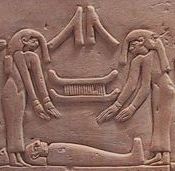
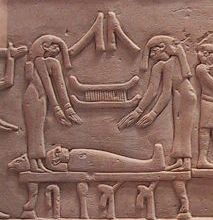
There is evidence of the Opening of the Mouth rite from texts of the Old Kingdom (inscription in mastaba of Metjen and in the Pyramid Texts). The Coffin Texts of the Middle Kingdom continue demonstrating the existence of this rite. In this period of the Egyptian history maybe can we envisage already one graphic proof in the stele of Abkaou (stele C15) from Abydos. In it the sculptor represented the rites of the Osiris festivity[1], where the myth was reproduced.  The two mourners shake their hair over the corpse; between them we can see the hieroglyphs of the adze and the sledge. What does it mean?

Detail of the stele of Abkaou in the Louvre Museum. XI Dynasty. Photo: www.commons.wikimedia.org

Detail of the stele of Abkaou in the Louvre Museum. XI Dynasty. Photo: http://www.commons.wikimedia.org

The sledge is the phoneme tm; it can be a negative verb[2], but it also is the term for “to complete”, “be completed”, in the sense of uniting the different parts of the body[3], mainly in relation to the mummy limbs[4]. The adze could be the verb nwi “to be in charge of”[5]. So, we could read the inscription as “in charge of completing” in the sense of restoring the corpse of the deceased. That would not be crazy if we think that in the legend Anubis was the one who embalmed the body, but with the assistance of Isis and Nephtys.

However, looking at the entire register of the stele there is no trace of inscription in the other images. So, why do we have to consider these three hieroglyphs as an inscription?

Detail of the register with the Osiris festivities. Stele d'Abkaou. Musée du Louvre. XI Dynasty. Photo: www.commons.wikimedia.org

Detail of the register with the Osiris festivities. Stele d’Abkaou. Musée du Louvre. XI Dynasty. Photo: http://www.commons.wikimedia.org

The tekenu on a sledge. Detail from the tomb of Montuherkhepeshef in Gourna. XVIII Dynasty. Image: www.excavacionegipto.com

The tekenu on a sledge. Detail from the tomb of Montuherkhepeshef in Gourna. XVIII Dynasty. Image: http://www.excavacionegipto.com

If we consider them just as the pure objects that they represent, we notice that the adze is one of the main tools in the Opening of the Mouth ceremony in the New Kingdom iconography; on its behalf the sledge is one of the means for transporting the human victim/tekenu, whose ritual we have seen was also part of the Opening Mouth ceremony in New Kingdom.

One possible theory could be that in the stele of Abkaou the sculptor was representing the Opening of the Mouth ceremony and the morning ritual in a shorten version, as it was done later in the New Kingdom, when artist included in the same scene mourners, priests, corpse and ritual tools. And we could as well think not just of a short version, but a codified way of representing a hidden ritual in the attempt of protecting the information of a confidential rite.

Opening of the Mouth ceremony. The image shows the two mourners, the priests and the table with all the tools utilised, included the foreleg of an ox. Painting from the tomb of Khonsu in Gourna. XIX Dynasty. Photo: www.osirisnet.net

Opening of the Mouth ceremony. The image shows the two mourners, the priests and the table with all the utilised tools, included the foreleg of an ox. Painting from the tomb of Khonsu in Gourna. XIX Dynasty. Photo: http://www.osirisnet.net

The renovating rites for the mummy’s rebirth might be secret. All along this work we have read some funerary texts making allusion to this concept of “hidden” in everything surrounding Osiris’ death and resurrection. For instance, in the tomb of Ramsés IX the inscription accompanying the scene of the women pulling their frontal locks of hair says: “…they are mourning over the secret place of Osiris…they are screaming and crying over the secret place of the ceremony …they move away SnDt[6], their two arms with their two arms, their secret is in their fingers…”[7]. In the same line we have the coffin of Ramses IV, decorated with both mages of Isis and Nephtys pulling their frontal lock of hair and whose inscription says:  “…the two goddesses who are in this secret place…they hide the secrets of the divine land… They move their faces during the moan; they mourn over the secret corpse Both goddesses are holding their locks swt”.

It seems that in ancient Egyptian belief, the mystery of death and resurrection was not accessible to all people; because of that in the Book of the Dead we read in relation to the Osiris’ resurrection. “… it is a secret of the Duat and a religious mystery in the deceased’s Kingdom …it is a mystery, that cannot be know, to take care of the blessed heart, give him movement, take away the bandage from his eyes, open his face…Read that with no one seeing it, apart from your truly friend and the lector priest[8].

The death itself was for the dead an initiation to the Hereafter’s mysteries[9]. Only the priests knew the secret of the Osiris death and resurrection, and to keep this secrecy was crucial for the universal harmony[10], possibly for that reason the “night of Isis” hid the mysteries of resurrection[11]. Even Isis sometimes received the name of “The Mysterious One”, since she “has been everything she has been, everything she is and everything she will be, and her veil, no mortal has never took off[12].

The Theban Books of Breathing, dating from Ptolemaic period was a funerary text recited just before closing the cover of the coffin [13] and the woman in the role of Isis gave a speech for reviving Osiris and help his soul go up to the sky as lunar disc: “That is something that needs to be hidden. Do not let anyone read it. It is useful for one in the necropolis. He will live again successfully millions of times”[14].

The chapter 17 of the Book of the Dead mentions the moment Osiris recovers his virility thanks to Isis, and she stresses the secret nature of her action: “I am Isis, you found me when I had my hair disordered over my face, and my crown was dishevelled. I have conceived as Isis, I have procreated as Nephtys. Isis dispels my bothers (?). My crown is dishevelled; Isis has been over her secret, she has stood up and has cleaned her hair”

The Magical Papyrus Salt 825 contains a text about the rite for the conservation of life and it informs the reader that the “House of Life” is hidden, unknown and invisible; it is a “secret book…contains life and death. Do not reveal it, the one who reveals it will die suddenly or will be murdered[15].

Opening of the Mouth ceremony at the door of the tomb. Painitgn from the tomb of Khonsu in Gourna. XIX Dynasty. Photo: www.osirisnet.net

Opening of the Mouth ceremony at the door of the tomb. Painting from the tomb of Khonsu in Gourna. XIX Dynasty. Photo: http://www.osirisnet.net

Everything points to the idea that in ancient Egypt the resurrection process is something that only concerns to the deceased and the team helping him in his recovery and that it is not something accessible for everybody. That would explain then why there is no much iconographical evidence of the Opening of the Mouth ceremony; it comes mainly from New Kingdom on (tomb decoration or papyri) and it is not explicit at all. On the other hand these scenes showing the priests and mourner with the mummy in front of the tomb would not be real. If the ritual for the resurrection was something secret, the Opening of the Mouth ceremony could not be made in open air. All practices for helping the mummy to come back to life should be made inside the tomb or inside a special building in the necropolis. So the images of the mourners crying close to the corpse while the priests are officiating would be the artistic solution to allude to the rite without revealing details.


[1] Gayet, 1886, pl. LIV.

[2] Wb V, 302, 5.

[3] Wb V, 303.

[4] Wb V, 305, 1.

[5] Wb II, p. 220

[6] Fear (?).

[7] Piankoff, 1942, pp. 1-11; 1944, pp. 1-62; 1946, pp. 1-50.

[8] LdM, 148.

[9] S. Mayassis, 1957, p. 218.

[10] S. Mayassis, 1957, p. 42.

[11] Sinesio, Epist., XIII,v.s. 89; S. Mayassis, 1957, p. 65.

[12] Plutarco, De Iside et Osiride, 9.

[13] J.Cl. Goyon, 1972, p. 217.

[14] Book of Breathing I, 1.

[15] Ph. Derchain, 1964, p. 139.

[16] S. Mayassis, 1957, p. 40.

Hair, Mourners and Light in Ancient Egypt.


The finality of the rites during the funerals in ancient Egypt was the deceased’s rebirth. In the mourning ritual accomplished during the Opening of the Mouth ceremony by the two women in the role of Isis and Nephtys, the dead returned to the womb for coming back to life as a new born; he was also the incarnation of Osiris, so the dead husband who needed stimulation for recovering the vital faculties (mobility, breath, eyesight, hearing, virility). The dead needed the eye irt eye irtfor reviving; the eye in Egyptian belief had a regeneration meaning from the moment it created the mankind (rmT Mankind rmT) from the teardrops (rmit teardrops rmit). So, the eye and its tears had the capacity of producing life. On the other hand we cannot omit the semantic relationship between the Egyptian word for eye irt and the verb for “make” iri[1]. For some the hieroglyph of irt could be an image of the solar disc inside the mouth as a symbol of the verb iri[2].

The sem priest is making the Opening of the Mouth ceremony on the dead's image, in front of him the make-up for Udjat eye as final offering. Painting from the tomb of Inerkha in Deir el-Medina. XIX Dynasty. Photo: www.osirisnet.net

The sem priest is making the Opening of the Mouth ceremony on the dead’s image, in front of him the make-up for Udjat eye as final offering. Painting from the tomb of Inerkha in Deir el-Medina. XIX Dynasty. Photo: http://www.osirisnet.net

But the eye needed by the deceased is the lunar eye Udjat, the symbol of light (life) in the darkness of the night (death). The light symbolises rebirth and nature and life depend on the received light[3]; much light means much life, while shadow means the contrary. The Udjat eye as the full moon is the light in the middle of the darkness and it is also the health and strength in the death[4]. The Udjat eye illuminates in the middle of the shadows as a manifestation of life.

In the Egyptian language the concept of lunar eye and light is closely linked to femininity. Not only because irt or wDAt are feminine words (ended in –t), there are many terms and expressions which support this idea: Axt is the « bright eye » of the sun god or Horus[5] ; iAbt is the « left eye », so the moon[6] ; HDt  is the « white of the eye » ; sSmt can be a designation for the « lunar eye »[7] ; iAbt.f iaH m grh means «  his left eye is the moon during the night »[8].

It is also interesting to notice that nearly all terms about hair we have seen taking part of the mourning ritual in ancient Egypt are feminine: Samt, Hnskt, wprty, lock swt. The exception is: hair sma (and/or Hair Sni ) . These two words we have seen that they are related to the idea of chaos and disorder, and when they entail the concept of resurrection they symbolize vegetation, water, breath of life or conception, but never moon/light.

Two different ways of representing Isis and Nephtys assisting the deceased: as the two kites (tomb of Sennedjem) and as women (tomb of Nakhtamon). XIX Dynasty. Photos: www.osirisnet.net

Two different ways of representing Isis and Nephtys assisting the deceased: as the two kites (tomb of Sennedjem) and as women (tomb of Nakhtamon). XIX Dynasty. Photos: http://www.osirisnet.net

The feminine principle was then basic in the ancient Egypt resurrection, it is necessary for giving birth and that makes the figure of Isis essential in the Osiris rebirth. Consequently, in Egyptian funerals the two kites or two Drty made their mourning ritual as impersonations of Isis and Nepthys, but also as women. And maybe that is why their hair with its lunar connexion was such an important element in the deceased’s reanimation.


[1] W. B. Kristensen, 1992, p. 13.

[2] J.E. Cirlot, 1991, p. 339

[3] J. Chevalier et A. Gheerbrandt, 1969, p. 154.

[4] W. B. Kristensen, 1992, p. 15.

[5] 3xt, with the cow determinative is a way of referring to Hathor, whose relationship with the full moon and the rebirth we have already seen. Wb I, 17, 3

[6] Wb I, 30.

[7] The translation of sSm is “guide”, and the moon is the guide in the night sky.

[8] R. el Sayed, 1987, pp. 62-67.

Hair, Mourners and Moon in Ancient Egypt.


According to the Egyptian funerary texts the mourner/s crying close to the mummy were the representatives of Isis and Nephtys, in the iconography the inscription accompanying their/her image/s describes them/her as the deceased’s wife, widow or even servant; so stressing the wife’s role of Isis in the legend of Osiris.

They made a mourning ritual in some moment of the Opening of the Mouth ceremony, not only as a sadness proof but also as means of getting the deceased’s rebirth. Thanks to the decoration in some New Kingdom tombs from Thebes we can discern that it happened when the ox was slaughtered.

Mourners over the corpse. Detail of the stele of Akbaou. XI Dynasty. Photo: www.commons-wikimedia.org

Mourners over the corpse. Detail of the stele of Akbaou. XI Dynasty. Photo: http://www.commons-wikimedia.org

From Egyptian funerary texts and from iconography the mourning ritual consisted in shaking hair and/or pulling hair towards the corpse. And presumably it ended with the cut of that shaken and/or pulled hair, which in the mythic sphere coincided with the offering of the Udjat eye to the deceased as a grant of his final resurrection.

At this “lunar” point the presence of two women in the rebirth process of the dead makes much sense. The moon is closely related to women, since it regularizes the menstrual cycle[1]. Scholar R. Briffault considered that in ancient Egypt women’s fertility depended on the moon and he assures the existence of a Theban inscription saying that women conceived thanks to the moon[2].  That point of view would give all the sense to the Osiris’ lunar rebirth, since thanks to it Isis could conceive Horus.

That would also explain why the Egyptian word for moon was masculine (iaH iah moon). According to R. Briffault lunar goddesses become prominent in advanced periods of the culture, especially with the agriculture development[3].  It is a star related also with the magical power of women[4], as the magic practiced by Isis and Nephtys over the mummy to contribute to the Osiris’ resurrection. Because in the primitive belief the moon’s attributes are character and aptitudes of women[5], the star portrays the women’s nature, so, as reflect of the sun, the moon is the feminine complement of the king of stars, which in the mythic sphere was Hathor[6].

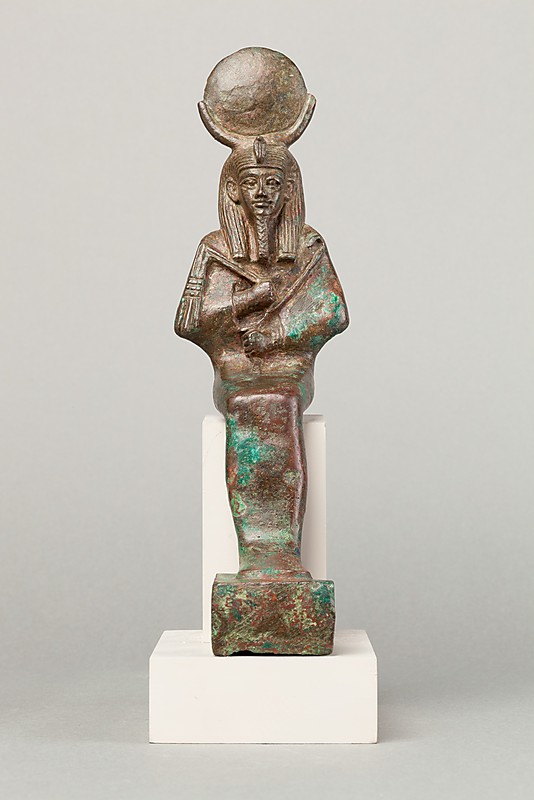
Bronze statue of Osiris in his lunar facet. Late Period. Photo: www.metmuseum.org

Bronze statue of Osiris in his lunar facet. Late Period. Photo: http://www.metmuseum.org

At this point it goes without saying the important role of this goddess in the lunar resurrection. But it helps in understanding the function of the two mourners during the mourning rite. Isis and Nephtys appear as the leading performers in the Songs of Isis and Nephtys, where the lector priest barely takes part; that ritual was something just made by women. The lunar rebirth of the deceased seems to be in large part a responsibility of the two mourners impersonating Isis and Nepthys, maybe because this relationship of women with the moon as the star that regulates their fertility and their magic. They shaked or pulled their hair, which we have already seen it was related to the moon and finally Osiris/ the deceased comes back to life when he receives the Udjat eye, the full moon. Osiris/the deceased revives as a masculine moon, but for getting that state he needs the feminine aspect of the star[7].


[1] R. Briffault, 1974, p. 293.

[2] R. Briffault, 1974, p. 294.

[3] R. Briffault, 1974, p. 295.

[4] R. Briffault, 1974, p. 296.

[5] R. Briffault, 1974, p. 307.

[6] H. Kees, 1956, p. 210.

[7] For some scholars the Egyptian word for moon could remember the bisexuality in the creation of the world (S.Ratié, 1984, p. 179)

Hair, Mourners and Opening of the Mouth in Ancient Egypt.


We have seen throughout this work that the mourners’ hair (locks, mane, dishevelled, plaits) played a very important role in the funerary ceremony of ancient Egypt. We have also seen that sometimes those different aspects of the hair had just a symbolic meaning from a resurrection point of view (as for instance the two ringlets wprty). We also know now that there were two types of mourners: those ones being in a group in the procession accompanying the corpse and the two women impersonating Isis and Nephtys and in charge of the deceased’s rebirth.

The two priests and one mourner (the wife according to the inscription) in the Opening of the Mouth of Roy. Painting from the tomb of Roy in Dra Abu el-Naga. XVIII Dynasty. Photo: Mª Rosa Valdesogo Martín.

The two priests and one mourner (the wife according to the inscription) in the Opening of the Mouth of Roy. Painting from the tomb of Roy in Dra Abu el-Naga. XVIII Dynasty. Photo: Mª Rosa Valdesogo Martín.

According to the sources the hair of these two mourning women was important from many points of view: symbolic, mythic and ritual. From the Egyptian iconography and texts we can discern a mourning rite in which the two women made a gesture with their hair or lock of hair over the mummy with a regenerating goal, and we can also guess a practice of shaving or cutting hair to the two mourners that happened in some moment at the end of the funerals when the deceased’s rebirth was a fact.

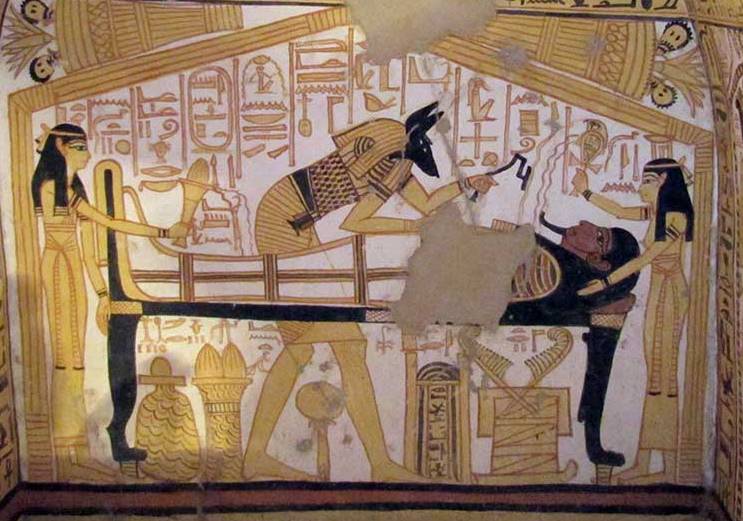
After the embalming of the corpse, the cortège walked to the necropolis, once there took place the main Egyptian rite for the benefit of the dead: the Opening of the Mouth ceremony, which consisted in a group of gestures for transmitting vitality to the mummy (this way the deceased recovered the ability of breathing, seeing, hearing…), and the two representatives of Isis and Nephtys took part in that process. Many sources reflect this ritual, but usually they are not too explicit. It is mostly represented in a shorten way, with the lector priest and/or the sem priest holding the utensils used for the ritual (mainly the adze and the stone vessels) and officiating on the mummy, meanwhile two mourners or sometimes just one, cry close to the dead. In some cases the scene has a more divine nuance and the one officiating is Anubis, while Isis and Nephtys stay at both extremes of the corpse.

Anubis, Isis and Nephtys in the Opening of the Mouth rite. Painting from the tomb of Nakhtamon in Deir el-Medina. XIX Dynasty. Photo: www.osirisnet.net

Anubis, Isis and Nephtys in the Opening of the Mouth rite. Painting from the tomb of Nakhtamon in Deir el-Medina. XIX Dynasty. Photo: http://www.osirisnet.net

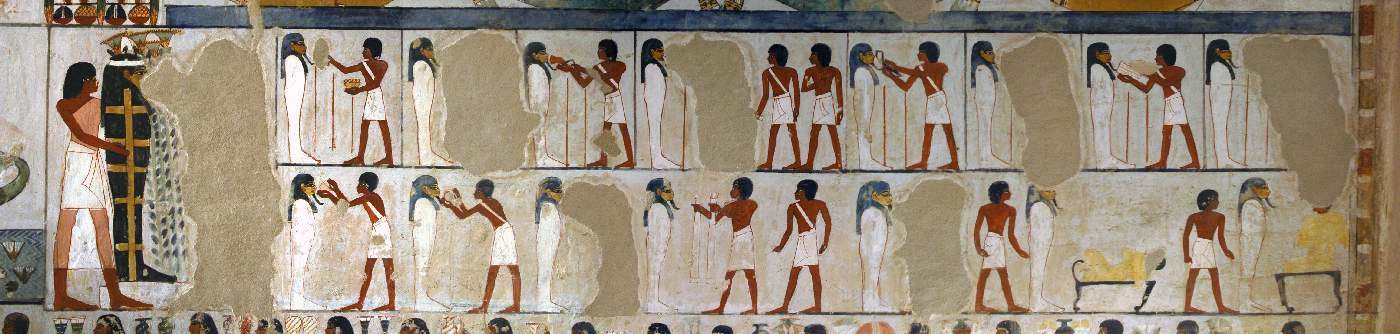
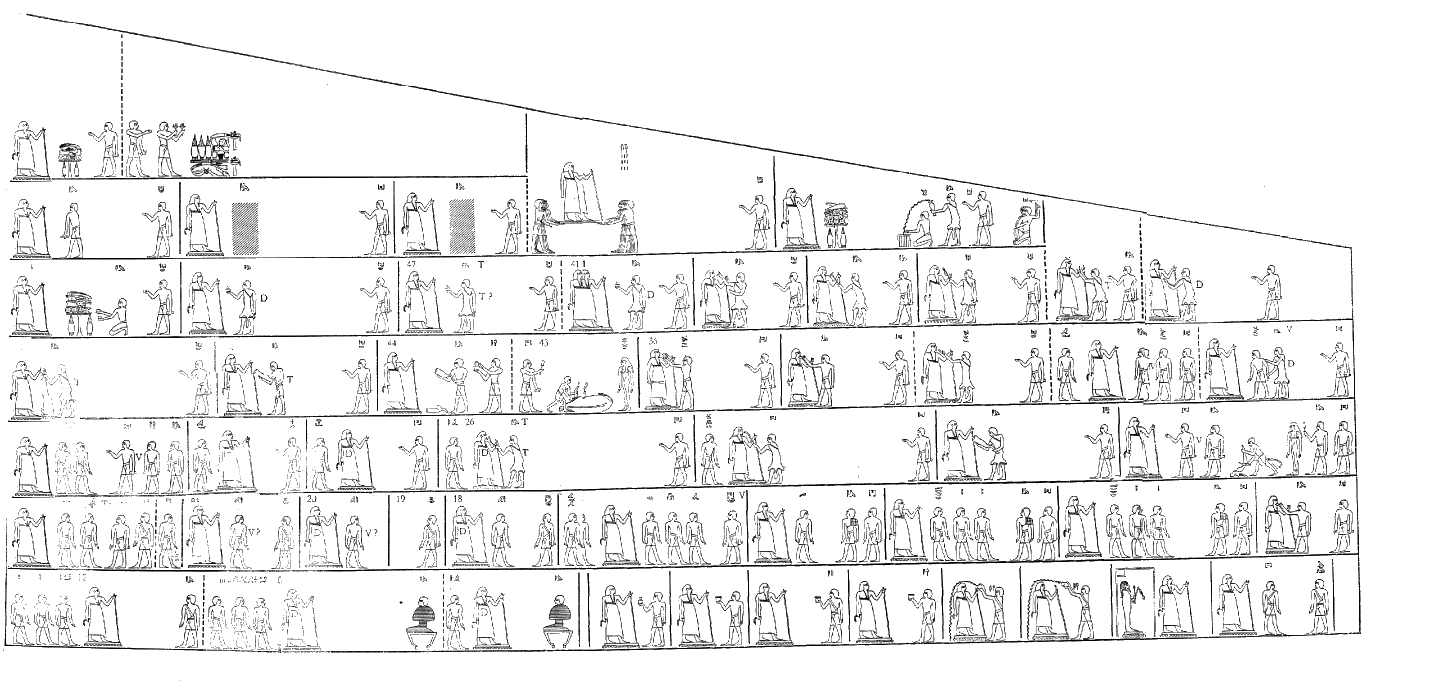
The most explicit document about the Opening of the Mouth ceremony that ancient Egyptians have left to us is the representation in the south wall on the tomb of Rekhmire. In a composition of fifty three scenes the artist showed the rite step by step.

Opening of the Mouth ceremony from the tomb of Rekhmire in Gourna. XVIII Dynasty. Image: www.digitalegypt.ucl.uk

Opening of the Mouth ceremony from the tomb of Rekhmire in Gourna. XVIII Dynasty. Image: http://www.digitalegypt.ucl.uk

The broad outline which Rekhmire offers would be:

1. The mummy or deceased’s statue (as it is the case in Rekhmire’s tomb) is put on a mound symbolising the primeval hill.
2. The mummy/statue is purified with water, natron and incense.
3. The sem priest transmits the vital energy rememorizing the ancient Egyptian tradition of the sacrifice and rebirth of the tekenu. The sem priest imitated the ancient victim curled up and wrapped in a clothing, he came up from it and had a small dialogue with the lector priest:

Sem priest: “I saved the eye from his mouth, I healed his leg”

Lector priest: “I have placed your eye, through which you revive”[1].

4. The sem priest makes the first gestures of Opening the Mouth with the little finger.
5. The mesentiu (labourers) work on the statue (polishing and carving) as a creational gesture[2].
6. Sacrifice of the ox of Upper Egypt for restoring the vitality of the deceased. The sem priest offers the animal’s heart and foreleg to the mummy/statue. One of the mourners (the big Dyeret) is present:

Sem priest: “to stretch the arms towards the bull ng of Upper Egypt”

Slaughterer: “get up over him, cut its foreleg and remove its heart”

The big Drt says at his ear: “Your lips have done that against you. Will your mouth open?”

Sacrifice of the ox with the presence of the mourner. Painting from the tomb of Rekhmire in Gourna. XVIII Dynasty. Photo: Mª Rosa Valdesogo Martín.

Sacrifice of the ox with the presence of the mourner. Painting from the tomb of Rekhmire in Gourna. XVIII Dynasty. Photo: Mª Rosa Valdesogo Martín.

This part of the ceremony is very important for us, not just because of the presence of one of the mourners, but also because it seems to remind the conflict between Horus and Seth. According to J. C. Goyon the sequence would stage when these two gods fought and Isis became a kite, landed on a tree and cried to Seth, who denounced unconsciously his crime: “Cry over you. Your own mouth has said it. Your ability has judged you. What else?[3]

The idea is the same one as in the tekenu ceremony we have seen in the tomb of Mentuherkhepeshef: killing a victim and offering the foreleg and the heart… but what about the hair?

Funerary scene of the tomb of Montuherkhepeshef in Dra Abu el-Naga. XVIII Dynasty.

Funerary scene of the tomb of Montuherkhepeshef in Dra Abu el-Naga. XVIII Dynasty.

Maybe we should relate the lock of hair of the tomb of Mentuherkhepeshef with the presence of the mourner in the tomb of Rekhmire; and think that a mourner’s piece of hair was cut and offered join with the foreleg and the heart.

7. After the sacrifice the sem priest makes more gestures of opening the mouth to the mummy/statue with the utensils, and in one case with the ox’s foreleg. The finality was to keep in touch the whole of the head with those magical tools (the nTrt adze and the wr-HkAw).
8. The mummy/statue is given to the rpat, who represented the heir[4], and the mesentiu work again on it.
9. New gestures of opening the mouth to the deceased are made. After that, there is an offer of 3bt stones[5].
10. Sacrifice of the ox of Lower Egypt. Here again we have the presence of one mourner, the small Dyeret, and once more the animal’s foreleg and heart are offered to the dead one.
11. After the sacrifice the priest opens again ritually the deceased’s mouth.
12. Funerary offerings and the final resurrection is a fact (the sem priest pays his respects to the new soul who lives in the Hereafter).

According to Rekhmire’s tomb, the two mourners impersonating Isis and Nephtys took part in the Opening of the Mouth ceremony. TTA4 and TT53 have both scenes of sacrifice of an ox with the presence of one mourner. But it is also true that in some other cases there is no trace of mourning women in this rite, as we can see in the tomb of Menna[6]

Opening of the Mouth ceremony from the tomb of Menna in Gourna. XVIII Dynasty. Photo: www.osirisnet.net

Opening of the Mouth ceremony from the tomb of Menna in Gourna. XVIII Dynasty. Photo: http://www.osirisnet.net

Anyway, sources proof that the two mourners in the role of Isis and Nephtys made an important role in that ritual for the deceased’s resurrection. They were members of the group of personalities who took care of the rebirth of the corpse and who reproduced the myth of Osiris.

The Opening of the Mouth ceremony was a group of practices for giving the life back to the deceased assimilated to Osiris. The priests and the two mourners recreated the chapter of the legend where Horus avenges his father’s death at the hands of Seth. In the rite it is the moment of the animal sacrifice, the ox, as scapegoat, with the presence of the sem priest, the slaughterer and the two mourners. The animal’s foreleg and heart are offered to the dead one, but also a piece/lock of hair. At this point we must remember chapter 667 of the Coffin Texts, where the healing of the hair sm3 happens at the same time of the offering of the foreleg and the giving of breath. And the final resurrection happens when the lunar eye is reconstituted and offered as Udjat eye to the deceased. E. Otto assimilated the lunar eye with the foreleg and/or the heart of the animal victim[7]; for others the moon can also be a knife, a leg or a lock of hair[8].

Carrying the leg and the heart for the deceased. Painting from the tomb of Menna in Gourna. XVIII Dynasty. Photo: www.osirisnet.net

Carrying the leg and the heart for the deceased. Painting from the tomb of Menna in Gourna. XVIII Dynasty. Photo: http://www.osirisnet.net

Throughout this work we have seen the relationship in Egyptian belief between the hair and the lunar eye and how there is a clear coincidence between cutting mourner’s hair (cutting the s3mt or shaving the mourners) and giving the Udjat eye to the dead one. It is also interesting to notice the use in the Opening of the Mouth ceremony of the flint knife peseshkef, considered by scholars as a very ancient tool for cutting the umbilical cord.

Knife peseshkef made of flint and coming from a tomb in Giza. VI Dynasty. Kunsthistorisches Museum of Wien. Photo: www.globalegyptianmuseum.org)

Knife peseshkef made of flint and coming from a tomb in Giza. VI Dynasty. Kunsthistorisches Museum of Wien. Photo: http://www.globalegyptianmuseum.org

The sacrifice of the ox represented the victory of Horus over Seth, it was also the moment of restoring the Udjat eye and, according to the funerary texts, shaving the mourners and/or cutting the s3mt. And New Kingdom iconography shows the mourners taking part in the Opening of Mouth ceremony and with no mane of hair after the rite.

But, do we really know why were these two women there, what did they really do or why their presence during the Opening of the Mouth is not so evident in iconography?


[1] E.Otto, 1960, p. 71.

[2] This step would be made when the ceremony was made on a statue. In ancient Egypt the sculptor was called sankh, which meant “to make live”.

[3] J.C.Goyon, 1972, p. 121.

[4] It means “prince” (Wb II, 415, 15).

[5] Some scholars consider they symbolize the milk teeth.

[6] TT69

[7] E. Otto, 1950, p. 171.

[8] Ph. Derchain, 1962, p.20.

The Hair s3mt and the final Resurrection in the Coffin Texts of Ancient Egypt.


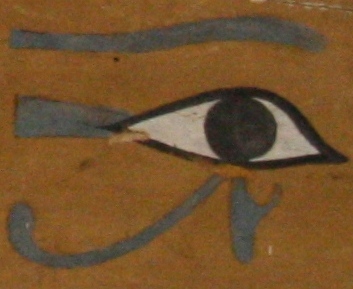
Udjat eye in a Middle Kingdom coffin. Beni Suef Museum. Photo: Mª Rosa Valdesogo Martín.

Udjat eye in a Middle Kingdom coffin. Beni Suef Museum. Photo: Mª Rosa Valdesogo Martín.

Once the damaged eye of Horus, that was related with the hair sm3, has been healed it becomes the Udjat eye, the full moon as a symbol of the total regeneration. The question is does this aspect of the lunar eye have any connection with the hair? The answer is yes, it does.

Some chapters of the Coffin Texts relates the final episode of the Egyptian myth of Osiris, when he gets triumphant over his enemies and he is reborn; on earth that means the deceased’s resurrection. It is when Horus gets his eye back, his Udjat eye, and it is interesting to notice how in that moment the funerary texts mention two very relevant things:

  1. The presence of the lock of hair (or just hair) s3mt.
  2. The shave of the mourners.

Chapter 339 is about the Osiris’ victory over the enemies and his resurrection. It mentions towns related somehow with Osiris and his burial: Busiris (where was the Osiris’ spine), Letopolis (here was the shoulder), Buto (the ladies of Buto crying for Osiris were Isis and Nephtys), Abydos (where was his head and his burial place)…; Thoth appears as the god claiming “true of voice”  Osiris, Horus also offers his Udjat eye to his father[1]; with that act culminates the final resurrection, it means the end of the chaos, the order restitution and the beginning of the new life. Osiris is reborn as king of the Herafter, while Horus inherits the throne of Egypt. And, according to chapter 339, that moment of restoration is the moment of shaving the mourners in Buto, so shaving Isis and Nephtys:

“…Busiris, this is the day of giving the Udjat eye to his lord. Pe-Dep[2], this is the day of shaving the mourners…”

Chapter 339

Razor made of bronze and wood, coming from the tomb of Hatnofer and Ramose in Gourna. XVIII Dynasty. The Metropiltan Museum oj Art of New York. Photo: www.metmuseum.org

Razor made of bronze and wood, coming from the tomb of Hatnofer and Ramose in Gourna. XVIII Dynasty. The Metropiltan Museum oj Art of New York. Photo: http://www.metmuseum.org

Chapter 942 is too damaged, but it seems to allude to the fight between Horus and Seth:

“Provide with her s3mt burning (?)…Chapter 942 (I)

 Those ones from Hermopolis adore him [3](…), they break the double power. My coming up is the coming up of this goddess, raising with Re…the only lord, which has taken the flame of the Luminous One.

The two i3rty of Sokaris[4] are shaved for herChapter 942 (II)

The face is adorned [5](…) made against her in the name of Wnwt[6]. Seth is put by her under her pleats (…) the peace is made (…) in their names. I am alive and intact, they are alive and intact ».

When Seth is put under Wnwt, which is related to the uraeus snake, the peace is made because in Egyptian belief the uraeus is benefactor; it eliminates the evil (Seth), that is, it helps in restoring the universal order.
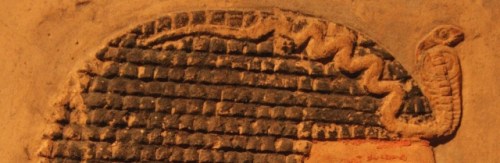
Uraeus on the forehead of Amenhotep I. XII Dynasty. Metropolitan Museum of Art of New York. Photo: Mª Rosa Valdesogo Martín.

Uraeus on the forehead of Amenhotep I. XII Dynasty. Metropolitan Museum of Art of New York. Photo: Mª Rosa Valdesogo Martín.

What about the hair elements we find in the text? P. Barguet translated the first sentence as: “her plait is destroyed”. If the word instead of s3mt were sm3, we could maybe think of an allusion to the damage suffered by the lunar eye, but if we look at verb, Htm could be also translated as “provide with”, “equip with”, and specially “equip the face with the eye” [7].

Regarding the i3rty, the dual form and the hair determinative make us think of the two mourners Isis and Nephtys. I3r means « sadness » or « mourning » [8]. R.O. Faulkner translated the term i3rr iArr as “weakness of the eye” or “weakness of the heart” [9]. On the other hand, i3rt  iArt is also an Egyptian expression that designates the uraeus snake of Re[10] ; so we could also consider that the i3rty would be the two uraei of Sokaris, which will be shaved.

The meaning of Haq is “shave”, so it is applied just to hair. The question is why is it here used with snakes instead of hair? It is no new for us the Egyptian assimilation of both elements, since we have already seen how the plait Hnskt was identified with the snake as symbols of rebirth. For that same reason it would not be so crazy to consider that in Ancient Egypt the two uraei could be identified with both locks of hair s3mt.

Statuettes of Isis and Nephtys mourning. Ptolemaic Period. Metropolitan Museum of Art of New York. Photo: www.metmuseum.org

Statuettes of Isis and Nephtys mourning. Ptolemaic Period. Metropolitan Museum of Art of New York. Photo: http://www.metmuseum.org

So, the chapter 942 would be relating the shave of the uraei, which would be the same as saying that the two locks of hair were cut. With these i3rty of Sokaris maybe we would be facing again a new case of metonymy, the two mourners being mentioned through their most relevant part: the i3rty, so it would be a way of describing Isis and Nephtys. Maybe we are reading about the shave of both mourners’ locks of hair, and these ones assimilated to two uraei as victors over the evil.

After shaving the i3rty (locks of hair or uraei) the text says how the face is adorned or dressed, but…with what? Do we have to think about the arrangement of the Udjat eye on the Osiris/deceased’s face? If so, why is it related to the locks of hair and its shaving?

Finally, we have another passage in Coffin Texts showing a very narrow relationship between lock of hair and eye. In chapter 1131 the deceased is at the same level of Osiris, that one is described as an image of the god. In this context the dead one goes ahead to his resurrection and one of the things happening before that is the following:

“… The lock of hair (or just hair) s3mt is cut; the eye is sealed by the nestling in its hole…”chapter 1131

P. Barguet[11] and William A. Ward[12] transliterated this sentence as follows: Hdq s3mt irt xtmt n t3 nb3b3.f, so having a verb (nb3b3), with unclear translation[13]. But if we take the final as n b3b3.f the texts has more sense: the nestling[14] is into its hole b3b3. This word can refer to the seven orifices on the face, of which two are the eye sockets[15] ; taking into consideration our context, it seem quite logical to think of b3b3 in this chapter as a way to referring to the eye socket. That allows to translate the sentence as « the eye is sealed (or closed) », since the nestling is inside the orbit (as it was a nest) and impedes the vision.

We need also to focus on a following sentence for ending the chapter that says: “Live the nestling that goes out from you…flies the fly and live Osiris…” This flight is strongly connected with the resurrection of Osiris-bird. When that one remains inside the nest-socket, the eye is sealed and that means no to access light, it is the moment of shadows and darkness (death). The chapter 1131 connects that with cutting the s3mt and after doing that the nestling flies and the eye can open; it symbolizes the capacity to see, the brightness after the darkness, the Osiris/deceased’s resurrection.

Sokaris, as a falcon, with the Udjat eye over him, spread his wings for fliying up. Painting from the tomb of Pashedu in Deir el-Medina. XIX Dynasty. Photo: Mª Rosa Valdesogo Martín.

Sokaris, as a falcon, with the Udjat eye over him, spread his wings for flying up. Painting from the tomb of Pashedu in Deir el-Medina. XIX Dynasty. Photo: Mª Rosa Valdesogo Martín.

That is a very solid idea in Ancient Egypt and dates back from the Old Kingdom; the dead king could reach the Hereafter as the eye of Horus, but he usually took the aspect of a bird, using the faculties of this animal for flying up[16].

Summing up, the main ideas we can take from these three chapters of the Coffin Texts are:

  1. The s3mt  (lock of hair or just hair) is cut just before the final resurrection in ancient Egypt funerals.
  2. The Osiris’ resurrection is connected with the shave of the mourners.
  3. The cut of the s3mt is connected in Egyptian belief with the eye and the vision recovery.

[1] The offer of  the Udjat eye will be the offer per excellence, so everything offered will be called “Eye of Horus”  (A. Erman, 1952, p. 209).

[2] Buto.

[3] Reconstruction could be (n).f

[4] In ancient Egypt there were assimilation between Osiris and Sokaris.

[5] or “dressed“.

[6] Name related to the uraeus (Wb I, 317, 11).

[7] Wb III, 196, 14.

[8] Wb I, 32, 2.

[9] R.O. Faulkner, 1962, p. 9, 5.

[10] Wb I, 32, 3.

[11] P. Barguet, 1986, p. 665.

[12] W.A. Ward, 1975, p. 62.

[13] It seems to be a verb related to the eye of Horus (Wb II, 243, 14).

[14]  nestling this sign is the image of the nestling into the nest nest

[15] Wb I, 419, 1.

[16] Pyr., 1216 y 1770. Whitney M. Davies, 1977,p. 167.
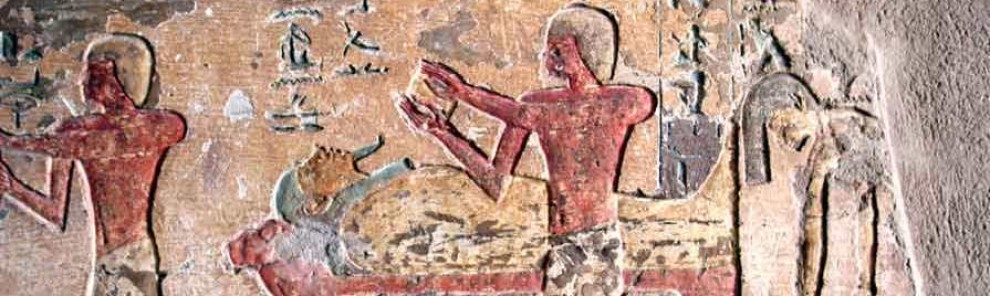
Cutting the Lock of Hair s3mt in Ancient Egypt.


The Coffin Texts show us how the lock of hair s3mt was not just a symbolic element which had a very important place in the funerary imagery. Apparently it could also have been a physical thing which was manipulated and cut during the ceremony.

Chapter 532 is about to restore many parts of the corpse. To place the deceased’s head in his neck is the main gesture for reaching the new life:

Formula for placing the head…Mi head is placed. My neck is put by Tefnut. This is the day of putting their heads to the gods. My two eyes are given to me, I see with them. I have received my dorsal spine from Ptah-Sokaris. Is tied to me a lock of hair in Heliopolis, the day of cutting the lock s3mt[1]

chapter 532

In this chapter the deceased gets his eyes, his neck, his spine and the lock of hair syt, which we have already identified as the frontal lock of hair in mourners. According to the text it is a Helipolitan practice for restoring the corpse, which also includes the cutting of the lock of hair s3mt.

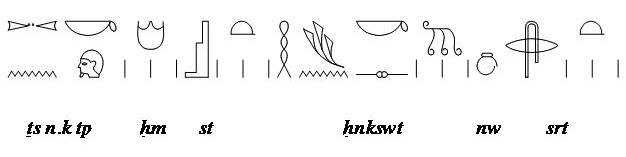
The Osirian ritual of Ancient Egypt represented the life, death and resurrection of that god. During the Stundenwachen-liturgy, where the two representative mourners of Isis and Nephtys had an important role, there was a practice of tying up the lock of hair. According to the inscription[2], in the second hour of the night one of the mourners, called “small Dyerit”, says:

“Join the head for you, put the plaits of hair Hnskwt[3].Stundenwachen

 Sr can be translated as “hair of woman” or “hair of animal”[4] and srt means “bull’s hair”[5]. The action takes place in a resurrection rite where the mourner is giving a hair element. Could we think of a relationship between this passage of the Stundenwachen and the chapter 532 of the Coffin Texts? The imbalance here is that the document of the Middle Kingdom mentions the lock of hair syt, while the document from a later period mentions the plait of hair Hnskwt. Maybe we should think of a variation due to the passing of time.

Chapter 640 of the Coffin Texts mentions also the same practice, although in a more confusing context:

“A knot is tied for me around me in the sky connected with the earth by Re each day. He puts a knot on the inert over his two thighs on that day of cutting the lock of hair s3mt.

chapter 640

  Seth ties a knot around me when the ennead is in its first power, with no turmoil.

You protect me against those who slew the father. Nut ties a knot around me, at the sight of the first time before I had seen Maat, before the gods were created[6]. I am Penty[7]; I am the heir of the gods”[8].

We find again the expression to cut the s3mt in a context of Heliopolitan divinities.

Would the action of cutting the lock of hair in Ancient Egyptian funerals come from prehistoric times? Cutting rituals (depilation, cutting hair, dental mutilations…) are usually in all cultures one of the first techniques of purification; by means of that men apart themselves from animality[9]. The fact of cutting is something fundamental in initiation ceremonies, as it is for instance circumcision. We know that in Ancient Egypt the cut of the side lock in children was made when they were already adults[10] (nowadays some African peoples still do the same), so in the pass from childhood to a new state of existence.

Nudity and lock of hair were features of childhood. Relief from the mastaba of Ptahhotep in Saqqara. VI Dynasty. Photo: Mª Rosa Valdesogo Martín.

Nudity and lock of hair were features of childhood. Relief from the mastaba of Ptahhotep in Saqqara. VI Dynasty. Photo: Mª Rosa Valdesogo Martín.

We know that death for the Egyptians was just a change of condition and funerary ritual was not just a burial ceremony, but a rite of passage. The dead changed his condition; he passed from dead to reborn, from child to adult, from crescent to full moon. And in some moment of that process happened to cut the s3mt. The fact that this Egyptian word could also be translated as “mourning” or “sadness” refers us again to the mourning women; were there a connection between these women and the cut of the lock of hair s3mt?

P. Barguet considered cutting the s3mt as a Helipolitan ritual[11]. The side lock of Egyptian children was cut when they became adults. In Roman times athletes and youth initiated in Isis cult were distinguished because first ones had a side lock on the top of the head, while second ones had it over the right ear; this lock of hair was cut with the puberty at the same time of circumcision[12]. In religious sphere, Khonsu, the lunar god, was represented with his side lock and his lunar head-dress.

Could we think of cutting the s3mt of chapters 532 and 640 as a lunar rite? In a symbolic context, maybe to cut the s3mt was made when the moon was not a crescent anymore, but a full moon, that is, when the moon stopped being a child and became an adult. In the funerary ceremony, this cut of hair was maybe made as a symbol of the lunar rebirth of the deceased; it could reflect the end of the chaos and darkness which dominated the universe before the creation. Cutting the s3mt would mean full moon, light, order and new life.


[1] CT VI, 532

[2] H. Junker studied the inscription from Dendera, Edfu and Philae.

[3] H. Junker, 1910; E XIV, 95.

[4] Wb IV, 191, 3 y 4.

[5] Wb IV, 191, 5.

[6] The primeval moment.

[7] Pnt is an Egyptian verb related to the making of bread (to knead) and beer (press) (Wb I, 511, 3). Desinence y converts it in a prospective passive participle, which indicates a future fact, so, Pnty would mean “The one who will be produced”; that would refer to the deceased as a new creation.

[8] CT VI, 640

[9] G. Durand, 1979, p.160.

[10] Scholars consider that circumcision in Ancient Egypt was made between six and fourteen years old.

[11] P. Barguet, 1986, p. 52, n. 5

[12] V. von Gonzenbach, 1957 (summary in AEB, nº 57214, pp. 61-62).

The Ringlets wprty and the lunar Resurrection.


We have already seen how in chapters 107, 109, 332 and 533 of the Coffin Texts the moon is the main element. In them Hathor is the lunar goddess who guides the boat during the night (this boat assimilated to the quarter of the moon) and the one who receives the deceased in the Hereafter. Her two ringlets wprty are separated and/or given and this helps the dead to get out from the darkness of the death and see the Hathor’s face, that is, the moon, the light.

Image of Hathor with her two ringlets at both sides of the face. paintign from the tomb of Roy in Dra Abu el-Naga. XVIII Dynasty. Photo: Mª Rosa Valdesogo Martín.

Image of Hathor with her two ringlets at both sides of the face. Paintign from the tomb of Roy in Dra Abu el-Naga. XVIII Dynasty. Photo: Mª Rosa Valdesogo Martín.

Hathor is “The one with bright face” (thnt Hr), « The Luminous one » (HAit)[1], and her two ringlets open to see « The Bright One, who makes live everyone she loves, people live when they see her » [2]. The idea of this act is completely opposite to the nwn gesture of covering the eyes with the hair; to die means a lack of light; it is the night of the death; the rebirth comes when the moon appears and provides light in the darkness.

Why is the moon so relevant in the deceased’s resurrection? It is a star that grows and dies, but the moon’s death is not definitive; after a period of some days it revives and appears again as a first quarter. The moon is at the same time death and resurrection, darkness and brightness. The moon is the first dead and symbolises the crossing point from death to life. For that reason the human being wants to have also a lunar nature; the star’s regeneration means a hope of resurrection for him.

Some cultures consider the moon the place for the resurrection; it can be as a trip in the star or as an immortal stay in it after the death.  According to R. Briffault, in tribal societies, thanks to its cyclic nature, the moon measures the time and also creates it[3], so it has the mystery of the resurrection. The moon changes constantly, it increases and decreases, with an interval of invisibility (identified with the death), where it goes out from regenerating itself[4]. If the moon causes the time, to convert in moon means to control the temporality and come into the eternity.

Due to this changing nature, lunar mythic beings are usually crippled[5], as in Ancient Egypt was Osiris. The moon dies, as the man dies, and it resurrects as the man wants to resurrect. It is supposed the human condition to be identical as the lunar condition, so humans, after dying, come back to life in a lunar shape. For that reason for ancient Egyptians Osiris was “the moon in the sky”, he renews himself as he wishes and he gets old when he wants[6].

Bronze statue of Osiris in his lunar facet. Late Period. Photo: www.metmuseum.org

Bronze statue of Osiris in his lunar facet. Late Period. Photo: http://www.metmuseum.org

This context helps us understand the lunar nature of Hathor and why opening her two ringlets of hair means to get into the light, into the cyclic renewal, to get into the lunar boat and plough through the night sky[7]. Lunar Hathor guides the dead in the boat through the sky until Sothis, the morning star which announces the flood and the beginning of the Egyptian year, so the renewal of everything.

The ancient Egyptians celebrated the « Festival of the Sky » (Hb n pt), which inaugurated the lunar year and started with the appearance of Sothis. This moment was called in Egyptian “opening of the year” (wpt rnpt). This same expression meant also « the beginning of the youth », since rnpt was substantive of the verb rnpi (« to be young », « to be rejuvenated ») [8]. We find then two parallel concepts: the opening of the lunar year and the beginning of the lunar youth of the deceased. We must here remember that with the term rnp was also designed Osiris in the Songs of Isis and Nephtys.

The moon is a symbol of fecundity too , since it controls the waters, the rain and the tides[9]. Moon seems to be associated to the primeval waters as receptacle of creation power. For that reason the moon metaphorically speaking is the egg or the womb of the world, both elements as life generators. That makes the moon a life centre; and if it distributes the waters, it also intercedes between the sky and the earth (whose union we have seen is the hierogamy, the primeval couple).

In many cultures, the moon is closely related to woman and her fecundity power, because her physiological cycle is also regulated by the star. The moon is, then, the “Lord of the women” and he is sentimentally united to them. “Many people thought that the moon, with the look of a man or with the shape of a snake, mate with their women” [10], in the same way Osiris, as lunar god, is bound to Isis. The menstrual cycle contributes also to the idea of the moon as the first husband of female, as Osiris is Isis’ spouse.

As a star bound to the female fecundity, the moon is united as well to the Mother Goddess, and therefore has a maternal influence over the individual, as alimentary and affective mother[11]. In the funerary ritual that turns the deceased into a new born, who Isis looks after and Hathor takes in (both goddesses related to fecundity and moon).

On the other hand, the connection between the moon and the femininity would explain the intervention of the two mourners in the roles of Isis and Nephtys in the funerary ceremony for helping in the deceased’s resurrection. It would also explain why lunar Hathor, opening and/or giving her two ringlets wprty, allows the dead to get into the Hereafter and aim for a lunar regeneration.


[1] Ph. Derchain, 1972.

[2] A. Mariette, 1875, VI, 33, 8.

[3] R. Briffault, 1974, p. 297.
[4] According to Frazer, due to this regenerating nature, for increasing something it has to be done during the crescent and for decreasing it during the waning moon.  (J.G. Frazer, 1914, Vol. II, p. 133).

[5] G. Durand, 1979, p. 292.

[6] A. Mariette, 1880, II, 54 f., Z.5.

[7]CT VI, 623.

[8] Wb II, 432.

[9] G. Rossi, 1990, pp. 32-33.

[10] M. Eliade, 1970, p. 147.

[11] It is proven that there are more births during full moon (G. Rossi, 1990, p. 36).