Tag Archives: resurrection

The Hair symbolises the Vegetation in Ancient Egypt.


If tears are identified with the water and the flood, could we then think of the hair as the shores and the vegetation? If so, we would have a very symbolic image of Egypt: the tears drooping from the eyes would be like the Nile, while the hair at both sides of the face would be both banks of the river.

Mourners with tears falling from their eyes (water) and hair on both sides of the face (vegetation). The image could be a metaphor of the Egyptian landscape, made up by the Nile and the both shores of the river. Painting from the tomb of Ramose in Gourna. XVIII Dynasty. Photo: Mª Rosa Valdesogo Martín.

Mourners with tears falling from their eyes (water) and hair on both sides of the face (vegetation). The image could be a metaphor of the Egyptian landscape, made up by the Nile and the both shores of the river. Painting from the tomb of Ramose in Gourna. XVIII Dynasty. Photo: Mª Rosa Valdesogo Martín.

At that point it is meaningful the fact that in Egyptian the expression for “vegetation” was « the hair of the earth ».

el pelo de la tierra

In chapters 168 and 562 of the Coffin Texts both banks of the river are considered as the manes shenu of Isis and Nephtys[1]. Chapter 168 says :

 « Join both banks. The hair of Isis is tied to the hair of Nephtys (and) vice versa.atar pelo de Isis y NeftisFluids[2] have no boat. River is dry. Geb has taken the water up. Both hands of Smsw are united over the lungs of Both Ladies »

In chapter 562 we also read:

« The hair of Isis is united to the mane of Nephtys …The West bank joins the East bank. Both united when they were separated. Then I passed across…I reunited with both sisters, they do not suffer anymore… »

 To unite both hairs shenu means to get both banks together, and that would allow the dead to pass to the Hereafter without needing any boat. The hair of Isis and Nephtys was a means for getting the resurrection.

But we can move a step forward. The union of both shores symbolised the reconciliation of the two sisters. According to a version of the legend, Osiris cheated on Isis with her sister Nephtys, of which union Anubis was born. Obviously that caused discord between both sisters; in the symbolic dimension the union of both manes was the end of the discord, as we can read in Book of the Dead: “Pray Osiris …both shores are reconciled…he has caught aversion from their hearts for you, they hug each other[3].

It is also interesting to indicate that in chapter 167 of Coffin Texts the mourners give their hair sema , while in the following 168 the hair shenu of Isis and Nephtys get tied, so we could wonder if they are two successive acts or one same gesture means two different actions.

The Papyrus Salt 825 in the British Museum (from the Late Period) contents the rites for preserve the life[4], which were a group of practices made during the month of Thot[5], and we can read in it:

(I,1) “The night is not lighter[6] and the day does not exist[7]. One mourning is made twice in the sky and in the earth (I,2) Gods and goddesses put their hands over their heads, the earth is devastated (I,3) the sun does not rise and the moon is late, it does not exist. The Nun staggers ;(I,4) the earth frets; the river is not navigable anymore. (I,5)…Listen. Everybody is moaning and crying. The souls, (I,6) the gods, the goddesses, people, the Akhu, the dead ones, small animals (I,7) and big ones, the… cry, cry so much,…” [8].

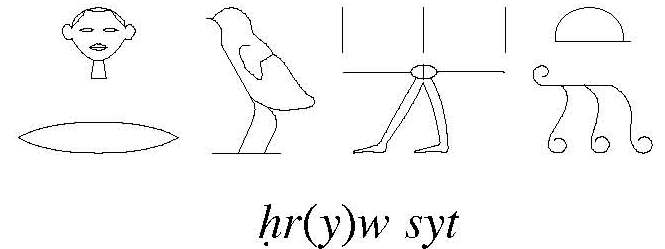
For the expression “the earth is devastated” the scribe wrote:

la tierra calvaThe verb fk means « be bald »[9]. The wasteland is an earth without hair. The absence of hair is a parallel of the absence of herb[10]. So, the hair shenu of Isis and Nepthys could easily be assimilated to the vegetation.

Life and death in Ancient Egypt were made conditional to nature and the seasons. The inundation that extended the mud all over the land and fertilised it, made possible the vegetation to grow up once the water retired. That was during peret, the season of sowing. If the hair element was before related to water, now it is linked to plants as the result of the fertilization of the land thanks to the regenerating waters.

The funerary cult is usually influenced by the cult to fertility and the “sacrifices and/or offers to the ancestral souls are taken from agricultural rites”[11]. The Osiris rite is an agricultural and lunar ritual, where lunar cycle and agrarian rites are mixed. As the moon does, the plants also have a cycle of birth, growing, death and resurrection. Cyclic also are the seasons (from drought to fertility). Moon, plants and seasons are cyclic; for that reason in Egyptian religion the lunar divinities are also vegetation gods.

In Ancient Egypt there were three seasons: akhet (inundation), peret (sowing) and shemu (harvest). The Egyptian year stated with the flooding of the Nile and the first month of akhet was tekh emborracharse, word which meant « get drunk ». Inebriation and inundation together makes us think of concepts as chaos and orgy and also of the disorder of the hair sema, since the verb tekhtekh estar desgreñado(duplication of tekh) means “to dishevel”[12]. At the end of the akhet season (in the month of Khoiak) took place the festival for Osiris.

Osiris, the mutilated god, came back to life in his shape of moon and in his shape of plant, so both cases were perfect images of resurrection. In those rites first some grains were put into moulds with the shape of the mummy of Osiris, where those grains would become plants. The 23rd of that moth took place a ceremony symbolizing the search and collection of the pieces of the corpse of Osiris and the embalming made by Anubis in the Golden House, which was also the place where the « Ceremony of the Opening of the Mouth » was carried out. According to some documents of Middle and New Kingdom, the 23rd day on Khoiak month was also called the day of the “Great Mourning”. The night of 25th took place the Lamentations of Isis and Nephtys, songs which read aloud the women representing the two goddesses. Just after that mourning rite, in the sunrise of 26th, was the resurrection of Osiris.

So, the akhet season started with the inebriation, the disorder, the chaos, and the primeval waters and finished with the fertilisation of the land, the end of the darkness and the resurrection of Osiris after a Mourning Rite made by Isis and Nephtys.

The hair of Isis and Nepthys had a role related to the cycle of life: first the sema is identified with the water, the inundation, the Nun, as a receptacle of regenerating principles; afterwards the hair shenu is assimilated to vegetation, as the product of the creation and as a manifestation of life. This would explain succession of chapters 167 and 168 in the Coffin Texts.

Once again hair is an element related to life; although we have seen now two different terms (first sema and then shenu) we are not moving away from the funerary and mourning context. The verb sheni means « suffer » and related to it is the name of the goddess Shentayt[13]. This divinity, which is documented from XIX dynasty, was assimilated to Isis as a mourner and widow of Osiris and appears in funerary rites of regeneration and purification oh him[14].


[1] Vegetation grows up on shores

[2] Mention to the putrefied Osiris corpse.

[3] BD, 183.

[4] Derchain, 1964.

[5] When the ceremony took place there also were some other funerary festivities (Derchain, 1964, p. 63).

[6] The moonlight does not illuminate.

[7] Darkness caused by the death.

[8] Derchain, 1964, p. 137.

[9] Wb I, 579.

[10] In agricultural people the growing of the hair is linked to the image of the growing of alimentary plants; and the same idea of growing up is related to the idea of rise. (Chevalier et Gheerbrandt, 1969, p.369).

[11] Elíade, 1970, p. 297.

[12] Wb V, 328, 8.

[13] Wb IV, 518, 3.

[14] Cauville, 1981, pp. 21-40.
The Hair as a Symbol of Water in Ancient Egypt: The Hair is the Primeval Water.


In 1964 D. Bonneau assimilated the hair of Isis with the rise of the Nile due to the bushes of papyrus floating on it[1]. According to her, “in the ancient Egyptian tradition the manes of the gods were bushes of papyrus”[2] and the locks of hair are the vegetable fibres that content the first rise and announce the flooding of the river. For that reason D. Bonneau assured that usually the hair was united to gods related to the flood of the Nile[3]. That also would explain why in decoration the water was always coloured in green with black waves or why the hieroglyph of water were usually in black colour.

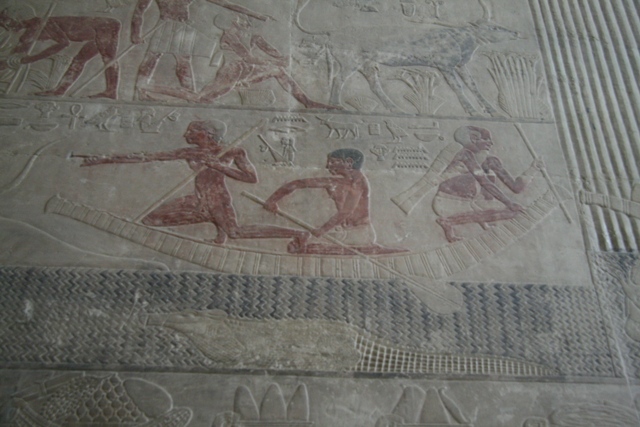
A boat is on a green water with black waves. Relief from the mastaba of Ti in Saqqara. VI Dynasty. Photo: Mª Rosa Valdesogo Martín

A boat is on a green water with black waves. Relief from the mastaba of Ti in Saqqara. VI Dynasty. Photo: Mª Rosa Valdesogo Martín

Hieroglyph of water in black colour. Coffin of the Middle Kingdom. Bahr el-Yussef Museum. Photo: Mª Rosa Valdesogo Martín

Hieroglyph of water in black colour. Coffin of the Middle Kingdom. Bahr el-Yussef Museum. Photo: Mª Rosa Valdesogo Martín

From the Old Kingdom we can see this relationship between hair and water. In the Pyramid texts of Pepi I we read that “…the hair of Pepi is the Nun…”[4] In fact, the hair is inseparable from the aquatic element, since in those parts where there were no papyri, Egyptians called “the hair of Isis” to coralline formations in the shores of Red Sea and the Indic Ocean[5].

We could then think of the hair as the water having the principles of the Creation and Renewing. The water of the flood has a magic power itself, as we can read in the magical Papyrus from Paris I, line 29. It is said how, for ensuring the effectiveness of the sacrifice of a cock, it was necessary “to go to a place where the Nile has already retired its water before nobody has step on it, or to a place dipped completely by the water of the Nile, or to a place flooded by the Nile in an accidental way [6]. According to these words it had to be a place soaked by those regenerating principles, which improved the magic. If the water had this magical power and was assimilated to the hair, it makes sense to think about a magical attribute of the hair.

It seems obvious the relationship in Ancient Egypt between the renovating rituals and the flooding, which was announced by Sothis, the brightest star that appeared  in the morning sky with the sun between the seventeenth and the nineteenth of July[7]. Sothis was for Egyptians «  the one who renovates the vegetation »[8] and she was assimilated to Isis: “Your sister Isis comes to you, happy with your love, you put her over your phallus, your semen goes up to her, sharp as Sothis, (like) Horus equipped coming out from you, like Horus who is in Sothis » [9]. The sexual aspect is very important and we consider it later.

Isis, assimilated to Sothis, announces with her hair the rise of the Nile, like the second one does appearing in the firmament. Isis is “the one who makes the Nile to increase and flow, the one who makes the Nile to get bigger in this season [10]. So, the mane of Isis would be a promise of resurrection, because would be the image of the water that creates and renovates. In the funerary rite it would emanate to the dead by means of the nwn gesture next to the corpse.  That would suppose a return to the Nun, the primeval waters where the first living went out from as the Nile permits the constant renovation of the Egyptian life. To shake the hair onwards would be then the announcement of a new creation, like the presence of Sothis means the beginning of the flood and the New Year.

Nile fertilising the land of Egypt near of Al-Minya. Photo: Mª Rosa Valdesogo Martín

Nile fertilising the land of Egypt near Al-Minya. Photo: Mª Rosa Valdesogo Martín

Many years ago S. Mayassis already studied the meaning of hair in Egyptian believing[11]. According to him, the hair was a synonym of power[12] and Isis covered her face with her mane to get profit of its own force and allow also the others to do the same thing[13]. S. Mayassis considered also to untie the hair was a way of putting the magical power of the knot aside[14], so the force of the hair was set out and joined the person[15].

Certainly the hair constitutes an element of power and vigour, but Mayassis did not mention that the power of the Isis’ mane is because its assimilation with the renovating water of the flood. That would explain the nwn gesture done by mourners in funerals was a revitalising gesture, that brings backs the dead to the Nun, for bringing him back to life, since he is “the one who has been created in the Nun [16].

In the month of Khoiak, the fourth month of the season Akhet (Inundation), took place the Mysteries of Osiris, a group of rites recalling the Osiris Myth[17]. In all these rites the mourning had a relevant place; women representing Isis and Nephtys were mourning at the moment of making the figurine of Osiris with earth and cereal[18], which grow up as a symbol of life and resurrection.  In the festivity of Osiris, the two representatives of Isis and Nephtys recited aloud a sacred song of mourning the twenty-fifth day of the Khoiak month just before the Osiris resurrection[19]. Lamentation would be the prelude of the new life for Osiris, also evident with the rise of the Nile[20]; in the funeral the meaning of that mourning would be the same.

On the other hand, Pausanias said how the tears of Isis were considered as the flood of the Nile: “Egyptians say that Isis weeps for Osiris when the river starts increasing; and when it floods the fields, they say that it is Isis’ tears[21]. Once the Nile started its rise, Egyptians celebrated the Festival of Isis; she, as mourner of Osiris, caused with her tears the increase of the water level of the Nile[22]. In fact, in the Songs of Isis and Nephtys, when they mourn we read: “I am Isis I flood the land in that day[23].

Tears (in Ancient Egyptian rmit) had in Egyptian mythology a strong creation power, because mankind (rmT) issued from tears[24].  According to a legend dating from XII Dynasty, the god Re sent one of their two eyes for fighting against his enemy Apophis. That eye was taking a long time to come back, so it was replaced by another one.  When the eye of Re came back from the battle and saw another one in his place he became very upset. This eye started crying and people came from its tears. For consoling the sorrow Re turned it into the ureus and put it on his forehead.

Amehotep I with the ureus in his forehead. Painting from the tomb of Inerkha in Deir el-Medina. Altes Museum of Berlin. XX Dynasty. Photo: Mª Rosa Valdesogo Martín

Amehotep I with the ureus in his forehead. Painting from the tomb of Inerkha in Deir el-Medina. Altes Museum of Berlin. XX Dynasty. Photo: Mª Rosa Valdesogo Martín

According to B. Mathieu “to come out from the eye” (pr m irt) is an Egyptian expression for referring to the weeping and he emphasizes the fact that mankind appears from a sorrow[25]. The eye and the humidity coming out from it (tears) have the power of giving life: “He has opened his eyes in the moment he was going out from the Nun. All these things have come to existence from his eyes”[26]. That would explain such an important role of the mourners during the funerary rite; they shed their tears with regenerating power that will help in the resurrection of the dead. We need also to notice the importance of the eye as a beneficial organ for the regeneration of the deceased (we will see it in another post).

In chapter 674 of the Coffin texts we could already read how “the water is the hair sema of Mht over you”. Water and Inundation are vital elements par excellence in Egyptian mythology. Water has always a negative and a positive aspect, because for renovating it is needed first a destruction. If the hair sema is like the water, that one will also have a double value: it will be at the same time image of chaos and of new life.

For that reason, we could think that the nwn gesture, depending on in which moment of the funeral it would be made, it could refer on one hand to the sorrow for the dead and the chaos of the death, and on the other hand to the rebirth and a the new creation. Mourners could shake their hair onwards as a sign of despair but also as an image of the primeval and chaotic water, which have the power of giving life and create.


[1] Bonneau, 1964, p. 259.

[2] Bonneau, 1964, p. 260.

[3] Bonneau, 1964, p. 260, n. 9.

[4] Budge,  1969, p. 109. This same assimilation of hair and Nun appears in the papyri of Ani and Un.

[5] “Juba relates that near of Trogloditas Islands a brush grew up in deep down in the sea called “hair of Isis”, without leaves and similar to coral” (Pliny the Elder, Natural History,  XIII, 51)

[6] Bonneau, 1964, p. 285.

[7] Bonneau, 1964, p. 263.

[8] Pyr. 477.

[9] Pyr. 632.

[10] Budge, 1973, p. 278.

[11] Mayassis, 1955.

[12] Mayassis, 1955, p. 354.

[13] Mayassis, 1955, pp. 354 y 362.

[14] Mayassis, 1955, p. 356.

[15] Mayassis, 1955, p. 362.

[16] CT, 544.

[17] That also shows the relationship between Osiris and the water.

[18] Guglielmi, 1980, p.80.

[19] Gaballa and Kitchen, 1969, p.45.

[20] Kees, 1956, p. 354.

[21] Pausanias, De Phocicis,  X, 32,10.

[22] Frazer, 1914, Third Ed., p. 33.

[23] Canciones…,3,16.

[24] Guglielmi, 1980, p. 82.

[25] Mathieu, 1986, p. 500.

[26] Fragment on the South facade of the temple of Hathor in Dendera (el-Kordy, 1982, p. 203).

The Hair is a Symbol of Water in Ancient Egypt. Hair in the Festival of the Valley.


The nwn gesture is also represented in a relief from the Red Chapel of Hatshepsut in Karnak. A group of women are dancing in the Festival of the Valley[1].

Dancers in the Festival of the Valley. Red Chapel of Hatshepsut in Karnak. XVIII Dynasty. Photo: Mª Rosa Valdesogo Martín

Dancers in the Festival of the Valley. Red Chapel of Hatshepsut in Karnak. XVIII Dynasty. Photo: Mª Rosa Valdesogo Martín

This festivity is documented for the first time in the temple of Mentuhotep II in Deir el-Bahari as a funerary Theban festivity. It was a feast in honour of the deceased ones. People visited the necropolis, decorated the tombs and carried offers to the dead relatives. In the gods sphere the image of the god Amon went out from the temple of Karnak in his sacred barque [2] and crossed the Nile for visiting every funerary temple of the West Bank. In the procession accompanying Amon there was a feminine clergy, among which there were some dancers.

Barque of Amon. Relief from the mortuary temple of Seti I in Dra Abu el-Naga. XIX Dynasty. Photo: Mª Rosa Valdesogo Martín

Barque of Amon. Relief from the mortuary temple of Seti I in Dra Abu el-Naga. XIX Dynasty. Photo: Mª Rosa Valdesogo Martín

The Festival of the Valley took place in the summer solstice, between the harvest and the flooding season. That means that it coincided with the rising of Sothis in the sky announcing the arrival of the flood[3]. People, who visited the tombs of their relatives during the night sung, drank and danced; according to some scholars sometimes the scenes were even “orgiastic”[4]. “The frontier between death and life disappears with the feast and the inebriation, the border that separates the living world and the Hereafter becomes blurred with the length of the night[5].

The last visit of Amon in his procession was the temple of Deir el-Bahari[6]. In the sanctuary of Hatshepsut the image of the god passed many days and nights. In this temple there is a scene with a barque over the “golden lake” surrounded by four ponds full of milk. During the night the barque was circled by torches, which were put out into the milk n the morning. That night took place the encounter between Amon and Hathor, the Cow Goddess. According to the scholar Naguib the milk into the ponds symbolised the milk of the Sacred Cow, the nourishment of Hathor; and at the same time these four ponds would symbolise the four cardinal points. So, “the solar God gets into the belly of the cosmic mother for renewing thanks to her milk, the same milk where the fire of the night is put out[7]. After that night the procession came back to the temple of Karnak.

After this encounter Amon was energized and ready for facing a new year. In fact it was a funerary festivity in which the god, as if it was a dead one, made a trip to the necropolis and was renewed after some ceremonial practices.

In addition the Festival of the Valley took place before the flood, and during that night of ecstasy Hathor showed her most erotic side. She was “the lady of the inebriation, the happiness in ecstasy, she promoted abundance and fertility”[8] , in whose night the flood was conceived[9]. The feminine being (Hathor) awarded the masculine principle (Amon) the fecundity power confirming this way the enthronement of the solar god.

In this renewing festivity we find again the nwn gesture. In the 30’s E. Brunner-Traut already compared the women who appear in the Red Chapel of Hatshepsut with the mourners of the tombs of Renni and Amenemhat, but she considered that they had nothing to do with each other[10]. According to her, the dancers of the Red Chapel were making a gesture of excitement and ecstasy[11], the movements of the mourners ware just a part of the moan[12]. However, H. Wild considered that what was said in chapters 1005 and 1974 of the Pyramid Texts about mourners pulling hair (« The souls of Buto rock for you; they beat their bodies and their arms for you, they pull their hair for you… ») was a description of a special dance in honour to the deceased king[13].

In the Theban tomb 53 of Amenemhat from the reign of Tutmosis III there is a very similar scene to that one of the Red Chapel. Some women are dancing or tumbling and caver their faces with the hair. In front of them three more women are shaking sistrums and a mena necklace; so this ceremony was related to the cult to Hathor.

Dancers from the tomb of Amenemhat (TT53). Gourna. XVIII Dynasty.

Dancers from the tomb of Amenemhat (TT53). Gourna. XVIII Dynasty.

In the 70`s Vandier considered that these were acrobatic dances and that women were making somersaults[14]. In the 80’s W. Decker, based on a reconstruction made by O. Keel[15], accepted the theory of Vandier and thought that the women with the hair over their faces were in fact getting ready for starting the somersault forward[16]. Also W. Decker compared this gesture with the one of the mourners in funerals (in particular with mourner in the Tomb of Minakht). But it seems unlikely that they describes similar moments; while in the first document we are in a group of dancing women, while in the tomb of Minakht she is not with other women making acrobatics.

Coming back to Deir el-Bahari, in the sanctuary there is a scene of the solar barque in procession. In it two women on their knees are touching their napes and cover their faces with the hair. Vandier thought that they were waiting their turn for making the same exercise as their fellows[17]. He emphasizes the fact that those women are not in a vertical posture, so maybe getting ready for making the somersault backwards[18].

Dancers in the Festival of the Valley. Relief from the temple of Deir el-Bahari. XVIII Dynasty. Photo: Mª Rosa Valdesogo Martín.

Dancers in the Festival of the Valley. Relief from the temple of Deir el-Bahari. XVIII Dynasty. Photo: Mª Rosa Valdesogo Martín.

It seems obvious that those women were making some acrobatics, but we do not think that cover their faces with hair were just a way of representing the first step of a somersault.  If thinking of a gymnast gaining momentum, the hair is never covering the face. The gesture nwn in the images of the dancers in the Festival of the Valley is not realistic at all (although about the realism in Egyptian art is another subject for debate). Taking into consideration that as much in tombs as in temples we are facing renewing ceremonies with a regeneration intention. So it is easy to think that nwn gesture in that dance had a reviving purpose. Dancers and mourners do the same movement of bending the body and throw the hair forward; and apparently in both cases with a similar symbolism.

On the other hand, the dance is something very common in religious rituals[19], and they have a connection with lunar rites[20]. “The dance is maybe considered as a fact of pleasant magic for promoting the lunar rebirth”[21]. If we notice that the Festival of the Valley was a funerary ceremony celebrated after the first new moon (a symbol of death) and before the flood (the annual renovation in Egypt), we could think that it was, as in burials, a new creation rite, it was the announcement of a cyclic renovation and the reenergizing of Amon[22].


[1] Michalowski, 1970, fot. 70.

[2] With the ones of  Mut and Jonsu.

[3] Naguib, 1990. Leuven, p. 129.

[4] Stadelmann, 1990, p. 148.

[5] Stadelmann, 1990, p. 149.

[6] Naguib, 1990, p. 126.

[7] Naguib, 1990, p. 128.

[8] Naguib, 1990, p. 129.

[9] Naguib, 1990, p. 130.

[10] Brunner-Traut, 1938, p. 51, n. 13.

[11] Brunner-Traut, 1938, p. 52.

[12] Brunner-Traut, 1938, p. 60.

[13] Wild, 1963, p. 86.

[14] Vandier, 1964, p. 451.

[15] Keel, 1974, fig. 11

[16] Decker, 1987, pp. 140-142.

[17] Vandier, 1964, p. 450.

[18] Vandier, 1964, p. 450.

[19] “Funerary dances take part in rites of passage, as in breaking rites of African cultures” (Naguib, 1993, p. 29).

[20] Briffault, 1974, p. 341.

[21] Briffault, 1974, p. 342.

[22] The physical activity (the movement) is a help for the resurrection. Amon, as king of gods, had to renew his power, as in the living world did the pharaoh.

The Hair is a Symbol of Water in Ancient Egypt. Hair in the Sed Festival.


It is impossible to avoid thinking of a relationship between the nwn gesture and the Nwn , the primeval chaos of the Egyptian cosmogony (It is also unavoidable to think on a play on words). The first one could easily be a way of coming back to the primeval moment, to the chaotic waters (Nwn) where the Primeval Hill came out from and where the Demiurge created the world.

At this point, we have to think of some other Egyptian rites with a renovating goal. It would also be possible that in those rituals exist similar practices. And we have found very interesting results looking at some documents related to two festivities: the Sed Festival and the Festival of the Valley.

Nwn gesture in Sed Festival.

In the tomb of Kheruef in Thebes (TT192), from the reign of Amenhotep III, there is a relief of the Sed festival of that pharaoh. A group of women are making a dance in front of Amenhotep III, in some cases they are making the nwn gesture[1]. The inscription says that the women are stretching out facing the king and making the ceremony [Sed Festival] before the throne.

Dancers shaking hair in the Sed Festival. Tomb of Kheruef. Assassif. XVIII Dynasty. Photo: www.osirisnet.net

Dancers shaking hair in the Sed Festival. Tomb of Kheruef. Assassif. XVIII Dynasty. Photo: http://www.osirisnet.net

The inscription just over the dancers could be a song, whose meaning would be related to their movements[2]. This same ceremony and dance is represented in some talatats found in Karnak, where it was the scene of the Sed Festival of Akhenaton.

The Sed Festival was a ceremony for renewing the pharaoh’s power. The king had a ritual death and afterwards he came back to life with all his faculties and in perfect physical conditions for going on with his kingship. It had five main parts:

  • The pharaoh is on a procession dressed with the Sed shroud
  • Rites of renewing and rebirth.
  • Homage is paid to the renewed king on his throne. He starts the new order of the world.
  • The pharaoh visits the gods in their chapels.
  • Ritual running of the pharaoh showing his physical vigour[3].

The Sed Festival has a Predynastic origin[4] and the god Sed could be an archaic version of Upuaut « The opener of the ways ». In the Palermo Stone the register related to the king Den shows the name of the god Sed written with the determinative of the Upuaut standard, the divinity that represents the king as the first-born son[5]. In addition it is interesting to notice how in the festival of Osiris in Abydos, the one avenging the death of his father was not Horus, but Upuaut[6].

We could maybe consider also that the Sed Festival in the Old Kingdom had some elements of the cult of Osiris[7]. In the Dramatic Ramesseum Papyrus, that tells the ascension of Sesostris I to the Throne of Egypt, we read that the erection of pillar djed (an Osirian rite) was a very important moment in the Sed Festival[8], there is also much iconography of the New Kingdom the relationship between the cult of Osiris and the Heb Sed[9].

This Festival is a death/resurrection ceremony, in which dancing women make an nwn gesture with their hair. What those dancers make with their hair could have a very deep symbolic meaning. The pharaoh is like a dead (although just hypothetically) and he has to revive. In this case the Sed Festival is a ceremony of death and resurrection, so those dancers maybe would be very close to the mourners in the funerary ceremony.

Mourning woman of Minnakht's tomb. www.1st-art-gallery.com

Mourning woman of tomb of Minnakht. Photo: http://www.1st-art-gallery.com

Dancing woman in nwn gesture. Tomb of Kheruef in Assassif. XVIII Dynasty. Photo: www.osirisnet.net

Dancing woman in nwn gesture. Tomb of Kheruef in Assassif. XVIII Dynasty. Photo: http://www.osirisnet.net

There was also a relationship between the Sed Festival and the beginning of the flood[10]. The Sed Festival was celebrated before the appearance of Sothis (the Egyptian name for the star Sirius) in the sky announcing the coming of the annual flooding of the Nile that was the beginning of the New Year in Ancient Egypt. The flood is one of the best examples of annual renewing for the Egyptians. The water of the flood, as the water of Nun in the Egyptian cosmogony, contents the active ingredient for the new life: the mud that fertilises the ground and grants the maintenance of Egyptian people.  Also in the tomb of Kheruef we read: “…Appearance of (king Amenhotep)…for resting on his throne that was in his Sed palace, built by him on the west side of the city. Open the way through S.M. over the water of the flood, for bringing the gods of the Sed Festival”[11].

In a statue of the New Kingdom we read how the owner is « beloved of Sothis, Lady of the Sed Festival » and in the ceiling of Ramesseum Ramses II sees Sothis “at the beginning of the year, the Sed Festival and the flood[12].

The Heb Sed was celebrated neither during the rise nor during the decrease of the flow, but in the driest moment[13], before the rising of Sothis and the arrival of the flooding. The Sed Festival announced the future waters, so it was the prelude of the new era, the new revival after the drought. And we have seen that in the rite, a dance with the nwn gesture took place.

In the Sed Festival, the pharaoh was like a ritual dead who had to come back to life[14], so he was assimilated to Osiris. That would explain the Osirian tinge of the ceremony. The king, symbolically dead, received the rites that Isis, Nephtys, Anubis, Thot and Horus made over the corpse for reviving[15]. In this regenerating ritual appears the nwn gesture as a part of the practices for the rebirth of Osiris/pharaoh.


[1] Fakhry, 1943, Pl. XL, p. 497.

[2] Fakhry, 1943, p. 497. In the temple of Bubastis there are some fragments relating to the Sed Festival; one of them shows a group of dancers with a small part of this song. (Naville, 1892, Pl. XIV)

[3] V, col. 785.

[4] V, col. 782. The Sed Festival is documented from the beginning of I Dynasty in the Narmer macehead and also maybe in the Scorpion macehead (Cervelló Autuori, 1996, p. 209, n. 154).

[5] Cervelló Autuori, 1996, p. 208, n. 150.

[6] Cervelló Autuori, 1996, p. 210.

[7] V, col. 786.

[8] V, col. 786; Barta, 1976, pp. 31-43.

[9] V, col. 786.

[10] Hornung und Staehelin, 1974, p. 56.

[11] Translation of Helck, 1966, p. 78.

[12] AH 1, 1974, p. 58.

[13] AH 1, p. 58.

[14] Mayassis, 1957, p. 226.

[15] Mayassis, 1957, p. 68.

The hair was a symbol of chaos in Ancient Egypt.


For understanding why the hair becomes such an important element, we have to get into its symbolic meanings. According to what we have read in religious texts, mourning, hair and resurrection are the three pillars of the believing.

The mourner gives the hair sema while she cries, weeps and regrets the death. The weeping and the mourning happen when there is disorder. In the Osiris legend, when the god died, the world, with no governor, was in a big chaos; the death of Osiris meant confusion, darkness and disaster.

In this context we could think that the nwn gesture of shaking the hair and covering the face with it would symbolize the chaos and darkness produced by the death; mourners hide their faces and cannot see in the same way that Osiris is blind because he is dead. The death reaches through the head; the lack of head means the lack of life, because it is impossible to see and breathe.

Detail of the mourners icovering their faces with the hair. Tomb of Rekhmire in Gourna. XVIII Dynasty. Photo: Mª Rosa Valdesogo

Detail of the mourners covering their faces with the hair. Tomb of Rekhmire in Gourna. XVIII Dynasty. Photo: Mª Rosa Valdesogo Martín.

The hair over the face is a gesture with a deep symbolic meaning, it dives the mourner in the same blindness of the dead one, so to put that hair away from the face allows the mourner see and pass from the shadows of the decease to the brightness of the resurrection.

In Ancient Egypt the death was not the end of a human being. To die took part of the life. A dead person was not a disappeared person, but a transformed one. Dying was another step in life cycle, as it was in the other natural events: lunar and solar cycles, the annual flood, vegetation cycle…So, the burial was just a transition, the dead person was changing his condition. In funerals mourning women would cover their faces with their hair sema, reproducing the shadow in which was the deceased, but in the moment of the resurrection they would uncover them recreating the coming back to light.

Because the chaos is a « personification of the primitive vacuum, before the creation”[1] and it becomes necessary to come back to it for finding the first manifestation of life, that in the funerary context will crystallize in the resurrection of the dead. The death is a return to the first moment of the creation, and in this new creation of revitalizing the deceased was crucial the life-giving gesture of shaking the hair.


[1] Chevalier et Gheerbrandt, 1969, p. 325.

Hair and Death in Ancient Egypt: Pulling Hair also in the Hereafter.


Mourners of Re pulling hair. Section two of the Book of Caverns. Tomb of Ramses VI. XX Dynasty.

Mourners of Re pulling hair. Section two of the Book of Caverns. Tomb of Ramses VI. XX Dynasty.

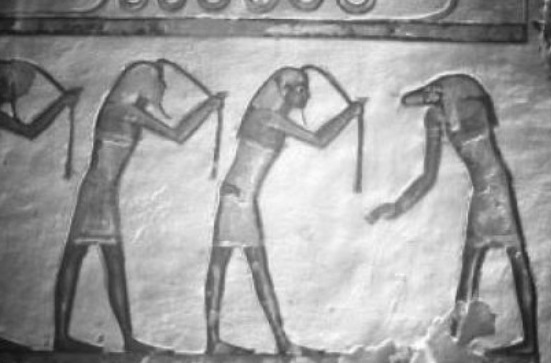
Not only on ancient Egyptian funerals were mourners shaking or pulling hair. Also in the Hereafter, supernatural beings were responsible of these kinds of practices. Book of Caverns show in the second section the god Re with head of crocodile walking towards nine divinities that hold their front lock of hair, the text says:

“Oh! The one who mourns, big of lock syt and of strong cry in the West protect the king.

“Oh! The one of the hair who is on the moan [1]el que está sobre el lamento

“Oh! These nein gods that mourn for Osiris, that cry for that one who is in front of Amduat.

Oh, look at me! I am walking towards you I pass by your caverns I call you and you scream to me. Duaty, he feels happy with your voice, those ones who mourn in Duat, the ones with secret faces, under you lock of hair syt[2], your voice is for me. I call you together , I light you up[3], mourners…you lead me and I walk towards you[4], I really protect your souls, I make you have my light, I take away the darkness that is on you…big mourners, having goods, you who are over the lock of hair syt in the land of the West . I walk on the ground I came from in my first birth”.

In the Duat the iakbyw (mourners) work for the regeneration of the dead god Osiris, crying and holding their locks of hair. And at the same time, that resurrection provides protection and light for their souls . When the deceased is in darkness the mourners are “under the lock of hair” covered with this hair:

bajo el mechón syt

When the deceased revives  and can walk in the Duat, the expression is just the contrary: “over the lock of hair” :

sobre el mechón syt

They are not anymore under the hair, but they have come to the light and the dead is “happy with the youth of his body

The words syt and swt describe the front lock of hair the mourners pull. We find also the term syt in The Coffin Texts in chapters 799 and 532, where tells about « tying the lock syt in Heliópolis the day of cutting the samt » and in several documents from the New Kingdom we also can read how a male characters are the mourners of Re and hold their lock of hair syt/swt[5] they grant that Osiris can be justified in the Hereafter [6]. At this point it is also interesting to say that in the chapter 339 of the Coffin texts, the day of the resurrection of Osiris is the day ofshaving the mourning women”.

Again, also in the Hereafter, the nwn m gesture is a part of the mourning rite, as a sign of pain but also as a way of making the dead revive and make easier his way in to the Hereafter.


[1] . Pay attention in the word used for moan (samt), which has de determinative of the hair. In the cenotaph of Seti I in Abydos we read: “Oh! The one of the hair, over his moan, who puts his voice, to whom the souls call” 

[2] . Piankoff translated the preposition  as “carrying” the locks syt.  But the first meaning of that preposition is “under”. If we take the sentence as “under the locks of hair syt” it made sense with the previous expression: “of secret faces”, so, “hidden under the hair”.

[3] The light comes after the darkness of the death.

[4] Mourners guide the dead with their screams. The deceased is blind (dead) and on the way to the new light (new life).

[5] Piankoff and Jacquet-Gordon, 1974, p. 55, Pl. 10.

[6] Berlin Papyrus 6, Piankoff and  Jacquet-Gordon, 1974, p. 57.

Pulling and shaking hair over the mummy in Ancient Egypt.


We have already seen how in chapter 180 of Book of the Dead the mourners appear dishevelled for or over the deceased.

Mourner covering her face with her hair. Tomb of Renni in el-Kab. XVIII Dynasty. Photo: www.egyptraveluxe.blogspot.com

Mourner covering her face with her hair. Tomb of Renni in el-Kab. XVIII Dynasty. Photo: http://www.egyptraveluxe.blogspot.com

The dead is now in the Hereafter and needs to get again the mobility. This chapter treats about the physical resurrection of the deceased and it was included in many tombs of kings (Tutmosis III, Seti I, Ramses II, Meneptah I, Seti II, Siptah, Ramses III and Ramses IV). In all cases the verb used for dishevelled was nwn. Taking into consideration those determinatives and the iconography of tombs of Amenemhat and Renni, one correct translation could be “…they are dishevelled over you…”.

We can then visualize the nwn gesture over the corpse for his benefit. Because after that the chapter follows: “…your soul gets happy, your body becomes glorious…” It describes the resurrection of the mummy, process in which was important that rite of mourning.

At this point we need to mention three relevant documents that refer to the role of mourning women in front of the body.

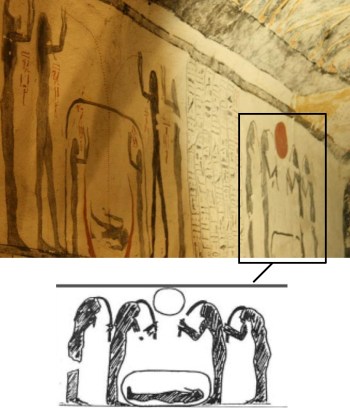
1)      The tomb of Ramses IX. On the left wall of the funerary chamber there is a unique scene of resurrection. The dead as a mummy inside an oval, over the corpse four women are making the nwn m gesture of pulling their locks of hair.

Women pulling lock of hair over the dead. Tomb of Ramses IX. Valley of the Kings. XX Dynasty. Photo: Mª Rosa Valdesogo Martín.

Women pulling lock of hair over the dead. Tomb of Ramses IX. Valley of the Kings. XX Dynasty. Photo: Mª Rosa Valdesogo Martín.

In the following scene the dead is not a mummy anymore, but now his legs and arms have movement. That makes us think about the nwn m gesture as something made for revitalising the body. The text accompanying the image is a fragment of the Book of Caverns in which we read about the resurrection of the dead and in that context it says:

“Those Goddesses are so, they are mourning over the secret place of Osiris…they are together, screaming and crying over the secret place of the ceremony…their secret is in their fingers…”

It is clear the relationship between mourning and the resurrection of the dead, to whom the women are pulling their locks of hair. On the other hand it is interesting to pay attention to the expression “…their secret is in their fingers…”, because with those fingers they are holding their hair. Which one is the secret? Is the resurrection or the way for reaching that resurrection?

2)      The coffin of Ramses IV. In the head piece there is a representation of Isis and Nephtys making the same nwn m gesture.

Isis and Nephtys pulling their locks of hair. This image is the head piece of the coffin of Ramses IV.

Isis and Nephtys pulling their locks of hair. This image is on the head piece of the coffin of Ramses IV.

Both goddesses are facing the head of the dead and the image is accompanied by an inscription where we read:

 “They move their faces during the moan; they mourn over the secret corpse of …

Both goddesses are holding their locks swt, the water is dropping from the eyes of these goddesses…the breath comes from them (the goddesses)…”

In some moment of his resurrection the dead finds Isis and Nephtys, which leaning their faces, holding their locks of hair swt and crying over the corpse, allow the dead to breathe and revive.

There is a very similar example in the coffin of the dwarf Dyedhor, who was dancer in the Serapeum. This coffin was found in Saqqara and belongs to the Persian period. The coffin of Dyedhor shows also Isis and Nephtys pulling their frontal locks of hair (Cairo Museum, nº cat. 1294).

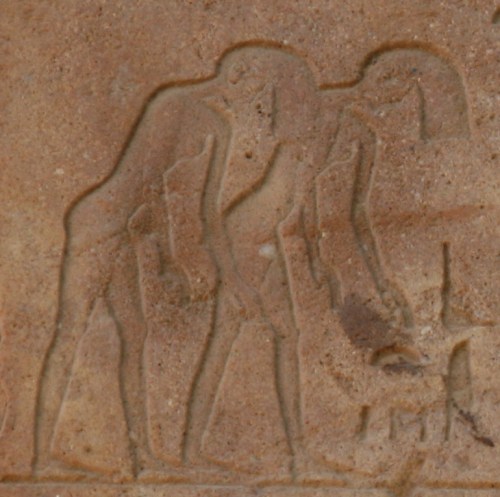
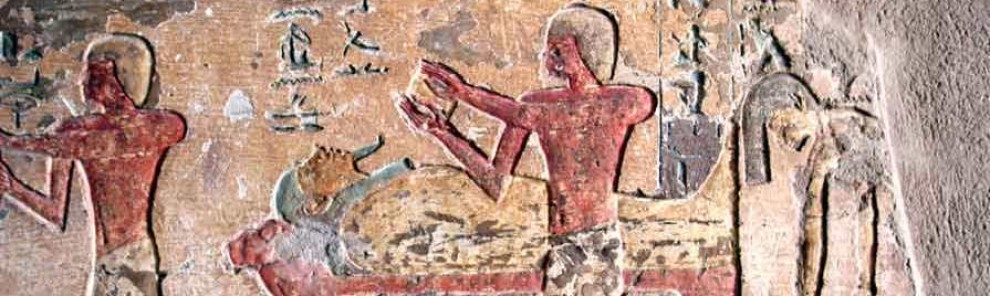
3)      The stele C15 in Louvre Museum is another important document for this subject. It was found in Abydos and dates from XI Dynasty. His owner was Abkaou, chief of the cattle. In the Middle Kingdom became very popular to put a stele in Abydos in the memory of the deceased god Osiris. In this stele the lower register shows Abkaou receiving the offerings while in an upper register there is an image of the ceremonies that took place during the Osiris festivity. Two mourners are over the lying corpse and both cover their face with the hair; in fact it remembers what it is said in chapter 180 of Book of the Dead.

Two mourners making nwn gesture over the corpse. Detail of the stele of Akbaou (stele C15) from Abydos. Musée du Louvre. XI Dynasty. Photo (stele): www.cartelfr.louvre.fr; photo (detail): www.commons.wikimedia.org

Two mourners making nwn gesture over the corpse. Detail of the stele of Abkaou (stele C15) from Abydos. Louvre Museum. XI Dynasty. Photo (stele): http://www.cartelfr.louvre.fr; photo (detail): http://www.commons.wikimedia.org

The inscription is much reduced: once hieroglyph tm and twice the hieroglyph nwi.   niw tm

The verb tm in ancient Egyptian means “complete”, “be completed”, “join the different parts of the body” (Wb V, 303), especially when it is about the parts of the dead (Wb V, 305, 1) and nwi means “to be in charge of” (Wb II, 220);  the whole could be translated as “to be in charge of completing”. In the Myth of Osiris Isis with the help of Nephtys are the ones who collect the different parts of the body of Osiris, so these two mourners of the image would also be in charge of mending the body of the dead. The nwn gesture they are doing over the body would be one of the practises for revitalizing the deceased.

Suming up, mourners in Ancient Egypt made a kind of rite with their hair during the funerals. It could be to cover the face with the hair (nwn) or pull the frontal lock of hair (nwn m). In both cases we have proofs of this practise over the corpse and always with a revitalising goal.

For understanding better the meaning of this practise we have to know more about the symbolism of hair.

Hair and Death in Ancient Egypt: Parts of the contents.


The work has four main parts:

1) The first one is dedicated to the gesture of shaking the hair made by mourners in Ancient Egypt.

Two women shaking their hairs. Relief from the Red Chapel of Hatshepsut in Karnak. Photo: Mª Rosa Valdesogo Martín

Two women shaking their hairs. Relief from the Red Chapel of Hatshepsut in Karnak. Photo: Mª Rosa Valdesogo Martín

Using the written documents and the iconography, this subject is treated from the practical and symbolic point of view, since I write about the symbology of hair for better understanding that gesture in the funerary context.

2) In the second part I tackle four different aspects of the hair:

  • the lock of hair swt
  • the braid Hnskt
  • the two curls wprty
  • the long hair (mane)  Samt

All speeches here are about these forms of hair from a symbolic perspective, which is always related to regeneration concept, so important in Ancient Egypt.

3) The third part of the work contemplates the relationship between the hair and the Udjat eye (Eye of Horus)Udyat Eye. At the end of the funerary ceremony the delivery of the Udjat eye means the resurrection of the deceased, assimilated to the god Osiris. In this last step the presence of the hair is very relevant, and to analyse it in third place is helpful for understanding much better the final of the funeral.

4) Once I have seen evidences in Ancient Egypt of a lamentation rite with the hair as the main element, I wanted to know in which moment of the funeral it took place. Reading between the lines the funerary texts and the iconography, we could think that the mourning rite was carry out in some moment during the “Opening of the Mouth” ceremony, a group of practices made in front of the mummy or the statue of the dead.

Women mourning beside the mummy. Tomb of Roy in Dra Abu el-Naga. Photo: Mª Rosa Valdesogo Martín.

Women mourning beside the mummy. Tomb of Roy in Dra Abu el-Naga. Photo: Mª Rosa Valdesogo Martín.

The two mourners representing the goddesses Isis and Neftis could be in charge of renewing gestures with their hairs for helping the deceased’s regeneration.