Tag Archives: hair

Hair and Death in Ancient Egypt: Pulling Hair also in the Hereafter.


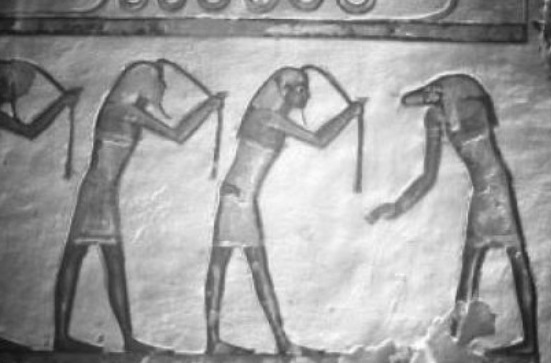
Mourners of Re pulling hair. Section two of the Book of Caverns. Tomb of Ramses VI. XX Dynasty.

Mourners of Re pulling hair. Section two of the Book of Caverns. Tomb of Ramses VI. XX Dynasty.

Not only on ancient Egyptian funerals were mourners shaking or pulling hair. Also in the Hereafter, supernatural beings were responsible of these kinds of practices. Book of Caverns show in the second section the god Re with head of crocodile walking towards nine divinities that hold their front lock of hair, the text says:

“Oh! The one who mourns, big of lock syt and of strong cry in the West protect the king.

“Oh! The one of the hair who is on the moan [1]el que está sobre el lamento

“Oh! These nein gods that mourn for Osiris, that cry for that one who is in front of Amduat.

Oh, look at me! I am walking towards you I pass by your caverns I call you and you scream to me. Duaty, he feels happy with your voice, those ones who mourn in Duat, the ones with secret faces, under you lock of hair syt[2], your voice is for me. I call you together , I light you up[3], mourners…you lead me and I walk towards you[4], I really protect your souls, I make you have my light, I take away the darkness that is on you…big mourners, having goods, you who are over the lock of hair syt in the land of the West . I walk on the ground I came from in my first birth”.

In the Duat the iakbyw (mourners) work for the regeneration of the dead god Osiris, crying and holding their locks of hair. And at the same time, that resurrection provides protection and light for their souls . When the deceased is in darkness the mourners are “under the lock of hair” covered with this hair:

bajo el mechón syt

When the deceased revives  and can walk in the Duat, the expression is just the contrary: “over the lock of hair” :
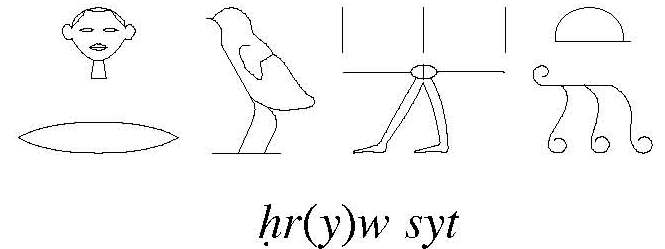
sobre el mechón syt

They are not anymore under the hair, but they have come to the light and the dead is “happy with the youth of his body

The words syt and swt describe the front lock of hair the mourners pull. We find also the term syt in The Coffin Texts in chapters 799 and 532, where tells about « tying the lock syt in Heliópolis the day of cutting the samt » and in several documents from the New Kingdom we also can read how a male characters are the mourners of Re and hold their lock of hair syt/swt[5] they grant that Osiris can be justified in the Hereafter [6]. At this point it is also interesting to say that in the chapter 339 of the Coffin texts, the day of the resurrection of Osiris is the day ofshaving the mourning women”.

Again, also in the Hereafter, the nwn m gesture is a part of the mourning rite, as a sign of pain but also as a way of making the dead revive and make easier his way in to the Hereafter.


[1] . Pay attention in the word used for moan (samt), which has de determinative of the hair. In the cenotaph of Seti I in Abydos we read: “Oh! The one of the hair, over his moan, who puts his voice, to whom the souls call” 

[2] . Piankoff translated the preposition  as “carrying” the locks syt.  But the first meaning of that preposition is “under”. If we take the sentence as “under the locks of hair syt” it made sense with the previous expression: “of secret faces”, so, “hidden under the hair”.

[3] The light comes after the darkness of the death.

[4] Mourners guide the dead with their screams. The deceased is blind (dead) and on the way to the new light (new life).

[5] Piankoff and Jacquet-Gordon, 1974, p. 55, Pl. 10.

[6] Berlin Papyrus 6, Piankoff and  Jacquet-Gordon, 1974, p. 57.

Pulling and shaking hair over the mummy in Ancient Egypt.


We have already seen how in chapter 180 of Book of the Dead the mourners appear dishevelled for or over the deceased.

Mourner covering her face with her hair. Tomb of Renni in el-Kab. XVIII Dynasty. Photo: www.egyptraveluxe.blogspot.com

Mourner covering her face with her hair. Tomb of Renni in el-Kab. XVIII Dynasty. Photo: http://www.egyptraveluxe.blogspot.com

The dead is now in the Hereafter and needs to get again the mobility. This chapter treats about the physical resurrection of the deceased and it was included in many tombs of kings (Tutmosis III, Seti I, Ramses II, Meneptah I, Seti II, Siptah, Ramses III and Ramses IV). In all cases the verb used for dishevelled was nwn. Taking into consideration those determinatives and the iconography of tombs of Amenemhat and Renni, one correct translation could be “…they are dishevelled over you…”.

We can then visualize the nwn gesture over the corpse for his benefit. Because after that the chapter follows: “…your soul gets happy, your body becomes glorious…” It describes the resurrection of the mummy, process in which was important that rite of mourning.

At this point we need to mention three relevant documents that refer to the role of mourning women in front of the body.

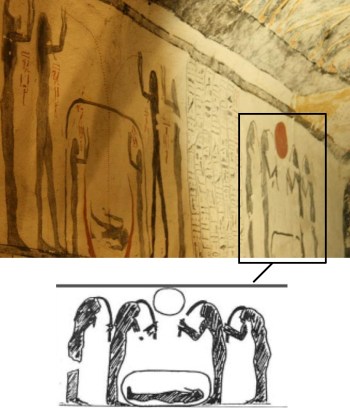
1)      The tomb of Ramses IX. On the left wall of the funerary chamber there is a unique scene of resurrection. The dead as a mummy inside an oval, over the corpse four women are making the nwn m gesture of pulling their locks of hair.

Women pulling lock of hair over the dead. Tomb of Ramses IX. Valley of the Kings. XX Dynasty. Photo: Mª Rosa Valdesogo Martín.

Women pulling lock of hair over the dead. Tomb of Ramses IX. Valley of the Kings. XX Dynasty. Photo: Mª Rosa Valdesogo Martín.

In the following scene the dead is not a mummy anymore, but now his legs and arms have movement. That makes us think about the nwn m gesture as something made for revitalising the body. The text accompanying the image is a fragment of the Book of Caverns in which we read about the resurrection of the dead and in that context it says:

“Those Goddesses are so, they are mourning over the secret place of Osiris…they are together, screaming and crying over the secret place of the ceremony…their secret is in their fingers…”

It is clear the relationship between mourning and the resurrection of the dead, to whom the women are pulling their locks of hair. On the other hand it is interesting to pay attention to the expression “…their secret is in their fingers…”, because with those fingers they are holding their hair. Which one is the secret? Is the resurrection or the way for reaching that resurrection?

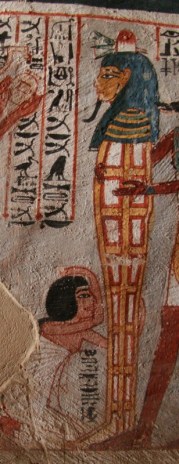
2)      The coffin of Ramses IV. In the head piece there is a representation of Isis and Nephtys making the same nwn m gesture.

Isis and Nephtys pulling their locks of hair. This image is the head piece of the coffin of Ramses IV.

Isis and Nephtys pulling their locks of hair. This image is on the head piece of the coffin of Ramses IV.

Both goddesses are facing the head of the dead and the image is accompanied by an inscription where we read:

 “They move their faces during the moan; they mourn over the secret corpse of …

Both goddesses are holding their locks swt, the water is dropping from the eyes of these goddesses…the breath comes from them (the goddesses)…”

In some moment of his resurrection the dead finds Isis and Nephtys, which leaning their faces, holding their locks of hair swt and crying over the corpse, allow the dead to breathe and revive.

There is a very similar example in the coffin of the dwarf Dyedhor, who was dancer in the Serapeum. This coffin was found in Saqqara and belongs to the Persian period. The coffin of Dyedhor shows also Isis and Nephtys pulling their frontal locks of hair (Cairo Museum, nº cat. 1294).

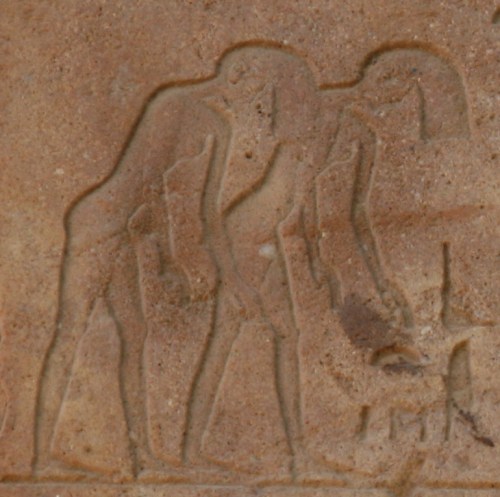
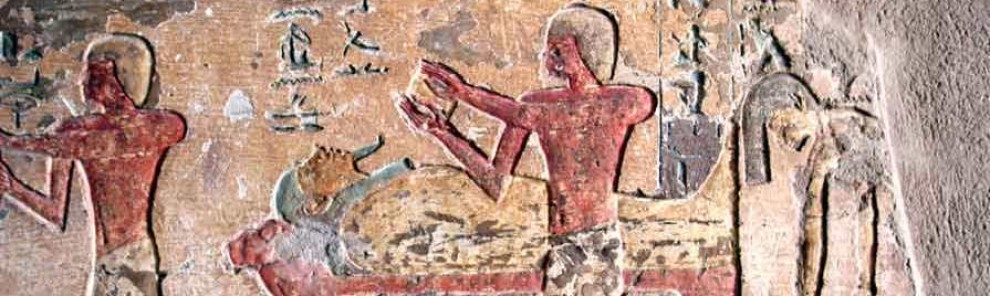
3)      The stele C15 in Louvre Museum is another important document for this subject. It was found in Abydos and dates from XI Dynasty. His owner was Abkaou, chief of the cattle. In the Middle Kingdom became very popular to put a stele in Abydos in the memory of the deceased god Osiris. In this stele the lower register shows Abkaou receiving the offerings while in an upper register there is an image of the ceremonies that took place during the Osiris festivity. Two mourners are over the lying corpse and both cover their face with the hair; in fact it remembers what it is said in chapter 180 of Book of the Dead.

Two mourners making nwn gesture over the corpse. Detail of the stele of Akbaou (stele C15) from Abydos. Musée du Louvre. XI Dynasty. Photo (stele): www.cartelfr.louvre.fr; photo (detail): www.commons.wikimedia.org

Two mourners making nwn gesture over the corpse. Detail of the stele of Abkaou (stele C15) from Abydos. Louvre Museum. XI Dynasty. Photo (stele): http://www.cartelfr.louvre.fr; photo (detail): http://www.commons.wikimedia.org

The inscription is much reduced: once hieroglyph tm and twice the hieroglyph nwi.   niw tm

The verb tm in ancient Egyptian means “complete”, “be completed”, “join the different parts of the body” (Wb V, 303), especially when it is about the parts of the dead (Wb V, 305, 1) and nwi means “to be in charge of” (Wb II, 220);  the whole could be translated as “to be in charge of completing”. In the Myth of Osiris Isis with the help of Nephtys are the ones who collect the different parts of the body of Osiris, so these two mourners of the image would also be in charge of mending the body of the dead. The nwn gesture they are doing over the body would be one of the practises for revitalizing the deceased.

Suming up, mourners in Ancient Egypt made a kind of rite with their hair during the funerals. It could be to cover the face with the hair (nwn) or pull the frontal lock of hair (nwn m). In both cases we have proofs of this practise over the corpse and always with a revitalising goal.

For understanding better the meaning of this practise we have to know more about the symbolism of hair.

Hair and Death in Ancient Egypt: Parts of the contents.


The work has four main parts:

1) The first one is dedicated to the gesture of shaking the hair made by mourners in Ancient Egypt.

Two women shaking their hairs. Relief from the Red Chapel of Hatshepsut in Karnak. Photo: Mª Rosa Valdesogo Martín

Two women shaking their hairs. Relief from the Red Chapel of Hatshepsut in Karnak. Photo: Mª Rosa Valdesogo Martín

Using the written documents and the iconography, this subject is treated from the practical and symbolic point of view, since I write about the symbology of hair for better understanding that gesture in the funerary context.

2) In the second part I tackle four different aspects of the hair:

  • the lock of hair swt
  • the braid Hnskt
  • the two curls wprty
  • the long hair (mane)  Samt

All speeches here are about these forms of hair from a symbolic perspective, which is always related to regeneration concept, so important in Ancient Egypt.

3) The third part of the work contemplates the relationship between the hair and the Udjat eye (Eye of Horus)Udyat Eye. At the end of the funerary ceremony the delivery of the Udjat eye means the resurrection of the deceased, assimilated to the god Osiris. In this last step the presence of the hair is very relevant, and to analyse it in third place is helpful for understanding much better the final of the funeral.

4) Once I have seen evidences in Ancient Egypt of a lamentation rite with the hair as the main element, I wanted to know in which moment of the funeral it took place. Reading between the lines the funerary texts and the iconography, we could think that the mourning rite was carry out in some moment during the “Opening of the Mouth” ceremony, a group of practices made in front of the mummy or the statue of the dead.

Women mourning beside the mummy. Tomb of Roy in Dra Abu el-Naga. Photo: Mª Rosa Valdesogo Martín.

Women mourning beside the mummy. Tomb of Roy in Dra Abu el-Naga. Photo: Mª Rosa Valdesogo Martín.

The two mourners representing the goddesses Isis and Neftis could be in charge of renewing gestures with their hairs for helping the deceased’s regeneration.

Hair and Death in Ancient Egypt: Foreword.


I started this research when Dr. Nadine Guilhou from the university of Montpellier told me about some images in Egyptian iconography where hair in funerary rites was treated in a very special way.

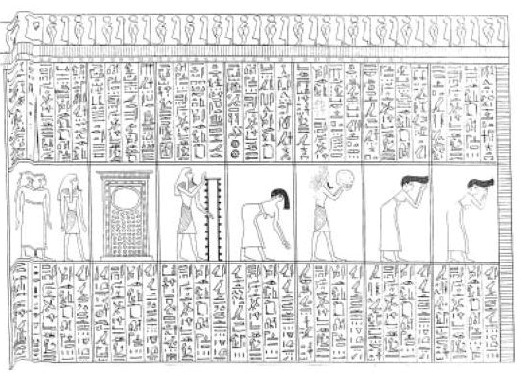
The first important document was a vignette in the chapter 168 of the Book of the Dead. Here mourning women in the funeral cortege of Re were shaking their hair and covering their faces with it.

Chapter 168 B of the Book of the Dead.

Chapter 168 B of the Book of the Dead.

I needed to be sure that it was not an isolated case, so I had to find out more similar examples. I found many similar scenes in Theban tombs from the New Kingdom where mourning women gesticulated in the same way: Amenemhat (TT82),  Minakht (TT87), Rekhmire (TT100) and Ineni (TT81), in the tomb of Renni at el-Kab (see the front of the blog). Out of the burials, but always in the funerary context, there is a scene from the funerary temple of Seti I in Dra Abu el-Naga.

Relief from the tomb of Amenemhat (TT 82)

Relief from the tomb of Amenemhat (TT 82)

Such a common attitude could not be just a coincidence, or a theatrical exposure of pain, but it had to arise from a deeper reason related to the funeral rite.

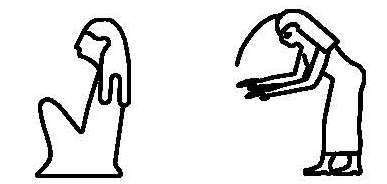
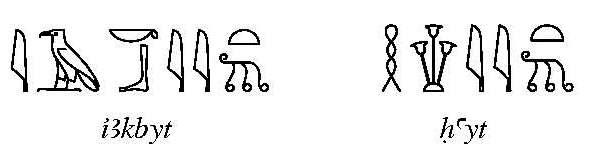
I still needed to look for more. Together with the iconography in Egyptology is necessary to have a look to the vocabulary. Among the words used by the Egyptian for “mourner” there was iakhbyt or hayt; I noticed that in many cases the writing did not include the determinative of a woman or a dishevelled woman, but the hieroglyph of the hair.

Determinatives of a woman and a dishevelled woman.

Determinatives of a woman and a dishevelled woman. Below the words in egyptian for “mourner“.

Jeroglíficos Foreword1


  This showed that the mourner’s hair was such an important part of them, that even it could identify them.

As we were in the funeral field, I had to consider all funerary texts and I found many allusions to the capillary element. Those ones were more frequent in the Coffin Texts of the Middle Kingdom and all of them with a « common denominator »: in all speeches mentioning the hair, mourner women were the main personages (and of course the mourning rite) and the Osiris myth was the backdrop.

For supporting the written document of the Middle Kingdom I found two images from the same period. One of them was a representation of a mourner beside the coffin leaning onwards and with her hair over her face; the other one was the Louvre stela C15, where the two mourners who assist the dead are doing this same gesture.

Mourning woman beside the coffin. Image in a coffin of the Middle Kingdom from Abydos.

Mourning woman beside the coffin. Image in a coffin of the Middle Kingdom from Abydos.

Given that the Coffin Texts is where more allusions to hair can be found, I decided to initiate the research with reading of this corpus, so the other texts I mention are just support documents.

HAIR AND DEATH IN ANCIENT EGYPT


In 2005 I published my book about Hair in Funerary Context in Ancient Egypt, which was my doctorate research. With the help of Nadine Guilhou from Université Paul Valéry (Montpellier) I came to important conclusions that helped to know much better some funerary rites in Ancient Egypt.  But, mainly, I noticed the importance of mourning women, whose presence was crucial for the dead’s resurrection.

Mourning women, one of them on the ground pulling her hair. Relief from the tomb of Mereruka in Saqqara. Photo: Mª Rosa Valdesogo Martín.

It was published in Spanish and my intention was to translate it into English or French for the international community.

Thanks to the new technologies, now we can share knowledge in an easy and quick way, so I have thought to use them  to transmit that content to everyone who could be interested.

I hope you enjoy.

María Rosa Valdesogo Martín