Tag Archives: Isis

The two Ringlets wprty give Access to the Realm of the Dead.


The presence of hair in Ancient Egypt funerary belief is more than just the mane or the lock of hair. There are mentions in three chapters of the Coffin Texts to another shape of hair: the ringlets.
1) In chapter 107 of the Coffin Texts the deceased goes out to the day, that is, he comes back to light and to life; in that process we read:

“…praises are given; the double ringlet starts the jubilee

wprty starts the jubilee

 While the Duat gets open for me…”

There is undoubtedly a word game with wpw (open) and wprty; since wpt can be also the crown as the origin of the hair[1], the upper part of the head (and also the zenith of the sky). On the other hand, the Egyptian word wprty describes the lateral plait or ringlet that can be seen in children as a sign of youth[2]; it is also the side lock of the god Khonsu[3], the god of moon.

The god Khonsu with side lock. Relief from the funerary temple of Seti I in Dra Abu el-Naga. Photo: Mª Rosa Valdesogo Martín.

The god Khonsu with side lock. Relief from the funerary temple of Seti I in Dra Abu el-Naga. Photo: Mª Rosa Valdesogo Martín.

D. Meeks translates it with a wider meaning as « lock of hair in the temple » [4]. Taking into account that the chapter relates how the deceased gets into the Duat, it makes sense to think about the two lateral ringlets of Hathor, the Egyptian goddess who receives the dead ones in the flank of the West Mountain, when they get into the realm of the dead, and she guides them in the night sky.

One of Hathor’s symbols of identity is her two big lateral ringlets framing her face[5]. Apparently this image of the goddess derives from a version of the myth of the “Eye of Re”.

The goddess Hathor with lateral ringlets. Column from the temple of Khnum in Elephantine Island. Photo: Mª Rosa Valdesogo Martín.

The goddess Hathor with lateral ringlets. Column from the temple of Khnum in Elephantine Island. Photo: Mª Rosa Valdesogo Martín.

It relates how Hathor (also Tefnut) lived in the Nubian desert as a wild lioness, while her father Re ruled alone the mankind. This one commanded Shu and Thot the mission of looking for Hathor and bring her back to Egypt. When they were in Philae, Hathor immersed in the holy water of the first cataract and she became a very pretty woman “goddess of love, with pretty face and the hair on two big ringlets, bright eyes and firm breast”[6]. The legend of the Eye is the legend of the return: the return of the goddess from the desert, the flood after the winter, it is also the cyclic return of the agricultural prosperity[7].

2) In chapter 109 of the Coffin Texts we read:

“Open the Occident. Praises are given. The jubilee starts when Hathor gives the double ringlet”[8]

wprty starts the jubilee (109)

This chapter confirms the previous exposure, since the wprty are the two ringlets of Hathor. It is about the funerary goddess, the one who takes the deceased in the necropolis; she is “Hathor, the Mistress of the Occident, who rules the frontier of the desert”; she presents the two ringlets, Hathor, the lunar goddess which guides the dead in the darkness of the death.

Could we think that this passage is referring to a rite? Would it be ridiculous to think of a kind of priestess or representative of Hathor in the necropolis presenting two ringlets to the mummy? If so, and taking into consideration the assimilation of Hathor with Isis in Egyptian religion, could be that woman the mourner in the role of Isis? [9]. Thinking so, we would keep in the same line and with the mourners as the main persons of our research; we would not need to resort to a third woman, which, on the other hand, does not appear in any funerary scene.

3) In chapter 533 the dead becomes a scribe of Hathor; the text is long but just in a few sentences we find something very interesting for our subject:

“Become scribe of Hathor. I am the one who is glad before her horns, being arms united, the lector priest, scribe of god words…in the secret palace…

…my two ringlets get open
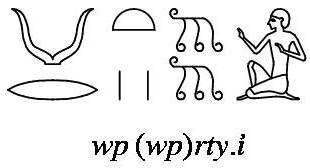
my ringlets open

 and the face of Hathor makes lighter to me. Hathor holds her arms out”

Once again we are facing Hathor as the goddess who takes the dead in, holding her arms out. When the two ringlets separate, as if they were curtains, the deceased discover her face, as if it was a window that lets the light come in; Hathor’s face gets lighter, like the moon in the dark sky.

For the expression “make lighter”, the scribe used the Egyptian word HD, which it is also used for terms related to « clear », « silver » or « moon » [10]. Separate the wprty ringlets means to see the moon; it is the access to the light after the darkness of the death. Hathor/moon allows the vision during the night; she illuminates, guides and takes the deceased in.

It is also interesting to notice how in chapter 44 of the Coffin Texts we can read: “Heaven’s doors open with your beauty, you go out and you see Hathor [11]. To get into the heaven and see the goddess, either the doors get open, or the wprty ringlets get separated. It seems both elements doors and ringlets could be assimilated and interchangeable. To separate the wprty as if they were curtains allows seeing the light (Hathor’s face / moon) in the middle of the night sky.


[1] Wb I, 297, 13. It is also the part of the head new born “opens” the mother for coming to life, so it is a part related to the rebirth.

[2] Wb I, 305, 6.

[3] We can read it in the propylon of the temple of Khonsu in Karnak. K. Sethe und O. Firchow, 1957, 67 78, 81.

[4] D. Meeks, 1977-79, II, p.94, 78.0951.

[5] According to S. Aufrère “Hathor dissimulait sa face ronde et plate d’Asiatique dans une épaisse coiffure de bédouine, aux inmenses volutes, formant la nuit de lapis-lazuli” (S. Aufrére, 1993, p. 17).

[6] H. Junker, 1911.

[7] E. Bresciani, 1993, p. 47.

[8] In some coffins the writing  wprt  is reduced tort.

[9] In the scene of resurrection in the tomb of Petosiris Isis on the left with the side lock is the “Lady of Rekhyt”, an epithet of Hathor (F. Daumas, 1960, pl. I).

[10] Wb III, 206-208

[11]CT I, 44.

Hair, Hathor and Moon.


Joint with the hair, we have seen now two new important elements which we cannot ignore: Hathor and light. Hathor is mentioned as the « guide of the boat, who keeps ropes kasu in front of the rudder in the West ways… », she is « the lady of the light, who guides the Big One who is tired ». Hathor and light means that the text is referring to the lunar Hathor, the guide during the night.

According to an Egyptian tradition, Hathor was patroness of deceased[1]; she was a goddess that very soon became the goddess of The West and the imagery put her on the flank of the mountain, the place of the sunset and where the dead ones got into the Underworld[2].

The goddess Hathor in the flank of the west mountain ready for receiving the dead. Painting from the tomb of Shuroy in Dra Abu el-Naga. XIX Dynasty. Phot: Mª Rosa Valdesogo Martín.

The goddess Hathor in the flank of the west mountain ready for receiving the dead. Painting from the tomb of Shuroy in Dra Abu el-Naga. XIX Dynasty. Phot: Mª Rosa Valdesogo Martín.

Religious texts show that from very soon Hathor was a goddess who received the dead[3], who sheltered him[4], who helped him in reaching the eternity[5]; in the Afterlife the dead was in the entourage of Hathor[6] and she was the main one in the necropolis, that is why one of her epithets was “Hathor at the head of the Necropolis”[7]. Hathor helped the dead to go up to the sky, the same sky where she is guardian and that is his own body as celestial cow. In fact, the Egyptian name Hathor means « The house of Horus » [8].Hathor's name

Hathor grants the dead be sitting in the sky, that according to E. Drioton would be a lunar paradise[9], so a night sky. Not only Hathor has a relationship with the moon, with the night sky and with Horus[10], she also is connected somehow with the Udyat eye[11]. There are several examples of Hathor with a lunar character, so she is the “left eye of Re” [12], the “eye of Re in the sky during the day and the eye of Horus which makes the darkness bright” [13].

It is well-know the relationship between cattle and the moon, because the horns are assimilated to the crescent quarter. This aspect contributes to that image of Hathor as a sky goddess, which exist in Ancient Egypt from the Predynastic period.

Cow-head palette from Gerzeh. Predynastic period. Photo: www.touregypt.net

Cow-head palette from Gerzeh. Predynastic period. Photo: http://www.touregypt.net

We see it clearly in the cow-head palette from Gerzeh in Cairo Museum with the image of a cow rounded with stars making a very ancient image of a celestial cow[14].

But Hathor, is mainly a mother goddess, a celestial cow whose main role is feed people and gods and, so that, has the faculty of giving the life[15]. Maybe that is the reason why, as a mortuary divinity, Hathor also took part in the deceased’s resurrection and was assimilated with Isis[16].

The maternal nature of the cow makes that animal a symbol of rebirth. In this sense Hathor should be consider as a manifestation of the primeval mother[17]. Because “horns of cattle, that characterize great fecundity gods, are the emblem of the divine “Magna Mater[18] and because moon and fertility go together.

Hathor, as lunar deity, is also guide of the boat and she maintains the ropes. In this regard we consider interesting to refer to chapters 404 and 405 in the Coffin Texts, where the bow rope is assimilated to the braid of Isis. It is the night boat, which carries the deceased when he revives during the night, so it is the moon. The shape of the boat could remember the quarter of the moon, so the boat crescent-shape will be one of the first means of transport[19] in Egyptian culture, as it will be for the dead once he will be in the Afterlife.

In fact, the usual head-dress for lunar deities is a full moon over a crescent, in the same way the deceased reborn as a full moon will travel in the Hereafter in the lunar boat, identified with the crescent.

Head-dress of Khonsu with full moon over the crescent. Relief from the temple of Khonsu in Karnak. XIX Dynasty. Photo: Mª Rosa Valdesogo Martín.

Head-dress of Khonsu with full moon over the crescent. Relief from the temple of Khonsu in Karnak. XIX Dynasty. Photo: Mª Rosa Valdesogo Martín.

So, what we are facing is a lunar rebirth. In that rebirth we have seen the important role of the hair element. The feminine hair appears related to water, maternity, sexuality…and also now to the moon.  If hair is related to water and moon, the lock of hair swt in mourning should also have a connection with the lunar resurrection of the dead, with the goddess Hathor in her lunar nature, as guide of the boat (crescent of the moon) in the dark of the night sky.

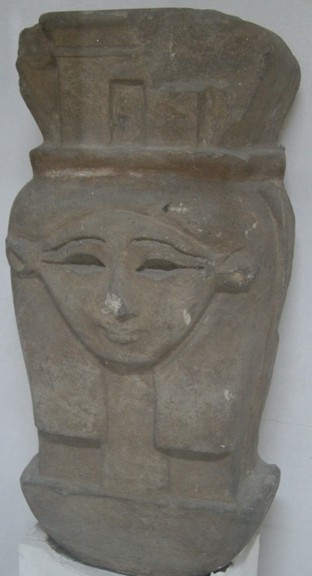
Hathor capital. Bahr el-Yussef museum. Photo: Mª Rosa Valdesogo Martín.

Hathor capital. Bahr el-Yussef museum. Photo: Mª Rosa Valdesogo Martín.

So, we have the mourners and /or the locks of hair swt in the moan, that is, mourning on earth during the funerals while the goddess Hathor in her lunar nature is in the night sky with her both ringlets on each side of her frontal face;  Hathor  is a grant of the deceased’s resurrection and she guides the boat, which bow rope is the braid of Isis. In the funerary ceremony the two locks of hair of the mourners could be the announcement of the lunar resurrection.


[1] E. Drioton, 1985, p. 188.

[2] A. Erman, 1952, p. 50.

[3] Pyr. 1026.

[4] CT VI, 769.

[5]CT V, 398.

[6] LdM, 144.

[7] S. Allam , 1963, p. 67

[8] S. Allam, 1963, p. 99

[9] E. Drioton, BiOr 15, p. 189.

[10] A. Mariette, 1875, IV, 77 a; en Ph. Derchain, 1962, p. 46.

[11] CT VI, 670.

[12] A. Mariette, 1875, I, 112, 7(A).

[13] A. Mariette, 1875, VI, 144, 2-3(J).

[14] According to F. A. Hassan it could represent Orion (F. A. Hassan, 1992, p. 314).

[15] One epithet for Hathor is “Mistress of Life” (A. Mariette, 1875, I, 26 f.).

[16] According to a version of the Osiris legend, Isis lost her head and Thoth replaced it with a cow’s head (Pap. Sallier IV). In addition, sometimes Hathor is called with the epithet of “Beautiful One of Osiris” (A. Mariette, 1875, VI, 3, 3).

[17] F. A. Hassan, 1992, p. 315.

[18] M. M. Eliade, 1970, p. 146.

[19] G. Durand, 1979, p. 238.

The meaning of the word swt


There is another chapter referring to swt; although it is a confusing text, we can make some deductions examining consciously the words. In the chapter 332 of the Coffin Texts the dead is being guided by a powerful goddess who is

“…the lady of the power, who guides to those ones in the caverns. I am Hathor, Lady of the northern sky, who maintains the ropes kAsw of those awaken…the earth trembles because of the jubilation, while the locks of hair are in the mourning…

locks of hair in the mourning

Sw is a verb, whose meaning is “to be something harmful for someone”[1], maybe it could be translated as “hurt “or “wound”. The substantive would then be swt (“damage”, “hurt”)[2].  We already find this verb in the Pyramid Texts of the Old Kingdom:

The two armas over the head is a very normal posture among mourners in Ancient Egypt. Painting from the tomb of Roy in Dra Abu el-Naga. XVIII Dynasty. Photo: Mª Rosa Valdesogo Martín.

The two arms over the head is a very normal posture among mourners in Ancient Egypt. Painting from the tomb of Roy in Dra Abu el-Naga. XVIII Dynasty. Photo: Mª Rosa Valdesogo Martín.

“The deceased is the Lord of his enemies, which have been beaten by Horus for him. Go up! Sit over him! You are stronger than him, hurt him…!” (di ir.k swt ir.f)[3]Isis is sitting, her arms over her head. Nephtys, holds her breasts because of the death of her brother, Anubis is bended over his stomach, Osiris is in his damage » (Wsir m swt.f) [4].

We could maybe consider the word swt as a passive participle of the verb sw, so the translation would be something as: “the damaged ones” or “the hurt ones”, the ones who have been damaged, that is, the mourners Isis and Nephtys; they were hurt by the death of Osiris and that is why they are in mourning.  This would also explain the use of the hieroglyph of hair as determinative in so many words that refer to mourners and mourning.This passage is clearly describing the typical funerary scene in which the mummy is laying while Anubis makes his embalming process and the two mourners Isis and Nephtys regret the death of her husband/brother.

We should also notice a kind of word game with the “locks of hair” (swt) in chapter 531 and the “hurt ones” (swt) in chapter 332, in both cases applied to the mourners who dishevel their hair as a sign of mourning.  It is as well interesting how each mourner is indentified with a lock of hair; so mourners and hair go together. That is what we call a metonymy; the whole (the mourners) is designated using its most significant part (the hair).

But we wanted to go on searching more on the verb swverb sw  and we found that it also could be translated as “to increase the strength” or “to get the strength back” [5]. We can read this verb in the Pyramid Texts[6] and also in the Coffin Texts:

“…I came and I recovered the strength back in nsrsr island”[7].isla nsrsr

In both texts the dead, after drinking milk or beer (both considered revitalising drinks), recover his force and comes back to life. It makes sense the use of the hair as determinative ; if the hair is an energy source and the nwn/nwn m gesture pretend the resurrection of the corpse, it is normal here to find it related with a verb meaning « fortify ». On the other hand, swt is a causative verb that derives from wt, whose translation is “be powerful” or “be big” [8]. In addition, wt also means « to embalm » [9] and there is direct relationship between embalming and the deceased’s resurrection. One of the main goals of embalming was to reconstruct the whole body, the physical reconstruction as getting the soul’s support, and this consolidation is connected with the hair element.


[1]   Wb IV, 59, 16

[2]   Wb IV, 59, 18

[3] Pyr., 652.

[4] Pyr., 1281-1282.

[5] D. Meeks, 1977-1979, II, p. 311, nº 78.3367; D. Meeks, 1976, p. 88, n. 14.

[6] Pyr., 1282 b.

[7]CT VII, 1013. Translation of P. Barguet (P. Barguet, 1986, p. 417).

[8] Wb IV, 77, 9.

[9] Wb I, 378, 8.

The Locks of Hair swt are Isis and Nephtys.


The chapter 531 of the Coffin Texts treats about the prophylaxis of the different parts of the funerary mask, always assimilating them with many divinities. After saying how perfect is the face (that is the mask) of the dead we read:

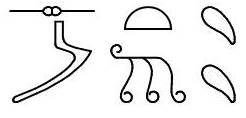
Your White Crown is Thoth; your crown is Wp-wawt[1]. Your eyebrows are both Enneads. Your eyes are the boat of the day and the boat of the night.

Your two locks of hair are Isis and Nephtys.

Swt are Isis and Nephtys

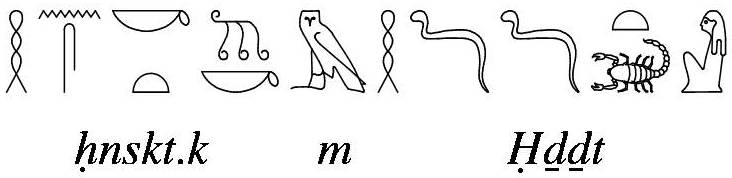
Your nape is Duanenuy. Your plait is Hddt

Hnskt is Hddt

 The funerary mask is like a complete head, or like its substitute, and to put it on the deceased’s face is a revivifying action. The dead is assimilated to the acephalic Osiris and the mask has two functions. On one hand it hides the damage made by Seth on the Osiris’ face; on the other hand it restores the faculties to the head, as to see and to breath; through the mask the dead can also perceive things that mortals cannot notice[2]; the replacement of the head, symbolised by the placement of the mask, allows the deceased to come back to life.

Scholar D. Meelks translated the word swt as “lock” or “plait”[3]. Due that the chapter is describing the funerary mask; we could think that this word would be making an allusion to the two locks of hair that fall on both sides of the face; in the same way that Isis and Nephtys are always at both extremes of the dead.

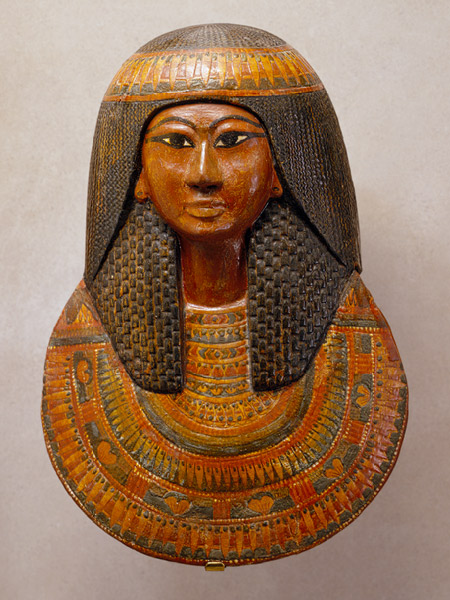
Khonsu's funerary mask. XIX Dynasty. Metropoliltan Museum of New York. Photo: www.metmuseum.org

Khonsu’s funerary mask. XIX Dynasty. Metropoliltan Museum of New York. Photo: http://www.metmuseum.org

Let’s remember also that we have already seen how the word swt designates the front lock of hair the mourners pull. Maybe both locks of hair were assimilated to the hair the two goddesses pull from.

In the wig both locks of hair fall at both sides of the face while the rest of the hair falls over the back. The term hnskt usually means “plait of hair”[4].  But in the context we are the two locks of hair are assimilated with Isis and Nephtys, and just before the text mentions the nape, so it makes sense to think of Hnskt as the mop of hair that in the wig falls on the back[5]. On the other hand, the term Hnskty is a dual that means « the two women with plait », Isis and Nephtys[6]. And that refers us to those images of Isis and Nephtys with the head-dress afnt (see image in header) or to those images of mourners with the hair tied in a back tail; , which would reinforce the idea that hnskt could be that hair identified with the goddess Hddt (a kind of Isis in Edfu).

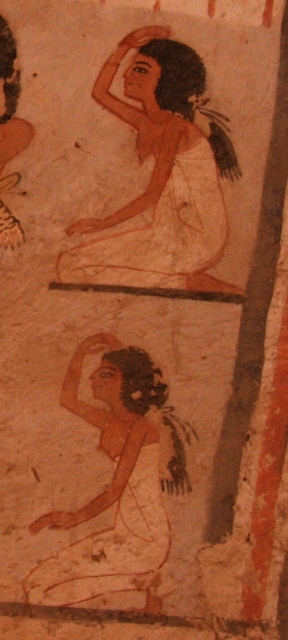
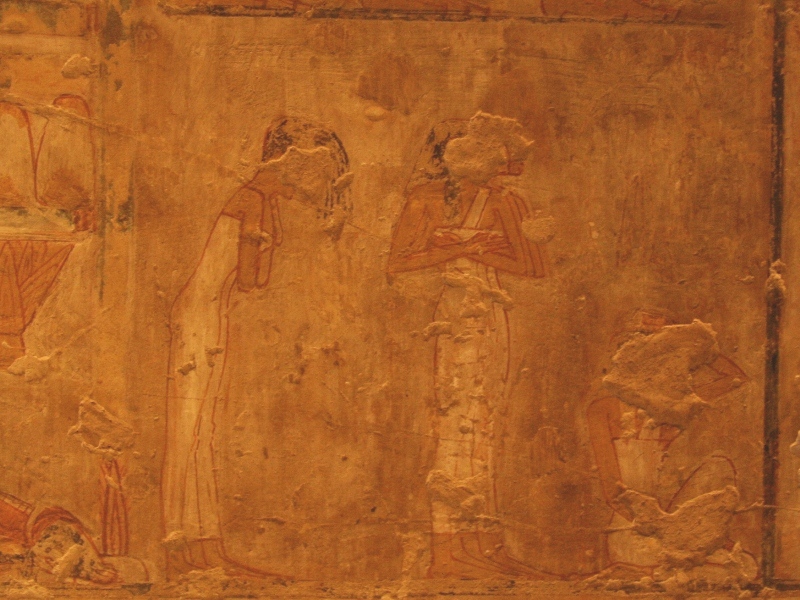
Mourners with hair tied in a back tail. Painting from the tomb of Roy in Dra Abu el-Naga. XIX Dynasty. Photo: Mª Rosa Valdesogo Martín.

Mourners with hair tied in a back tail. Painting from the tomb of Roy in Dra Abu el-Naga. XVIII Dynasty. Photo: Mª Rosa Valdesogo Martín.

At this point we consider important to point out a scene of a libation on an altar in Dendera. In it the spelling of Isis Hddt is changed by another one that refers to a light symbolism.  We are in a context where the mission of Isis is to bright in the sky just in the moment of bringing the flood[7]. That makes us think about what we have seen in former chapters about the nwn gesture and the beginning of the Egyptian year; the nwn gesture would be a way of symbolising the new flood, the new year and, therefore, the new life. Again we would be facing the hair element with a strong regenerating symbolism.


[1] “The One who open the ways”, the name of the jackal god from Asiut, that opens the ways to the king in the battle. Let’s think about its presence also in the Sed Festival.

[2] D. Meeks, 1991, p. 7.

[3] D. Meeks, 1977-1979, II, p. 312, nº 78.3373.

[4] Wb III, 116, 4.

[5] Chr. Desroches-Noblecourt considers that Hnskt refers to the small braids under the head-dress afnt (Chr. Desroches-Noblecourt, 1953, p. 28, n. 2) and that it is related with the manifestation of the deceased’s ka (Chr. Desroches-Noblecourt, 1953, p. 25, n. 5). The mother of the dead in funerals wears the head-dress afnt: “Your mother is the great cow in el-Kab, (with) the crown Atef and head-dress afnt, with long hair, with hanging breasts, which has nursed you(Pyr., 2003).

[6] Wb III, 121, 1. It appears like that in The Songs of Isis and Nephtys, Pap. Bremner-Rhind I; 1,9; 3,23; 6,23 y 11,19.

[7] M-Th. Derchain-Urtel, 1993. Leuven, p. 102.

When did the mourners pull or shake hair in the Egyptian funerary ceremony?


During these days we have seen how iconography and texts proof the existence of a gesture, posture or movement made by mourners in Ancient Egypt funerals. Sometimes they pulled their front lock of hair (nwn m) and sometimes they shook their mane onwards covering their faces with it (nwn). In both cases there was always an implicit symbolism, mostly related to the Osiris legend and the resurrection of the dead.

But now many questions come to mind: when did these women do that gesture during the funerary ceremony? Was the mourning rite constant during the whole ceremony or was just for some special moments? Were the normal mourners and the representatives of Isis and Nephtys making it together and/or at the same time?

Firstly we should distinguish the common mourners from the two women in the role of Isis and Nephtys. It makes sense to think about two different kind of performance. The iconography has several examples of mourners “outdoors” making the nwn m or nwn gesture. They would be part of the group of women accompanying the coffin in the funerary procession, we see them in movement in the reliefs from the tombs of Mereruka and Idu or in the Middle Kingdom coffin from Abydos; but also we see them in a more static moment, when some mourners are sit while others are making the nwn gesture, as in the tombs of Amenemhat, Miankht or Rekhmire.

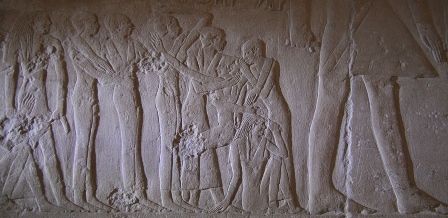
Mourners in the tomb of Mereruka at Saqqara. VI Dynasty. Photo: Mª Rosa Valdesogo Martín

Mourners in the tomb of Mereruka at Saqqara. VI Dynasty. Photo: Mª Rosa Valdesogo Martín

From the iconography we could deduce that the nwn gesture made by common mourners could take place:

-During the procession, while the coffin was transported.

-In necropolis, when the retinue has already close to the burial.

-Both, first during the procession and second once the retinue were in the necropolis, while the body was being buried.

Mourners. Painting from the tomb of Rekhmire in Gourna. XVIII Dynasty. Photo: Mª Rosa Valdesogo Martín

Mourners. Painting from the tomb of Rekhmire in Gourna. XVIII Dynasty. Photo: Mª Rosa Valdesogo Martín

However we only have Isis and Nephtys in iconography making the nwn gesture in the stele C15 from the Middle Kingdom (the whole scene represents the Osiris Festivity) and the funerary temple of Seti I in Dra Abu el-Naga and also pulling their front lock of hair (nwn m) in the coffin of Ramses IV and the one of dwarf Djedhor. Religious texts mention how the goddesses make the nwn gesture and show or give the hair sema to the deceased. It does not seem to be a public moment, but a more secret practice and closely linked to the corpse and the resurrection of the dead. If so, the two mourners representing Isis and Nephtys would be two selected women for representing a divine role. And maybe their mourn ritual with their hair was a part of the group of practices made for the resurrection of the dead.

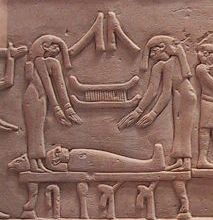
Mourners over the corpse. Detail of the stele of Akbaou. XI Dynasty. Photo: www.commons-wikimedia.org

Mourners over the corpse. Detail of the stele of Akbaou (stele C15). XI Dynasty. Photo: http://www.commons-wikimedia.org

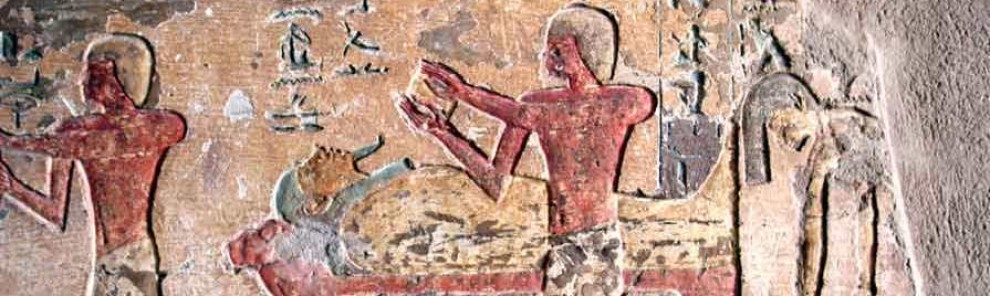
In Ancient Egyptian funerals there was a ceremony for restoring the deceased’s faculties: the ceremony of the Opening of the Mouth, which ended with the final resurrection of the dead. Was it maybe during that ritual when the two mourners made their mourning gesture with their hair? As we will see further in this work, the Ceremony of the Opening of the Mouth was not a public ceremony, but a rite reserved for those who accomplished it, as they were the sem priest, the lector priest and the two mourners. It consisted of a group of practices in favour of the deceased; the goal was to restore all the faculties he needed for his resurrection and his new life in the Herefater: breathing, eyesight, mobility, sexuality… Those practises were made over the mummy or the statue of the deceased and it seems reasonable to think that the mourners in the role of Isis and Nephtys did their nwn gesture near the body in some moment during the Ceremony of the Opening of the Mouth. In fact it is usual to find in the Egyptian iconography many scenes of that ceremony with the presence of mourners; maybe the most explicit one would be the one in the tomb of Renni, where we can see how priest is making the ritual over the corpse and the statue, while a mourner is making the nwn gesture.

Opening of the Mouth with mourner in nwn gesture on the right. Tomb of Renni in el-Kab. XVIII Dynasty. Photo: http://www.oisplendorsofthenile.blogspot.com.es

Summing up, the nwn and nwn m gesture had two dimensions, with different meanings and in different moments of the funerary ceremony. The public one made by common mourners outdoors during the procession or out of the tomb in the necropolis; and the private one, made by the two women in the divine role of Isis and Nephtys for the resurrection of the dead. In the first case the nwn/nwn m gesture is related to the chaos, the darkness of the death and is a sign of despair. In the second one those same practices had a revivifying goal.

The sexual Meaning of Hair in Ancient Egypt Funerals. Part I.


We already know the relationship between mourning and hair and the connexion it has with the Osiris legend. A very important part of that myth is the episode when Osiris recovers his virility. According to the legend, once the different parts of Osiris corpse were found and the body was restored, Isis put herself over her husband’s body and conceived the posthumous son Horus. Thanks to that act the cosmic order was again established; Horus became the king of Egypt and Osiris resurrected as the king of the Hereafter.

Isis as a kite is over the body of the dead. Statuette of prince Tutmosis, son of Amenhotep III. XVIII Dynasty. Altes Musuem (Berlin). Photo: Mª Rosa Valdesogo Martín.

Isis as a kite is over the body of the dead. Statuette of prince Tutmosis, son of Amenhotep III. XVIII Dynasty. Altes Musuem (Berlin). Photo: Mª Rosa Valdesogo Martín.

In a coffin found in Gebelein and dating from the XIII Dynasty, there is a vignette with both women assisting the dead, over him is bending a feminine image.

A female figure is bending over the dead. Scene in a coffin from Gebelein. XIII Dynasty.

A female figure is bending over the dead. Scene in a coffin from Gebelein. XIII Dynasty.

Already in the 50’s Chr. Desroches-Noblecourt considered that the goal of this gesture was to give back the virility to the mummy[1]. In fact, the Pyramid Texts show that in the Old Kingdom Isis and Nephtys were considered the responsible ones of regenerating the deceased’s faculty for fertilising[2]. The Egyptian iconography has several examples of the copulation of Isis and Osiris; Isis as a kite[3] put herself over the phallus of her husband, and she assures the conception of the son who will avenge the murder of his father; also literature has many examples of that episode:

I am your sister Isis. No god and no goddess have done what I have done. I have performed the procreation, although I am a woman alone, for making your name to endure on earth. Your divine semen was inside my womb and I put it over the earth, this way he can spread your image. He is healthy, although you suffer. He must send the violence to those who had caused it. Set succumb to his knife. Fellows of Set succumb because of Set. The throne of Geb is yours. You are his beloved son…”[4]

 In some tombs of the Middle Kingdom were found some figurines maybe used for restoring the virility to the dead. According to Chr. Desroches-Noblecourt, these figurines evocate a young femininity and with no visible effects of maternity; so, they would not be images of fecundity, but of eroticism[5]. That premise would send us to what we exposed formerly (see post of 27th May) about the two mourners in the roles of Isis and Nephtys; we think that these two women should have been mother yet. It looks as if these figurines were also put in tombs of New Kingdom for restoring the ka of the dead[6].

In chapter 991 of the Coffin Texts we could read how the dead is “the one who fertilises the mourners” (see post of 21rst May) and in The Songs of Isis and Nepthys there are several allusions to that matter; many times Osiris is “the lord of the sexual pleasure”[7], “the lord of the love [8], “bull that fertilises the cows[9]. We also read in that text: « you give the life over the woman[10], so, « you impregnate her »; it is the same meaning as we read in chapter 991 of Coffin Texts. In the Songs of Isis and Nephtys Osiris is also called « the one who engenders » [11] and the mourners ask him to have sexual relations:

“Copulate you with us as a male” [12].

“Copulate you with your sister Isis[13].

 There is a very meaningful sequence: 

“Lord of the sexual pleasure,

¡Oh! Come to me;

Be in union the sky and the earth”[14].

 In the mythic sphere the primeval union is the one between earth and sky (in Ancient Egyptian cosmogony between Geb and Nut); it is the moment of the Creation, symbolised by the sexual act because it contents the power of generating life. This reflexion makes us think of orgy as a sexual celebration; in many cultures orgy is a synonym of agricultural fecundity; it is an act in favour of life for stimulating new births; and there is also a bond between vegetation and eroticism.


[1] Desroches-Noblecourt, 1953, p. 43.

[2] Pyr., 366, 628 a, 631 b, 632 a-d and 123-125.

[3] Roeder, 1960, p. 180.

[4] Pap. Louvre, 3079; Roeder, 1960, p. 182.

[5] Desroches-Noblecourt, 1953, p. 18. However she accepts the idea of the virginity of the two mourners representing Isis and Nephtys.

[6] Desroches-Noblecourt, 1953 p. 39.

[7] Songs…1,23; 12,8.

[8] Songs…3,5.

[9] Songs…3,6.

[10] Songs…14,27.

[11] Songs…3,26.

[12] Songs…2,9.

[13] Songs…5,25.

[14] Songs…12,8-9-10. There are allusions to that matter in 7,4; 12,11-12; 12,16.


The Hair gives the Breath of Life in Ancient Egypt.


In Abaton, where Isis and Nephtys moan[1], is also where “Osiris receives the crying from your mouth and his soul breaths thanks to the weeping”[2]. The breathing is essential for living and also for rebirth; according to what we have read, that breath can be transmitted by means of mourning. There is a chapter of the Coffin Texts where the deceased’s breath is assured thanks to different aspects of hair, we read how the dead “…breathes the east wind through her plait, he catch the north wind through her plait, he takes the south wind through his plaits[3], he takes the west wind through his curls (or his plaits)…” [4].

Thanks to the hair element the dead /Osiris can breathe the wind from the four cardinal points, in the same way that he could breathe in Abaton thanks to the weeping. Again hair and mourning are two inseparable aspects[5] and once again this union hair-mourning-breath sends us to the Osiris Myth. Isis as a kite moved her wings over the corpse of Osiris made the air for causing his resurrection.

Isis as a kite over the corpse of Osiris. Relief from the temple of Seti I in Abydos. XIX Dynasty. Photo: www.common.wikimedia.org)

Isis as a kite over the corpse of Osiris. Relief from the temple of Seti I in Abydos. XIX Dynasty. Photo: http://www.common.wikimedia.org

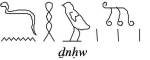
On the other hand it is also interesting to have a look on the word hw, which indicates a movement made by the feathers and whose writing in hieroglyphs was with the determinative of the hair[6]; also words as “feather” or “wings” in some cases could be written with the determinative of hair.

verbo Hw                          pluma Swt                        alas DnHw

So, the union feather-kite-air seems to be very close to the union hair-mourning-breath; it would not be hare-brained to think then in a relationship between the kite’s feather (in the mythical dimension) and the mourner’s hair (in the ritual dimension), both elements making the breath of life.


[1] Guglielmi, 1980, p. 81.

[2] Guglielmi, 1980, p. 80.

[3] In some coffins we read “eyebrow”.

[4]CT III, 228. A very similar passage is in Book of the Dead (LdM 172).

[5] In the Coffin Texts we read: “…the hands of Ssmw are united over the lungs…” (CT III, 168); and in coffin B4Bo the writing for “lungs” is pulmones

[6]CT II, 148

The Hair as a Symbol of Water in Ancient Egypt: The Hair is the Primeval Water.


In 1964 D. Bonneau assimilated the hair of Isis with the rise of the Nile due to the bushes of papyrus floating on it[1]. According to her, “in the ancient Egyptian tradition the manes of the gods were bushes of papyrus”[2] and the locks of hair are the vegetable fibres that content the first rise and announce the flooding of the river. For that reason D. Bonneau assured that usually the hair was united to gods related to the flood of the Nile[3]. That also would explain why in decoration the water was always coloured in green with black waves or why the hieroglyph of water were usually in black colour.

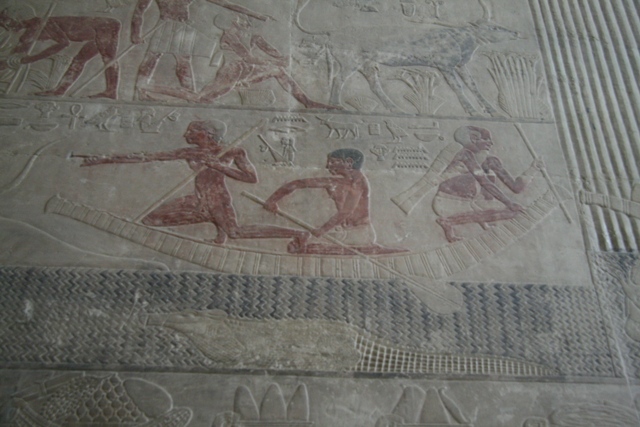
A boat is on a green water with black waves. Relief from the mastaba of Ti in Saqqara. VI Dynasty. Photo: Mª Rosa Valdesogo Martín

A boat is on a green water with black waves. Relief from the mastaba of Ti in Saqqara. VI Dynasty. Photo: Mª Rosa Valdesogo Martín

Hieroglyph of water in black colour. Coffin of the Middle Kingdom. Bahr el-Yussef Museum. Photo: Mª Rosa Valdesogo Martín

Hieroglyph of water in black colour. Coffin of the Middle Kingdom. Bahr el-Yussef Museum. Photo: Mª Rosa Valdesogo Martín

From the Old Kingdom we can see this relationship between hair and water. In the Pyramid texts of Pepi I we read that “…the hair of Pepi is the Nun…”[4] In fact, the hair is inseparable from the aquatic element, since in those parts where there were no papyri, Egyptians called “the hair of Isis” to coralline formations in the shores of Red Sea and the Indic Ocean[5].

We could then think of the hair as the water having the principles of the Creation and Renewing. The water of the flood has a magic power itself, as we can read in the magical Papyrus from Paris I, line 29. It is said how, for ensuring the effectiveness of the sacrifice of a cock, it was necessary “to go to a place where the Nile has already retired its water before nobody has step on it, or to a place dipped completely by the water of the Nile, or to a place flooded by the Nile in an accidental way [6]. According to these words it had to be a place soaked by those regenerating principles, which improved the magic. If the water had this magical power and was assimilated to the hair, it makes sense to think about a magical attribute of the hair.

It seems obvious the relationship in Ancient Egypt between the renovating rituals and the flooding, which was announced by Sothis, the brightest star that appeared  in the morning sky with the sun between the seventeenth and the nineteenth of July[7]. Sothis was for Egyptians «  the one who renovates the vegetation »[8] and she was assimilated to Isis: “Your sister Isis comes to you, happy with your love, you put her over your phallus, your semen goes up to her, sharp as Sothis, (like) Horus equipped coming out from you, like Horus who is in Sothis » [9]. The sexual aspect is very important and we consider it later.

Isis, assimilated to Sothis, announces with her hair the rise of the Nile, like the second one does appearing in the firmament. Isis is “the one who makes the Nile to increase and flow, the one who makes the Nile to get bigger in this season [10]. So, the mane of Isis would be a promise of resurrection, because would be the image of the water that creates and renovates. In the funerary rite it would emanate to the dead by means of the nwn gesture next to the corpse.  That would suppose a return to the Nun, the primeval waters where the first living went out from as the Nile permits the constant renovation of the Egyptian life. To shake the hair onwards would be then the announcement of a new creation, like the presence of Sothis means the beginning of the flood and the New Year.

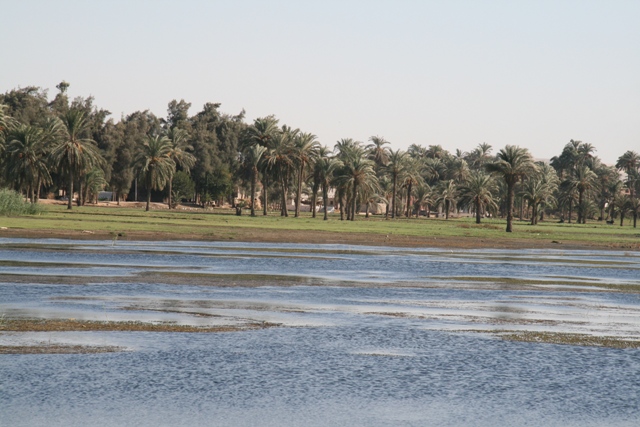
Nile fertilising the land of Egypt near of Al-Minya. Photo: Mª Rosa Valdesogo Martín

Nile fertilising the land of Egypt near Al-Minya. Photo: Mª Rosa Valdesogo Martín

Many years ago S. Mayassis already studied the meaning of hair in Egyptian believing[11]. According to him, the hair was a synonym of power[12] and Isis covered her face with her mane to get profit of its own force and allow also the others to do the same thing[13]. S. Mayassis considered also to untie the hair was a way of putting the magical power of the knot aside[14], so the force of the hair was set out and joined the person[15].

Certainly the hair constitutes an element of power and vigour, but Mayassis did not mention that the power of the Isis’ mane is because its assimilation with the renovating water of the flood. That would explain the nwn gesture done by mourners in funerals was a revitalising gesture, that brings backs the dead to the Nun, for bringing him back to life, since he is “the one who has been created in the Nun [16].

In the month of Khoiak, the fourth month of the season Akhet (Inundation), took place the Mysteries of Osiris, a group of rites recalling the Osiris Myth[17]. In all these rites the mourning had a relevant place; women representing Isis and Nephtys were mourning at the moment of making the figurine of Osiris with earth and cereal[18], which grow up as a symbol of life and resurrection.  In the festivity of Osiris, the two representatives of Isis and Nephtys recited aloud a sacred song of mourning the twenty-fifth day of the Khoiak month just before the Osiris resurrection[19]. Lamentation would be the prelude of the new life for Osiris, also evident with the rise of the Nile[20]; in the funeral the meaning of that mourning would be the same.

On the other hand, Pausanias said how the tears of Isis were considered as the flood of the Nile: “Egyptians say that Isis weeps for Osiris when the river starts increasing; and when it floods the fields, they say that it is Isis’ tears[21]. Once the Nile started its rise, Egyptians celebrated the Festival of Isis; she, as mourner of Osiris, caused with her tears the increase of the water level of the Nile[22]. In fact, in the Songs of Isis and Nephtys, when they mourn we read: “I am Isis I flood the land in that day[23].

Tears (in Ancient Egyptian rmit) had in Egyptian mythology a strong creation power, because mankind (rmT) issued from tears[24].  According to a legend dating from XII Dynasty, the god Re sent one of their two eyes for fighting against his enemy Apophis. That eye was taking a long time to come back, so it was replaced by another one.  When the eye of Re came back from the battle and saw another one in his place he became very upset. This eye started crying and people came from its tears. For consoling the sorrow Re turned it into the ureus and put it on his forehead.

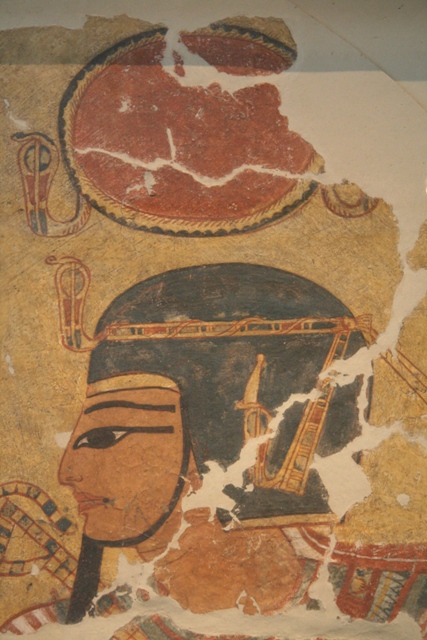
Amehotep I with the ureus in his forehead. Painting from the tomb of Inerkha in Deir el-Medina. Altes Museum of Berlin. XX Dynasty. Photo: Mª Rosa Valdesogo Martín

Amehotep I with the ureus in his forehead. Painting from the tomb of Inerkha in Deir el-Medina. Altes Museum of Berlin. XX Dynasty. Photo: Mª Rosa Valdesogo Martín

According to B. Mathieu “to come out from the eye” (pr m irt) is an Egyptian expression for referring to the weeping and he emphasizes the fact that mankind appears from a sorrow[25]. The eye and the humidity coming out from it (tears) have the power of giving life: “He has opened his eyes in the moment he was going out from the Nun. All these things have come to existence from his eyes”[26]. That would explain such an important role of the mourners during the funerary rite; they shed their tears with regenerating power that will help in the resurrection of the dead. We need also to notice the importance of the eye as a beneficial organ for the regeneration of the deceased (we will see it in another post).

In chapter 674 of the Coffin texts we could already read how “the water is the hair sema of Mht over you”. Water and Inundation are vital elements par excellence in Egyptian mythology. Water has always a negative and a positive aspect, because for renovating it is needed first a destruction. If the hair sema is like the water, that one will also have a double value: it will be at the same time image of chaos and of new life.

For that reason, we could think that the nwn gesture, depending on in which moment of the funeral it would be made, it could refer on one hand to the sorrow for the dead and the chaos of the death, and on the other hand to the rebirth and a the new creation. Mourners could shake their hair onwards as a sign of despair but also as an image of the primeval and chaotic water, which have the power of giving life and create.


[1] Bonneau, 1964, p. 259.

[2] Bonneau, 1964, p. 260.

[3] Bonneau, 1964, p. 260, n. 9.

[4] Budge,  1969, p. 109. This same assimilation of hair and Nun appears in the papyri of Ani and Un.

[5] “Juba relates that near of Trogloditas Islands a brush grew up in deep down in the sea called “hair of Isis”, without leaves and similar to coral” (Pliny the Elder, Natural History,  XIII, 51)

[6] Bonneau, 1964, p. 285.

[7] Bonneau, 1964, p. 263.

[8] Pyr. 477.

[9] Pyr. 632.

[10] Budge, 1973, p. 278.

[11] Mayassis, 1955.

[12] Mayassis, 1955, p. 354.

[13] Mayassis, 1955, pp. 354 y 362.

[14] Mayassis, 1955, p. 356.

[15] Mayassis, 1955, p. 362.

[16] CT, 544.

[17] That also shows the relationship between Osiris and the water.

[18] Guglielmi, 1980, p.80.

[19] Gaballa and Kitchen, 1969, p.45.

[20] Kees, 1956, p. 354.

[21] Pausanias, De Phocicis,  X, 32,10.

[22] Frazer, 1914, Third Ed., p. 33.

[23] Canciones…,3,16.

[24] Guglielmi, 1980, p. 82.

[25] Mathieu, 1986, p. 500.

[26] Fragment on the South facade of the temple of Hathor in Dendera (el-Kordy, 1982, p. 203).

Hair and Death in Ancient Egypt: Pulling Hair also in the Hereafter.


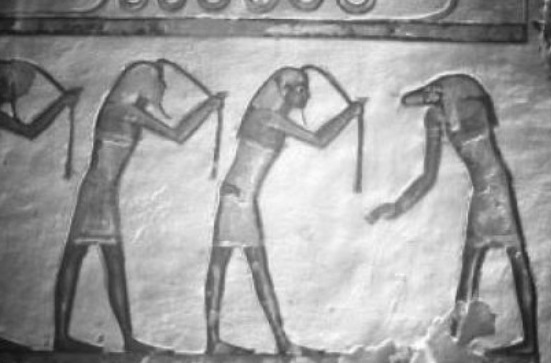
Mourners of Re pulling hair. Section two of the Book of Caverns. Tomb of Ramses VI. XX Dynasty.

Mourners of Re pulling hair. Section two of the Book of Caverns. Tomb of Ramses VI. XX Dynasty.

Not only on ancient Egyptian funerals were mourners shaking or pulling hair. Also in the Hereafter, supernatural beings were responsible of these kinds of practices. Book of Caverns show in the second section the god Re with head of crocodile walking towards nine divinities that hold their front lock of hair, the text says:

“Oh! The one who mourns, big of lock syt and of strong cry in the West protect the king.

“Oh! The one of the hair who is on the moan [1]el que está sobre el lamento

“Oh! These nein gods that mourn for Osiris, that cry for that one who is in front of Amduat.

Oh, look at me! I am walking towards you I pass by your caverns I call you and you scream to me. Duaty, he feels happy with your voice, those ones who mourn in Duat, the ones with secret faces, under you lock of hair syt[2], your voice is for me. I call you together , I light you up[3], mourners…you lead me and I walk towards you[4], I really protect your souls, I make you have my light, I take away the darkness that is on you…big mourners, having goods, you who are over the lock of hair syt in the land of the West . I walk on the ground I came from in my first birth”.

In the Duat the iakbyw (mourners) work for the regeneration of the dead god Osiris, crying and holding their locks of hair. And at the same time, that resurrection provides protection and light for their souls . When the deceased is in darkness the mourners are “under the lock of hair” covered with this hair:

bajo el mechón syt

When the deceased revives  and can walk in the Duat, the expression is just the contrary: “over the lock of hair” :

sobre el mechón syt

They are not anymore under the hair, but they have come to the light and the dead is “happy with the youth of his body

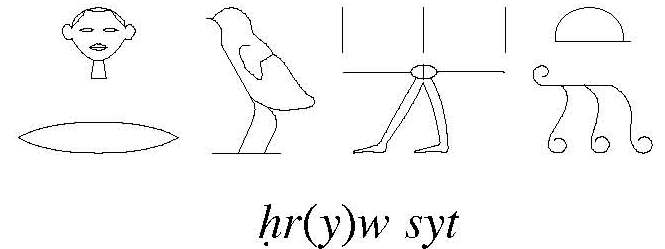
The words syt and swt describe the front lock of hair the mourners pull. We find also the term syt in The Coffin Texts in chapters 799 and 532, where tells about « tying the lock syt in Heliópolis the day of cutting the samt » and in several documents from the New Kingdom we also can read how a male characters are the mourners of Re and hold their lock of hair syt/swt[5] they grant that Osiris can be justified in the Hereafter [6]. At this point it is also interesting to say that in the chapter 339 of the Coffin texts, the day of the resurrection of Osiris is the day ofshaving the mourning women”.

Again, also in the Hereafter, the nwn m gesture is a part of the mourning rite, as a sign of pain but also as a way of making the dead revive and make easier his way in to the Hereafter.


[1] . Pay attention in the word used for moan (samt), which has de determinative of the hair. In the cenotaph of Seti I in Abydos we read: “Oh! The one of the hair, over his moan, who puts his voice, to whom the souls call” 

[2] . Piankoff translated the preposition  as “carrying” the locks syt.  But the first meaning of that preposition is “under”. If we take the sentence as “under the locks of hair syt” it made sense with the previous expression: “of secret faces”, so, “hidden under the hair”.

[3] The light comes after the darkness of the death.

[4] Mourners guide the dead with their screams. The deceased is blind (dead) and on the way to the new light (new life).

[5] Piankoff and Jacquet-Gordon, 1974, p. 55, Pl. 10.

[6] Berlin Papyrus 6, Piankoff and  Jacquet-Gordon, 1974, p. 57.

Pulling and shaking hair over the mummy in Ancient Egypt.


We have already seen how in chapter 180 of Book of the Dead the mourners appear dishevelled for or over the deceased.

Mourner covering her face with her hair. Tomb of Renni in el-Kab. XVIII Dynasty. Photo: www.egyptraveluxe.blogspot.com

Mourner covering her face with her hair. Tomb of Renni in el-Kab. XVIII Dynasty. Photo: http://www.egyptraveluxe.blogspot.com

The dead is now in the Hereafter and needs to get again the mobility. This chapter treats about the physical resurrection of the deceased and it was included in many tombs of kings (Tutmosis III, Seti I, Ramses II, Meneptah I, Seti II, Siptah, Ramses III and Ramses IV). In all cases the verb used for dishevelled was nwn. Taking into consideration those determinatives and the iconography of tombs of Amenemhat and Renni, one correct translation could be “…they are dishevelled over you…”.

We can then visualize the nwn gesture over the corpse for his benefit. Because after that the chapter follows: “…your soul gets happy, your body becomes glorious…” It describes the resurrection of the mummy, process in which was important that rite of mourning.

At this point we need to mention three relevant documents that refer to the role of mourning women in front of the body.

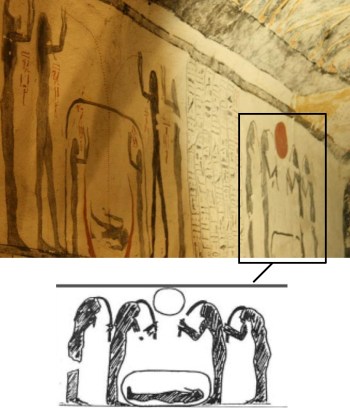
1)      The tomb of Ramses IX. On the left wall of the funerary chamber there is a unique scene of resurrection. The dead as a mummy inside an oval, over the corpse four women are making the nwn m gesture of pulling their locks of hair.

Women pulling lock of hair over the dead. Tomb of Ramses IX. Valley of the Kings. XX Dynasty. Photo: Mª Rosa Valdesogo Martín.

Women pulling lock of hair over the dead. Tomb of Ramses IX. Valley of the Kings. XX Dynasty. Photo: Mª Rosa Valdesogo Martín.

In the following scene the dead is not a mummy anymore, but now his legs and arms have movement. That makes us think about the nwn m gesture as something made for revitalising the body. The text accompanying the image is a fragment of the Book of Caverns in which we read about the resurrection of the dead and in that context it says:

“Those Goddesses are so, they are mourning over the secret place of Osiris…they are together, screaming and crying over the secret place of the ceremony…their secret is in their fingers…”

It is clear the relationship between mourning and the resurrection of the dead, to whom the women are pulling their locks of hair. On the other hand it is interesting to pay attention to the expression “…their secret is in their fingers…”, because with those fingers they are holding their hair. Which one is the secret? Is the resurrection or the way for reaching that resurrection?

2)      The coffin of Ramses IV. In the head piece there is a representation of Isis and Nephtys making the same nwn m gesture.

Isis and Nephtys pulling their locks of hair. This image is the head piece of the coffin of Ramses IV.

Isis and Nephtys pulling their locks of hair. This image is on the head piece of the coffin of Ramses IV.

Both goddesses are facing the head of the dead and the image is accompanied by an inscription where we read:

 “They move their faces during the moan; they mourn over the secret corpse of …

Both goddesses are holding their locks swt, the water is dropping from the eyes of these goddesses…the breath comes from them (the goddesses)…”

In some moment of his resurrection the dead finds Isis and Nephtys, which leaning their faces, holding their locks of hair swt and crying over the corpse, allow the dead to breathe and revive.

There is a very similar example in the coffin of the dwarf Dyedhor, who was dancer in the Serapeum. This coffin was found in Saqqara and belongs to the Persian period. The coffin of Dyedhor shows also Isis and Nephtys pulling their frontal locks of hair (Cairo Museum, nº cat. 1294).

3)      The stele C15 in Louvre Museum is another important document for this subject. It was found in Abydos and dates from XI Dynasty. His owner was Abkaou, chief of the cattle. In the Middle Kingdom became very popular to put a stele in Abydos in the memory of the deceased god Osiris. In this stele the lower register shows Abkaou receiving the offerings while in an upper register there is an image of the ceremonies that took place during the Osiris festivity. Two mourners are over the lying corpse and both cover their face with the hair; in fact it remembers what it is said in chapter 180 of Book of the Dead.

Two mourners making nwn gesture over the corpse. Detail of the stele of Akbaou (stele C15) from Abydos. Musée du Louvre. XI Dynasty. Photo (stele): www.cartelfr.louvre.fr; photo (detail): www.commons.wikimedia.org

Two mourners making nwn gesture over the corpse. Detail of the stele of Abkaou (stele C15) from Abydos. Louvre Museum. XI Dynasty. Photo (stele): http://www.cartelfr.louvre.fr; photo (detail): http://www.commons.wikimedia.org

The inscription is much reduced: once hieroglyph tm and twice the hieroglyph nwi.   niw tm

The verb tm in ancient Egyptian means “complete”, “be completed”, “join the different parts of the body” (Wb V, 303), especially when it is about the parts of the dead (Wb V, 305, 1) and nwi means “to be in charge of” (Wb II, 220);  the whole could be translated as “to be in charge of completing”. In the Myth of Osiris Isis with the help of Nephtys are the ones who collect the different parts of the body of Osiris, so these two mourners of the image would also be in charge of mending the body of the dead. The nwn gesture they are doing over the body would be one of the practises for revitalizing the deceased.

Suming up, mourners in Ancient Egypt made a kind of rite with their hair during the funerals. It could be to cover the face with the hair (nwn) or pull the frontal lock of hair (nwn m). In both cases we have proofs of this practise over the corpse and always with a revitalising goal.

For understanding better the meaning of this practise we have to know more about the symbolism of hair.