Tag Archives: death

Hair, Mourners and Secret in Ancient Egypt.


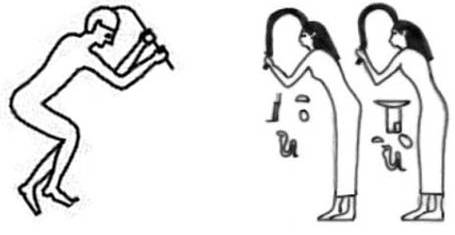
Egyptian funerary texts and iconography mention the mourners in the role of Isis and Nephtys as making a mourning ritual with their hair for the benefit of the deceased. According to the sources, this rite was a part of the practises which formed the Opening of the Mouth for the mummy’s rebirth.

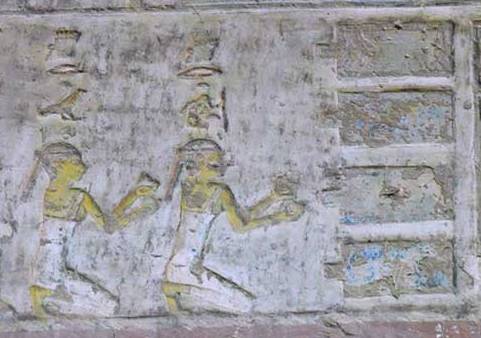
There is evidence of the Opening of the Mouth rite from texts of the Old Kingdom (inscription in mastaba of Metjen and in the Pyramid Texts). The Coffin Texts of the Middle Kingdom continue demonstrating the existence of this rite. In this period of the Egyptian history maybe can we envisage already one graphic proof in the stele of Abkaou (stele C15) from Abydos. In it the sculptor represented the rites of the Osiris festivity[1], where the myth was reproduced.  The two mourners shake their hair over the corpse; between them we can see the hieroglyphs of the adze and the sledge. What does it mean?
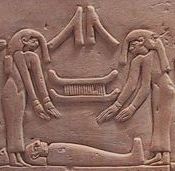
Detail of the stele of Abkaou in the Louvre Museum. XI Dynasty. Photo: www.commons.wikimedia.org

Detail of the stele of Abkaou in the Louvre Museum. XI Dynasty. Photo: http://www.commons.wikimedia.org

The sledge is the phoneme tm; it can be a negative verb[2], but it also is the term for “to complete”, “be completed”, in the sense of uniting the different parts of the body[3], mainly in relation to the mummy limbs[4]. The adze could be the verb nwi “to be in charge of”[5]. So, we could read the inscription as “in charge of completing” in the sense of restoring the corpse of the deceased. That would not be crazy if we think that in the legend Anubis was the one who embalmed the body, but with the assistance of Isis and Nephtys.

However, looking at the entire register of the stele there is no trace of inscription in the other images. So, why do we have to consider these three hieroglyphs as an inscription?

Detail of the register with the Osiris festivities. Stele d'Abkaou. Musée du Louvre. XI Dynasty. Photo: www.commons.wikimedia.org

Detail of the register with the Osiris festivities. Stele d’Abkaou. Musée du Louvre. XI Dynasty. Photo: http://www.commons.wikimedia.org

The tekenu on a sledge. Detail from the tomb of Montuherkhepeshef in Gourna. XVIII Dynasty. Image: www.excavacionegipto.com

The tekenu on a sledge. Detail from the tomb of Montuherkhepeshef in Gourna. XVIII Dynasty. Image: http://www.excavacionegipto.com

If we consider them just as the pure objects that they represent, we notice that the adze is one of the main tools in the Opening of the Mouth ceremony in the New Kingdom iconography; on its behalf the sledge is one of the means for transporting the human victim/tekenu, whose ritual we have seen was also part of the Opening Mouth ceremony in New Kingdom.

One possible theory could be that in the stele of Abkaou the sculptor was representing the Opening of the Mouth ceremony and the morning ritual in a shorten version, as it was done later in the New Kingdom, when artist included in the same scene mourners, priests, corpse and ritual tools. And we could as well think not just of a short version, but a codified way of representing a hidden ritual in the attempt of protecting the information of a confidential rite.

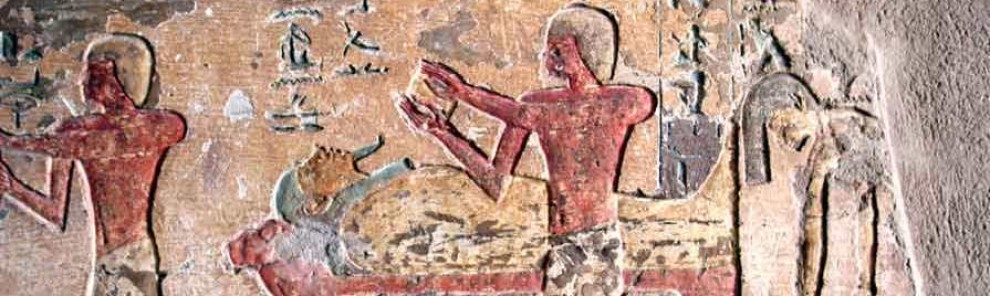
Opening of the Mouth ceremony. The image shows the two mourners, the priests and the table with all the tools utilised, included the foreleg of an ox. Painting from the tomb of Khonsu in Gourna. XIX Dynasty. Photo: www.osirisnet.net

Opening of the Mouth ceremony. The image shows the two mourners, the priests and the table with all the utilised tools, included the foreleg of an ox. Painting from the tomb of Khonsu in Gourna. XIX Dynasty. Photo: http://www.osirisnet.net

The renovating rites for the mummy’s rebirth might be secret. All along this work we have read some funerary texts making allusion to this concept of “hidden” in everything surrounding Osiris’ death and resurrection. For instance, in the tomb of Ramsés IX the inscription accompanying the scene of the women pulling their frontal locks of hair says: “…they are mourning over the secret place of Osiris…they are screaming and crying over the secret place of the ceremony …they move away SnDt[6], their two arms with their two arms, their secret is in their fingers…”[7]. In the same line we have the coffin of Ramses IV, decorated with both mages of Isis and Nephtys pulling their frontal lock of hair and whose inscription says:  “…the two goddesses who are in this secret place…they hide the secrets of the divine land… They move their faces during the moan; they mourn over the secret corpse Both goddesses are holding their locks swt”.

It seems that in ancient Egyptian belief, the mystery of death and resurrection was not accessible to all people; because of that in the Book of the Dead we read in relation to the Osiris’ resurrection. “… it is a secret of the Duat and a religious mystery in the deceased’s Kingdom …it is a mystery, that cannot be know, to take care of the blessed heart, give him movement, take away the bandage from his eyes, open his face…Read that with no one seeing it, apart from your truly friend and the lector priest[8].

The death itself was for the dead an initiation to the Hereafter’s mysteries[9]. Only the priests knew the secret of the Osiris death and resurrection, and to keep this secrecy was crucial for the universal harmony[10], possibly for that reason the “night of Isis” hid the mysteries of resurrection[11]. Even Isis sometimes received the name of “The Mysterious One”, since she “has been everything she has been, everything she is and everything she will be, and her veil, no mortal has never took off[12].

The Theban Books of Breathing, dating from Ptolemaic period was a funerary text recited just before closing the cover of the coffin [13] and the woman in the role of Isis gave a speech for reviving Osiris and help his soul go up to the sky as lunar disc: “That is something that needs to be hidden. Do not let anyone read it. It is useful for one in the necropolis. He will live again successfully millions of times”[14].

The chapter 17 of the Book of the Dead mentions the moment Osiris recovers his virility thanks to Isis, and she stresses the secret nature of her action: “I am Isis, you found me when I had my hair disordered over my face, and my crown was dishevelled. I have conceived as Isis, I have procreated as Nephtys. Isis dispels my bothers (?). My crown is dishevelled; Isis has been over her secret, she has stood up and has cleaned her hair”

The Magical Papyrus Salt 825 contains a text about the rite for the conservation of life and it informs the reader that the “House of Life” is hidden, unknown and invisible; it is a “secret book…contains life and death. Do not reveal it, the one who reveals it will die suddenly or will be murdered[15].

Opening of the Mouth ceremony at the door of the tomb. Painitgn from the tomb of Khonsu in Gourna. XIX Dynasty. Photo: www.osirisnet.net

Opening of the Mouth ceremony at the door of the tomb. Painting from the tomb of Khonsu in Gourna. XIX Dynasty. Photo: http://www.osirisnet.net

Everything points to the idea that in ancient Egypt the resurrection process is something that only concerns to the deceased and the team helping him in his recovery and that it is not something accessible for everybody. That would explain then why there is no much iconographical evidence of the Opening of the Mouth ceremony; it comes mainly from New Kingdom on (tomb decoration or papyri) and it is not explicit at all. On the other hand these scenes showing the priests and mourner with the mummy in front of the tomb would not be real. If the ritual for the resurrection was something secret, the Opening of the Mouth ceremony could not be made in open air. All practices for helping the mummy to come back to life should be made inside the tomb or inside a special building in the necropolis. So the images of the mourners crying close to the corpse while the priests are officiating would be the artistic solution to allude to the rite without revealing details.


[1] Gayet, 1886, pl. LIV.

[2] Wb V, 302, 5.

[3] Wb V, 303.

[4] Wb V, 305, 1.

[5] Wb II, p. 220

[6] Fear (?).

[7] Piankoff, 1942, pp. 1-11; 1944, pp. 1-62; 1946, pp. 1-50.

[8] LdM, 148.

[9] S. Mayassis, 1957, p. 218.

[10] S. Mayassis, 1957, p. 42.

[11] Sinesio, Epist., XIII,v.s. 89; S. Mayassis, 1957, p. 65.

[12] Plutarco, De Iside et Osiride, 9.

[13] J.Cl. Goyon, 1972, p. 217.

[14] Book of Breathing I, 1.

[15] Ph. Derchain, 1964, p. 139.

[16] S. Mayassis, 1957, p. 40.

Hair, Mourners and Opening of the Mouth in Ancient Egypt.


We have seen throughout this work that the mourners’ hair (locks, mane, dishevelled, plaits) played a very important role in the funerary ceremony of ancient Egypt. We have also seen that sometimes those different aspects of the hair had just a symbolic meaning from a resurrection point of view (as for instance the two ringlets wprty). We also know now that there were two types of mourners: those ones being in a group in the procession accompanying the corpse and the two women impersonating Isis and Nephtys and in charge of the deceased’s rebirth.

The two priests and one mourner (the wife according to the inscription) in the Opening of the Mouth of Roy. Painting from the tomb of Roy in Dra Abu el-Naga. XVIII Dynasty. Photo: Mª Rosa Valdesogo Martín.

The two priests and one mourner (the wife according to the inscription) in the Opening of the Mouth of Roy. Painting from the tomb of Roy in Dra Abu el-Naga. XVIII Dynasty. Photo: Mª Rosa Valdesogo Martín.

According to the sources the hair of these two mourning women was important from many points of view: symbolic, mythic and ritual. From the Egyptian iconography and texts we can discern a mourning rite in which the two women made a gesture with their hair or lock of hair over the mummy with a regenerating goal, and we can also guess a practice of shaving or cutting hair to the two mourners that happened in some moment at the end of the funerals when the deceased’s rebirth was a fact.

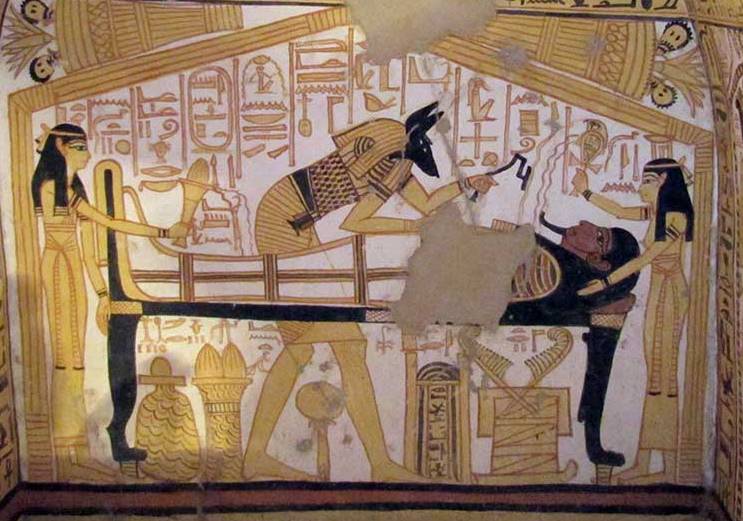
After the embalming of the corpse, the cortège walked to the necropolis, once there took place the main Egyptian rite for the benefit of the dead: the Opening of the Mouth ceremony, which consisted in a group of gestures for transmitting vitality to the mummy (this way the deceased recovered the ability of breathing, seeing, hearing…), and the two representatives of Isis and Nephtys took part in that process. Many sources reflect this ritual, but usually they are not too explicit. It is mostly represented in a shorten way, with the lector priest and/or the sem priest holding the utensils used for the ritual (mainly the adze and the stone vessels) and officiating on the mummy, meanwhile two mourners or sometimes just one, cry close to the dead. In some cases the scene has a more divine nuance and the one officiating is Anubis, while Isis and Nephtys stay at both extremes of the corpse.

Anubis, Isis and Nephtys in the Opening of the Mouth rite. Painting from the tomb of Nakhtamon in Deir el-Medina. XIX Dynasty. Photo: www.osirisnet.net

Anubis, Isis and Nephtys in the Opening of the Mouth rite. Painting from the tomb of Nakhtamon in Deir el-Medina. XIX Dynasty. Photo: http://www.osirisnet.net

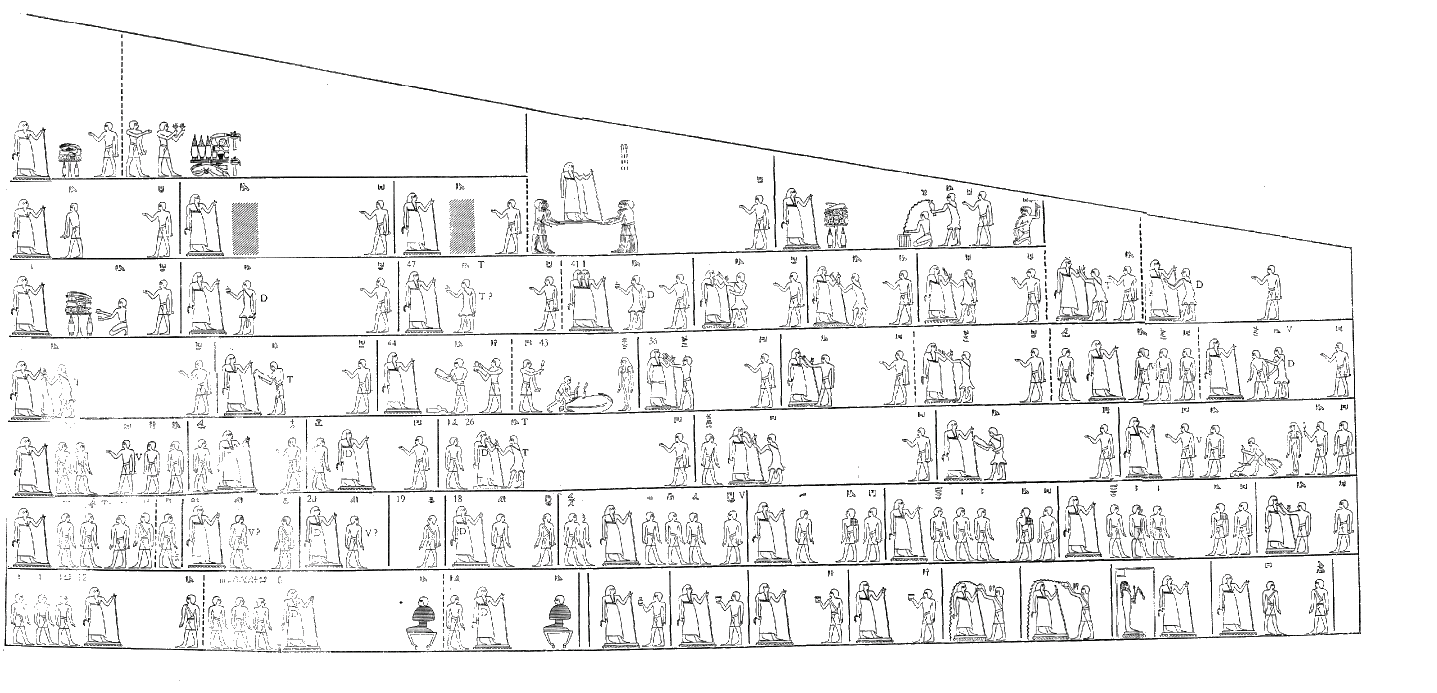
The most explicit document about the Opening of the Mouth ceremony that ancient Egyptians have left to us is the representation in the south wall on the tomb of Rekhmire. In a composition of fifty three scenes the artist showed the rite step by step.

Opening of the Mouth ceremony from the tomb of Rekhmire in Gourna. XVIII Dynasty. Image: www.digitalegypt.ucl.uk

Opening of the Mouth ceremony from the tomb of Rekhmire in Gourna. XVIII Dynasty. Image: http://www.digitalegypt.ucl.uk

The broad outline which Rekhmire offers would be:

1. The mummy or deceased’s statue (as it is the case in Rekhmire’s tomb) is put on a mound symbolising the primeval hill.
2. The mummy/statue is purified with water, natron and incense.
3. The sem priest transmits the vital energy rememorizing the ancient Egyptian tradition of the sacrifice and rebirth of the tekenu. The sem priest imitated the ancient victim curled up and wrapped in a clothing, he came up from it and had a small dialogue with the lector priest:

Sem priest: “I saved the eye from his mouth, I healed his leg”

Lector priest: “I have placed your eye, through which you revive”[1].

4. The sem priest makes the first gestures of Opening the Mouth with the little finger.
5. The mesentiu (labourers) work on the statue (polishing and carving) as a creational gesture[2].
6. Sacrifice of the ox of Upper Egypt for restoring the vitality of the deceased. The sem priest offers the animal’s heart and foreleg to the mummy/statue. One of the mourners (the big Dyeret) is present:

Sem priest: “to stretch the arms towards the bull ng of Upper Egypt”

Slaughterer: “get up over him, cut its foreleg and remove its heart”

The big Drt says at his ear: “Your lips have done that against you. Will your mouth open?”

Sacrifice of the ox with the presence of the mourner. Painting from the tomb of Rekhmire in Gourna. XVIII Dynasty. Photo: Mª Rosa Valdesogo Martín.

Sacrifice of the ox with the presence of the mourner. Painting from the tomb of Rekhmire in Gourna. XVIII Dynasty. Photo: Mª Rosa Valdesogo Martín.

This part of the ceremony is very important for us, not just because of the presence of one of the mourners, but also because it seems to remind the conflict between Horus and Seth. According to J. C. Goyon the sequence would stage when these two gods fought and Isis became a kite, landed on a tree and cried to Seth, who denounced unconsciously his crime: “Cry over you. Your own mouth has said it. Your ability has judged you. What else?[3]

The idea is the same one as in the tekenu ceremony we have seen in the tomb of Mentuherkhepeshef: killing a victim and offering the foreleg and the heart… but what about the hair?

Funerary scene of the tomb of Montuherkhepeshef in Dra Abu el-Naga. XVIII Dynasty.

Funerary scene of the tomb of Montuherkhepeshef in Dra Abu el-Naga. XVIII Dynasty.

Maybe we should relate the lock of hair of the tomb of Mentuherkhepeshef with the presence of the mourner in the tomb of Rekhmire; and think that a mourner’s piece of hair was cut and offered join with the foreleg and the heart.

7. After the sacrifice the sem priest makes more gestures of opening the mouth to the mummy/statue with the utensils, and in one case with the ox’s foreleg. The finality was to keep in touch the whole of the head with those magical tools (the nTrt adze and the wr-HkAw).
8. The mummy/statue is given to the rpat, who represented the heir[4], and the mesentiu work again on it.
9. New gestures of opening the mouth to the deceased are made. After that, there is an offer of 3bt stones[5].
10. Sacrifice of the ox of Lower Egypt. Here again we have the presence of one mourner, the small Dyeret, and once more the animal’s foreleg and heart are offered to the dead one.
11. After the sacrifice the priest opens again ritually the deceased’s mouth.
12. Funerary offerings and the final resurrection is a fact (the sem priest pays his respects to the new soul who lives in the Hereafter).

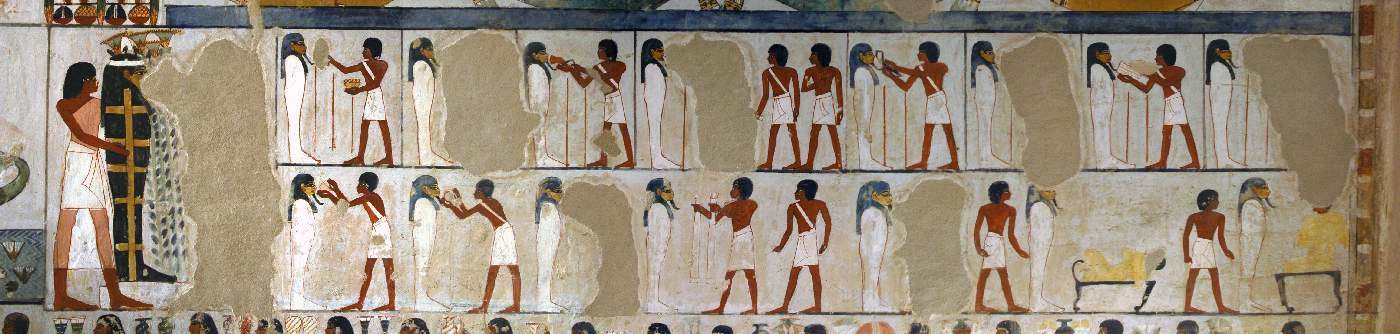
According to Rekhmire’s tomb, the two mourners impersonating Isis and Nephtys took part in the Opening of the Mouth ceremony. TTA4 and TT53 have both scenes of sacrifice of an ox with the presence of one mourner. But it is also true that in some other cases there is no trace of mourning women in this rite, as we can see in the tomb of Menna[6]

Opening of the Mouth ceremony from the tomb of Menna in Gourna. XVIII Dynasty. Photo: www.osirisnet.net

Opening of the Mouth ceremony from the tomb of Menna in Gourna. XVIII Dynasty. Photo: http://www.osirisnet.net

Anyway, sources proof that the two mourners in the role of Isis and Nephtys made an important role in that ritual for the deceased’s resurrection. They were members of the group of personalities who took care of the rebirth of the corpse and who reproduced the myth of Osiris.

The Opening of the Mouth ceremony was a group of practices for giving the life back to the deceased assimilated to Osiris. The priests and the two mourners recreated the chapter of the legend where Horus avenges his father’s death at the hands of Seth. In the rite it is the moment of the animal sacrifice, the ox, as scapegoat, with the presence of the sem priest, the slaughterer and the two mourners. The animal’s foreleg and heart are offered to the dead one, but also a piece/lock of hair. At this point we must remember chapter 667 of the Coffin Texts, where the healing of the hair sm3 happens at the same time of the offering of the foreleg and the giving of breath. And the final resurrection happens when the lunar eye is reconstituted and offered as Udjat eye to the deceased. E. Otto assimilated the lunar eye with the foreleg and/or the heart of the animal victim[7]; for others the moon can also be a knife, a leg or a lock of hair[8].

Carrying the leg and the heart for the deceased. Painting from the tomb of Menna in Gourna. XVIII Dynasty. Photo: www.osirisnet.net

Carrying the leg and the heart for the deceased. Painting from the tomb of Menna in Gourna. XVIII Dynasty. Photo: http://www.osirisnet.net

Throughout this work we have seen the relationship in Egyptian belief between the hair and the lunar eye and how there is a clear coincidence between cutting mourner’s hair (cutting the s3mt or shaving the mourners) and giving the Udjat eye to the dead one. It is also interesting to notice the use in the Opening of the Mouth ceremony of the flint knife peseshkef, considered by scholars as a very ancient tool for cutting the umbilical cord.

Knife peseshkef made of flint and coming from a tomb in Giza. VI Dynasty. Kunsthistorisches Museum of Wien. Photo: www.globalegyptianmuseum.org)

Knife peseshkef made of flint and coming from a tomb in Giza. VI Dynasty. Kunsthistorisches Museum of Wien. Photo: http://www.globalegyptianmuseum.org

The sacrifice of the ox represented the victory of Horus over Seth, it was also the moment of restoring the Udjat eye and, according to the funerary texts, shaving the mourners and/or cutting the s3mt. And New Kingdom iconography shows the mourners taking part in the Opening of Mouth ceremony and with no mane of hair after the rite.

But, do we really know why were these two women there, what did they really do or why their presence during the Opening of the Mouth is not so evident in iconography?


[1] E.Otto, 1960, p. 71.

[2] This step would be made when the ceremony was made on a statue. In ancient Egypt the sculptor was called sankh, which meant “to make live”.

[3] J.C.Goyon, 1972, p. 121.

[4] It means “prince” (Wb II, 415, 15).

[5] Some scholars consider they symbolize the milk teeth.

[6] TT69

[7] E. Otto, 1950, p. 171.

[8] Ph. Derchain, 1962, p.20.

Cutting the s3mt, shaving the Mourners, offering the Udjat eye.


According to what we have seen all along this last part of the work, there is a coincidence among cutting the s3mt, shaving the mourners in the role of Isis and Nephtys and giving the Udjat eye. We are at the end of the resurrection process made for the mummy. The two mourners incite with their actions the Osiris’ corpse reanimation[1], after that Osiris is mentioned under a lunar appearance; as Papyrus Louvre I, 3079 says: “gets into the Udjat eye, joining him. Thoth collects the constitutive elements of the eye; afterwards the sadness is captured, because you get up to the sky with it”[2]. The Egyptian myth of Osiris tells how, once the corpse of this god was restored, Horus gave him the Udjat eye (the healed lunar eye of Horus). With this offering, Horus helped in the final reanimation of his father.

Osiris (father) coming back to life and helped by Isis (his wife) and Horus (his son). Relief from the temple of Seti I in Abydos. XIX Dynasty. Photo: www.egypte-antique.fr)

Osiris (father) coming back to life and helped by Isis (his wife) and Horus (his son). Relief from the temple of Seti I in Abydos. XIX Dynasty. Photo: http://www.egypte-antique.fr

The presence of the son is relevant, because it makes necessary the restitution of the deceased’s virility. The result is the Triad (in this case Osiris, Isis and Horus), which is such a common concept in many cultures. Scholar G. Durand considered the Triad had a lunar nature, since the son’s figure, as an extension of the family line, helps in defeating temporality. On the other hand, the Horus presence means the appearance of the living masculine side as a complement of the feminine one incarnated in his mother Isis. G. Durand’s theory is that the origin of the son’s image would be in the primitive androgynous version of the lunar divinities, having so the masculine (son) and feminine (mother) values together[3]. In ancient Egypt belief, as in all cultures, these two values are necessary for generating life, so in the funerary context they are essential for the deceased’s rebirth.

Horus gives his healthy eye (Udjat eye) to his father and that means the lunar resurrection of Osiris, who becomes “the lord of the Udjat eye[4]. According to some chapters of the Coffin Texts this moment has something to do with cutting the lock of hair s3mt and/or shaving the mourners in the role of Isis and Nephtys. But what does the iconography says?

Funerals of Sobekmose with the two mourners (or two kites) with no mane of hair. Relief from the tomb of Sobekmose in el-Rizeikat. XVIII Dynasty. Photo: www.blog.naver.com

Funerals of Sobekmose with the two mourners (or two kites) with no mane of hair. Relief from the tomb of Sobekmose in el-Rizeikat. XVIII Dynasty. Photo: www.blognaver.com  

The tomb of Sobekmose in el-Rizeikat dating from the reign of Amnehotep III has a very important relief of the mortuary ceremony located in the north wall of the funerary chamber[5]. On the right Anubis is embalming the mummy while the coffin on a sledge is pulled by seven men. On the left the two mourning women with no mane of hair are the Drty orthe two kites[6], the women impersonating Isis and Nephtys; they are facing the mww dancers. Drty and mww are usually represented in the final moment of the funerary ceremony.

Isis and Nephtys as the two kites. Painting from the tomb of Sennedjem in Deir el-Medina. XIX Dynasty. Photo: www.osirisnet.net

Isis and Nephtys as the two kites. Painting from the tomb of Sennedjem in Deir el-Medina. XIX Dynasty. Photo: http://www.osirisnet.net

Also in the north wall over the previous scene there is an image of the deceased in front of the judges; the inscription says: “…I am the nose that gives life to everybody in the day of completing the Udjat eye in Heliopolis[7]

We have seen that the day of giving the Udjat eye is the day of shaving the mourners, and the cut of the s3mt, a Heliopolitan rite, is related with the healing of the lunar eye, so has a lunar nature. Taking that into consideration, it is tempting to relate the expression “the day of cutting the s3mt” we have read in Coffin Texts with “the day of completing the Udjat eye” in the tomb of Sobekmose. We have already suggested the idea of cutting the lock of hair as a way of symbolising the maturity of the moon, so becoming the full moon (Udjat eye).

Hair, moon and Heliopolis converge in ancient Egypt already from at least the Old Kingdom in the figure of the girl Hwnt Hwnt. According to the Pyramid Texts she is “the great young who is in Heliopolis…she has given you the two arms[8] and”she put her arms over you [9]. A. Erman and H. Grapow considered Hwnt wrt as a goddess in Heliopolis, who in the late period was assimilated to Hathor and Nephtys[10]. The Pyramid Texts describe her as “the little girl who is in the eye of Horus” [11], that is, the pupil in the eye’s god[12]. The hieroglyph of a girl with a lock of hair as determinative, made H. Kees think of the lock of hair as a symbol and substitute of the lunar eye[13]; as a consequence he considered the girl with the lock of hair in fury as the damaged eye of Horus, while the hair sm3 was the damage itself[14].

The two Drty (two kites), offering nw vases to the four pools. Relief from the tomb of Pahery in el-Kab. XVIII Dynasty. Photo: www.osirisnet.net

The two Drty (two kites), offering nw vases to the four pools. Relief from the tomb of Pahery in el-Kab. XVIII Dynasty. Photo: http://www.osirisnet.net

By extension we could also relate the shave of the mourners with the two mourners with short hair of the tomb of Sobekmose. They are not the only examples. We count on many tombs with images of the final funerary rites with the two Drty with no mane: the tomb of Sobekhotep[15] and Rekhmire[16] in Gourna, the tomb of Pahery in el-Kab and the tomb of Nefersekheru in Zawyet Sultan (all of them dating from the New Kingdom) show the Drty with short hair at the end of the funerals offering two globular vases in front of the four pools; while the tomb of Renni in el-Kab has an image of the mourner with short hair wrapping a person with a kind of clothing.

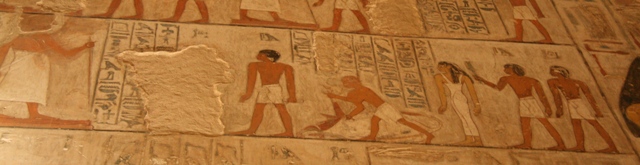
The most explicit iconography about what happens in that moment of the funerary ceremony is the tomb decoration of Rekhmire. It shows how after the Opening of the Mouth ceremony, a woman with short hair is offering green make-up[17].

Women (mourner) offering the make-up. Detail from the south wall in the tomb of Rekhmire. XVIII Dynasty.

Women (mourner) offering the make-up. Detail from the south wall in the tomb of Rekhmire. XVIII Dynasty.

That is something already documented in the Old Kingdom Pyramid Texts, where we can read: “make up the intact eye of Horus in your face[18] or “Horus has made up to you his eye [19]. Also in the Coffin Texts we can find many mentions to that practice, as for instance: “…I make up to you a green eye of Horus in your face [20], “green make-up and black make-up I give you the eye of Horus, black and white…they will lighten your face [21].

Giving the make-up is a synonym of giving the Udjat eye. According to Z. el-Kordy, “the offering of the make-up was a way of making the full moon to come back and avoiding the cosmic disorder”, so it was a rite with lunar nature[22]. In the Egyptian funerals it symbolized the victory of Horus over Seth and the offering of the healed eye (Udjat eye) to the deceased, who will come back to life as did Osiris in the legend.

We have seen that in the Egyptian funerary texts to cut the s3mt was related to the healing of the eye of Horus and with the shave of the two mourners. The Egyptian iconography shows us the offering of the make-up (Udjat eye) after the Opening of the Mouth ceremony and made by a mourner without mane of hair. And also many tombs decoration show the two mourners at the end of the funerary ceremony with no mane.

Everything points to an Egyptian funerary custom of shaving or cutting a piece of hair of the two mourners in the role of Isis and Nephtys. But, when?


[1] Pap. Louvre I, lines 49-52.

[2] Pap. Louvre I, line 51.

[3] G.Durand, 1979, p. 285.

[4] Songs…, 10, 3. For some scholars, the writing of the Osiris’ nameWsir     means “the place of the eye” (W.B. Kristensen, 1992, p. 17).

[5] W.C. Hayes, 1939.

[6] Wb V, 596.

[7]Sobekmose-inscripción

[8] Pyr., 728.

[9] Pyr., 2002 a.

[10] Wb III, 53, 15.

[11] Pyr., 93.

[12] Wb III, 53, 21.

[13] H. Kees, 1925, p. 6.

[14] H. Kees, 1925, p. 8. Also that made H. Kees think that the lock of hair in the head of the bald of Heliopolis was related to the girl Hwnt (H. Kees, 1925, p. 6)

[15] TT 63.

[16] TT 100.

[17] S. Hodel-Hoenes, 1991, p.130

[18] Pyr., 54b-55.

[19] Pyr., 609.

[20] CT  VII, 936.

[21] CT  VII, 934.

[22] Z. el-Kordy, 1982, p. 201.

Cutting the s3mt, beheading the Enemy.


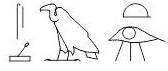
S3mt was for Egyptians apparently something more than just “mourning”. What about that s3mt that could be cut, which was related to snake uraeus, which appears in a moment of restoring some parts of the mummy and which was also an offer to the deceased? In chapters 532 and 640 of Coffin Texts the s3mt is cut and also tied around the dead one, when his neck and head are also restored. Do we have any other documents where to find more clues?

Chapter 50 of Book of the Dead was the heir of the chapter 640 of the Coffin Texts and belongs to a group of chapters related to the regeneration of the corpse. In a Ptolemaic version in the Egyptian Museum in Turin we can read: Formula for not entering the butchering hall of the god. Speech said by Osiris, alive and justified: my vertebrae are united in my nape by them, the Ennead. My vertebrae are united in my nape (bis) in the sky and on earth by Re, in that day of reinforce and reconstitute the exhausted ones[1]  over the two legs, in that day of cutting the necks[2]. The vertebrae in the nape are united by Seth with his power, when[3] there was no disturbance”.

But in some other versions of the same chapter we read a very similar text to that one of the Middle Kingdom: “…fours knots have been tied around me by the sky’s guardian, he has fixed a knot to the dead ones over the legs in that day of cutting the lock of hair s3mt….”

At this point it is important to notice that the writing for the Egyptian word nHbwt (necks) had the determinative of hair:neck. It seems that cutting the lock of hair s3mt is interchangeable with cutting the necks. So there was in ancient Egyptian belief assimilation between both hair and necks, which would mean that cutting the necks, would be the same act as cutting the s3mt.

Hair and necks, what can that have to do with the snakes? In this regards it is interesting J.F. Borghouts comment about chapter 532 of the Coffin Texts where we have already read about a Heliopolitan rite: “…Is tied to me a lock of hair in Heliopolis, the day of cutting the lock s3mt” [4]. J. F. Borghouts focus on the beginning of the passage: “Formula for placing a man’s head in the necropolis…” The passage relates how the deceased receives his head and his neck at the same time that the gods receive their heads, and that action happens the same day that the s3bwt snakes (or multi colour snakes) were expelled from Heliopolis, because they caused the gods to lose their heads[5]. The s3bwt snakes where the enemies of the Sun god because they injured the gods and let them headless. We would be facing an archetype “rite of defeating the evil one”, where the Demiurge announces: “I have appeased the Heliopolis’ disturbance after the judgement, I have restored the heads to those ones who had them not, and I have finished the mourning in this country” [6].

Beheading the snake as an image of the evil. The cat of Heliopolis killing the snake Apohis, enemy of Re. Painting from the tomb of Inerkha in Deir el-Medina. XIX Dynasty. Photo: www.osirisnet.net

Beheading the snake as an image of the evil. The cat of Heliopolis killing the snake Apohis, enemy of Re. Painting from the tomb of Inerkha in Deir el-Medina. XIX Dynasty. Photo: http://www.osirisnet.net

The head is the central of the body for all senses, not having head means not having faculties of perception and it is also a lack of identity. In Egyptian funerary belief, the lack of head is, not only the obvious lack of life, it is also the impossibility of resurrection. To restore the head is a step to the new life, since thanks to it the deceased will have again the faculty of breathing, seeing, listening[7]. In line with that is the Egyptian union between headless Osiris and the invisibility of the new moon[8]; the disappearance of the head is like the disappearance of the moon, it is the darkness, and so, it is the death. When a human being dyes he gets into a period of shadows, which fades gradually at the same time of the funerary rites. Among these rites here we need to mention the put of the funerary mask, which was a head’s substitute; with it the dead one will have again access to light, to the new life.

There is a stela found in Abydos and dating from the reign of Ramses VI where we can read: Oh! Horus, I have spitted over your eye, after it was removed by your aggressor…Oh! Isis and Nephtys, I make bring[9] to you your heads, I have put[10] your napes for you in this night of cutting[11] the heads (?) of s3bwt snakes in front of Letopolis…”[12] The text reminds to the former chapters we have already seen about the healing of the damaged lunar eye and the shaving of the two mourners.

The healing of the Udjat eye happens at the same time of the gods’ heads restoring and the revenge over the s3bwt snakes. And cutting the s3mt could be the same as cutting the s3bwt.

According to J. F. Borghouts, the parallel between s3mt and s3bwt could be caused by a deformation in the writing with the passage of the time. But so many times repeating the expression “cutting the s3mt” would maybe respond more to assimilation with “cutting the s3bwt” than just a mistake in the writing. The result would be in line with our research: the lock of hair s3mt would be identified the the s3bwt snakes as a negative element that needs to be eliminated. So, to cut the s3mt would symbolize a sacrifice of a dangerous animal. The hymn to Sobek in Ramesseum Papyrus says:

“Welcome in peace, lord of peace!

Your fury has been eliminated; your anger has passed…

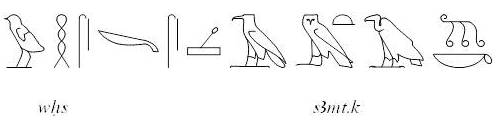
Your s3mt is cut” [13].

Sobek-hymn

 The Egyptian verb whs was used for “cutting hair”, but also for “sacrificing enemies” [14], and that put in the same level to cut the lock of hair s3mt and to sacrifice an adversary. Hair, enemy and sacrifice are already familiar concepts to us.

Beheading the enemies of Osiris. Paiting from the tomb of Tutmosis III in the Valley of the Kings. XVIII Dynasty. Photo: Mª Rosa Valdesogo Martín.

Beheading the enemies of Osiris. Painting from the tomb of Tutmosis III in the Valley of the Kings. XVIII Dynasty. Photo: Mª Rosa Valdesogo Martín.

Let’s compile some ideas to give shape to our post:

  • The day of shaving the mourners is the day of giving the Udjat eye.
  • To equip with a lock of hair s3mt appears at the same time of shaving the i3rty of Sokaris.
  • The s3mt is cut when the deceased is still blind/dead and after that action he has access to light/new life.
  • To spit over the damaged eye of Horus for healing it, to restore the gods’ heads and napes and to cut the heads of the s3bwt snakes, the enemies, happened together.

Summing up, we find four elements together in the deceased’s regeneration:

  1. Slaughter the s3bwt snakes as the evil ones.
  2. Cut the s3mt
  3. Restore the heads
  4. Recover the Udjat eye.

The two first ones are similar actions for eliminating the evil and after them the two last ones are actions which meant the perception and the access to light, so the deceased’s resurrection.


[1] The dead ones.

[2] chapter 50 BD

[3] From XVIII Dynasty on, preposition tp could have a temporal sense.

[4] We have seen this chapter in the first paragraph about the lock of hair s3mt.

[5] J. F. Borghouts, 1970, p. 73.

[6] Urk. VI, 115, 9-15 (D. Meeks, 1991, p. 6. The Egyptians thought that Horus from Letopolis was the one who restored the gods’ heads. The day commemorating that was a festivity in Heliopolis (J.F. Borghouts, 1970, p. 206)

[7] D. Meeks, 1991, p. 6.

[8] D. Meeks, 1991, p. 8

[9] siar means “make go up”, in the sense of “bring” or “give” (Wb IV, 32, 10)

[10] smn means “join”, “bind”, “put” limbs that have been separated (Wb IV, 132, 20)

[11] The generic meaning of sn es “decapitate” (Wb III, 457, 17).

[12] KRI VI, p.24, 3-4; M.Korostovtsev, 1947, pp. 155-173.

[13] A. Gardiner, 1957, p. 46.

[14] Wb I, 351, 14.

The Egyptian word s3mt. “Hair”, “Mourning” or both?


We have read in many chapters of the Coffin Texts that the s3mt was cut -although not destroyed (CT 334) – and offered, and that seems to happen when the mourners were shaved. But, do we know exactly what the s3mt was?

Pharaoh Snofru. Funerary stela from Cairo Museum. IV Dynasty. Photo: Mª Rosa Valdesogo Martín

Pharaoh Snofru. Funerary stela from Cairo Museum. IV Dynasty. Photo: Mª Rosa Valdesogo Martín

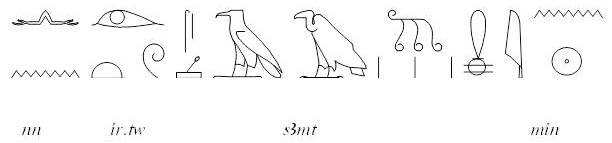
The Egyptian word s3mt had different meanings[1]. According to A. Erman and H. Grapow, it meant “sadness” [2]; but s3mt could also be “moan” [3] or “mourning” [4]. Some scholars have translated s3mt as “lock of hair” [5]. Some consider that it could describe “not cut hair” as a sign of mourning[6] or “careless hair” [7]. William A. Ward took as basis chapter 1131 and affirmed that the expression Hdq s3mt meant “cut the dishevelled hair” and for giving this meaning to s3mt he referred to the Prophecy of Neferty[8].

The text relates how the wise man Neferty tells Pharaoh Snofru (IV Dynasty) about the future (First Intermediate Period), as a chaotic time when all rules (natural and cultural) get reversed. Among all the disasters happening to Egypt (the country will be attacked by Asiatics, the sun will not shine, the Nile will dry, and there will be wars…) Neferty says:

“…nobody will cry for the death,

Nobody will fast during for the death,

A man’s hearth will be concerned just about himself,

Today will[9] not be any s3mt carried out,

Neferty


The heart will be completely away from it…”

W. Helck translated “…today none will dress hairstyle for death” but M. Lichtheim considered that Neferty was saying that the mourning was not done and for G. Lefrebvre Neferty’s words said “…there will not be mourning ceremonies…”[10] Before that Neferty told how none would cry nor fast for the death, that is, would nobody do the orthodox funerary practices; that means that s3mt could be considered as an Egyptian word for the mourning as a funerary custom. So, for us it makes more sense to translate as: “…today will not be the s3mt carried out…” and it would match perfectly with the chaotic image Neferty is describing.

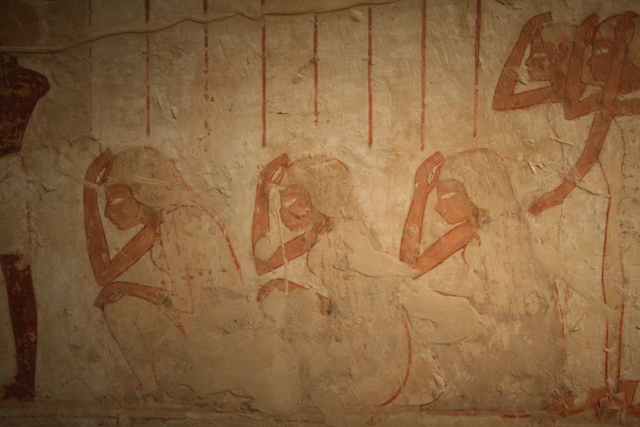
Group of mourning women. Unfinished painting from the tomb of Userhat in Gourna. XVIII Dynasty. Photo: Mª Rosa Valdesogo Martín.

Group of mourning women. Unfinished painting from the tomb of Userhat in Gourna. XVIII Dynasty. Photo: Mª Rosa Valdesogo Martín.

Thanks to some stelas found in Serapeum we know that during the embalming of Apis there was mourning ceremony called s3mt: “… I was among the miserable, being in moan, being in mourningSerapeum-s3mt[11].

The word s3mt could refer to an spect of the mourner's hair or just to the mourning itself.

The word s3mt could refer to an spect of the mourner’s hair or just to the mourning itself.

Everything points to the Egyptian word s3mt as a funerary custom related to hair and mourning, but nothing indicates that it could refer to a special hairstyle. Would it be maybe the two mourners’ hair manipulated during funerals for the deceased’s benefit?


[1] In the Old Kingdom s3mt is documented  as a personal name (P.Kaplony, 1966, p. 68)

[2] Wb IV, 18, 10.

[3] D. Meeks, 1977-1979, p.306, nº 78.3295.

[4] D. Meeks, 1977-1979, p.304, nº 77.3349. Another way of writing s3mt wass3mt-ojo

[5] R.O. Faulkner, 1962, p. 210.

[6] D. Meeks, 1977-1979, p. 239, nº 79.2409.

[7] D. Meeks, 1977-1979, p. 304, nº 77.3349.

[8] W. Helck, 1970

[9] nn sDm.f implies future.

[10] G. Lefebvre, 1988, pp. 101-102.

[11] W. Jansen, 1994, p. 35; J. Vercoutter, 1962, pp. 37-38.

The Hair s3mt and the final Resurrection in the Coffin Texts of Ancient Egypt.


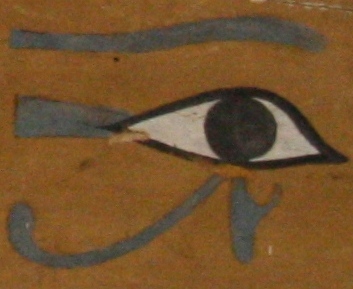
Udjat eye in a Middle Kingdom coffin. Beni Suef Museum. Photo: Mª Rosa Valdesogo Martín.

Udjat eye in a Middle Kingdom coffin. Beni Suef Museum. Photo: Mª Rosa Valdesogo Martín.

Once the damaged eye of Horus, that was related with the hair sm3, has been healed it becomes the Udjat eye, the full moon as a symbol of the total regeneration. The question is does this aspect of the lunar eye have any connection with the hair? The answer is yes, it does.

Some chapters of the Coffin Texts relates the final episode of the Egyptian myth of Osiris, when he gets triumphant over his enemies and he is reborn; on earth that means the deceased’s resurrection. It is when Horus gets his eye back, his Udjat eye, and it is interesting to notice how in that moment the funerary texts mention two very relevant things:

  1. The presence of the lock of hair (or just hair) s3mt.
  2. The shave of the mourners.

Chapter 339 is about the Osiris’ victory over the enemies and his resurrection. It mentions towns related somehow with Osiris and his burial: Busiris (where was the Osiris’ spine), Letopolis (here was the shoulder), Buto (the ladies of Buto crying for Osiris were Isis and Nephtys), Abydos (where was his head and his burial place)…; Thoth appears as the god claiming “true of voice”  Osiris, Horus also offers his Udjat eye to his father[1]; with that act culminates the final resurrection, it means the end of the chaos, the order restitution and the beginning of the new life. Osiris is reborn as king of the Herafter, while Horus inherits the throne of Egypt. And, according to chapter 339, that moment of restoration is the moment of shaving the mourners in Buto, so shaving Isis and Nephtys:

“…Busiris, this is the day of giving the Udjat eye to his lord. Pe-Dep[2], this is the day of shaving the mourners…”

Chapter 339

Razor made of bronze and wood, coming from the tomb of Hatnofer and Ramose in Gourna. XVIII Dynasty. The Metropiltan Museum oj Art of New York. Photo: www.metmuseum.org

Razor made of bronze and wood, coming from the tomb of Hatnofer and Ramose in Gourna. XVIII Dynasty. The Metropiltan Museum oj Art of New York. Photo: http://www.metmuseum.org

Chapter 942 is too damaged, but it seems to allude to the fight between Horus and Seth:

“Provide with her s3mt burning (?)…Chapter 942 (I)

 Those ones from Hermopolis adore him [3](…), they break the double power. My coming up is the coming up of this goddess, raising with Re…the only lord, which has taken the flame of the Luminous One.

The two i3rty of Sokaris[4] are shaved for herChapter 942 (II)

The face is adorned [5](…) made against her in the name of Wnwt[6]. Seth is put by her under her pleats (…) the peace is made (…) in their names. I am alive and intact, they are alive and intact ».

When Seth is put under Wnwt, which is related to the uraeus snake, the peace is made because in Egyptian belief the uraeus is benefactor; it eliminates the evil (Seth), that is, it helps in restoring the universal order.

Uraeus on the forehead of Amenhotep I. XII Dynasty. Metropolitan Museum of Art of New York. Photo: Mª Rosa Valdesogo Martín.

Uraeus on the forehead of Amenhotep I. XII Dynasty. Metropolitan Museum of Art of New York. Photo: Mª Rosa Valdesogo Martín.

What about the hair elements we find in the text? P. Barguet translated the first sentence as: “her plait is destroyed”. If the word instead of s3mt were sm3, we could maybe think of an allusion to the damage suffered by the lunar eye, but if we look at verb, Htm could be also translated as “provide with”, “equip with”, and specially “equip the face with the eye” [7].

Regarding the i3rty, the dual form and the hair determinative make us think of the two mourners Isis and Nephtys. I3r means « sadness » or « mourning » [8]. R.O. Faulkner translated the term i3rr iArr as “weakness of the eye” or “weakness of the heart” [9]. On the other hand, i3rt  iArt is also an Egyptian expression that designates the uraeus snake of Re[10] ; so we could also consider that the i3rty would be the two uraei of Sokaris, which will be shaved.

The meaning of Haq is “shave”, so it is applied just to hair. The question is why is it here used with snakes instead of hair? It is no new for us the Egyptian assimilation of both elements, since we have already seen how the plait Hnskt was identified with the snake as symbols of rebirth. For that same reason it would not be so crazy to consider that in Ancient Egypt the two uraei could be identified with both locks of hair s3mt.

Statuettes of Isis and Nephtys mourning. Ptolemaic Period. Metropolitan Museum of Art of New York. Photo: www.metmuseum.org

Statuettes of Isis and Nephtys mourning. Ptolemaic Period. Metropolitan Museum of Art of New York. Photo: http://www.metmuseum.org

So, the chapter 942 would be relating the shave of the uraei, which would be the same as saying that the two locks of hair were cut. With these i3rty of Sokaris maybe we would be facing again a new case of metonymy, the two mourners being mentioned through their most relevant part: the i3rty, so it would be a way of describing Isis and Nephtys. Maybe we are reading about the shave of both mourners’ locks of hair, and these ones assimilated to two uraei as victors over the evil.

After shaving the i3rty (locks of hair or uraei) the text says how the face is adorned or dressed, but…with what? Do we have to think about the arrangement of the Udjat eye on the Osiris/deceased’s face? If so, why is it related to the locks of hair and its shaving?

Finally, we have another passage in Coffin Texts showing a very narrow relationship between lock of hair and eye. In chapter 1131 the deceased is at the same level of Osiris, that one is described as an image of the god. In this context the dead one goes ahead to his resurrection and one of the things happening before that is the following:

“… The lock of hair (or just hair) s3mt is cut; the eye is sealed by the nestling in its hole…”chapter 1131

P. Barguet[11] and William A. Ward[12] transliterated this sentence as follows: Hdq s3mt irt xtmt n t3 nb3b3.f, so having a verb (nb3b3), with unclear translation[13]. But if we take the final as n b3b3.f the texts has more sense: the nestling[14] is into its hole b3b3. This word can refer to the seven orifices on the face, of which two are the eye sockets[15] ; taking into consideration our context, it seem quite logical to think of b3b3 in this chapter as a way to referring to the eye socket. That allows to translate the sentence as « the eye is sealed (or closed) », since the nestling is inside the orbit (as it was a nest) and impedes the vision.

We need also to focus on a following sentence for ending the chapter that says: “Live the nestling that goes out from you…flies the fly and live Osiris…” This flight is strongly connected with the resurrection of Osiris-bird. When that one remains inside the nest-socket, the eye is sealed and that means no to access light, it is the moment of shadows and darkness (death). The chapter 1131 connects that with cutting the s3mt and after doing that the nestling flies and the eye can open; it symbolizes the capacity to see, the brightness after the darkness, the Osiris/deceased’s resurrection.

Sokaris, as a falcon, with the Udjat eye over him, spread his wings for fliying up. Painting from the tomb of Pashedu in Deir el-Medina. XIX Dynasty. Photo: Mª Rosa Valdesogo Martín.

Sokaris, as a falcon, with the Udjat eye over him, spread his wings for flying up. Painting from the tomb of Pashedu in Deir el-Medina. XIX Dynasty. Photo: Mª Rosa Valdesogo Martín.

That is a very solid idea in Ancient Egypt and dates back from the Old Kingdom; the dead king could reach the Hereafter as the eye of Horus, but he usually took the aspect of a bird, using the faculties of this animal for flying up[16].

Summing up, the main ideas we can take from these three chapters of the Coffin Texts are:

  1. The s3mt  (lock of hair or just hair) is cut just before the final resurrection in ancient Egypt funerals.
  2. The Osiris’ resurrection is connected with the shave of the mourners.
  3. The cut of the s3mt is connected in Egyptian belief with the eye and the vision recovery.

[1] The offer of  the Udjat eye will be the offer per excellence, so everything offered will be called “Eye of Horus”  (A. Erman, 1952, p. 209).

[2] Buto.

[3] Reconstruction could be (n).f

[4] In ancient Egypt there were assimilation between Osiris and Sokaris.

[5] or “dressed“.

[6] Name related to the uraeus (Wb I, 317, 11).

[7] Wb III, 196, 14.

[8] Wb I, 32, 2.

[9] R.O. Faulkner, 1962, p. 9, 5.

[10] Wb I, 32, 3.

[11] P. Barguet, 1986, p. 665.

[12] W.A. Ward, 1975, p. 62.

[13] It seems to be a verb related to the eye of Horus (Wb II, 243, 14).

[14]  nestling this sign is the image of the nestling into the nest nest

[15] Wb I, 419, 1.

[16] Pyr., 1216 y 1770. Whitney M. Davies, 1977,p. 167.

The Hair sm3 and the Healing of the lunar Eye in Ancient Egypt. Part II: The damaged Eye of Horus.


The god Thoth. Relief from the ptolemaic temple in Deir el-Medina. Photo: Mª Rosa Valdesogo Martín.

The god Thoth. Relief from the ptolemaic temple in Deir el-Medina. Photo: Mª Rosa Valdesogo Martín.

We find already in the Old Kingdom the belief of Thoth being the god who healed the injured eye of Horus with sputum:

He has come with that one that spits the hair (sm3), for his hair (sm3), which is sick at the beginning of each month and sick[1] at the beginning of middle month[2].

This passage belongs to a chapter of the Pyramid Texts which mentions two lunar festivities (3bd[3] and smdt(?)[4]); they are Helioplitan celebrations with some rituals for the reconstruction of the lunar eye, to give it back the health[5]. These festivities appear also in the Coffin Texts when the deceased has to be transformed into Thoth:

“…this N. is the one who makes the rite ibd (the second day of the month) and he is the one who controls the rite nt (fifteenth day of the month).The plait of hair of Horus is on the hand of this N. in the Thoth’s entourage…“ [6] (important to remember that chapters 167 and 674 mention mourner’s hair sm3 joint with two lunar festivities: snwt and dnit).

Egyptians considered equal the lunar eye and hair sm3, and we will see that many times. After spitting at the hair sm3, chapter 133 says how the deceased gets up triumphant, it seems that after healing the eye, he could rebirth again. In chapter 164 again the act of spitting at the hair sm3 is a healing action, here the god spits first over the shoulder. According to P. Barguet the passage relates the healing of the Osiris’ injured shoulder and hair sm3, that is, the lunar eye[7] ; the chapter mention mutilations that have happened in the myth of Osiris and that have been solved after the battle.

In chapter 610 the healing is over the hair sm3 of Atum and also over Hdd. In Egyptian mythology the moon, that is, the Udjat eye, is one of the eyes of Atum, the other one was the sun. Hdd is a name coming from the verb hd, which means “attack”[8]. It is a 2-lit. verb with second radical geminated in perfect passive participle. So, the meaning of hdd could be “attacked”, “the one who has been attacked”. This way, Hdd would be personifications of the attacked eye of Horus, hence the need of refreshing it for its cure. But it is also interesting to notice how in chapter 667 the healing of the hair sm3 is at the same level of offering a leg and giving breath, both gestures for giving life.

Finally, we find a very visual moment in all that process of healing the damaged lunar eye. We have translated chapter 335 as the action of raising the hair from the Udjat eye. P. Barguet considered that m was an equivalence preposition, so for him the text was saying that the hair Sny was the same Udjat eye. But if we take preposition m as “from”, the passage makes more sense. It would be describing the gesture of moving the hair away from the lunar eye for healing it, and also from the face for allowing seeing the light after the darkness.

Falcons have an excelent vision. In the image a Lanner Falcon. Photo: www.ibc.lynxeds.com

Falcons have an excelent vision. In the image a Lanner Falcon. Photo: http://www.ibc.lynxeds.com

In Ancient Egypt (as many cultures) the eye, as the vision organ, symbolizes the light and its disappearance or mutilation is a synonym of darkness. The sacrifice of the eye and its following recovery supposes a regenerating act, in the same level of creation after the chaos. Restitution of vision means access to light after the darkness of the death.

We have already seen in chapter 533 how the face of Hathor gets visible and clear after separating the two lateral ringlets, opening them as if they were curtains the deceased can see the full moon. When moving the hair Sny away from the face allows healing the eye and makes the Udjat eye visible, the healthy eye, that is, the full moon. On the other hand, we know that hair Sny is similar to hair sm3, the same hair that did not allow to see the brightness and could be a symbol of darkness and shadows[9]. The one who moves the hair away from the eye is Thoth because, according to the Egyptian legend, he is the lunar god who heals the lunar eye after the fight against Seth.

The connection between the hair and the eye of Horus is clear, but if Thoth spits over the hair sm3 for healing the eye, this one cannot be the Udjat eye (the healthy one), but the damaged eye of Horus, which in Egyptian was nknkt[10] or nkkt[11] and who needs a cure for becoming the Udjat eye.destacada 24de junio Once again we find the hair with a negative nuance; we have seen previously that the hair sm3 was a symbol of the chaos, the primeval waters, it was the Nun that dominated the world before the final creation. H. Kees considered that the hair sm3 in the context that concern us could be the damage suffered by the lunar eye[12], which makes the darkness of the night; in the same way that the hair sm3 over the faces of the mourners covers their eyes and they cannot see. So, to split over the hair sm3 would eliminate that damage, in the same way that to move the hair away from the face means to see the light.

The god Seth. Relief from a block in the Open Air Musuem of Karnak. Photo: Mª Rosa Valdesogo Martín.

The god Seth. Relief from a block in the Open Air Musuem of Karnak. Photo: Mª Rosa Valdesogo Martín.

The hair sm3 would then symbolize in Egyptian belief the disorder dominating during the fight between Horus and Seth. This combat is full of sense, since, as says J.E. Cirlot, the fight is the “primeval sacrifice”[13]; it is the combat between two apposite forces, and it contributes to stimulate the vital energy, whose result is the victory of the order over the chaos. This victory means the world creation, and the winner goes out from it as a hero with an extra power. In the Egyptian funerary context that meant the resurrection of the deceased, the access to the light to his new life.


[1] The word nqm, parallel to “sick”, in reality designates a “bad property of the hair”(Wb II, 344, 3).

[2] Pyr., 521.

[3] Wb I, 65, 10.

[4] Wb IV, 147, 1.

[5] S. Ratié, 1984, p. 179.

[6] iw dnt irt ¡r Hr(y)-a n N pn m smswt DHwty CT  IV, 277.

[7] P. Barguet, 1986, p. 377, n. 10.

[8] Wb II, 504, 15.

[9] According H. Kees, Sni and  sm3 have both the same relationship with the lunar legend (H. Kees, 1925, p. 8).

[10] Wb II, 347, 6.

[11] Wb II, 347, 9.

[12] H. Kees, 1925, p. 8.

[13] J. E. Cirlot, 1991, p. 282.

The Hair sm3 and the Healing of the lunar Eye in Ancient Egypt. Part I: Chapters in Coffin Texts.


We have seen how the reading of the Coffin Texts shows many different aspects of hair related to renovating practices or regenerating symbols. The main symbol of renovation, resurrection and regeneration in Egyptian religion was the Udjat eye. The eye of Horus, injured during the fight against Seth, was identified with the moon, and the process of the increasing from crescent to full moon was assimilated with the combat between both gods.

Eye of Horus, the falcon god. Detail from an image of Horus in the tomb of Roy in Dra Abu el-Naga. XVIII Dynasty. Photo: Mª Rosa Valdesogo Martín.

Eye of Horus, the falcon god. Detail from an image of Horus in the tomb of Roy in Dra Abu el-Naga. XVIII Dynasty. Photo: Mª Rosa Valdesogo Martín.

The full moon was the evidence of final victory of Horus over Osiris’s murderer, which finished with the resurrection of Osiris as king of the Hereafter.

Many chapters of the Coffin Texts mention the hair sm3 in an Osiris context of healing. Let’s have a look of each and deduce some ideas:

  • Chapter 133:

“Those ones who are in their temples they blink and make the Great One. The Great One belongs to me; the eye of the Great One belongs to me. I have spitted[1] over the hair sm3 of Sw[2] for his healing.

chapter 133

 Everything has been given to me, I feel triumphant, and I stand up triumphant. I have created all my family, for whom I have spoken. I am Re, the sun’s father”

  • Chapter 164:

“…I treat the great god because of his harm

Which one is the suffering of the great god?

It is his head, his shoulder and his leg.

I came for spitting in his shoulder, for refreshing the hair sm3

chapter 164

And for healing the two legs of the great god…”

  • Chapter 610:

« … This N. has spitted over the hair sm3 of Atum, he has refreshed Hdd[3]

chapter 610

 Shu and Thoth, beloved, being together behind the great god, Shu and the hair sm3…this N, has spitted (over) the hair sm3, this N has refreshed his vertebra. It is a medicine inside the body of this N…[4] »

  • Chapter 667:

« …He has spitted (over) the hair sm3

chapter 667

He carries a leg and he gives breath to who does not have. This N has brought his ba soul; his has taken his power and magic ».

  • Chapter 335:

“…I have recovered the eye after it was damaged the night of the combat between the Two Fellows[5]. I have raised the hair from the Udjat eye when he was furious

chapter 335

Who raises the hair from the Udjat eye? Who is the Udjat eye in his moment of anger?

It is the right eye of Re and Thoth is the one who raises the hair from it… »

chapter335thoth

 We find a common denominator: the hair, mainly sm3, but in one case also Sni, is linked somehow to the Udjat eye, it gets involved in fight and suffers damage; in the mythic sphere this hair is treated and healed with a spit.


[1] iw sDm.n.f is a narrative tense and it stress a very important fact of the story.

[2] According to Barguet, it is the city of Seth in the Heracleopolitan nome (P. Barguet, 1986, p. 256, n. 6)

[3] “The attacked one”, eye of Horus?

[4] Healing properties of saliva.

[5] Horus and Seth.

Hair and Death in Ancient Egypt. First Summary.


Hair and mourning women. Summary

According to what we have seen in the category « Hair and Mourning Women » we can mention some main ideas:

  • Mourners in Ancient Egypt made two gestures: Nwn: to cover their faces with their hair sm3 (in some cases is Snw) and nwn m: to pull their front lock of hair swt. Both are a way of showing despair and sadness.

    Mourning woman of Minnakht's tomb. www.1st-art-gallery.com

    Mourning woman of Minnakht’s tomb. http://www.1st-art-gallery.com

  • The hair over the face symbolized the darkness of the death into which the dead is sunk; it remembered the chaos in the primeval state of creation, so the Nwn gesture symbolized the Nun, the primeval waters.
  • Egyptians assimilated the hair sm3 to vital elements as breath, vegetation and water. So, to give the hair sm3 with the nwn gesture was a propitiatory practice, the hair became an instrument for sending vital energy to the deceased.
  • The heir was an important figure for the deceased’s resurrection in Ancient Egypt belief. As in the Osirian myth, Horus was the avenger who restored the cosmic order. For that reason the dead had to get again his virility. The nwn gesture in funerals could be a way of symbolizing the mythical copulation through which Osiris recovered his virility and Isis could conceive Horus.

    Funerary stele of Lady Taperet with an image of Nut in nwn gesture. XXII Dynasty. Musée du Louvre. Photo: www.nybooks.com

    Funerary stele of Lady Taperet with an image of Nut in nwn gesture. XXII Dynasty. Musée du Louvre. Photo: http://www.nybooks.com

  • The deceased, as Osiris and as a reborn, became Nut’s son. This goddess also made in the mythic sphere the nwn gesture. In funerary ceremony, the nwn gesture that the mourners made with the hair would remember the posture of Nut, as sky goddess, when bearing Osiris.

Locks, Plaits and Ringlets. Summary

The main ideas of the second category are:

The goddess Hathor with lateral ringlets. Column from the temple of Khnum in Elephantine Island. Photo: Mª Rosa Valdesogo Martín.

The goddess Hathor with lateral ringlets. Column from the temple of Khnum in Elephantine Island. Photo: Mª Rosa Valdesogo Martín.

  • The deceased was welcome to the Hereafter by Hathor, lunar goddess whose face is flanked by the two ringlets wprty. When she received the dead one these two ringlets opened and let see her face; that symbolized to see the light of the full moon in the night sky and it was the culmination of the lunar resurrection for the deceased, in the same way the full moon in the Osiris myth meant the resurrection of the god.
  • Egyptians identified the plaits Hnskt with lunar elements as horns (an image of the crescent) and snakes (which regenerates regularly), and also helped in that lunar resurrection.

    The god Khonsu with side lock. Relief from the funerary temple of Seti I in Dra Abu el-Naga. Photo: Mª Rosa Valdesogo Martín.

    The god Khonsu with side lock. Relief from the funerary temple of Seti I in Dra Abu el-Naga. Photo: Mª Rosa Valdesogo Martín.

  • The lock of hair s3mt seems to be also identified with the first moments of life and the childhood of the moon (it would be the side lock of children), so it was as well an element for contributing to the lunar resurrection of the dead. It also seems to have a negative aspect, since it was maybe identified with the evil which threats the dead one and which suffers an ablation for allowing the deceased to get back to life.

Hair, Enemy and Sacrifice in Ancient Egypt. Part II: Tekenu and Magical Heads.


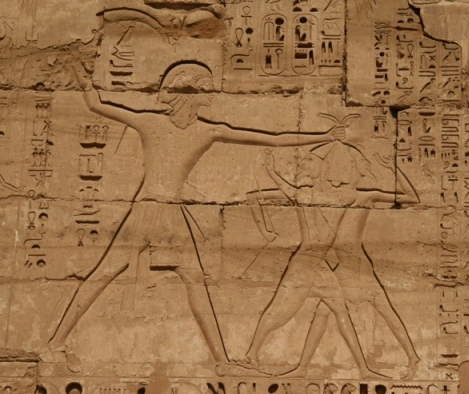
The gesture made by the enemy is the same as the one made by mourners when they hold the front lock of hair swt. enemy and mournersThe relationship between enemy and hair is not exclusive of Sed Festival. Egyptian iconography always shows how the Pharaoh grabbed the hair of the enemies of Egypt. They were the personification of the evil and the king had to eliminate them for protecting the country from that danger. Was to kill them also to cut their locks of hair? In those scenes we can see the Pharaoh holding the mace but also sometimes a cutting weapon, the sickle. He could with it to cut the enemy’s head or as well his lock of hair.

Ramses III holding the enemies. Relief from his funerary temple of Medinet Habu. XIX Dynasty. Photo: Mª Rosa Valdesogo Martín.

Ramses III holding the enemies. Relief from his funerary temple of Medinet Habu. XIX Dynasty. Photo: Mª Rosa Valdesogo Martín.

If cutting the enemy’s hair symbolizes to eliminate the danger, then the lock of hair swt symbolizes the enemy, the evil. We would be again in a case of metonymy with lock of hair swt. As we saw formerly the lock of hair swt identified the two mourners. Once again the whole (the enemy) is identified with a very significant part (lock of hair). In the renovation/resurrection sphere of ancient Egypt the tekenu, whose image appears in Sed festivals and funerals, would be that malignant being that must be destroyed; to cut and get his lock of hair could symbolize his murder, so the end of the danger, the pass from darkness to light, from death to new life.

Obviously this is just a hypothesis, since the rite of tekenu is still much unknown. Anyway, there are some documents that allow us to approach. The tomb of Montuherkhepeshef in Thebes[1] dates from XVIII Dynasty and has a very valuable scene related to the tekenu.

Funerary scene of the tomb of Montuherkhepeshef in Dra Abu el-Naga. XVIII Dynasty.

Funerary scene of the tomb of Montuherkhepeshef in Dra Abu el-Naga. XVIII Dynasty.

Among the many funerary scenes, there is one showing a hole containing the word tknwtknw; four elements share the place: the skin meska piel msk(apparently where the tekenu was wrapped), the heartheart, a bull leg bull leg and a lock of hairhair. It seems that they are parts of the tekenu[2]. Could we think that the human victim in some moment of the Egyptian history was replaced by an animal victim? All those parts of the victim seem to be very important in the funerary ceremony, at least in Montuherkhepeshef’s burial. Concretely, the lock of hair had to be in the same level of importance as the skin, the heart and the leg and maybe with a very similar function.

If the lock of hair swt in the Egyptian Sed Festival could be a symbol of the evil, and its destruction a symbol of the victory over the meanness, we could also think something similar in the funerary context. To eliminate the lock of hair swt would mean the victory of the good over the evil that the deceased needs for coming back to life. The document has not an easy explanation, but at least we can see how important could be the lock of hair in the mortuary ritual of tekenu; we could consider it as something for providing vital energy to the dead and as a grant of the end of the chaos and the danger; so the beginning of a new life for the deceased.

In this line we consider appropriate to mention the research made by R. Tefnin about the called “magical heads”[3] found in Giza[4]. They are sculptures of heads made in limestone and discovered in non royal tombs from IV Dynasty. The individual features makes think of portraits, but their purpose is not clear.

Magical heads from Giza. IV Dynasty. Cairo Museum. Photo: www.wikipedia.org

Magical heads from Giza. IV Dynasty. Cairo Museum. Photo: http://www.wikipedia.org

R. Tefnin noticed that, although their individuality, they shared many characteristics; actually it seems that a kind a damage was made in those heads before the burial; these damages were deep incisions in neck, top of the head, ears and in the frontal line of the hair. According to R. Tefnin these marks would respond to a ritual made in some moment of the funerary ceremony. We have already said that in Egyptian though the head was the centre of the life, the head has vital faculties as breathing, seeing, hearing, tasting. Not to have head meant the incapacity of making breathing and perceiving, and that was a synonym of death. Funerary texts show Osiris as a death being who needs to recover vital faculties for finishing his resurrection. In that point R. Tefnin refers to “the ambiguous attitude of Egyptians towards their deceased ones” [5].

Magical head of Nofer from his tomb in Giza (G2110A). IV Dynasty. Museum of Fine Arts Boston. Photo: www.mfa.org

Magical head of Nofer from his tomb in Giza (G2110A). IV Dynasty. Museum of Fine Arts Boston. Photo: http://www.mfa.org

On one hand the deceased needs the help of the living ones, but he can also be a danger; the dead ones belong to an unknown dimension, which the living ones cannot control, so the deceased can become a spirit coming back from the beyond to the earth with bad intentions[6]. If the dead could be an adversary, he had to be treated as an enemy. For R. Tefnin this point of view would explain those ritual mutilations made on the “Magical heads”.

The head, as image of the deceased as an enemy, suffers in some moment of the funerals, some ritual damages, which refer to punishments inflicted to adversaries: the incision in the neck would symbolize the beheading, the mark on the skull would be the hit with the mace, the cut of the ears was also a documented war practice, to cut the hair over the front should then also be a punishment made to the enemies.

Again we meet a relationship between cutting the hair and eliminating the danger. It is the same principle of the tekenu; the idea of an expiatory sacrifice materialized in renovating rites through the ablation of a lock of hair.


[1] TT 20.

[2] Spanish mission in the tomb of Dyehuty has discovered a very interesting scene related to the tekenu.

[3] Also known as “reserve heads” or “replacement heads”.

[4] R. Tefnin, 1991.

[5] R. Tefnin, 1991, p. 86.

[6] In fact we there were conjurations and incantations for avoiding the ghosts to annoy the living ones.