S3mt: Hair and Mourning, Evil and Udjat Eye.


The word s3mt appears repeatedly in the Egyptian funerary texts. It can be translated as lock of hair or mourning and it is closely linked to the idea of destruction of evil, the healing of the lunar eye and finally recovering the Udjat eye.

S3mt seems to refer to something related to the  mourning ritual and focused on the mourner’s hair. It could probably be considered as the hair that during the mourning rite women manipulated with a symbolic meaning, shaking it forwards (nwn sm3) or pulling it (nwn m swt).
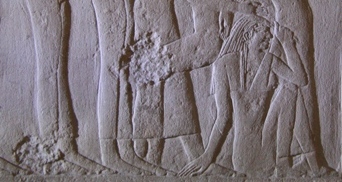
Group of mourners, one of them making nwn m gesture of pulling her frontal lock of hair. Relief from the mastaba of Mereruka. VI Dynasty. Photo: Mª Rosa Valdesogo Martín.

Mourner making nwn m gesture of pulling her front lock of hair. Relief from the mastaba of Mereruka. VI Dynasty. Photo: Mª Rosa Valdesogo Martín.
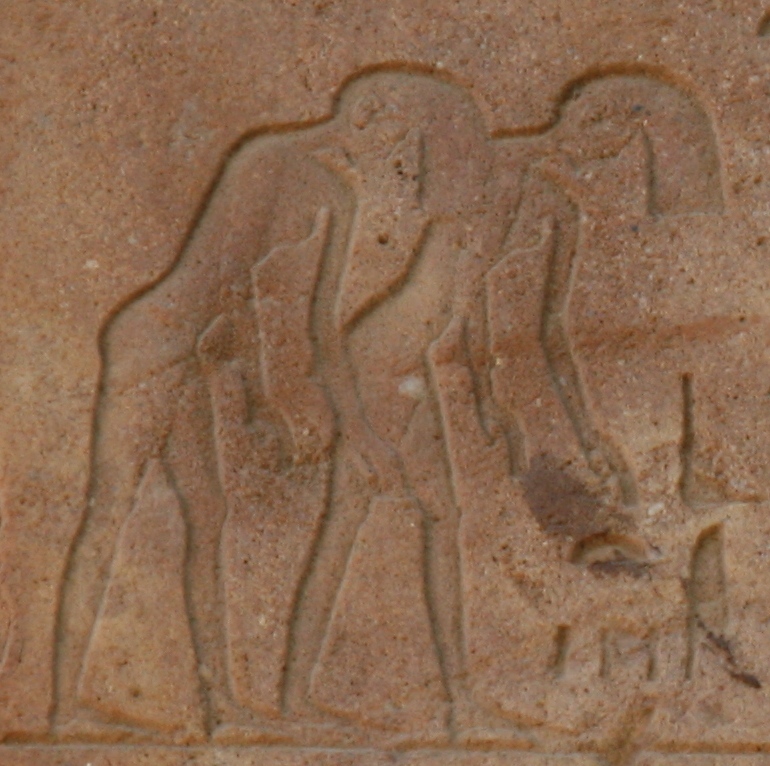
Two women shaking their hairs. Relief from the Red Chapel of Hatshepsut in Karnak. Photo: Mª Rosa Valdesogo Martín

Two women shaking their hair. Relief from the Red Chapel of Hatshepsut in Karnak. Photo: Mª Rosa Valdesogo Martín

The funerary texts communicate that this s3mt was cut, using the Egyptian word Hsq, which meant “cut”, but also “behead”. And also we find evidence that the mourners were shaved at the end of the mourning rite.
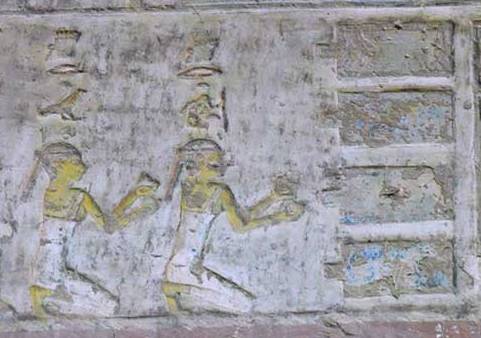
The two Drty (two kites), offering nw vases to the four pools. Relief from the tomb of Pahery in el-Kab. XVIII Dynasty. Photo: www.osirisnet.net

The two Drty (two kites), offering nw vases with short hair to the four pools. Relief from the tomb of Pahery in el-Kab. XVIII Dynasty. Photo: http://www.osirisnet.net

Many documents assimilate the hair s3mt with the s3bwt snakes. These were malign animals that in Egyptian mythology beheaded the gods, so they were an image of the enemy and responsible of the death.

Beheading the snake as an image of the evil. The cat of Heliopolis killing the snake Apohis, enemy of Re. Painting from the tomb of Inerkha in Deir el-Medina. XIX Dynasty. Photo: www.osirisnet.net

Beheading the snake as an image of the evil. The cat of Heliopolis killing the snake Apohis, enemy of Re. Painting from the tomb of Inerkha in Deir el-Medina. XIX Dynasty. Photo: http://www.osirisnet.net

In Egyptian funerary belief, it is necessary to restore the head for living again and annihilate those s3bwt. Making that the adversary is wiped out; the gods recover their heads and also their faculties for seeing, breathing and knowing.  In the funerary ambit, this will benefit the deceased, since cutting the s3mt will have the same effects on him: to recover the faculties that give him access to the new life.

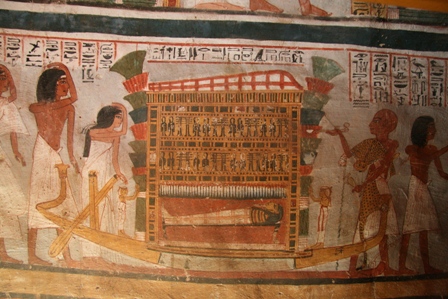
Tekenu wrapped in a shroud and in foetal position over a sledge. Painting from the tomb of Ramose in Gourna.XVIII Dynasty. Photo: Mª Rosa Valdesogo Martín.

Tekenu wrapped in a shroud and in foetal position over a sledge. Painting from the tomb of Ramose in Gourna.XVIII Dynasty. Photo: Mª Rosa Valdesogo Martín.

Cutting the s3mt is also closely related to the sacrifice and the figure of tekenu. This human victim, who goes back to ancient times in Egyptian history, has a double value, expiatory and propitiatory. In the first documents, one of the remarkable elements of the human victim is a front lock of hair. Once the human victim is replaced by an ox in the Opening of the Mouth ceremony again the lock of hair is one of the most important elements. So, this last one seems to be related with the evil elimination.
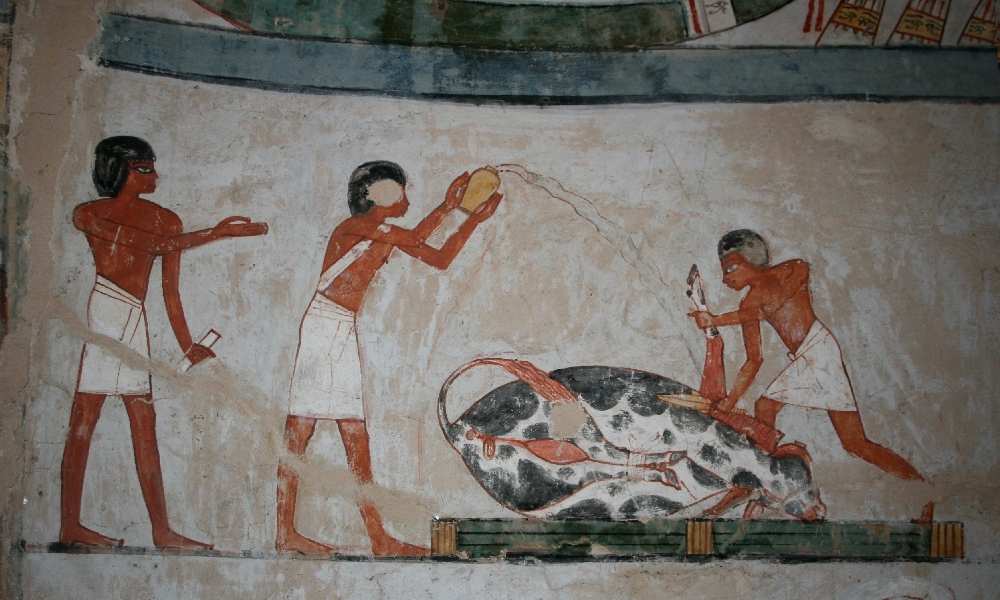
Sacrifice of an ox in the funerary ceremony. Painting from the tomb of Menna in Gourna. XVIII Dynasty. Photo: www.osirisnet.net

Sacrifice of an ox in the funerary ceremony. Painting from the tomb of Menna in Gourna. XVIII Dynasty. Photo: http://www.osirisnet.net

As cutting the s3mt is a way of removing the bad, it is also a way of recovering the Udjat eye as symbol of the final resurrection. Firstly Thoth spits on the damaged eye of Horus and this action is narrated in sacred texts as Thoth spitting on the hair sm3, afterwards the mourners are shaved or the s3mt is cut and the Udjat eye is offered to the deceased.
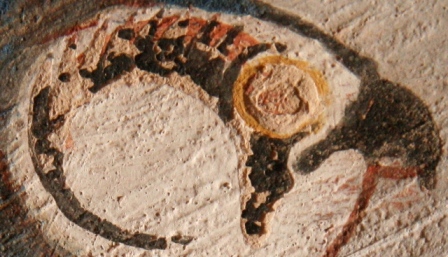
Eye of Horus, the falcon god. Detail from an image of Horus in the tomb of Roy in Dra Abu el-Naga. XVIII Dynasty. Photo: Mª Rosa Valdesogo Martín.

Eye of Horus, the falcon god. Detail from an image of Horus in the tomb of Roy in Dra Abu el-Naga. XVIII Dynasty. Photo: Mª Rosa Valdesogo Martín.

Summing up, to cut the s3mt supposes annihilate the enemy, the evil but also recover the Udjat eye and allow the final resurrection.

Ringlets and Plaits, Horns and Snakes, Moon and Resurrection.


In ancient Egypt some aspects of the hair have just a symbolic dimension in the deceased’s resurrection, these are the cases of the two ringlets wprty and the plait of hair Hnskt.

The goddess Hathor with lateral ringlets. Column from the temple of Khnum in Elephantine Island. Photo: Mª Rosa Valdesogo Martín.

The goddess Hathor with lateral ringlets. Column from the temple of Khnum in Elephantine Island. Photo: Mª Rosa Valdesogo Martín.

Wprty are, according to the Coffin Texts, the two lateral ringlets at both sides of Hathor’s face; these two pieces of hair are in Egyptian imagery a kind of curtains which open and let see the goddess’ face. It is about the lunar divinity and to see her face means to see the moon, it is the metaphoric access to light from the darkness of the death, so a proof of resurrection. When the two wprty open, the deceased can come into the Herefater and be guided by the moon through the night sky.

Regarding the plait Hnskt, it is assimilated to the snake and the horns, both elements having a lunar nature. In Egyptian belief moon and snake are immortal, due to their cyclic renovation; they change gradually without dying; in fact that change is a way of regeneration and getting in a new existence. This is the Egyptian idea of death: it was not a disappearance, but a change of condition in the human life, so the funerary ceremony could be considered as a rite of passage.

Comparison of crescent (photo: www.channing.info) with the horns of a bull. Relief from a block in the Open Air Museum of Karnak. Photo: Mª Rosa Valdesogo Martíni.

Comparison of crescent (photo: http://www.channing.info) with the horns of a bull. Relief from a block in the Open Air Museum of Karnak. Photo: Mª Rosa Valdesogo Martín.

Horns in many ancient cultures, and also in the Egyptian one, were a symbol of regeneration thanks to the shape, which remembered the first quarter of the moon. This union between hair and horns makes us as well think about the two ringlets wprty of Hathor as a hair image of the two horns of the goddess. Precisely for that reason, the horns of Hathor can be connected with the plait Hnskt, which, according to one version of the Osiris legend, the goddess lost.

Head fragment from a statue of a "Bald of Hathor". New Kingdom. Metropolitan Museum of New York. Photo: www.metmuseum.org

Head fragment from a statue of a “Bald of Hathor”. New Kingdom. Metropolitan Museum of New York. Photo: http://www.metmuseum.org

In turn, all that can be related to the clergy of Hathor, whose priests were called “bald of Hathor” and whose requirement was the lack of hair in the crown, so remembering the goddess’ mutilation.

Pulling the front Lock of Hair in Ancient Egypt.


Group of mourners, one of them making the nwn m gesture of pulling her frontal lock of hair. Relief from the mastaba of Mereruka in Saqqara. VI Dynasty. Photo: Mª Rosa Valdesogo Martín.

Group of mourners, one of them making the nwn m gesture of pulling her front lock of hair. Relief from the mastaba of Mereruka in Saqqara. VI Dynasty. Photo: Mª Rosa Valdesogo Martín.

In ancient Egyptian funerary ceremony mourners also made a different gesture with their hair, it was the nwn m gesture, which was to pull the front lock of hair. In fact, Egyptian language made an exercise of metonymy and the front lock of hair swt/syt was also used in many texts for designating the mourners, considering that it was their most significant part. According to some documents coming mainly from the Old Kingdom the nwn m gesture was a desperation act, since there is iconography showing mourners ripping their clothes, beating their arms and pulling their front lock of hair as a gesture of sadness.

Women pulling lock of hair over the dead. Tomb of Ramses IX. Valley of the Kings. XX Dynasty. Photo: Mª Rosa Valdesogo Martín.

Women pulling lock of hair over the dead. Tomb of Ramses IX. Valley of the Kings. XX Dynasty. Photo: Mª Rosa Valdesogo Martín.

However, thanks to some sources coming from the New Kingdom it could also be a gesture made over the corpse or forward the mummy. It seems that in this case, it could be a way of transferring the life force contained in the hair to the deceased and helping in his final resurrection.

Mourners of Re pulling hair. Section two of the Book of Caverns. Tomb of Ramses VI. XX Dynasty.

Mourners of Re pulling hair. Section two of the Book of Caverns. Tomb of Ramses VI. XX Dynasty.

But in the Egyptian belief the nwn m gesture was not only something made on earth, but also in the Hereafter. Those ones, who also mourned in the divine dimension and pulled their front lock of hair, guided the deceased with their shouts to find the way in the darkness of the death, so they helped him as well, as the mourners did on earth.

Why a front lock of hair? The forehead is a special part of the anatomy in ancient Egypt. According to one version of the episode of Horus and Seth, the lunar disk came out from the forehead of this one. We also know that Re put in his forehead the ureus, the snake which was in origin the eye of Re; the assimilation snake/eye makes us think of a triple similarity: lock of hair swt/ureus/lunar eye. If, as we have seen in this work, eye and snake are closely bound to the idea of resurrection, the front lock of hair might also have regenerating nature. That would reinforce the idea of the nwn m as a gesture made for the benefit of the deceased.

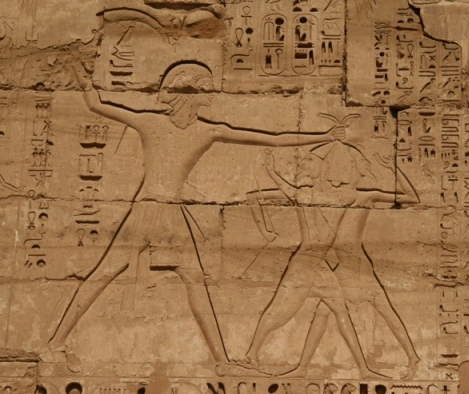
Ramses III holding the enemies. Relief from his funerary temple of Medinet Habu. XIX Dynasty. Photo: Mª Rosa Valdesogo Martín.

Ramses III holding the enemies. Relief from his funerary temple of Medinet Habu. XIX Dynasty. Photo: Mª Rosa Valdesogo Martín.

On the other hand, Egyptian writing shows us the image of the enemy as a man making what we could understand as the nwn m gesture. We have seen the relationship between hair and enemy in the figure of the human victim in the Sed festival (tekenu) and also in the scenes of the Pharaoh killing the enemies of Egypt while holding them from their hair. The idea is that the front lock of hair swt could also represent the adversaries or the evil the deceased needs to eliminate for having access to the eternal life.

As in the case of  the nwn movement of shaking the hair sm3 forwards, we notice that the nwn m gesture of pulling the front look of hair swt/syt had a negative and positive value, since it was a proof of sadness and consternation but also something made for helping in the deceased’s resurrection.

The Rite recalls the Myth. The Hair gives Breath of Life and Virility in Ancient Egypt.


The whole funerary ceremony is full of practices that recall the mythic death and resurrection of Osiris and the mourning rite is not an exception. The legend tells how the goddess Isis, when mourning the death of her husband, became a kite and put over the mummy of her husband; flapping her wings she could give the breath of life to Osiris and helped in his reanimation. In this work we have seen that there is also in the thought of ancient Egypt an assimilation between hair and feathers, therefore the nwn gesture of the mourner shaking the hair sm3 forwards the corpse could be interpreted as a way of producing the air that the deceased needs for breathing and coming back to life.

Isis as a kite over the corpse of Osiris. Relief from the temple of Seti I in Abydos. XIX Dynasty. Photo: www.common.wikimedia.org)

Isis as a kite flapping wings over the corpse of Osiris. Relief from the temple of Seti I in Abydos. XIX Dynasty. Photo: http://www.common.wikimedia.org)

Changing into a kite, Isis could also restore Osiris’ virility. Egyptian funerary texts claim that when the mourners (smwt) give their hair sm3w to the deceased, he impregnates those women. It is interesting to notice that the Egyptian year started with the inundation (season of akhet), which was announced in some rituals (also the funerary one) with the nwn gesture, and the first month of that season was called, which means « inebriation ». On the other hand, the reduplicated form of txi is txtx and means “to dishevel”.

Isis as a kite is over the body of the dead. Statuette of prince Tutmosis, son of Amenhotep III. XVIII Dynasty. Altes Musuem (Berlin). Photo: Mª Rosa Valdesogo Martín.

Isis as a kite is over the body of the dead. Statuette of prince Tutmosis, son of Amenhotep III. XVIII Dynasty. Altes Musuem (Berlin). Photo: Mª Rosa Valdesogo Martín.

Inebriation and dishevelling are two concepts together in the orgy, and this one is a way of coming back to the primeval chaos. It is the first state of creation, where sexuality and dishevelled hair take part. From anthropological point of view orgy is an act on behalf of life, it helps in generating a new productivity and in agricultural societies it strengthens the agrarian fertility; the orgy stimulates the renovation from the chaos. If the funerary ceremony is a way for getting the deceased’s resurrection through a return to the primeval moment, the eroticism, which encourages the chaos’ creation power, needs to be also a part of the ritual.

When the Egyptian mourner was making the nwn gesture during the Opening of the mouth ceremony, she was making a symbolic movement with her hair sm3 recalling the episode of the Osiris legend when Isis over the mummy restored the virility of her husband and copulated with him.

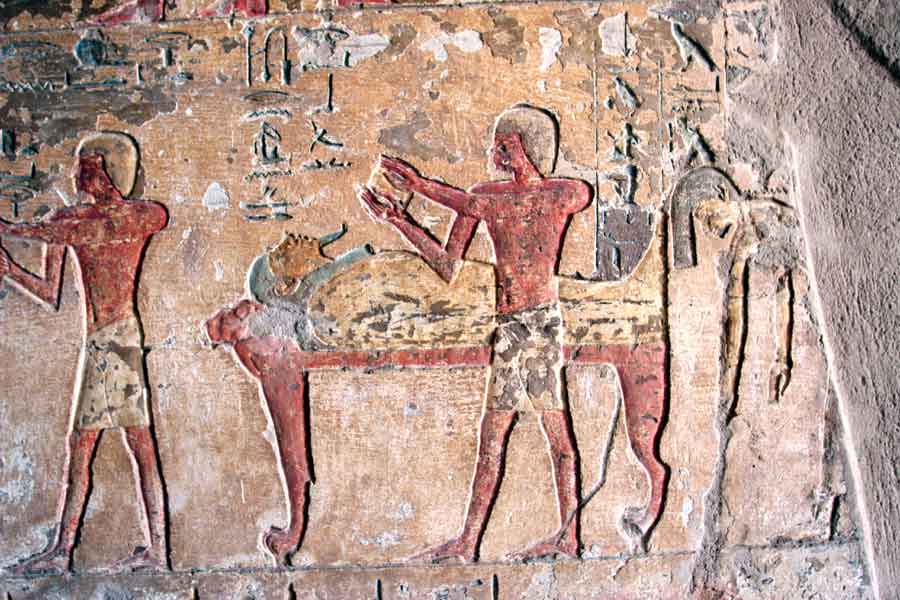
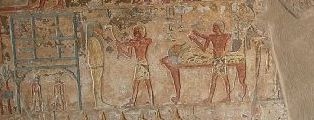
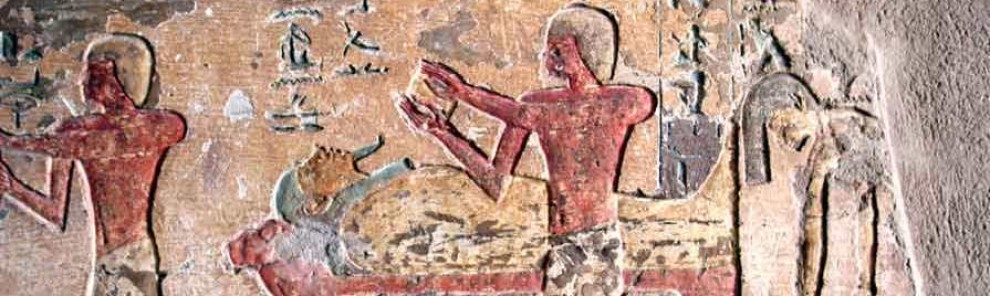
Opening of the Mouth ceremony; on the right the mourning is making the nwn gesture forwards the mummy. Tombof Renni in el-Kab. XVIII Dynasty. Photo: www.osirisnet.net

Opening of the Mouth ceremony; on the right the mourning is making the nwn gesture forwards the mummy. Tomb of Renni in el-Kab. XVIII Dynasty. Photo: http://www.osirisnet.net

The ejaculation of Osiris was a very important step in the myth because it was a proof of his physical regeneration; in fact the virility is in Egyptian sacred iconography a resource the artist had for indicating the resurrection, since he represented the deceased with “penile erection”. It also granted the conception of Horus, his heir, his avenger, the one who eliminated the evilness and restored the order, succeeding to the Egypt’s throne and allowing his father Osiris to revive as king of the Hereafter.

Hair is Vegetation in Ancient Egypt.


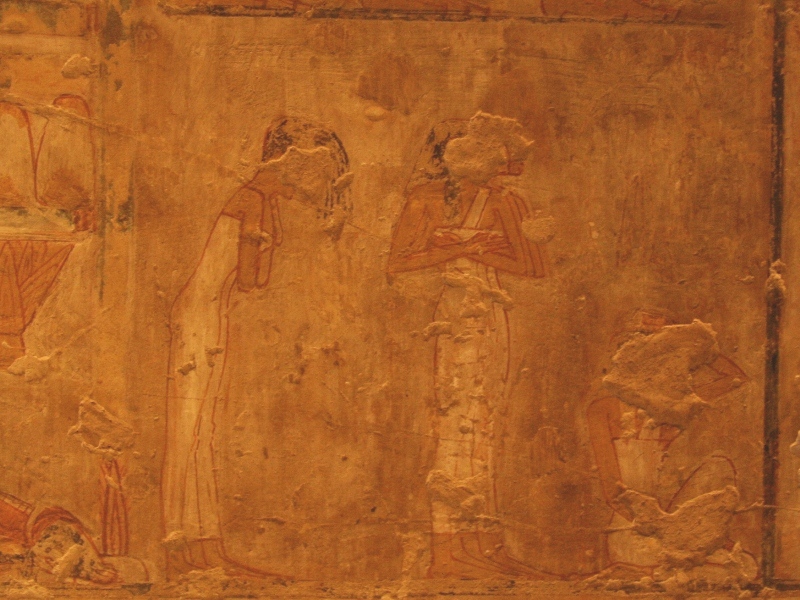
Mourners with tears falling from their eyes (water) and hair on both sides of the face (vegetation). The image could be a metaphor of the Egyptian landscape, made up by the Nile and the both shores of the river. Painting from the tomb of Ramose in Gourna. XVIII Dynasty. Photo: Mª Rosa Valdesogo Martín.

Mourners with tears falling from their eyes (water) and hair at both sides of the face (vegetation). The image could be a metaphor of the Egyptian landscape, made up by the Nile and the both banks of the river. Painting from the tomb of Ramose in Gourna. XVIII Dynasty. Photo: Mª Rosa Valdesogo Martín.

The connection of hair with nature is not only in its assimilation with water. The Egyptian funerary texts show hair Snw of Isis and Nephtys as an image of both banks of the Nile. According to Pausanias the tears dropping from the eyes of Isis were like the water in the riverbed, so the two mops of hair at both sides of the face could be considered as the vegetation on each bank of the Nile.

For reinforcing this idea we have the Egyptian language, which designates the vegetation as “the hair of the earth” el pelo de la tierraand considers a land with no plants as a “bald land”la tierra calva; therefore the hair is clearly in Egyptian belief identified with the vegetation. The two mourners’ pieces of hair/vegetation would be a metaphoric image of the two banks of the river.

From the natural point of view, we would be here facing a second seasonal step of the Egyptian calendar. The hair sm3 is a symbolic image of the inundation, that happens in the first season of akhet, while the hair Snw is referring to the plants, so the second season of peret. The growing of the plants is a natural rebirth, so making the nwn gesture and throwing the hair assimilated to the vegetation could be understood as a way of transferring the living force to the corpse; in the funerary dimension this would be a way of contributing to the mummy’s resurrection.

Hair is Water in Ancient Egypt.


In the ninth hour of the Book of the Gates there is the "pool of the drowned". These are the waters of the Nun with bodies floating. These are the primeval waters, which revives the deceased. Scene from the tomb of Tauseret in the Valley of the Kings. XIX Dynasty. Photo: www.thebanmappingproject.com

In the ninth hour of the Book of the Gates there is the “pool of the drowned”. These are the waters of the Nun with bodies floating. These are the primeval waters, which revives the deceased. Scene from the tomb of Tauseret in the Valley of the Kings. XIX Dynasty. Photo: http://www.thebanmappingproject.com

The women’s hair is also assimilated to the liquid element. To give the hair sm3 is a way of giving the primeval waters of the first moment in the Egyptian cosmogony. The regenerating rite is mainly a creation ceremony, so it is necessary to remember the primeval waters (Nun) where the world came from. Making the nwn gesture of throwing the hair forwards, the mourners transfer to the corpse the Nun (Nwn), the mythical waters that originated everything. This is a very important step in the regenerating rite, since the renovating waters (so the mourner’s hair) erase the mortal past and transport the deceased to a new existence. Coming back to the primeval moment, the dead one becomes a new-born baby, it is when the Egyptian funerary texts refer to him as an “inert one in the Nun “, it is just the instant when his mother’s water break and he is reborn.

Hair sm3 also symbolizes the waters of the inundation. In this work we have seen how the nwn gesture was as well made in two other Egyptian festivities: The Festival of the Valley and the Sed Festival. Both celebrations coincide with the appearance of Sothis in the sky and the following rise of the Nile and both festivities are a process of death and resurrection for granting the continuity of Amun and Pharaoh’s power respectively.

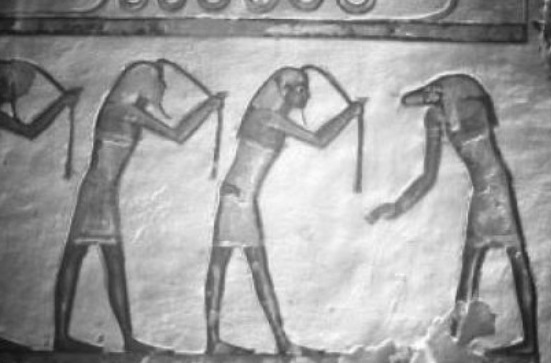
Dancers in the Festival of the Valley. Red Chapel of Hatshepsut in Karnak. XVIII Dynasty. Photo: Mª Rosa Valdesogo Martín

Dancers in the Festival of the Valley. Red Chapel of Hatshepsut in Karnak. XVIII Dynasty. Photo: Mª Rosa Valdesogo Martín

In both events there were a group of dancers making the nwn gesture, which as we understand it, it was more than just an artistic movement. According to us, and due to the assimilation between hair and water, when throwing their hair forwards those dancing women were announcing the regenerating waters, which will renew the power of both god and king. In the same way, in the mourning ritual, with the nwn gesture the mourner sent the renovating waters to the deceased.

Hair is Maternity in Ancient Egypt.


The nwn gesture has also a positive reading, because the hair sm3 has also a double value in Egyptian thinking. The hair sm3 is an element full of life force, which has to be delivered to the deceased for making easier the final resurrection.
To give the hair sm3 (rdi sm3) is a gesture that can be linked to the act of nursing; the mother’s milk is the first food, in the Egyptian funerary ambit the dead one in his rebirth is like a baby, so giving the hair sm3 contributes to this idea of the mummy as a new-born baby.

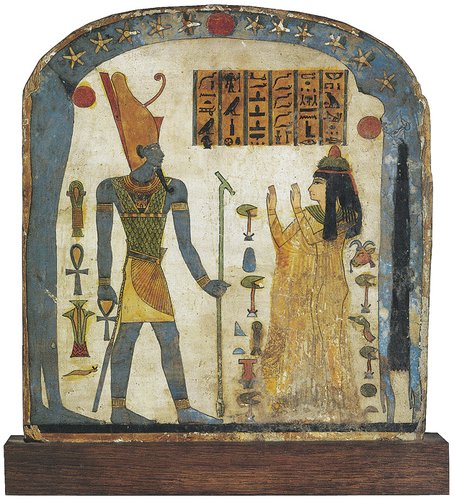
Funerary stele of Lady Taperet with an image of Nut in nwn gesture. XXII Dynasty. Musée du Louvre. Photo: www.nybooks.com

Funerary stele of Lady Taperet with an image of Nut in nwn gesture. XXII Dynasty. Musée du Louvre. Photo: http://www.nybooks.com

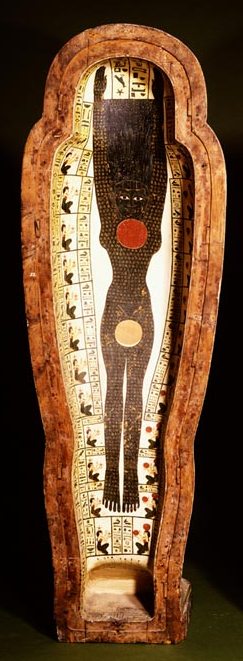
Internal side of the cover of the Coffin of Peftjauneith from Saqqara. Nut with raised arms and hair standing on end. Ptolemaic Period. Rijksmuseum of Leiden. Photo: www.rmo.nl

Internal side of the cover of the Coffin of Peftjauneith from Saqqara. Nut with raised arms and hair standing on end. Ptolemaic Period. Rijksmuseum of Leiden. Photo: http://www.rmo.nl

When the mourner makes the nwn gesture of throwing the hair onwards over her face she turns into the deceased’s mother, from whose belly he will be born. The mummy, assimilated to Osiris, is the Nut’s son and this goddess makes the nwn gesture inside the coffin, where happens the regeneration process. Nut bended and with her hair extended forwards gives birth her son Osiris, i. e. the dead one. For that reason we can find inside many coffin covers an image of Nut with raised arms and hair standing on end; it is the way the artist could represent her in that surface; but in reality she was bended forwards making the nwn gesture.

Hair is Darkness in Ancient Egypt.


All along this work we have seen that hair, in its different aspects, is an essential element in the Egyptian funerary ceremony. Its importance has two dimensions, ritual and symbolic and it is based on how the mourners treat it during the mourning rite and in the strong symbolic meaning of each hair aspect. Hair is a reviving tool, whose handling and symbolism helps in the deceased’s resurrection.

Mourners. Painting from the tomb of Rekhmire in Gourna. XVIII Dynasty. Photo: Mª Rosa Valdesogo Martín

Mourners. Painting from the tomb of Rekhmire in Gourna. XVIII Dynasty. Photo: Mª Rosa Valdesogo Martín

Hair sm3, whose most precise meaning seems to be the hair that comes from the crown (so the hair from its first origin in the head) is directly related in the funerals with the nwn gesture.

The nwn gesture has two variations: nwn: to shake the hair forwards covering the face with it and nwn m: to pull the front lock of hair swt/syt[1].

Group of mourners, one of them making the nwn m gesture of pulling her frontal lock of hair. Relief from the mastaba of Mereruka in Saqqara. VI Dynasty. Photo: Mª Rosa Valdesogo Martín.

Group of mourners, one of them making the nwn m gesture of pulling her front lock of hair. Relief from the mastaba of Mereruka in Saqqara. VI Dynasty. Photo: Mª Rosa Valdesogo Martín.

The nwn gesture has a very deep meaning, negative and positive.

HAIR IS DARKNESS.

In Ancient Egypt belief the hair sm3 means the darkness of the death, because the hair on the face stops the mourners seeing. With the nwn gesture the women reproduce the deceased’s blindness. It is also a way of alluding to the dead person’s lack of knowledge, because not to see means not to know, it is the state of unconsciousness typical of death. The negative nature of the nwn gesture comes not only from the darkness that causes the hair sm3, but also for the evilness that it symbolizes. The hair sm3 is assimilated to the damage done to the lunar eye. The hair sm3 in the Egyptian funerary belief is the image of the disaster that caused the blindness, the evil that Seth made to the eye of Horus, the lack of moon (so the light) in the night sky.

Mourning woman of Minnakht's tomb. www.1st-art-gallery.com

Mourning woman of Minnakht’s tomb. http://www.1st-art-gallery.com

While on earth the mourners have their hair over their faces, in the mythical sphere the Udjat eye has no vision, it cannot bright in the sky for illuminating the night. For recovering the brightness it is necessary to eliminate the evil, in the mythic dimension is when Thoth, spits on the sm3 and heals the lunar eye. The night has again its natural guide, the moon, and the moon is fundamental in all the regenerating process.


[1] In the Old Kingdom mourners pull the hair sm3; apparently it was later when the word sm3 is changed by the term for front lock of hair syt/swt.

Second Summary


The Hair and the Eye of Horus.

Detail of the mourners icovering their faces with the hair. Tomb of Rekhmire in Gourna. XVIII Dynasty. Photo: Mª Rosa Valdesogo

Detail of the mourners covering their faces with the hair. Tomb of Rekhmire in Gourna. XVIII Dynasty. Photo: Mª Rosa Valdesogo

The hair sm3 is assimilated to the lunar eye’s disease. The damage eye of Horus is an image of the battle between him and Seth, the Osiris’ murderer and in the Egyptian belief it symbolises the chaos and the darkness of the death. It is the moment the mourners are in nwn gesture and covering their faces with their hair sm3.

For the deceased’s rebirth it is necessary the healing of this lunar eye. In the mythic sphere is Thoth who spits on the eye for eliminating the disease it suffers, in the funerary ceremony we do not know if someone spitted on the mourner’s hair sm3.

Once the eye is recovered it becomes the Udjat eye. For contributing to the final resurrection the Udjat eye is offered to Osiris, this action symbolises the access from darkness to light.

In the funerary context it is the step from the hair sm3, image of chaos, darkness, evil, to the hair s3mt, assimilated to the Udjat eye. According to the funerary texts it is the moment of cutting the s3mt, something that can be understood as shaving the mourners and ending the mourning ritual.

The Hair and the Opening of the Mouth Ceremony.

On the right the mourner in nwn gesture towards the corpse. Scene from the tomb of Renni in el-Kab. XVIII Dynasty. Photo: www.osirisnet.net

On the right the mourner in nwn gesture towards the corpse. Scene from the tomb of Renni in el-Kab. XVIII Dynasty. Photo: http://www.osirisnet.net

The mourning ritual was one of the several sacred practices which formed the Opening of the Mouth ceremony. The two Drt, or two kites, maybe were professional and expert priestess who knew quite well this secret ritual of the resurrection. They shook (nwn) and/or pulled (nwn m) their hair towards the corpse dramatizing this way the passage in the Osiris’ legend, where Isis and Nephtys mourned his death, helped in his body recovery and contributed in his final rebirth.

Probably the mourning ritual started before the sacrifice of an ox. After a while hair started the slaughter of the animal while the mourners went on making the nwn gesture. The ox was the scapegoat and its death symbolised the victory of Horus over Seth, and the recovery of the Udjat eye. The female nature of these two women was crucial thanks to the relationship of women to moon and light.

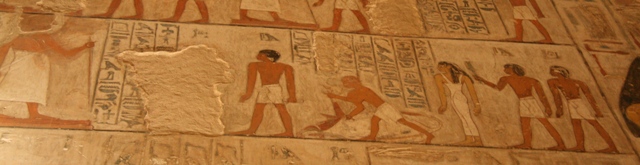
Sacrifice of the ox with the presence of the mourner. Painting from the tomb of Rekhmire in Gourna. XVIII Dynasty. Photo: Mª Rosa Valdesogo Martín.

Sacrifice of the ox with the presence of the mourner. Painting from the tomb of Rekhmire in Gourna. XVIII Dynasty. Photo: Mª Rosa Valdesogo Martín.

It is not clear if the mourning ritual was done before or after the tekenu rite, but in both cases the hair had a relevant role, because it seems that at the end a piece of hair was cut and offered to the deceased for his benefit and for contributing to his final resurrection.

Professional Mourners in Ancient Egypt.


The other point would be to discern who were these two women shaking and/or pulling their hair? Women represented next to the coffin are described as wife, widow, servant…The Egyptian Opening of the Mouth ceremony was secret and made by expert priests in the practices, therefore the mourning ritual, also secret and as a part of the first one, should be performed by women who knew very well every step of the rite.

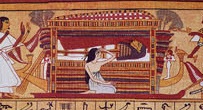
Close to the mummy the wife cries, while the two mourners in the role of Isis and Nephtys stand at both extremes. Detail from the Papyrus of Ani. XIX Dynasty. Photo: www.wikimedia.org

Close to the mummy the wife cries, while the two mourners in the role of Isis and Nephtys stand at both extremes. Detail from the Papyrus of Ani. XIX Dynasty. Photo: http://www.wikimedia.org

If we pay attention to Egyptian scenes of funerary processions, in many cases we can see the deceased’s wife crying on the coffin, while at both extremes stand two women identified as Isis and Nephtys. Although there are generic terms in Egyptian language for mourners, as iAkbyt, smwt or HAyt, the two mourners taking part in the rites for recovering the mummy are called Dryt, the two kites. They are the female figures standing at each extreme of the corpse, making the mourning ceremony impersonating Isis and Nephtys. The other mourning women or the deceased’s wife are never designed like that because the kite per excellence in Egyptian mythology was Isis and by extension, Nephtys. The role of those mourning women was too important and they could not be secular women, but official mourners who had the authority for getting into the “secret place”, where the corpse came back to life.

Isis and Nephtys are at both extremes of the mummy. Behind Roy's wife mourns her husband's death. Painting from the tomb of Roy in Dra Abu el-Naga. XVIII Dynasty. Photo: Mª Rosa Valdesogo Martín.

Isis and Nephtys are at both extremes of the mummy. Behind Roy’s wife mourns her husband’s death. Painting from the tomb of Roy in Dra Abu el-Naga. XVIII Dynasty. Photo: Mª Rosa Valdesogo Martín.

On the other hand these two women in the role of the goddesses are usually represented with clothing covering their hair, while the rest of mourners, also the wife, appear with the black mane visible. We could think that they were hiding a sacred element, through which they were able to bring the dead back to life. That makes us think that the mourning ritual was performed by someone who knew the secrets of the ceremony, a kind of priestess, who played the role of the deceased’s wife and sister-in-law, and who held the title of Drt.

The wife is kneeling and crying, Isis stands on the left and Nephtys on the right. Painting from the tomb of Samut in Assassif. XIX Dynasty. Photo: www.osirisnet.net

The wife is kneeling and crying, Isis stands on the left and Nephtys on the right. Painting from the tomb of Samut in Assassif. XIX Dynasty. Photo: http://www.osirisnet.net

Which features should they have these called souls of Buto? Obviously they should be initiated in the Osiris Mysteries, but we know from the Lamentations of Isis and Nephtys that one of the requirements for being a mourner in the role of Isis and Nephtys was not have been mother yet, so to have intact the power of conceiving. This idea is reinforced when in that same text Osiris is considered “the first-born who opens the body”. This was a way of being faithful to the myth and also a way of securing the resurrection of the dead, because the conceiving faculty of both Isis and Nephtys was intact[1].

About what other requirements they needed to have we do not know, but everything points to a pair of women who knew about that secret and sacred rite of mourning and performing with their hair in the deceased’s benefit. They had nothing to do with the common mourners of the cortège and nor with the dead’s wife, maybe even they had any kinship. Possibly they were professional mourners, knowing when to scream, when to recite some speeches and when and how to shake and/or pull their hair.


[1] Ph. Derchain also considered that they were two women without children (Derchain, 1975, p.73). In the myth of Osiris Isis has not yet given birth Horus. This one is born after his father’s death and his birth is the grant of the resurrection of Osiris. In the funerary ceremony the idea would be the same one: maternity happens after the decease.