Tag Archives: ancient egypt

Ringlets and Plaits, Horns and Snakes, Moon and Resurrection.


In ancient Egypt some aspects of the hair have just a symbolic dimension in the deceased’s resurrection, these are the cases of the two ringlets wprty and the plait of hair Hnskt.

The goddess Hathor with lateral ringlets. Column from the temple of Khnum in Elephantine Island. Photo: Mª Rosa Valdesogo Martín.

The goddess Hathor with lateral ringlets. Column from the temple of Khnum in Elephantine Island. Photo: Mª Rosa Valdesogo Martín.

Wprty are, according to the Coffin Texts, the two lateral ringlets at both sides of Hathor’s face; these two pieces of hair are in Egyptian imagery a kind of curtains which open and let see the goddess’ face. It is about the lunar divinity and to see her face means to see the moon, it is the metaphoric access to light from the darkness of the death, so a proof of resurrection. When the two wprty open, the deceased can come into the Herefater and be guided by the moon through the night sky.

Regarding the plait Hnskt, it is assimilated to the snake and the horns, both elements having a lunar nature. In Egyptian belief moon and snake are immortal, due to their cyclic renovation; they change gradually without dying; in fact that change is a way of regeneration and getting in a new existence. This is the Egyptian idea of death: it was not a disappearance, but a change of condition in the human life, so the funerary ceremony could be considered as a rite of passage.

Comparison of crescent (photo: www.channing.info) with the horns of a bull. Relief from a block in the Open Air Museum of Karnak. Photo: Mª Rosa Valdesogo Martíni.

Comparison of crescent (photo: http://www.channing.info) with the horns of a bull. Relief from a block in the Open Air Museum of Karnak. Photo: Mª Rosa Valdesogo Martín.

Horns in many ancient cultures, and also in the Egyptian one, were a symbol of regeneration thanks to the shape, which remembered the first quarter of the moon. This union between hair and horns makes us as well think about the two ringlets wprty of Hathor as a hair image of the two horns of the goddess. Precisely for that reason, the horns of Hathor can be connected with the plait Hnskt, which, according to one version of the Osiris legend, the goddess lost.

Head fragment from a statue of a "Bald of Hathor". New Kingdom. Metropolitan Museum of New York. Photo: www.metmuseum.org

Head fragment from a statue of a “Bald of Hathor”. New Kingdom. Metropolitan Museum of New York. Photo: http://www.metmuseum.org

In turn, all that can be related to the clergy of Hathor, whose priests were called “bald of Hathor” and whose requirement was the lack of hair in the crown, so remembering the goddess’ mutilation.

Pulling the front Lock of Hair in Ancient Egypt.


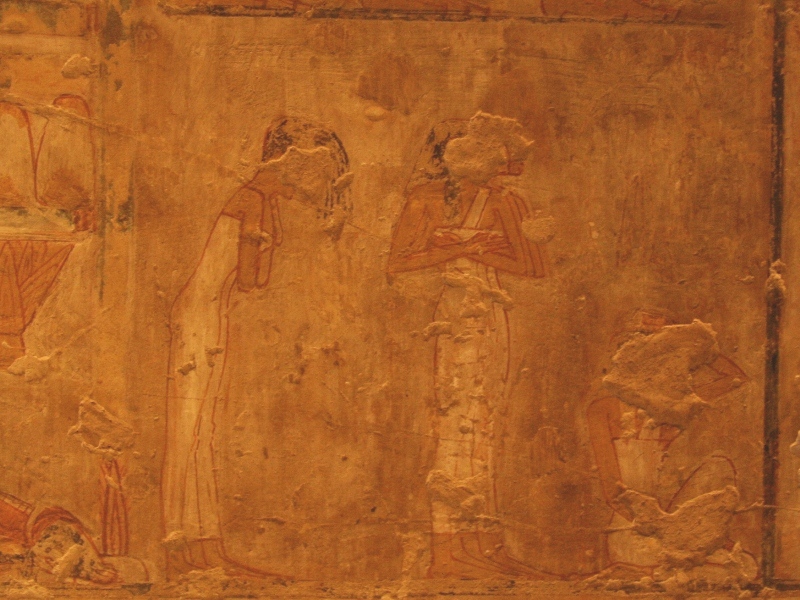
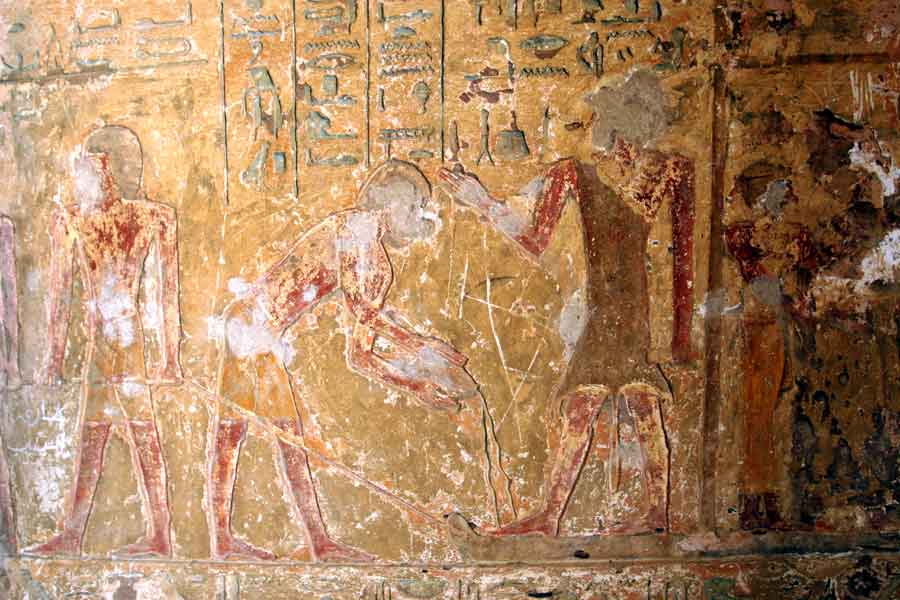
Group of mourners, one of them making the nwn m gesture of pulling her frontal lock of hair. Relief from the mastaba of Mereruka in Saqqara. VI Dynasty. Photo: Mª Rosa Valdesogo Martín.

Group of mourners, one of them making the nwn m gesture of pulling her front lock of hair. Relief from the mastaba of Mereruka in Saqqara. VI Dynasty. Photo: Mª Rosa Valdesogo Martín.

In ancient Egyptian funerary ceremony mourners also made a different gesture with their hair, it was the nwn m gesture, which was to pull the front lock of hair. In fact, Egyptian language made an exercise of metonymy and the front lock of hair swt/syt was also used in many texts for designating the mourners, considering that it was their most significant part. According to some documents coming mainly from the Old Kingdom the nwn m gesture was a desperation act, since there is iconography showing mourners ripping their clothes, beating their arms and pulling their front lock of hair as a gesture of sadness.

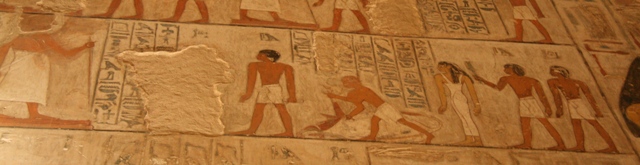
Women pulling lock of hair over the dead. Tomb of Ramses IX. Valley of the Kings. XX Dynasty. Photo: Mª Rosa Valdesogo Martín.

Women pulling lock of hair over the dead. Tomb of Ramses IX. Valley of the Kings. XX Dynasty. Photo: Mª Rosa Valdesogo Martín.

However, thanks to some sources coming from the New Kingdom it could also be a gesture made over the corpse or forward the mummy. It seems that in this case, it could be a way of transferring the life force contained in the hair to the deceased and helping in his final resurrection.

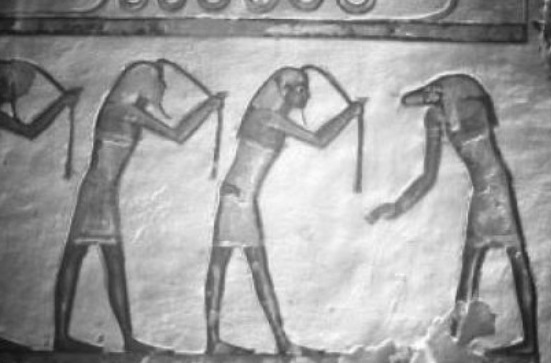
Mourners of Re pulling hair. Section two of the Book of Caverns. Tomb of Ramses VI. XX Dynasty.

Mourners of Re pulling hair. Section two of the Book of Caverns. Tomb of Ramses VI. XX Dynasty.

But in the Egyptian belief the nwn m gesture was not only something made on earth, but also in the Hereafter. Those ones, who also mourned in the divine dimension and pulled their front lock of hair, guided the deceased with their shouts to find the way in the darkness of the death, so they helped him as well, as the mourners did on earth.

Why a front lock of hair? The forehead is a special part of the anatomy in ancient Egypt. According to one version of the episode of Horus and Seth, the lunar disk came out from the forehead of this one. We also know that Re put in his forehead the ureus, the snake which was in origin the eye of Re; the assimilation snake/eye makes us think of a triple similarity: lock of hair swt/ureus/lunar eye. If, as we have seen in this work, eye and snake are closely bound to the idea of resurrection, the front lock of hair might also have regenerating nature. That would reinforce the idea of the nwn m as a gesture made for the benefit of the deceased.

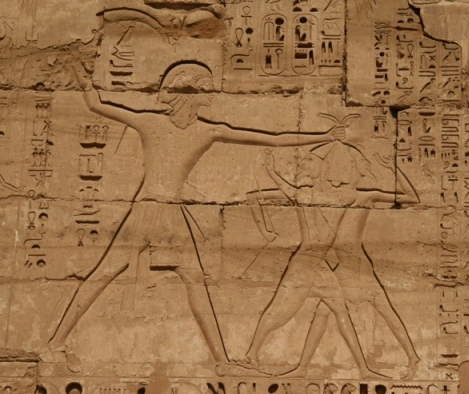
Ramses III holding the enemies. Relief from his funerary temple of Medinet Habu. XIX Dynasty. Photo: Mª Rosa Valdesogo Martín.

Ramses III holding the enemies. Relief from his funerary temple of Medinet Habu. XIX Dynasty. Photo: Mª Rosa Valdesogo Martín.

On the other hand, Egyptian writing shows us the image of the enemy as a man making what we could understand as the nwn m gesture. We have seen the relationship between hair and enemy in the figure of the human victim in the Sed festival (tekenu) and also in the scenes of the Pharaoh killing the enemies of Egypt while holding them from their hair. The idea is that the front lock of hair swt could also represent the adversaries or the evil the deceased needs to eliminate for having access to the eternal life.

As in the case of  the nwn movement of shaking the hair sm3 forwards, we notice that the nwn m gesture of pulling the front look of hair swt/syt had a negative and positive value, since it was a proof of sadness and consternation but also something made for helping in the deceased’s resurrection.

The Rite recalls the Myth. The Hair gives Breath of Life and Virility in Ancient Egypt.


The whole funerary ceremony is full of practices that recall the mythic death and resurrection of Osiris and the mourning rite is not an exception. The legend tells how the goddess Isis, when mourning the death of her husband, became a kite and put over the mummy of her husband; flapping her wings she could give the breath of life to Osiris and helped in his reanimation. In this work we have seen that there is also in the thought of ancient Egypt an assimilation between hair and feathers, therefore the nwn gesture of the mourner shaking the hair sm3 forwards the corpse could be interpreted as a way of producing the air that the deceased needs for breathing and coming back to life.

Isis as a kite over the corpse of Osiris. Relief from the temple of Seti I in Abydos. XIX Dynasty. Photo: www.common.wikimedia.org)

Isis as a kite flapping wings over the corpse of Osiris. Relief from the temple of Seti I in Abydos. XIX Dynasty. Photo: http://www.common.wikimedia.org)

Changing into a kite, Isis could also restore Osiris’ virility. Egyptian funerary texts claim that when the mourners (smwt) give their hair sm3w to the deceased, he impregnates those women. It is interesting to notice that the Egyptian year started with the inundation (season of akhet), which was announced in some rituals (also the funerary one) with the nwn gesture, and the first month of that season was called, which means « inebriation ». On the other hand, the reduplicated form of txi is txtx and means “to dishevel”.

Isis as a kite is over the body of the dead. Statuette of prince Tutmosis, son of Amenhotep III. XVIII Dynasty. Altes Musuem (Berlin). Photo: Mª Rosa Valdesogo Martín.

Isis as a kite is over the body of the dead. Statuette of prince Tutmosis, son of Amenhotep III. XVIII Dynasty. Altes Musuem (Berlin). Photo: Mª Rosa Valdesogo Martín.

Inebriation and dishevelling are two concepts together in the orgy, and this one is a way of coming back to the primeval chaos. It is the first state of creation, where sexuality and dishevelled hair take part. From anthropological point of view orgy is an act on behalf of life, it helps in generating a new productivity and in agricultural societies it strengthens the agrarian fertility; the orgy stimulates the renovation from the chaos. If the funerary ceremony is a way for getting the deceased’s resurrection through a return to the primeval moment, the eroticism, which encourages the chaos’ creation power, needs to be also a part of the ritual.

When the Egyptian mourner was making the nwn gesture during the Opening of the mouth ceremony, she was making a symbolic movement with her hair sm3 recalling the episode of the Osiris legend when Isis over the mummy restored the virility of her husband and copulated with him.

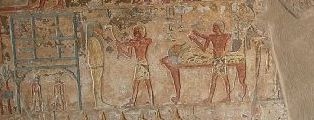
Opening of the Mouth ceremony; on the right the mourning is making the nwn gesture forwards the mummy. Tombof Renni in el-Kab. XVIII Dynasty. Photo: www.osirisnet.net

Opening of the Mouth ceremony; on the right the mourning is making the nwn gesture forwards the mummy. Tomb of Renni in el-Kab. XVIII Dynasty. Photo: http://www.osirisnet.net

The ejaculation of Osiris was a very important step in the myth because it was a proof of his physical regeneration; in fact the virility is in Egyptian sacred iconography a resource the artist had for indicating the resurrection, since he represented the deceased with “penile erection”. It also granted the conception of Horus, his heir, his avenger, the one who eliminated the evilness and restored the order, succeeding to the Egypt’s throne and allowing his father Osiris to revive as king of the Hereafter.

Hair is Vegetation in Ancient Egypt.


Mourners with tears falling from their eyes (water) and hair on both sides of the face (vegetation). The image could be a metaphor of the Egyptian landscape, made up by the Nile and the both shores of the river. Painting from the tomb of Ramose in Gourna. XVIII Dynasty. Photo: Mª Rosa Valdesogo Martín.

Mourners with tears falling from their eyes (water) and hair at both sides of the face (vegetation). The image could be a metaphor of the Egyptian landscape, made up by the Nile and the both banks of the river. Painting from the tomb of Ramose in Gourna. XVIII Dynasty. Photo: Mª Rosa Valdesogo Martín.

The connection of hair with nature is not only in its assimilation with water. The Egyptian funerary texts show hair Snw of Isis and Nephtys as an image of both banks of the Nile. According to Pausanias the tears dropping from the eyes of Isis were like the water in the riverbed, so the two mops of hair at both sides of the face could be considered as the vegetation on each bank of the Nile.

For reinforcing this idea we have the Egyptian language, which designates the vegetation as “the hair of the earth” el pelo de la tierraand considers a land with no plants as a “bald land”la tierra calva; therefore the hair is clearly in Egyptian belief identified with the vegetation. The two mourners’ pieces of hair/vegetation would be a metaphoric image of the two banks of the river.

From the natural point of view, we would be here facing a second seasonal step of the Egyptian calendar. The hair sm3 is a symbolic image of the inundation, that happens in the first season of akhet, while the hair Snw is referring to the plants, so the second season of peret. The growing of the plants is a natural rebirth, so making the nwn gesture and throwing the hair assimilated to the vegetation could be understood as a way of transferring the living force to the corpse; in the funerary dimension this would be a way of contributing to the mummy’s resurrection.

Hair is Water in Ancient Egypt.


In the ninth hour of the Book of the Gates there is the "pool of the drowned". These are the waters of the Nun with bodies floating. These are the primeval waters, which revives the deceased. Scene from the tomb of Tauseret in the Valley of the Kings. XIX Dynasty. Photo: www.thebanmappingproject.com

In the ninth hour of the Book of the Gates there is the “pool of the drowned”. These are the waters of the Nun with bodies floating. These are the primeval waters, which revives the deceased. Scene from the tomb of Tauseret in the Valley of the Kings. XIX Dynasty. Photo: http://www.thebanmappingproject.com

The women’s hair is also assimilated to the liquid element. To give the hair sm3 is a way of giving the primeval waters of the first moment in the Egyptian cosmogony. The regenerating rite is mainly a creation ceremony, so it is necessary to remember the primeval waters (Nun) where the world came from. Making the nwn gesture of throwing the hair forwards, the mourners transfer to the corpse the Nun (Nwn), the mythical waters that originated everything. This is a very important step in the regenerating rite, since the renovating waters (so the mourner’s hair) erase the mortal past and transport the deceased to a new existence. Coming back to the primeval moment, the dead one becomes a new-born baby, it is when the Egyptian funerary texts refer to him as an “inert one in the Nun “, it is just the instant when his mother’s water break and he is reborn.

Hair sm3 also symbolizes the waters of the inundation. In this work we have seen how the nwn gesture was as well made in two other Egyptian festivities: The Festival of the Valley and the Sed Festival. Both celebrations coincide with the appearance of Sothis in the sky and the following rise of the Nile and both festivities are a process of death and resurrection for granting the continuity of Amun and Pharaoh’s power respectively.

Dancers in the Festival of the Valley. Red Chapel of Hatshepsut in Karnak. XVIII Dynasty. Photo: Mª Rosa Valdesogo Martín

Dancers in the Festival of the Valley. Red Chapel of Hatshepsut in Karnak. XVIII Dynasty. Photo: Mª Rosa Valdesogo Martín

In both events there were a group of dancers making the nwn gesture, which as we understand it, it was more than just an artistic movement. According to us, and due to the assimilation between hair and water, when throwing their hair forwards those dancing women were announcing the regenerating waters, which will renew the power of both god and king. In the same way, in the mourning ritual, with the nwn gesture the mourner sent the renovating waters to the deceased.

Hair is Maternity in Ancient Egypt.


The nwn gesture has also a positive reading, because the hair sm3 has also a double value in Egyptian thinking. The hair sm3 is an element full of life force, which has to be delivered to the deceased for making easier the final resurrection.

To give the hair sm3 (rdi sm3) is a gesture that can be linked to the act of nursing; the mother’s milk is the first food, in the Egyptian funerary ambit the dead one in his rebirth is like a baby, so giving the hair sm3 contributes to this idea of the mummy as a new-born baby.

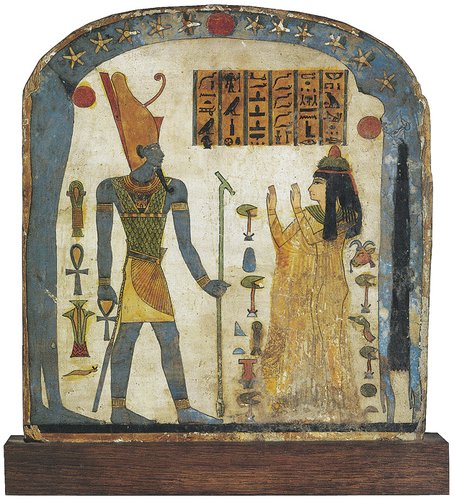
Funerary stele of Lady Taperet with an image of Nut in nwn gesture. XXII Dynasty. Musée du Louvre. Photo: www.nybooks.com

Funerary stele of Lady Taperet with an image of Nut in nwn gesture. XXII Dynasty. Musée du Louvre. Photo: http://www.nybooks.com

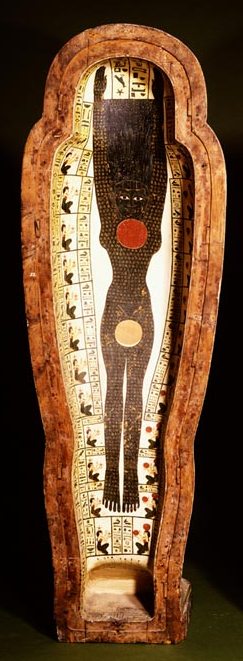
Internal side of the cover of the Coffin of Peftjauneith from Saqqara. Nut with raised arms and hair standing on end. Ptolemaic Period. Rijksmuseum of Leiden. Photo: www.rmo.nl

Internal side of the cover of the Coffin of Peftjauneith from Saqqara. Nut with raised arms and hair standing on end. Ptolemaic Period. Rijksmuseum of Leiden. Photo: http://www.rmo.nl

When the mourner makes the nwn gesture of throwing the hair onwards over her face she turns into the deceased’s mother, from whose belly he will be born. The mummy, assimilated to Osiris, is the Nut’s son and this goddess makes the nwn gesture inside the coffin, where happens the regeneration process. Nut bended and with her hair extended forwards gives birth her son Osiris, i. e. the dead one. For that reason we can find inside many coffin covers an image of Nut with raised arms and hair standing on end; it is the way the artist could represent her in that surface; but in reality she was bended forwards making the nwn gesture.

Hair is Darkness in Ancient Egypt.


All along this work we have seen that hair, in its different aspects, is an essential element in the Egyptian funerary ceremony. Its importance has two dimensions, ritual and symbolic and it is based on how the mourners treat it during the mourning rite and in the strong symbolic meaning of each hair aspect. Hair is a reviving tool, whose handling and symbolism helps in the deceased’s resurrection.

Mourners. Painting from the tomb of Rekhmire in Gourna. XVIII Dynasty. Photo: Mª Rosa Valdesogo Martín

Mourners. Painting from the tomb of Rekhmire in Gourna. XVIII Dynasty. Photo: Mª Rosa Valdesogo Martín

Hair sm3, whose most precise meaning seems to be the hair that comes from the crown (so the hair from its first origin in the head) is directly related in the funerals with the nwn gesture.

The nwn gesture has two variations: nwn: to shake the hair forwards covering the face with it and nwn m: to pull the front lock of hair swt/syt[1].

Group of mourners, one of them making the nwn m gesture of pulling her frontal lock of hair. Relief from the mastaba of Mereruka in Saqqara. VI Dynasty. Photo: Mª Rosa Valdesogo Martín.

Group of mourners, one of them making the nwn m gesture of pulling her front lock of hair. Relief from the mastaba of Mereruka in Saqqara. VI Dynasty. Photo: Mª Rosa Valdesogo Martín.

The nwn gesture has a very deep meaning, negative and positive.

HAIR IS DARKNESS.

In Ancient Egypt belief the hair sm3 means the darkness of the death, because the hair on the face stops the mourners seeing. With the nwn gesture the women reproduce the deceased’s blindness. It is also a way of alluding to the dead person’s lack of knowledge, because not to see means not to know, it is the state of unconsciousness typical of death. The negative nature of the nwn gesture comes not only from the darkness that causes the hair sm3, but also for the evilness that it symbolizes. The hair sm3 is assimilated to the damage done to the lunar eye. The hair sm3 in the Egyptian funerary belief is the image of the disaster that caused the blindness, the evil that Seth made to the eye of Horus, the lack of moon (so the light) in the night sky.

Mourning woman of Minnakht's tomb. www.1st-art-gallery.com

Mourning woman of Minnakht’s tomb. http://www.1st-art-gallery.com

While on earth the mourners have their hair over their faces, in the mythical sphere the Udjat eye has no vision, it cannot bright in the sky for illuminating the night. For recovering the brightness it is necessary to eliminate the evil, in the mythic dimension is when Thoth, spits on the sm3 and heals the lunar eye. The night has again its natural guide, the moon, and the moon is fundamental in all the regenerating process.


[1] In the Old Kingdom mourners pull the hair sm3; apparently it was later when the word sm3 is changed by the term for front lock of hair syt/swt.

Second Summary


The Hair and the Eye of Horus.

Detail of the mourners icovering their faces with the hair. Tomb of Rekhmire in Gourna. XVIII Dynasty. Photo: Mª Rosa Valdesogo

Detail of the mourners covering their faces with the hair. Tomb of Rekhmire in Gourna. XVIII Dynasty. Photo: Mª Rosa Valdesogo

The hair sm3 is assimilated to the lunar eye’s disease. The damage eye of Horus is an image of the battle between him and Seth, the Osiris’ murderer and in the Egyptian belief it symbolises the chaos and the darkness of the death. It is the moment the mourners are in nwn gesture and covering their faces with their hair sm3.

For the deceased’s rebirth it is necessary the healing of this lunar eye. In the mythic sphere is Thoth who spits on the eye for eliminating the disease it suffers, in the funerary ceremony we do not know if someone spitted on the mourner’s hair sm3.

Once the eye is recovered it becomes the Udjat eye. For contributing to the final resurrection the Udjat eye is offered to Osiris, this action symbolises the access from darkness to light.

In the funerary context it is the step from the hair sm3, image of chaos, darkness, evil, to the hair s3mt, assimilated to the Udjat eye. According to the funerary texts it is the moment of cutting the s3mt, something that can be understood as shaving the mourners and ending the mourning ritual.

The Hair and the Opening of the Mouth Ceremony.

On the right the mourner in nwn gesture towards the corpse. Scene from the tomb of Renni in el-Kab. XVIII Dynasty. Photo: www.osirisnet.net

On the right the mourner in nwn gesture towards the corpse. Scene from the tomb of Renni in el-Kab. XVIII Dynasty. Photo: http://www.osirisnet.net

The mourning ritual was one of the several sacred practices which formed the Opening of the Mouth ceremony. The two Drt, or two kites, maybe were professional and expert priestess who knew quite well this secret ritual of the resurrection. They shook (nwn) and/or pulled (nwn m) their hair towards the corpse dramatizing this way the passage in the Osiris’ legend, where Isis and Nephtys mourned his death, helped in his body recovery and contributed in his final rebirth.

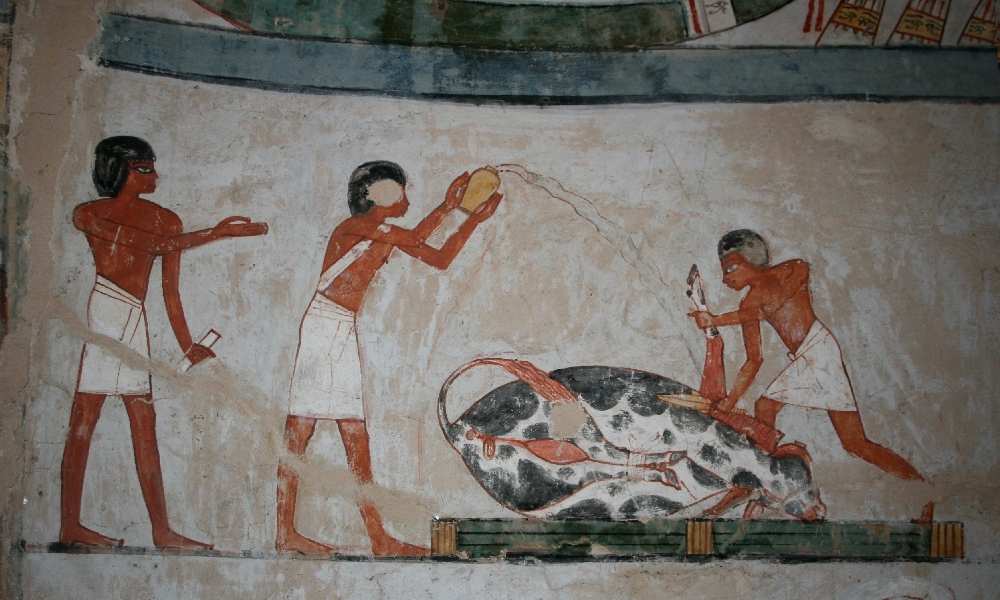
Probably the mourning ritual started before the sacrifice of an ox. After a while hair started the slaughter of the animal while the mourners went on making the nwn gesture. The ox was the scapegoat and its death symbolised the victory of Horus over Seth, and the recovery of the Udjat eye. The female nature of these two women was crucial thanks to the relationship of women to moon and light.

Sacrifice of the ox with the presence of the mourner. Painting from the tomb of Rekhmire in Gourna. XVIII Dynasty. Photo: Mª Rosa Valdesogo Martín.

Sacrifice of the ox with the presence of the mourner. Painting from the tomb of Rekhmire in Gourna. XVIII Dynasty. Photo: Mª Rosa Valdesogo Martín.

It is not clear if the mourning ritual was done before or after the tekenu rite, but in both cases the hair had a relevant role, because it seems that at the end a piece of hair was cut and offered to the deceased for his benefit and for contributing to his final resurrection.

The Mourning Ritual in the Opening of the Mouth Ceremony.


The fact of being a secret ceremony would explain why it is so rare to find images of the two mourners in the role of Isis and Nephtys carrying out the mourning ritual. The iconography shows them crying next to the mummy, but it is not usual to see what exactly they do.

on the right the mourner in nwn gesture towards the corpse. Scene from the tomb of Renni in el-Kab. XVIII Dynasty. Photo: www.osirisnet.net

On the right the mourner in nwn gesture towards the corpse. Scene from the tomb of Renni in el-Kab. XVIII Dynasty. Photo: http://www.osirisnet.net

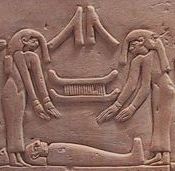
Some of the most explicit images of what the mourners do with their hair over or in front of the mummy are the stele of Abkaou (XI Dynasty), the tomb of Renni in el-Kab (XVIII Dynasty), the funerary temple of Seti I in Dra Abu el-Naga (XIX Dynasty) or the tomb of Ramsés IX (XX Dynasty); being scenes included in the coffin we could also put in this group the representations of Isis and Nephtys pulling their frontal lock of hair in the coffin of Ramsés IV (XX Dynasty) and in the coffin of Nes-shu-tefnut (Ptolemaic period).

Isis and Nephtys making nwn m gesture. Sarcophagus of Royal Scribe Nes-shu-tefnut from Saqqara. Ptolemaic Period. Kunsthistorisches Museum in Wien. Photo: www.globalegyptianmuseum.org

Isis and Nephtys making nwn m gesture. Sarcophagus of Royal Scribe Nes-shu-tefnut from Saqqara. Ptolemaic Period. Kunsthistorisches Museum in Wien. Photo: http://www.globalegyptianmuseum.org

Even the Opening of the Mouth rite of the tomb of Rekhmire does not give us a defined idea of the performance these women did it is the most complete scene of the whole ceremony that ancient Egyptians have left to us, but it is not clear what these two women did, since the mourners appear with a passive gesture. However, thanks to the funerary literature, we know that already from the Old Kingdom they performed a mourning ceremony screaming, crying and shaking or pulling hair. So, Rekhmire wanted the resurrection rites to be reflected in his tomb, but the artist might have a sacred limit, because the divine secrets must be concealed as a sign of respect[1].

According to the sources we have seen all along this work we have proofs of the following:

  • The mourning rite was a part of the Opening of the Mouth ceremony.
  • The mourning rite could be made by two women in the role of Isis and Nephtys or just by one mourner in the role of Isis (as Osiris’ wife), reproducing a passage of the Myth of Osiris.
  • In this mourning ritual the hair of the mourner(s) was the main element.
  • This mourning ritual consisted not just of crying for the death of Osiris (the deceased), but of a gesture made with the hair.
  • This gesture could be to shake the hair forwards and cover the face with it (nwn) or to pull the frontal lock of hair (nwn m).
  • According to the iconography these two gestures were made over or in front of the corpse, so in the deceased’s direction.

There is no evidence in iconography, or in the funerary texts that both gestures were done together. It seems that in the mourning rite the mourner(s) did one or another. On what did the choice depend? We do not know.

At this point we wonder in which moment of the Opening of the Mouth ceremony did the mourners made the nwn or the nwn m gesture. Mostly the iconography shows the mourner(s) in the moment of the ox sacrifice, as we can see in the tomb of Rekhmire or in TTA4 and TT53.

Sacrifice of the ox with the presence of the mourner. Painting from the tomb of Rekhmire in Gourna. XVIII Dynasty. Photo: Mª Rosa Valdesogo Martín.

Sacrifice of the ox with the presence of the mourner. Painting from the tomb of Rekhmire in Gourna. XVIII Dynasty. Photo: Mª Rosa Valdesogo Martín.

Thanks to the funerary texts we know that slaughtering the ox and mourning were not made at the same time. The Pyramid Texts give us a clue of what was first: “…the souls of Buto rock for you; they beat their bodies and their arms for you, they pull their hair for you. They say to you: Oh, Osiris you have gone and come back, you were sleepy and have waked up, you were dead and you have revived…Stand up, look what your son has done for you…he has beaten for you the one who beated you as a bull, he has killed for you the one who killed you as a bull sm3[2] may the mourning stop in both palaces…you go up (Osiris) to the sky and you are like Wpw-W3wt[3]. Your son Horus leads you over the heaven’s ways…”[4].

Reading this passage it seems that we find the following sequence:

1. The souls of Buto are Isis and Nephtys, so the mourners shake and/or pull their hair. We are in full mourning ritual.

2. Horus gets into the drama. That means that Isis has already conceived him and he could then revenge his father’s death. In the funeral it might be the moment of the sacrifice of the ox, as scapegoat. It remembered the fight between Horus and Seth and the victory of the falcon god.

3. Once the animal has been slaughtered, so the death of Osiris revenged, the moan stops. In this moment the deceased receives the foreleg and the heart of the ox and the Udjat eye as a symbol of the final resurrection. The end of the mourning was the cut of the s3mt. And maybe then was also when the mourner(s) were shaved and a lock of hair, assimilated to the healed lunar eye, was offered.

4. The Osiris’ rebirth is a fact.

If the sacrifice of an ox was the revenge of Horus it seems logical to think that the gesture of shaking hair was done before it. One of the meanings of this gesture was to allude to the moment Isis, as a kite, set on Osiris’ phallus for conceiving Horus. Once the heir was there, someone could revenge the Osiris’ death; it was the moment of the fight between Horus and Seth, which ended with the death of this one and the resurrection of Osiris. So firstly the mourner(s) started the gesture nwn towards the mummy; as the hair covering the face could also be a way of remembering the chaos and darkness, which in the legend was the battle between Horus and Seth, in some moment of this mourning rite, when the two mourners (kites) were still making the nwn gesture, started the ox’ slaughter. Once the animal had died, the two mourners (Isis and Nephtys) would stop the nwn gesture.

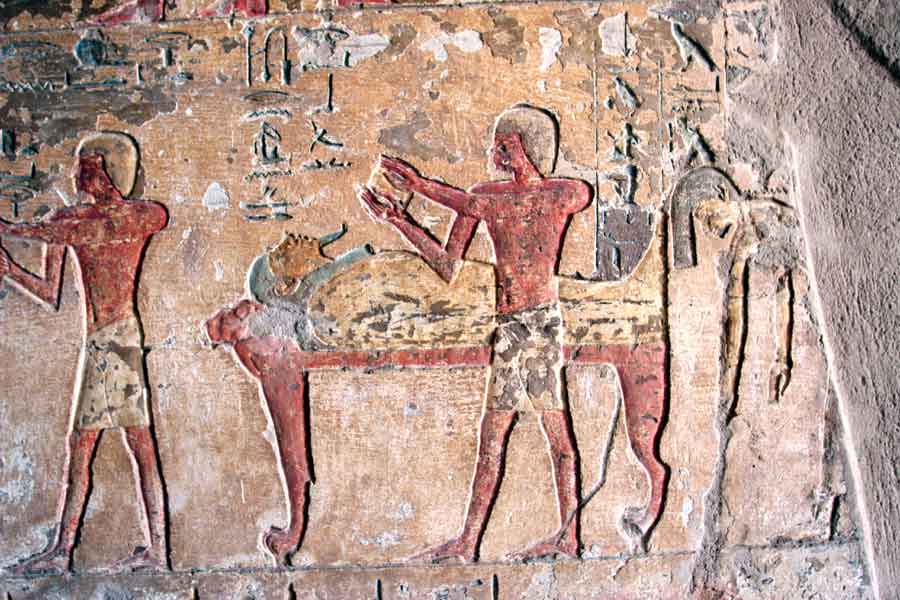
Sacrifice of an ox in the funerary ceremony. Painting from the tomb of Menna in Gourna. XVIII Dynasty. Photo: www.osirisnet.net

Sacrifice of an ox in the funerary ceremony. Painting from the tomb of Menna in Gourna. XVIII Dynasty. Photo: http://www.osirisnet.net

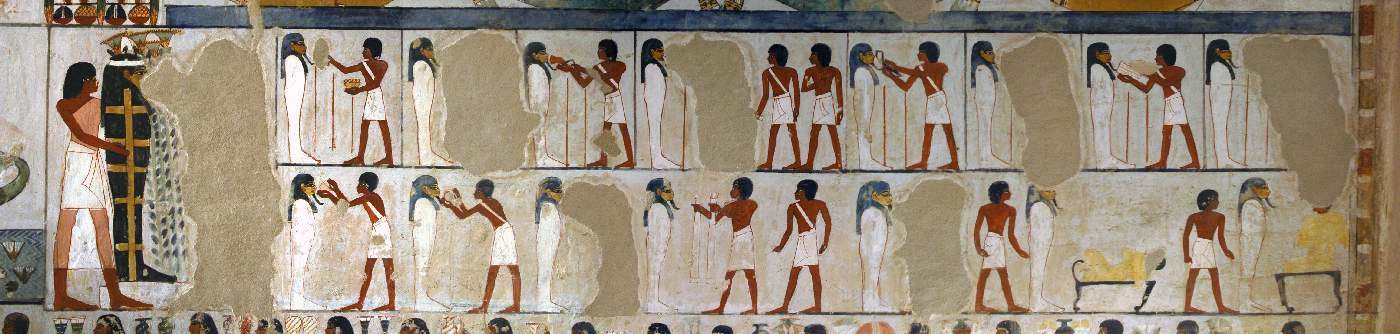
Taking into consideration that the mourning ritual and the ox’ slaughter were a reproduction of a passage of the myth of Osiris, it seems quite logical to place them at the end of the Opening of the Mouth ceremony, after other practices as for instance the tekenu ceremony. This is the way it appears in the tomb of Rekhmire. The tomb of Menna (TT69) has also a scene of the Opening of the Mouth where the tekenu practice appears at the beginning.

Opening of the Mouth ceremony from the tomb of Menna in Gourna. XVIII Dynasty. Photo: www.osirisnet.net

Opening of the Mouth ceremony from the tomb of Menna in Gourna. XVIII Dynasty. Photo: http://www.osirisnet.net

But in the tomb of Renni in el-Kab (EK7) there is a different version. On the east wall we can see how one mourner is making the nwn gesture towards the mummy during the Opening of the mouth ceremony.

On the right the mourner with short hair is wrapping someone. Scene from the tomb of Renni in el-Kab. XVIII Dynasty. Photo: www.osirisnet.net

On the right the mourner with short hair is wrapping someone. Scene from the tomb of Renni in el-Kab. XVIII Dynasty. Photo: http://www.osirisnet.net

In the upper register a woman with no mane, so the mourner appears wrapping with a kind of clothing a masculine figure. Would it be the early stage of the tekenu rite? So it seems; because the following image shows the tekenu being transported on a sledge while behind him stands the Drt with short hair.
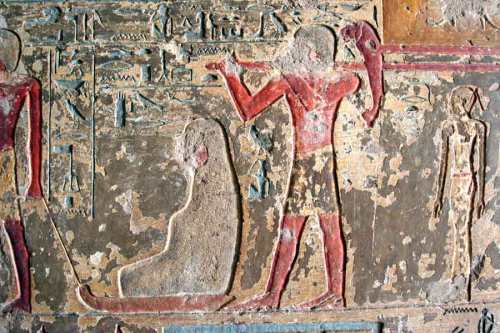
The tekenu on a sledge, behind we can see the mourner (Drt) with short hair. Scene from the tomb of Renni in el-Kab. XVIII Dynasty. Photo: www.osirisnet.net

The tekenu on a sledge, behind we can see the mourner (Drt) with short hair. Scene from the tomb of Renni in el-Kab. XVIII Dynasty. Photo: http://www.osirisnet.net

If so, then the mourning ritual with the hair would have been made before it. Why? Maybe these two practices made in the Opening of the Mouth ceremony had not an orthodox order or maybe the artists did not knew so much so they could represent the ritual as it was.


[1] S. Mayassis, 1957, p. 40.

[2] The bull sm3 is a bull for sacrifice that was assimilated to Set (Wb IV, 123, 17). It is interesting to notice the same phonetic as the word for hair sm3, which we know was related to darkness and chaos.

[3] The One who opens the Ways.

[4] Pyr., 1004-1010; 1972-1978
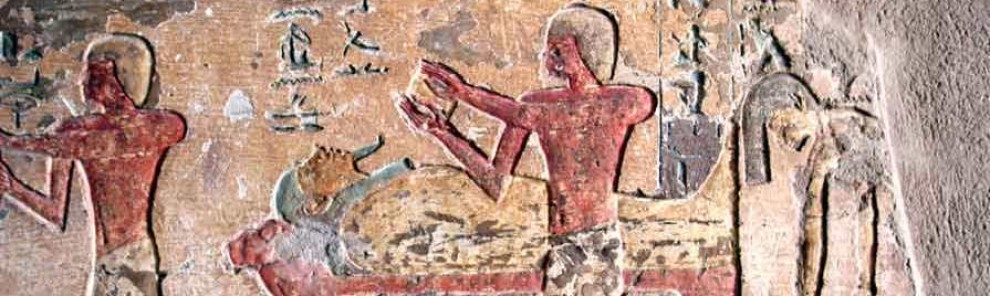
Hair, Mourners and Secret in Ancient Egypt.


Egyptian funerary texts and iconography mention the mourners in the role of Isis and Nephtys as making a mourning ritual with their hair for the benefit of the deceased. According to the sources, this rite was a part of the practises which formed the Opening of the Mouth for the mummy’s rebirth.

There is evidence of the Opening of the Mouth rite from texts of the Old Kingdom (inscription in mastaba of Metjen and in the Pyramid Texts). The Coffin Texts of the Middle Kingdom continue demonstrating the existence of this rite. In this period of the Egyptian history maybe can we envisage already one graphic proof in the stele of Abkaou (stele C15) from Abydos. In it the sculptor represented the rites of the Osiris festivity[1], where the myth was reproduced.  The two mourners shake their hair over the corpse; between them we can see the hieroglyphs of the adze and the sledge. What does it mean?

Detail of the stele of Abkaou in the Louvre Museum. XI Dynasty. Photo: www.commons.wikimedia.org

Detail of the stele of Abkaou in the Louvre Museum. XI Dynasty. Photo: http://www.commons.wikimedia.org

The sledge is the phoneme tm; it can be a negative verb[2], but it also is the term for “to complete”, “be completed”, in the sense of uniting the different parts of the body[3], mainly in relation to the mummy limbs[4]. The adze could be the verb nwi “to be in charge of”[5]. So, we could read the inscription as “in charge of completing” in the sense of restoring the corpse of the deceased. That would not be crazy if we think that in the legend Anubis was the one who embalmed the body, but with the assistance of Isis and Nephtys.

However, looking at the entire register of the stele there is no trace of inscription in the other images. So, why do we have to consider these three hieroglyphs as an inscription?

Detail of the register with the Osiris festivities. Stele d'Abkaou. Musée du Louvre. XI Dynasty. Photo: www.commons.wikimedia.org

Detail of the register with the Osiris festivities. Stele d’Abkaou. Musée du Louvre. XI Dynasty. Photo: http://www.commons.wikimedia.org

The tekenu on a sledge. Detail from the tomb of Montuherkhepeshef in Gourna. XVIII Dynasty. Image: www.excavacionegipto.com

The tekenu on a sledge. Detail from the tomb of Montuherkhepeshef in Gourna. XVIII Dynasty. Image: http://www.excavacionegipto.com

If we consider them just as the pure objects that they represent, we notice that the adze is one of the main tools in the Opening of the Mouth ceremony in the New Kingdom iconography; on its behalf the sledge is one of the means for transporting the human victim/tekenu, whose ritual we have seen was also part of the Opening Mouth ceremony in New Kingdom.

One possible theory could be that in the stele of Abkaou the sculptor was representing the Opening of the Mouth ceremony and the morning ritual in a shorten version, as it was done later in the New Kingdom, when artist included in the same scene mourners, priests, corpse and ritual tools. And we could as well think not just of a short version, but a codified way of representing a hidden ritual in the attempt of protecting the information of a confidential rite.

Opening of the Mouth ceremony. The image shows the two mourners, the priests and the table with all the tools utilised, included the foreleg of an ox. Painting from the tomb of Khonsu in Gourna. XIX Dynasty. Photo: www.osirisnet.net

Opening of the Mouth ceremony. The image shows the two mourners, the priests and the table with all the utilised tools, included the foreleg of an ox. Painting from the tomb of Khonsu in Gourna. XIX Dynasty. Photo: http://www.osirisnet.net

The renovating rites for the mummy’s rebirth might be secret. All along this work we have read some funerary texts making allusion to this concept of “hidden” in everything surrounding Osiris’ death and resurrection. For instance, in the tomb of Ramsés IX the inscription accompanying the scene of the women pulling their frontal locks of hair says: “…they are mourning over the secret place of Osiris…they are screaming and crying over the secret place of the ceremony …they move away SnDt[6], their two arms with their two arms, their secret is in their fingers…”[7]. In the same line we have the coffin of Ramses IV, decorated with both mages of Isis and Nephtys pulling their frontal lock of hair and whose inscription says:  “…the two goddesses who are in this secret place…they hide the secrets of the divine land… They move their faces during the moan; they mourn over the secret corpse Both goddesses are holding their locks swt”.

It seems that in ancient Egyptian belief, the mystery of death and resurrection was not accessible to all people; because of that in the Book of the Dead we read in relation to the Osiris’ resurrection. “… it is a secret of the Duat and a religious mystery in the deceased’s Kingdom …it is a mystery, that cannot be know, to take care of the blessed heart, give him movement, take away the bandage from his eyes, open his face…Read that with no one seeing it, apart from your truly friend and the lector priest[8].

The death itself was for the dead an initiation to the Hereafter’s mysteries[9]. Only the priests knew the secret of the Osiris death and resurrection, and to keep this secrecy was crucial for the universal harmony[10], possibly for that reason the “night of Isis” hid the mysteries of resurrection[11]. Even Isis sometimes received the name of “The Mysterious One”, since she “has been everything she has been, everything she is and everything she will be, and her veil, no mortal has never took off[12].

The Theban Books of Breathing, dating from Ptolemaic period was a funerary text recited just before closing the cover of the coffin [13] and the woman in the role of Isis gave a speech for reviving Osiris and help his soul go up to the sky as lunar disc: “That is something that needs to be hidden. Do not let anyone read it. It is useful for one in the necropolis. He will live again successfully millions of times”[14].

The chapter 17 of the Book of the Dead mentions the moment Osiris recovers his virility thanks to Isis, and she stresses the secret nature of her action: “I am Isis, you found me when I had my hair disordered over my face, and my crown was dishevelled. I have conceived as Isis, I have procreated as Nephtys. Isis dispels my bothers (?). My crown is dishevelled; Isis has been over her secret, she has stood up and has cleaned her hair”

The Magical Papyrus Salt 825 contains a text about the rite for the conservation of life and it informs the reader that the “House of Life” is hidden, unknown and invisible; it is a “secret book…contains life and death. Do not reveal it, the one who reveals it will die suddenly or will be murdered[15].

Opening of the Mouth ceremony at the door of the tomb. Painitgn from the tomb of Khonsu in Gourna. XIX Dynasty. Photo: www.osirisnet.net

Opening of the Mouth ceremony at the door of the tomb. Painting from the tomb of Khonsu in Gourna. XIX Dynasty. Photo: http://www.osirisnet.net

Everything points to the idea that in ancient Egypt the resurrection process is something that only concerns to the deceased and the team helping him in his recovery and that it is not something accessible for everybody. That would explain then why there is no much iconographical evidence of the Opening of the Mouth ceremony; it comes mainly from New Kingdom on (tomb decoration or papyri) and it is not explicit at all. On the other hand these scenes showing the priests and mourner with the mummy in front of the tomb would not be real. If the ritual for the resurrection was something secret, the Opening of the Mouth ceremony could not be made in open air. All practices for helping the mummy to come back to life should be made inside the tomb or inside a special building in the necropolis. So the images of the mourners crying close to the corpse while the priests are officiating would be the artistic solution to allude to the rite without revealing details.


[1] Gayet, 1886, pl. LIV.

[2] Wb V, 302, 5.

[3] Wb V, 303.

[4] Wb V, 305, 1.

[5] Wb II, p. 220

[6] Fear (?).

[7] Piankoff, 1942, pp. 1-11; 1944, pp. 1-62; 1946, pp. 1-50.

[8] LdM, 148.

[9] S. Mayassis, 1957, p. 218.

[10] S. Mayassis, 1957, p. 42.

[11] Sinesio, Epist., XIII,v.s. 89; S. Mayassis, 1957, p. 65.

[12] Plutarco, De Iside et Osiride, 9.

[13] J.Cl. Goyon, 1972, p. 217.

[14] Book of Breathing I, 1.

[15] Ph. Derchain, 1964, p. 139.

[16] S. Mayassis, 1957, p. 40.